

TL;DR:
- Introspection involves intentionally examining your thoughts, feelings, and sensations to foster genuine self-awareness. Modern practices like journaling and mindfulness enhance emotional regulation, decision-making, and personal growth, even through brief daily rituals. Avoid rumination by focusing on clarity and external feedback, making consistent, low-barrier reflection integral to emotional well-being.
Many people believe they are self-aware simply because they think about their feelings. But there is a meaningful difference between spinning through the same worries at midnight and actually learning something useful about yourself. Introspection is the psychological process of examining your own thoughts, emotions, and sensations with intention, and doing it well is a skill that can genuinely reshape your emotional well-being. This guide breaks down what introspection really is, where it comes from, and exactly how to practice it in ways that create lasting clarity rather than more confusion.
Table of Contents
Key Takeaways
| Point | Details |
|---|---|
| Introspection defined | Introspection is the practice of examining your own thoughts and feelings to deepen self-awareness. |
| Modern methods work | Journaling and mindfulness are evidence-backed ways to enhance well-being through introspection. |
| Avoid rumination traps | Use concrete, action-focused questions and limit excessive self-analysis for the best results. |
| Make it a habit | Consistent, simple daily practices lead to meaningful growth and emotional balance. |
What is introspection? A definition and history
Let’s break down what the word introspection actually means and how it became a key part of personal growth.
At its simplest, introspection means looking inward. You turn your attention away from the outside world and toward your own mental experience: what you are thinking, what you are feeling, and why. It sounds straightforward, but the practice has a rich and sometimes contested history that shapes how we understand it today.
“Introspection is the psychological process of examining one’s own thoughts, emotions, feelings, and sensations.” — Verywell Mind
Introspection as a formal method was developed in the late 19th century by psychologists Wilhelm Wundt and Edward Titchener. They trained participants to observe and report their conscious experiences in controlled laboratory settings. The idea was to make the study of the mind as rigorous as chemistry or physics. Critics, however, argued that self-reports were too subjective and unreliable to count as science, which led to the rise of behaviorism and a decades-long retreat from inner experience as a legitimate research topic.
The good news is that introspection made a strong comeback. Modern psychology no longer asks you to dissect your sensations under laboratory conditions. Instead, the effects of introspection on mental health are studied through journaling, mindfulness, therapy, and everyday self-reflection. The focus has shifted from precision measurement to practical benefit.
Here is why introspection matters for your mental well-being:
-
It builds self-awareness, helping you recognize patterns in your emotions and behavior before they run on autopilot.
-
It supports emotional regulation, giving you a pause between feeling and reacting.
-
It improves decision-making, because understanding your values and biases leads to choices that feel more aligned.
-
It deepens relationships, because people who understand themselves tend to communicate more honestly.
-
It promotes personal growth by revealing limiting beliefs you did not know you were carrying.
How introspection works today: Science and self-growth
Understanding the roots of introspection makes it easier to see why its modern forms can shape your growth.

Modern introspection is informal and practical, woven into everyday habits like journaling, mindfulness meditation, therapy sessions, and simple check-ins with yourself. You do not need a lab coat or a trained observer. What you do need is consistency and a method that fits your life.
The science backing these practices is growing fast. Mindfulness interventions improve self-reported interoception with an effect size of g=0.31 overall and g=0.41 specifically for mindfulness-based approaches. In plain language, that means people who practice mindfulness get meaningfully better at noticing what is happening inside their bodies and minds. That is exactly the feedback loop introspection depends on.
| Practice | Time required | Primary benefit | Best for |
|---|---|---|---|
| Mindfulness meditation | 5 to 20 min/day | Present-moment awareness | Stress reduction |
| Journaling | 5 to 15 min/day | Pattern recognition | Emotional processing |
| Body scan | 10 to 30 min/session | Physical self-awareness | Anxiety relief |
| Daily check-in | 2 to 5 min/day | Mood tracking | Building the habit |
One of the biggest misconceptions is that introspection has to be intense or time-consuming. A five-minute daily check-in, where you simply ask yourself how you feel, what you need, and what is weighing on you, can produce real insights over time. Deeper journal exercises add richness, but they work best when the daily habit is already in place.
Quality matters more than quantity. Asking specific, concrete questions produces far more useful insight than open-ended rumination. Explore journaling for emotional well-being and mindfulness for emotional well-being if you want to build these practices step by step.
Pro Tip: Start your introspection practice by rating your mood on a scale of 1 to 10, then write one sentence explaining why. This forces you to connect a feeling to a cause, which is where real self-awareness begins.
Techniques for productive introspection
Now, let’s move from theory into practice with hands-on strategies that actually boost self-awareness.
Not all introspection methods are equally effective, and that is worth taking seriously. Spontaneous reflection, the kind that happens when you are staring out the window, tends to be unfocused. Structured approaches give your mind a framework to work within and produce much more actionable insight.
Some of the most evidence-informed methods include the following. Structured journaling with focused questions is a core approach, and several proven frameworks make it even more powerful:
-
Reflection Depth Ladder: Move through five levels: Event (what happened?), Emotion (what did I feel?), Pattern (does this happen often?), Belief (what does this tell me about myself?), Action (what will I do differently?).
-
RAIN framework: Recognize what you are feeling, Allow it to be present, Investigate it with curiosity, Nurture yourself with self-compassion.
-
Mindfulness body scan: Move your awareness slowly through each part of your body, noticing tension, discomfort, or ease without judgment.
-
Five-minute mindful check-in: Set a timer, breathe for one minute, then answer three questions in writing: How am I feeling right now? What is driving that feeling? What do I need today?
-
Gratitude plus growth: Note one thing you are grateful for and one thing you want to understand better about yourself.
Journaling and mindfulness prompts meaningfully enhance self-awareness, reduce stress, and boost mood, which makes them the most accessible entry points for most people.
| Method | Structure level | Time investment | Best use case |
|---|---|---|---|
| Free writing | Low | 5 to 20 min | Releasing emotional pressure |
| Prompted journaling | High | 5 to 15 min | Targeted self-discovery |
| RAIN framework | High | 5 to 10 min | Processing difficult emotions |
| Body scan | Medium | 10 to 30 min | Reducing physical tension |
| Mindful check-in | Medium | 2 to 5 min | Daily habit building |
Explore self-reflection techniques for a deeper dive into each method, and check out additional strategies for improving self-awareness that pair well with these approaches.
Pro Tip: Use “what” questions instead of “why” questions during introspection. “What am I feeling?” and “What do I need?” keep you grounded and solution-oriented. “Why do I always do this?” tends to spiral into self-criticism with no exit.
Introspection pitfalls: Rumination vs. reflection
Practical methods only work if you can avoid the most common introspection traps. Here’s what you need to know.
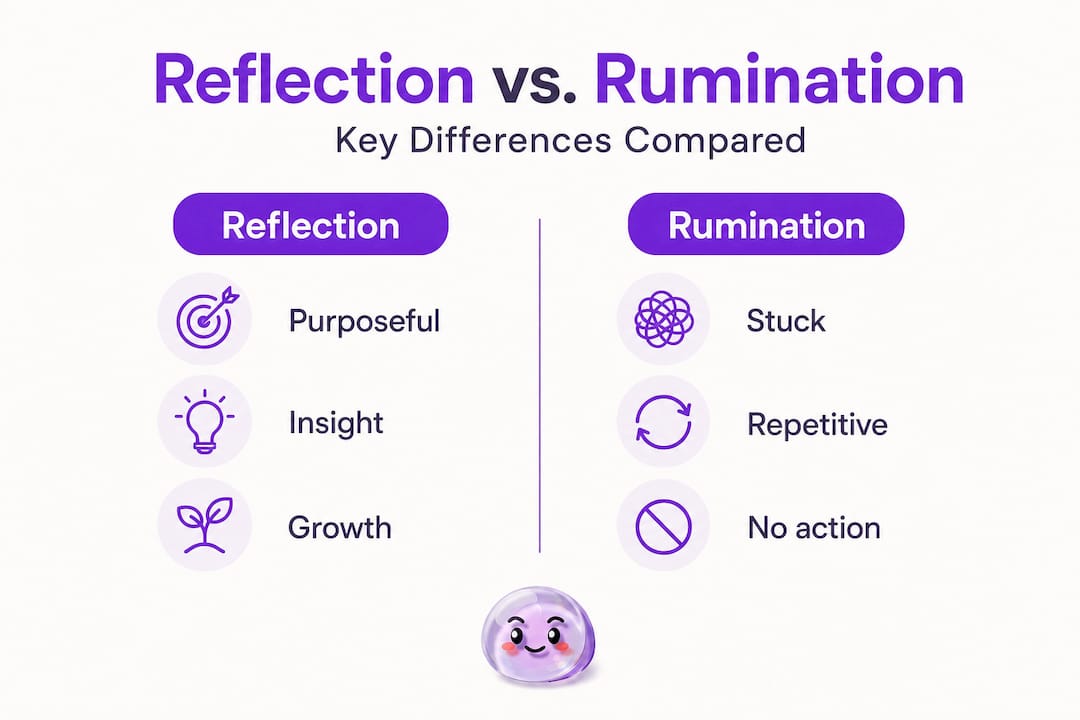
There is a fine but important line between reflection that helps you grow and rumination that keeps you stuck. Productive introspection contrasts sharply with rumination, which involves intrusive, abstract “why” questions that loop without resolution and are strongly linked to depression and increased self-doubt.
“The goal of introspection is not to explain yourself but to understand yourself well enough to make a meaningful choice about what comes next.”
Signs you are practicing healthy reflection:
-
You feel a sense of clarity or relief after the session.
-
You can identify a specific emotion and trace it to a cause.
-
You leave with at least one concrete takeaway or intention.
-
You feel compassionate toward yourself, not critical.
Signs you are stuck in rumination:
-
You keep circling the same thought without reaching new understanding.
-
You feel worse after reflecting than before you started.
-
Your questions focus on blame: why did this happen to me, why am I like this?
-
You feel paralyzed rather than empowered.
Over-analysis is a real risk, especially for people who are highly introspective by nature. The more you examine something without acting on it, the more you can amplify doubt and self-criticism. Building emotional resilience and growth means learning when to turn the lens inward and when to pause and take an action, however small. Pairing reflection with emotional regulation strategies helps you stay regulated while you explore difficult material.
An often overlooked remedy is external feedback. Talking to a trusted friend, therapist, or mentor after a reflection session gives you a perspective your internal lens cannot provide. Self-knowledge has blind spots, and other people can illuminate them in ways that years of solo journaling sometimes cannot.
Getting started: Making introspection a daily habit
Ready to apply what you have learned? Here is how you can make introspection a meaningful part of your routine.
The most effective introspection practice is the one you will actually keep doing. Five minutes of consistent daily reflection will outperform a three-hour deep-dive that you do once a month and forget. Habit formation research consistently shows that attaching a new behavior to an existing cue is one of the most reliable ways to make it stick.
Here is a simple framework for building your introspection habit:
-
Choose a trigger: Anchor your reflection to an existing routine, right after your morning coffee, just before bed, or during a lunch walk. The trigger does its job without willpower.
-
Keep the barrier low: Start with two to five minutes maximum. Opening a notebook and writing three sentences counts. Perfectionism is the enemy of habit.
-
Pick one method to start: Avoid switching between techniques in the first two weeks. Consistency with one approach builds the skill faster than experimenting with five.
-
Write it down: Even a voice memo or a note app works. Externalizing thoughts makes them easier to examine and revisit over time.
-
Review weekly: Look back at your entries once a week for patterns. This is where the real insight compounds. Mood shifts, recurring themes, and progress all become visible over time.
Journaling and mindfulness prompts with components like non-judgment predict positive affect over time, which means the attitude you bring to your reflection matters as much as the technique itself.
Tracking your mood alongside your journal entries adds a layer of motivation. Seeing a visual trend, even an imperfect one, reinforces the habit and gives you objective evidence that your practice is producing results. Learn more about reflecting on feelings to build this skill intentionally.
Pro Tip: For your first week, use a single prompted question per day rather than open-ended journaling. Something like “What emotion showed up most today, and where did I feel it in my body?” is specific enough to generate a real answer in two minutes.
Our take: What most people miss about introspection (and how to get real results)
We work with thousands of people on their journaling and self-reflection journeys, and the pattern we see most often is this: people approach introspection as either a luxury they do not have time for, or an intense psychological excavation they need to get exactly right. Both extremes miss the point entirely.
The uncomfortable truth is that introspection without action is just a very organized way of going in circles. You can fill fifty journals with insights about your childhood patterns or emotional triggers, but if none of those insights change how you show up at work, in your relationships, or in your daily choices, the reflection has not yet served its full purpose. Insight is the beginning of change, not the end of it.
Equally important is the role of outside perspective. Many people treat introspection as a purely solitary practice, and while privacy and solitude are genuinely valuable, they also create an echo chamber. Your brain is very good at confirming what it already believes about you. A therapist, a trusted friend, or even an AI journaling tool that asks follow-up questions can interrupt that confirmation loop in ways that solo reflection cannot.
Consistency also matters far more than intensity. One honest five-minute check-in every morning, where you note your mood and one thing you want to be more aware of today, will produce more growth over a year than sporadic marathon journal sessions after a crisis. The benefits of self-reflection accumulate precisely because regular, small acts of attention train your mind to notice patterns it would otherwise automate.
Our practical suggestion: set a single growth intention after each reflection session. Not a goal, not a resolution. Just one sentence that says “Today I want to notice when I feel resentful and pause before responding.” That is introspection with a pulse, and it is what actually changes behavior.
Take your next step toward self-awareness
Understanding what introspection is and how it works is the first step. Putting it into practice, consistently and skillfully, is where real emotional growth happens.

Voisley is designed specifically to support that journey. With AI-powered journaling prompts, mood tracking, and science-backed reflection frameworks, the platform gives you the structure that makes introspection effective rather than overwhelming. Whether you are brand new to self-reflection or looking to deepen an existing practice, Voisley meets you where you are. Explore practical self-reflection techniques and start building the habit that supports genuine clarity and emotional well-being. Your next insight is closer than you think.
Frequently asked questions
Is introspection the same as mindfulness?
No. Introspection is the active process of examining your thoughts and feelings, while mindfulness is the practice of maintaining present-moment awareness. Both can support each other, but they are distinct skills with different mechanisms.
Can introspection help with anxiety or stress?
Yes. Journaling and mindfulness-based practices reduce stress and boost mood when practiced consistently and with the right approach, making them effective tools for managing anxiety.
What is the difference between introspection and rumination?
Introspection is purposeful and moves toward insight and action, while rumination involves repetitive abstract thinking that loops without resolution and can worsen emotional states.
How can I start practicing introspection?
Begin with five-minute daily check-ins using a single prompted question, like “What am I feeling right now and what caused it?” Simple, consistent practice builds the skill faster than occasional deep dives.