

You probably think you know yourself pretty well. You know your favorite coffee order, what stresses you out, and which friends make you laugh. But here's the thing: knowing these facts isn't the same as understanding why you react defensively to feedback or why certain situations trigger anxiety. Personal insight goes beyond surface-level self-knowledge to reveal the causal connections between your thoughts, emotions, and behaviors. This guide explores what personal insight truly means, how it shapes your mental health, the tools that measure it, and practical journaling techniques to develop deeper self-awareness for lasting emotional growth.
Table of Contents
- Key takeaways
- Understanding personal insight: Definition and psychological basis
- The role of self-reflection in mental health and emotional regulation
- Measuring personal insight: Tools and their applications
- Navigating the nuances: Risks and cultural factors of personal insight
- Applying personal insight: Journaling techniques for emotional growth
- Enhance your personal insight journey with Voisley
- Frequently asked questions
Key Takeaways
| Point | Details |
|---|---|
| Definition of insight | Personal insight is the deep understanding of how your thoughts, feelings, and actions connect and influence one another. |
| Beyond basic knowledge | It explains why patterns recur by linking past experiences to present reactions. |
| Reflection and mental health | Structured journaling guided by prompts can reduce anxiety and boost positive emotions. |
| Structured journaling boosts insight | Using prompts and specific goals helps convert rumination into actionable self understanding. |
Understanding personal insight: Definition and psychological basis
Personal insight represents a sophisticated form of self-understanding that extends far beyond basic self-knowledge. While you might know you feel anxious before presentations, personal insight is the deep, accurate understanding of one's own thoughts, emotions, behaviors, motivations, and their causal interconnections. This means grasping why presentations trigger anxiety, perhaps because they connect to childhood experiences of being judged or deeper fears about competence.
Psychologists often call this quality psychological mindedness, the capacity to see relationships between thoughts, feelings, and actions. It requires stepping back from your immediate experience to observe your internal processes with some objectivity. Think of it as becoming both the participant and the observer in your own life, analyzing patterns rather than just experiencing them.
This analytical stance enables genuine emotional regulation and self-awareness. When you understand the root causes of your reactions, you can intervene more effectively. Key elements of personal insight include:
- Recognition of emotional triggers and their origins
- Understanding behavioral patterns and their underlying motivations
- Awareness of cognitive distortions and thinking habits
- Ability to connect past experiences with present reactions
The distinction between basic knowledge and insight lies in explanatory depth. Knowing you procrastinate is self-knowledge. Understanding that you procrastinate because perfectionism makes starting feel overwhelming, and that this perfectionism stems from early experiences where mistakes brought criticism, that's personal insight. This deeper understanding creates pathways for meaningful change because you can address root causes rather than just symptoms. When you turn your mood into action through this kind of understanding, emotional patterns become opportunities for growth rather than mysterious forces controlling your life.
"True self-awareness isn't about cataloging your traits. It's about understanding the invisible threads connecting your past, your reactions, and your choices."
The role of self-reflection in mental health and emotional regulation
The relationship between self-reflection and mental health is more complex than you might expect. Research reveals a nuanced picture: meta-analysis indicates self-reflection correlates with both negative and positive mental health indicators, meaning the practice itself isn't inherently good or bad. The key difference lies in how you reflect.
Unstructured rumination, where you replay negative experiences without reaching understanding or solutions, can intensify depression and anxiety symptoms. Your brain gets stuck in loops, rehashing problems without progress. This is self-reflection gone wrong, the kind that leaves you feeling worse rather than better.
However, structured reflection through journaling reduces anxiety and boosts positive emotions. When you guide your reflection with specific prompts and goals, you transform potentially harmful rumination into productive insight. The difference shows up in measurable mental health outcomes:
| Reflection Type | Anxiety Impact | Positive Emotion | Engagement Level |
|---|---|---|---|
| Unstructured rumination | Increased | Decreased | Lower |
| Guided journaling | Decreased | Increased | Higher |
| Balanced self-analysis | Minimal increase | Significantly increased | Much higher |
The benefits of properly channeled self-reflection include increased psychological engagement with life, reduced negative affect, and enhanced emotional regulation skills. When you turn your mood into action through intentional reflection, you create a feedback loop where understanding leads to better choices, which leads to improved emotional states.
Balanced reflection means combining emotional processing with action planning. You acknowledge feelings without drowning in them, identify patterns without getting paralyzed by analysis, and develop solutions rather than just documenting problems. Practical strategies for maintaining this balance:
- Set time limits for reflection sessions to prevent rumination
- Always end reflection with at least one actionable insight
- Focus on understanding causes rather than assigning blame
- Track patterns over time instead of obsessing over single events
Pro Tip: If you find yourself asking "why" about the same situation more than three times in one session, shift to "what can I do differently next time?" This prevents analysis paralysis and moves you toward solutions.
Measuring personal insight: Tools and their applications
Psychologists have developed several standardized scales to quantify personal insight and psychological mindedness, making it possible to assess this seemingly intangible quality objectively. Understanding these tools helps you recognize what genuine insight looks like and provides frameworks for self-assessment.
The Self-Reflection and Insight Scale (SRIS) measures two distinct dimensions: engagement in self-reflection and the insight gained from that reflection. This distinction matters because, as we've seen, reflection without insight can be counterproductive. The scale helps identify whether someone reflects productively or simply ruminates.
Another measure, the Psychological Mindedness Scale (PMS), focuses on interest in psychological processes and ability to identify and communicate feelings. It emphasizes the communicative aspect of insight, recognizing that understanding yourself includes articulating that understanding to others.
However, the Balanced Index of Psychological Mindedness (BIPM) shows the strongest psychometric properties among insight measures. This scale demonstrates superior reliability and validity, meaning it consistently measures what it claims to measure across different populations and contexts. The BIPM assesses:
- Interest in understanding psychological causes of behavior
- Ability to identify feelings and their origins
- Willingness to discuss psychological topics
- Capacity to see connections between past and present
| Scale | Primary Focus | Reliability | Best Application |
|---|---|---|---|
| SRIS | Reflection vs insight balance | Moderate | Identifying rumination tendencies |
| PMS | Psychological interest and communication | Moderate | Assessing therapy readiness |
| BIPM | Balanced psychological mindedness | High | Comprehensive insight assessment |
These insight measurement methods serve practical purposes beyond academic research. Therapists use them to identify potential barriers to treatment, since low insight can make it difficult for clients to engage meaningfully in therapy. High scores, conversely, often predict better therapeutic outcomes because clients can connect interventions to their internal experiences.
For personal development, understanding these frameworks helps you evaluate your own growth. You can ask yourself the kinds of questions these scales pose: Do I understand why I react certain ways? Can I identify the origins of my emotional patterns? Am I interested in exploring the psychological dimensions of my experiences? Research on psychological mindedness suggests that even informal self-assessment using these dimensions can guide your development efforts, helping you focus on areas where your insight remains limited.
The measurement approach also reveals that insight exists on a continuum rather than as an all-or-nothing trait. You might have strong insight into your work-related behaviors but limited understanding of relationship patterns, or vice versa. Recognizing these variations helps you target your self-reflection efforts where they'll create the most value.
Navigating the nuances: Risks and cultural factors of personal insight
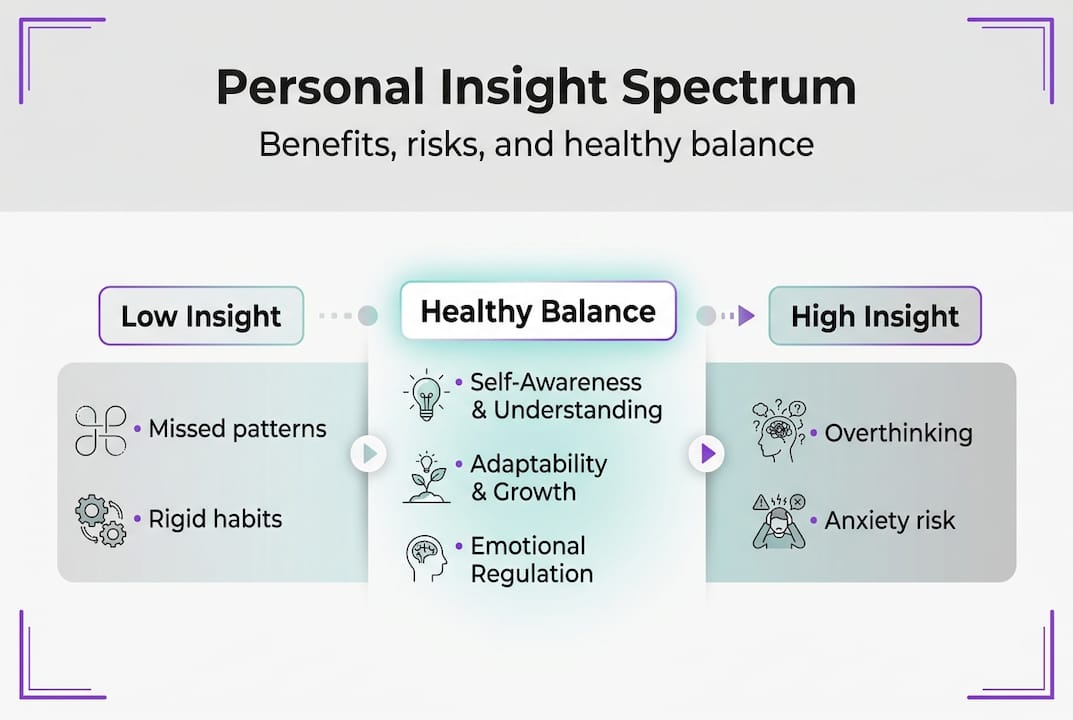
Personal insight operates on a spectrum, and finding the sweet spot matters more than maximizing the trait. Too low insight hampers therapy while too high can cause rumination if not well-managed, and cultural factors moderate expression and impact. This complexity means developing insight requires wisdom about when to look inward and when to focus outward on action.
Impaired insight creates obvious problems. Without understanding your patterns, you repeat the same mistakes, struggle to learn from experience, and find it difficult to change behaviors even when you want to. Therapy becomes less effective because you can't connect interventions to your internal reality. Relationships suffer because you misunderstand your own contributions to conflicts.
But excessive psychological mindedness carries risks too. High insight correlates with personality traits like openness to experience, which generally benefits well-being. However, when combined with neuroticism or anxiety, intense self-focus can spiral into unproductive rumination. You become so absorbed in analyzing your thoughts and feelings that you neglect taking action or engaging with the external world.
Cultural context shapes how insight manifests and whether it's valued. Some cultures emphasize introspection and psychological exploration, viewing deep self-understanding as a mark of maturity. Others prioritize social harmony and role fulfillment, considering excessive self-focus as self-indulgent or disruptive. Neither approach is inherently superior, they simply reflect different values about the relationship between individual psychology and collective well-being.
Effective insight balances self-awareness with actionable change. The goal isn't endless self-analysis but rather understanding that enables better choices. Strategies to maintain this balance:
- Connect every insight to a specific behavioral experiment or change
- Alternate between reflection periods and action periods
- Evaluate insights by their practical utility, not just their depth
- Share insights with trusted others to test their accuracy
- Notice when reflection starts feeling circular rather than progressive
Pro Tip: If an insight doesn't change how you think, feel, or behave within two weeks, it's probably intellectual understanding rather than genuine personal insight. Real insight creates movement.
The adaptive middle ground involves enough self-awareness to recognize patterns and make informed choices, but not so much self-absorption that you lose connection with present experience or become paralyzed by analysis. When you manage emotional insight effectively, you use understanding as a tool for growth rather than an end in itself. Research on adaptive self-reflection confirms that the most psychologically healthy individuals combine self-awareness with present-moment engagement and action orientation.
Applying personal insight: Journaling techniques for emotional growth
Theory becomes valuable only when translated into practice. Journaling offers the most accessible and effective method for developing personal insight, especially when you use structured approaches rather than freeform writing. Structured journaling prompts like the '5 Whys' help transform description into causal insight and balanced action plans, reducing rumination.
The '5 Whys' technique, borrowed from problem-solving methodology, works powerfully for emotional insight. Start with a behavior or feeling, then ask why it occurred. Take that answer and ask why again. Repeat five times, each iteration digging deeper toward root causes. For example:
- Why did I snap at my partner? Because I felt criticized.
- Why did their comment feel like criticism? Because it touched on my work performance.
- Why am I sensitive about work performance? Because I've been doubting my competence.
- Why am I doubting my competence? Because my recent project didn't go as planned.
- Why does one setback shake my confidence so much? Because I tie my self-worth to professional success.
This progression moves from surface reaction to core belief, creating genuine understanding. Once you identify root causes, you can address them directly rather than just managing symptoms. Additional journaling techniques for developing insight:
- Pattern tracking: Record similar situations over two weeks, then analyze common elements
- Emotion mapping: Draw connections between events, thoughts, feelings, and behaviors
- Future self dialogue: Write conversations between your current and future self about challenges
- Assumption testing: Identify beliefs driving behaviors, then examine evidence for and against them
Balanced reflection includes both emotional processing and action planning. Acknowledge what you feel, explore why you feel it, then determine what you'll do differently. This three-part structure prevents journaling from becoming either emotional venting without insight or cold analysis without emotional engagement.
Maintaining consistency matters more than perfect technique. Small regular sessions build insight better than occasional marathon journaling. Tips for building the habit:
- Start with just five minutes daily
- Use prompts when you feel stuck rather than staring at blank pages
- Track patterns monthly to see progress
- Celebrate insights that lead to behavior changes
Pro Tip: End every journal session by writing one specific action you'll take based on your insights. This creates accountability and ensures reflection translates into growth.
The benefits extend beyond understanding to measurable improvements in emotional well-being. Studies show reduced anxiety, increased positive emotions, and better emotional regulation among consistent journalers who use structured approaches. When you commit to journaling for emotional awareness, you create a private laboratory for self-discovery where experiments cost nothing but reveal everything.
Enhance your personal insight journey with Voisley
Developing personal insight through journaling becomes significantly easier with the right tools supporting your practice. Voisley transforms the journaling process from a solitary struggle into a guided journey toward deeper self-understanding.
The platform combines structured prompts with mood tracking, helping you identify emotional patterns you might miss through unguided reflection. AI-powered insights analyze your entries to surface connections between thoughts, feelings, and behaviors, essentially automating the pattern recognition that makes insight so valuable. You get the benefits of professional psychological analysis without the cost or scheduling constraints of traditional therapy.

Voisley's different journal types, from gratitude to shadow work to future goals, ensure you explore multiple dimensions of self-awareness rather than getting stuck in one mode of reflection. The visualizations show your emotional trends over time, making abstract patterns concrete and actionable. This combination of structure, analysis, and tracking creates the ideal environment for developing genuine personal insight that translates into emotional growth and better daily choices. Start your journey with Voisley's mood tracking platform and discover what becomes possible when self-reflection meets intelligent support.
Frequently asked questions
What is the difference between personal insight and self-knowledge?
Self-knowledge consists of basic facts about yourself, like knowing you prefer mornings over evenings or that you enjoy creative work. Personal insight goes deeper to reveal why you have these preferences and how they connect to your broader psychological patterns. For example, insight might reveal that your morning preference stems from anxiety that builds throughout the day, or that creative work appeals to you because it provides control that you lacked in childhood. The distinction lies in causal understanding rather than simple awareness.
How can journaling improve personal insight effectively?
Structured journaling prompts guide your reflection toward uncovering root causes rather than just describing events or venting emotions. Techniques like the '5 Whys' force you to dig beneath surface explanations to identify core beliefs and patterns driving your behaviors. The key is focusing on actionable insights that connect understanding to behavior change, preventing the unproductive rumination that can occur with unguided reflection. Consistency matters more than length, even five minutes daily builds insight over time.
Can too much personal insight be harmful?
Excessive insight without corresponding action can increase anxiety and lead to analysis paralysis, where you understand your patterns so thoroughly that you become stuck in observation mode rather than making changes. The risk intensifies when high psychological mindedness combines with neuroticism, creating rumination loops. Balanced insight involves using self-understanding as a springboard for emotional regulation and behavior change rather than an end in itself. If insights don't translate into different choices within a couple weeks, you've likely crossed into counterproductive over-analysis.
What scales are used to measure personal insight?
The Self-Reflection and Insight Scale (SRIS), Psychological Mindedness Scale (PMS), and Balanced Index of Psychological Mindedness (BIPM) represent the most established measurement tools. Each assesses slightly different dimensions, from reflection quality to psychological interest to balanced self-understanding. The BIPM demonstrates the strongest psychometric properties with superior reliability and validity across populations. These scales help therapists assess treatment readiness and individuals evaluate their own development, providing frameworks for understanding what genuine insight looks like in practice.