

You've probably heard that emotional regulation means staying calm or not showing feelings. That's a widespread myth. True emotional regulation isn't about suppressing emotions or pretending they don't exist. It's the strategic process of influencing which emotions you experience, when they arise, and how you express them to meet life's demands effectively. Mastering this skill transforms how you navigate stress, relationships, and daily challenges. This guide breaks down what emotional regulation actually involves, explores proven strategies backed by research, and shows you how guided journaling and mindfulness can help you develop this essential capability for lasting emotional well-being.
Table of Contents
- Key Takeaways
- Understanding emotional regulation: definition and importance
- Core strategies of emotional regulation: the process model
- Nuances and challenges in emotional regulation
- Applying emotional regulation techniques with guided journaling and mindfulness
- Boost your emotional well-being with Voisley
- FAQ
Key Takeaways
| Point | Details |
|---|---|
| Definition and purpose | Emotional regulation is the strategic process of influencing which emotions you experience and how you express them to meet life demands. |
| Myths and healthy approach | True regulation involves acknowledging feelings and choosing constructive responses rather than suppressing or avoiding them. |
| Process model overview | The Process Model identifies five strategy families that operate at different points in the emotional generation process to help you manage emotions. |
| Practical strategies examples | Examples include situation selection, situation modification, and attentional deployment to influence triggers and emotional responses. |
| Journaling and mindfulness | Guided journaling and mindfulness practices help you develop awareness and regulate emotional responses over time. |
Understanding emotional regulation: definition and importance
Emotional regulation is the process of influencing emotions you experience and express. It's not about eliminating feelings or maintaining a poker face through every situation. Instead, it involves choosing how to respond to emotional experiences in ways that help you meet goals and handle demands effectively. This strategic approach lets you acknowledge feelings while deciding how to channel them productively.
Many people confuse emotional regulation with emotional suppression or avoidance. Suppression means pushing feelings down or hiding them from others. Avoidance involves dodging situations that trigger uncomfortable emotions. Neither approach constitutes healthy regulation. True regulation recognizes emotions as valuable information, then applies strategies to manage intensity and expression appropriately for the context. You might feel anger during a disagreement but choose to express it constructively rather than explosively or not at all.
Proper emotional regulation improves mental health outcomes significantly. Research consistently shows that people who regulate emotions adaptively experience less anxiety, depression, and stress-related problems. They maintain better relationships because they can communicate feelings without overwhelming others or shutting down completely. Daily functioning improves when you can stay focused during challenging moments instead of being derailed by emotional intensity.
"Emotional regulation helps you meet situational demands and accomplish personal goals by strategically managing emotional experiences and expressions."
The ability to regulate emotions develops throughout life but requires conscious practice. Some people naturally develop better regulation skills through supportive environments and positive modeling. Others need structured approaches to build these capabilities. Understanding what emotional regulation truly involves sets the foundation for developing effective strategies. Turn your mood into action by learning techniques that work with your emotional experiences rather than against them.
Core strategies of emotional regulation: the process model
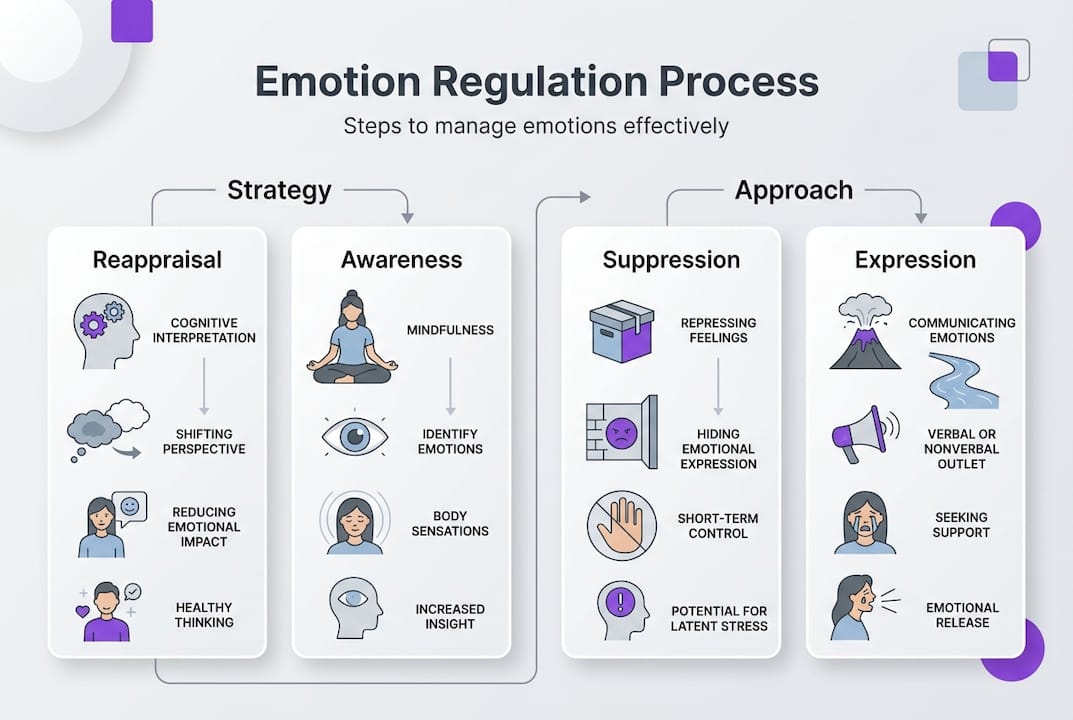
James Gross developed the Process Model outlining five strategy families that operate at different points in the emotional generation process. These strategies differ in timing and mechanism, offering multiple entry points for managing emotional experiences. Understanding each approach helps you select the right tool for specific situations.
-
Situation selection involves choosing or avoiding circumstances likely to trigger certain emotions. You might decline an invitation to a crowded party if overwhelming social situations cause anxiety. This proactive approach prevents emotional challenges before they start.
-
Situation modification means changing aspects of a situation to alter its emotional impact. If a cluttered workspace increases stress, organizing it modifies the environment to reduce negative feelings. This strategy adjusts external factors rather than internal responses.
-
Attentional deployment redirects focus away from emotion-triggering aspects of a situation. During a stressful meeting, you might concentrate on breathing rather than anxious thoughts. Distraction and concentration both fall under this category.
-
Cognitive change reframes how you interpret a situation to shift emotional response. Viewing a critical comment as constructive feedback rather than personal attack exemplifies this approach. Reappraisal represents the most studied form of cognitive change.
-
Response modulation directly influences emotional expression after feelings arise. Taking deep breaths to calm physiological arousal or masking disappointment with a smile both modify responses after emotions emerge.
Research shows these strategies produce different psychological outcomes. Antecedent-focused approaches like reappraisal, which occur before emotions fully develop, generally prove more adaptive than response-focused ones like suppression. Reappraisal reduces negative emotion experience and expression without the cognitive costs that suppression creates. Suppression might hide feelings from others but maintains or intensifies internal distress while draining mental resources.
| Strategy Type | Timing | Effectiveness | Common Example |
|---|---|---|---|
| Situation selection | Before emotion | High for prevention | Avoiding triggers |
| Cognitive reappraisal | Early in process | Very high | Reframing thoughts |
| Attentional deployment | During emotion | Moderate | Redirecting focus |
| Response modulation | After emotion | Lower, costly | Suppressing expression |
Pro Tip: Favor reappraisal and awareness-based strategies over suppression for better long-term emotional health. Suppression might seem effective in the moment but creates hidden costs that accumulate over time. Learn more about turning your mood into action with adaptive strategies.
The process model of emotion regulation provides a comprehensive framework for understanding when and how different strategies work. Selecting appropriate strategies for specific contexts maximizes effectiveness while minimizing unwanted side effects.
Nuances and challenges in emotional regulation
Emotional regulation doesn't work identically for everyone in every situation. Cultural background significantly shapes which strategies prove adaptive or harmful. Research reveals that cultural context affects strategy effectiveness, with suppression showing less negative impact in some collectivist cultures compared to individualist ones. What works well in one cultural framework might create problems in another.
Individual differences also matter enormously. People with alexithymia struggle to identify and describe their own emotions, making cognitive reappraisal particularly challenging since it requires recognizing what you feel before reframing it. Those with borderline personality disorder often experience emotions more intensely and have difficulty using regulation strategies effectively without specialized support. Anxiety disorders, depression, and other mental health conditions alter both emotional experiences and regulation capacity.
The distinction between frequency and intensity of strategy use produces different outcomes. Studies show that using strategies more frequently doesn't always predict better well-being compared to using them more intensely when needed. Someone who constantly tries to reappraise every minor irritation might exhaust themselves, while another person who deploys reappraisal selectively for major stressors achieves better results. Lab success at regulating emotions doesn't fully predict daily life regulatory ability, highlighting the gap between controlled settings and real-world complexity.
- Neurobiological factors influence regulation capacity through brain structure and function
- Developmental stage affects which strategies children, adolescents, and adults can access
- Stress levels impact available cognitive resources for effortful regulation
- Sleep quality and physical health alter emotional reactivity and control
Neuroscience research illuminates how different strategies engage distinct brain networks. Studies reveal that reappraisal activates control networks in prefrontal regions while acceptance involves the default mode network for whole-brain integration. Understanding these mechanisms helps explain why certain strategies feel harder or easier for different people based on their neurological makeup.
"Recognizing your personal and cultural context helps you select emotional regulation strategies that work with your natural tendencies rather than against them."
Pro Tip: Pay attention to which strategies feel most natural and effective for you personally. Your cultural background, individual traits, and current circumstances all shape what works best. Experiment with different approaches to discover your optimal regulation toolkit rather than forcing yourself to use strategies that don't fit your needs.
Applying emotional regulation techniques with guided journaling and mindfulness
Guided journaling offers powerful tools for developing emotional regulation skills through structured practice. Affect labeling, the process of putting feelings into words, activates neurobiological mechanisms that downregulate amygdala activity and reduce emotional intensity. When you write "I feel frustrated because this project isn't progressing" instead of just experiencing vague discomfort, you engage prefrontal regions that help modulate emotional responses.
Reframing prompts during journaling support cognitive reappraisal by guiding you to view situations from alternative perspectives. A prompt like "What might be another way to interpret this event?" or "What could I learn from this challenge?" encourages the mental flexibility that characterizes adaptive regulation. Regular practice with these prompts strengthens your ability to reappraise spontaneously in daily life without needing written exercises.
Pattern tracking through consistent journaling reveals emotional triggers and regulation tendencies you might not notice otherwise. Recording emotions, situations, and responses over time creates data that shows which circumstances consistently provoke strong reactions and which strategies you naturally favor. This awareness enables intentional strategy selection rather than habitual, potentially maladaptive responses.
- Daily emotion check-ins build awareness of feeling states before they intensify
- Trigger identification exercises help you recognize patterns and plan proactive responses
- Gratitude journaling shifts attention toward positive aspects, using attentional deployment
- Future self-reflection creates perspective that facilitates cognitive reappraisal
Mindfulness practices complement journaling by enhancing attentional control and present-moment awareness. Mindfulness meditation trains your ability to notice emotions without immediately reacting, creating space for intentional regulation choices. This pause between stimulus and response represents the foundation of effective emotional management. You can observe anger arising and choose whether to express it, reframe the triggering thought, or redirect attention rather than automatically lashing out.

Combining mindfulness with writing amplifies benefits for emotion control. A practice sequence might involve mindful breathing to center yourself, then journaling about emotional experiences with guided prompts that encourage reappraisal or acceptance. This integration engages both awareness-building and cognitive restructuring simultaneously, reinforcing regulation skills through multiple pathways.
Pro Tip: Use daily emotion tracking with guided prompts to build regulation skills over time. Start with just five minutes each evening to note what you felt, what triggered those emotions, and how you responded. This consistent practice develops the self-awareness and strategic thinking that underlie effective emotional regulation. Explore tools at Voisley designed specifically to support this practice with personalized prompts and mood visualization.
Boost your emotional well-being with Voisley
You've learned what emotional regulation truly means and discovered evidence-based strategies for managing emotions effectively. Now comes the practical challenge of integrating these techniques into daily life consistently. That's where structured support makes the difference between good intentions and lasting change.
Voisley provides a comprehensive platform designed specifically to turn your mood into action through guided journaling, mood tracking, and mindfulness tools. The app combines science-backed frameworks with AI-powered insights to create a private space for exploring thoughts, feelings, and patterns. You'll find personalized prompts that guide affect labeling and reframing exercises, making cognitive reappraisal accessible even when you're new to these techniques. Mood tracking features reveal emotional trends over time, helping you identify triggers and measure progress as regulation skills develop. Different journal types support various goals, from gratitude practice to shadow work, giving you flexibility to match techniques with current needs. The platform emphasizes habit formation, making it easier to maintain the consistent practice that builds lasting emotional regulation capacity.
FAQ
How can I tell if I'm using healthy emotional regulation strategies?
Healthy strategies reduce distress and improve your ability to function in important life areas like work, relationships, and self-care. You'll notice greater emotional flexibility, meaning you can adapt responses to different situations rather than relying on one rigid approach. Pay attention to whether your strategies help you move toward goals or keep you stuck in avoidance patterns.
Can guided journaling replace therapy for emotional regulation?
Journaling supports self-awareness and skill-building as a valuable complement to professional support, but it doesn't replace therapy for complex emotional issues. If you're experiencing persistent distress, trauma symptoms, or mental health conditions that significantly impact functioning, working with a therapist provides essential guidance. Guided journaling tools work best as part of a comprehensive approach to emotional well-being.
How does culture influence emotional regulation?
Cultural context shapes whether suppression or reappraisal strategies prove adaptive for well-being. Some cultures view emotional expression differently, making certain regulation approaches more or less acceptable and effective. Understanding your cultural background helps you select strategies that align with your values and social context rather than forcing techniques that feel unnatural or create additional stress.
What are common pitfalls when starting emotional regulation practices?
Expecting quick results leads many people to give up before skills develop fully. Emotional regulation improves gradually through consistent practice, not overnight transformation. Another pitfall involves rigidly applying one strategy to every situation instead of flexibly matching techniques to contexts. Skipping the awareness step and jumping straight to regulation attempts also undermines effectiveness since you need to recognize what you're feeling before you can manage it strategically.