

TL;DR:
- Structured self-reflection enhances self-awareness, emotional regulation, and personal growth.
- Using prompts, routines, and external feedback ensures productive and sustainable reflection.
- Tracking mood, gratitude, and patterns helps measure progress and maintain long-term benefits.
Most people know that nagging feeling of being stuck, replaying the same emotional loops without knowing why. Self-reflection is one of the most powerful tools for breaking those patterns, yet it's one of the most skipped practices in daily life. Research consistently links structured reflection to stronger self-awareness, emotional regulation, and personal growth. This guide walks you through exactly what you need to get started, which techniques actually work, how to avoid common pitfalls, and how to measure real progress over time. Whether you're brand new to journaling or looking to deepen an existing practice, you'll find actionable steps here.
Table of Contents
- Preparation: What you need for effective self-reflection
- Step-by-step self-reflection techniques
- Overcoming challenges and avoiding common mistakes
- Verifying progress: How to measure and sustain your growth
- Our perspective: Why balancing self-reflection is critical
- Connect with guided journaling tools for lasting growth
- Frequently asked questions
Key Takeaways
| Point | Details |
|---|---|
| Preparation matters | Gather the right tools and establish a positive mindset before beginning self-reflection. |
| Use guided prompts | Structured prompts make self-reflection easier and help avoid rumination or overthinking. |
| Beware rumination | Balance reflection with routine and seek external input to minimize negative effects. |
| Track your progress | Use benchmarks like mood, optimism, and emotional clarity to measure the impact of self-reflection. |
| Sustain your practice | Maintain consistency for long-term growth and emotional well-being. |
Preparation: What you need for effective self-reflection
Before you write a single word in a journal, the right setup makes all the difference. Jumping into reflection without a clear space or mindset is like trying to have a deep conversation in a crowded, noisy room. You need the right environment, the right tools, and a mental posture that welcomes honesty without judgment.
Tools to gather before you start:
- A dedicated journal (physical or digital)
- A set of starter prompts or a guided journaling app
- A quiet space with minimal interruptions
- Optional: voice recorder or visual journaling materials (colored pens, sticky notes)
The mindset matters just as much as the tools. Approach reflection with curiosity rather than criticism. You're not auditing your failures. You're exploring your inner landscape with genuine interest. The moment self-reflection becomes self-punishment, it loses its power.
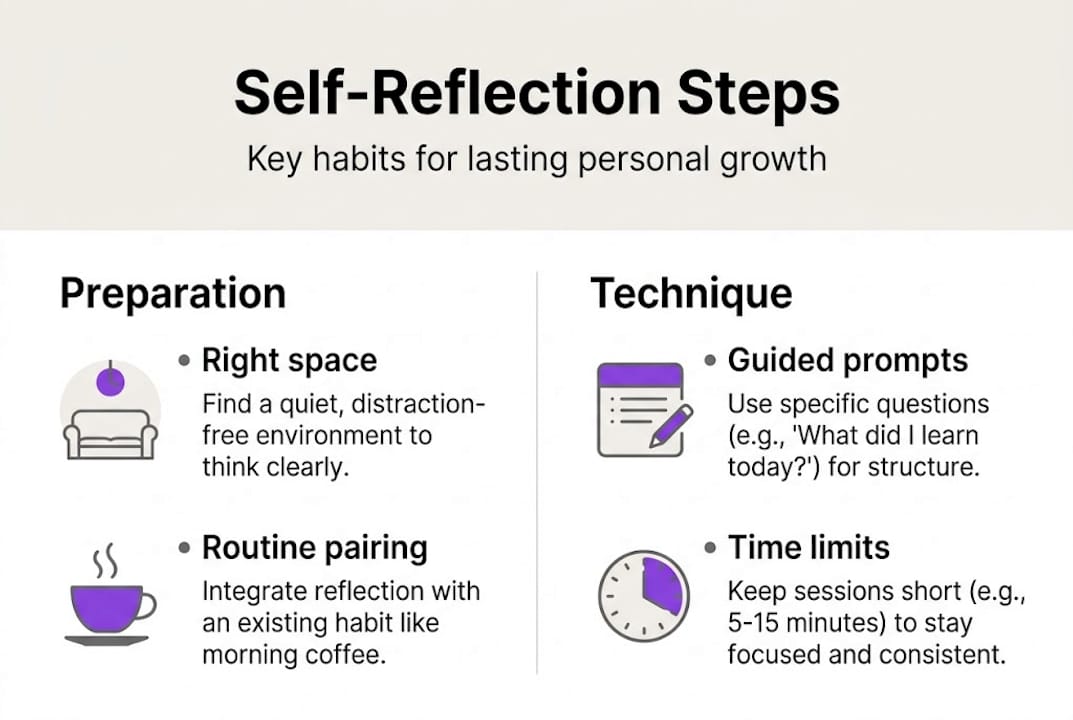
One of the most effective strategies is pairing reflection with an existing daily routine. Morning coffee, an evening walk, or the ten minutes before bed are all natural anchors. The self-reflection benefits become far more accessible when the practice feels like a natural extension of your day rather than another task to schedule.
Harvard Health recommends you start small, pair reflection with routines, and experiment with formats to build a sustainable habit. That's practical advice worth taking seriously. Not everyone thrives with written journaling. Some people process better through voice notes, others through sketching or mind mapping.
| Format | Best for | Time needed |
|---|---|---|
| Written journaling | Deep processing, pattern recognition | 10 to 20 minutes |
| Voice notes | Commuters, quick reflection | 3 to 5 minutes |
| Visual journaling | Creative thinkers, emotional mapping | 15 to 30 minutes |
| Digital app prompts | Guided structure, beginners | 5 to 10 minutes |
A gratitude journal practice is one of the easiest entry points, especially if open-ended reflection feels overwhelming at first. Listing three things you're grateful for each day trains your brain to notice positive patterns, which builds the observational muscle you need for deeper reflection later.
Pro Tip: Set a physical cue, like placing your journal next to your coffee maker or phone charger, to trigger the habit automatically. Cues remove the need for willpower.
Step-by-step self-reflection techniques
With the right tools and mindset, you're ready to try specific techniques. The key is moving from vague introspection to structured inquiry. Open-ended thinking tends to wander. Guided prompts give your reflection a spine.
How to run a basic daily reflection session:
- Find your anchor time (morning or evening works best for most people).
- Open your journal or app and write today's date.
- Answer one or two prompts, such as "What went well today?" and "What challenged me?"
- Spend two minutes on the "5 Whys" technique for any challenge: ask "why" five times to reach the root cause.
- Close with one intention for tomorrow.
- Review your entries weekly to spot recurring themes.
Guided journaling prompts like "What went well?", "What challenged me?", and the 5 Whys help deepen insights by pushing past surface-level reactions into actual patterns. This is where real self-awareness lives.

A reflective practice study found that structured reflection improves both critical thinking and emotional self-regulation over time. That's not a small outcome. Those two skills affect every relationship, decision, and goal you pursue.
For a more detailed walkthrough, the step-by-step journaling guide on Voisley's blog breaks down session structure in practical terms. You can also explore different journaling techniques to find the format that fits your thinking style.
| Technique | Best outcome | Frequency |
|---|---|---|
| Daily prompts | Habit formation, consistency | Daily |
| Weekly review | Pattern recognition | Weekly |
| 5 Whys | Root cause analysis | As needed |
| Gratitude log | Optimism, positive bias | Daily or 3x/week |
| Audio reflection | Spontaneous processing | As needed |
Pro Tip: If you miss a day, don't try to catch up. Just resume the next day. Consistency over perfection is what builds lasting insight.
Overcoming challenges and avoiding common mistakes
Once you're practicing techniques, it's important to handle potential pitfalls. The most common one is rumination, which looks like reflection but is actually just looping on the same painful thought without resolution. The difference is movement. Reflection moves toward insight. Rumination circles without landing.
Signs you may be ruminating instead of reflecting:
- You're revisiting the same event repeatedly without new conclusions
- Your journaling feels heavier after each session, not lighter
- You're focused on blame (self or others) rather than understanding
- You avoid your journal because it feels draining
A meta-analysis of 39 studies found that self-reflection can correlate with negative mental health outcomes when overdone or approached without structure. Culture and tools matter significantly in how reflection lands emotionally. This is a critical warning: more reflection is not always better reflection.
Another important distinction comes from research on how self-perception works. Reflected appraisal stays stable over time, while self-appraisal fluctuates with mood. That means how you see yourself on a bad day is not an accurate picture. Journaling during emotional lows without prompts can reinforce distorted thinking rather than correct it.
"Reflection without structure risks becoming a mirror that magnifies pain rather than one that reveals growth."
The fix is straightforward. Use prompts. Stick to a time limit (15 to 20 minutes is usually enough). Combine personal reflection with external feedback from a trusted friend, coach, or therapist. External perspectives reveal blind spots that solo reflection simply cannot reach.
For a deeper look at how introspection affects your mental health, the introspection and mental health article offers grounded, research-backed context.
Also, adapt your practice to your current state. If you're going through a high-stress period, lighter prompts like gratitude lists are safer than deep shadow work. Know when to ease up and when to go deeper. Self-awareness includes awareness of your own capacity.
Pro Tip: Set a timer for your reflection sessions. When the timer ends, close the journal. This prevents spiraling and trains your brain to process within a healthy boundary.
Verifying progress: How to measure and sustain your growth
With challenges managed, it's time to confirm you're seeing real benefits. Progress in self-reflection is subtle at first. You won't wake up one day feeling transformed. But over weeks and months, you'll notice shifts in how you respond to stress, how quickly you recover from setbacks, and how clearly you understand your own motivations.
Practical ways to track your growth:
- Review journal entries monthly and highlight recurring themes or emotional patterns
- Rate your mood before and after each session to track immediate impact
- Note changes in how you handle conflict or frustration in daily life
- Track how often you feel emotionally clear versus overwhelmed
- Celebrate small wins: a calmer response to a trigger, a moment of genuine gratitude
Reflective practice improves critical thinking and self-regulation, and gratitude journaling specifically increases optimism over time. These are measurable outcomes you can actually feel.
| Benchmark | What to look for | Timeline |
|---|---|---|
| Optimism | More positive framing in entries | 2 to 4 weeks |
| Stress response | Shorter recovery time after stress | 4 to 6 weeks |
| Emotional clarity | Clearer language when describing feelings | 3 to 5 weeks |
| Self-awareness | Recognizing patterns before they escalate | 6 to 8 weeks |
When progress stalls, adjust. Try a new prompt set, switch formats, or bring in a journaling partner. The well-being workflow guide offers practical frameworks for keeping momentum alive. If you feel like you're going in circles, the self-discovery process resource can help you reorient with fresh structure.
Sustainability is the real goal. A five-minute daily practice you keep beats a two-hour session you abandon after a week. Build reflection into your life in a way that feels natural, not heroic.
Our perspective: Why balancing self-reflection is critical
Here's the part most guides skip. Self-reflection is not inherently good. It's a tool, and like any tool, it can help or harm depending on how you use it. We've seen this pattern repeatedly: someone starts journaling with genuine enthusiasm, goes too deep too fast without prompts or structure, and ends up feeling worse than before. Then they conclude that journaling doesn't work for them. But the practice wasn't the problem. The approach was.
The meta-analysis of 39 studies makes it clear: prioritizing non-judgmental, prompted practices prevents rumination, and combining reflection with external feedback addresses the blind spots that solo introspection misses.
Culturally, reflection looks different for different people. Some cultures emphasize communal processing over private journaling. Some individuals process better through conversation than writing. There is no single correct method. What matters is that your approach feels honest, sustainable, and growth-oriented rather than self-critical.
Exploring your emotional pattern journaling practice with structured prompts is one of the most effective ways to keep reflection productive and grounded in genuine self-compassion.
Connect with guided journaling tools for lasting growth
If you've found value in these techniques and want a structured space to practice them consistently, Voisley was built exactly for this.

Guided journaling tools on Voisley combine AI-powered prompts, mood tracking, and multiple journal types including gratitude, shadow work, and future goals to help you reflect with purpose and clarity. You don't have to figure out the structure alone. The platform does the heavy lifting so you can focus on the insight. For ongoing strategies and deeper reading, the mental wellness journaling blog covers everything from beginner routines to advanced emotional intelligence practices.
Frequently asked questions
What are the best prompts for self-reflection journaling?
Effective prompts include "What went well?", "What challenged me?", and the "5 Whys" to dig deeper into root causes. Guided journaling methodologies consistently show that structured prompts produce more meaningful insights than open-ended free writing.
How often should I practice self-reflection?
Aim for at least three sessions per week, or short daily check-ins, to build a lasting habit. Gratitude journaling three times weekly for just two weeks has been shown to measurably increase optimism.
Can self-reflection make anxiety worse?
Yes, if it becomes unstructured rumination or self-criticism. Using prompts and setting time limits keeps reflection productive. A correlation with negative mental health appears when reflection is overdone or lacks compassionate structure.
What's the difference between introspection and guided self-reflection?
Introspection is unstructured inner observation, while guided self-reflection uses prompts and routines to produce clearer, more actionable insights. Prompted and structured reflection is specifically designed to prevent the kind of looping that makes introspection feel unproductive.
How can I measure my progress with self-reflection?
Track mood ratings, gratitude entries, and prompt responses over time to spot improvements in optimism and emotional clarity. Reflective practice improves self-regulation in ways you can observe directly in how you respond to everyday stress and challenge.