

You sit with your thoughts, yet clarity remains elusive. Emotions swirl without names, patterns repeat without understanding, and your core values feel buried beneath daily noise. This confusion isn’t uncommon. Many people struggle to decode their inner landscape, leaving them reactive rather than intentional. Journaling offers a structured path through this fog. Research confirms that guided journaling increases emotional intelligence while reducing anxiety. This guide provides a proven, step-by-step framework for using reflective writing to uncover who you are, what drives you, and how to align your life with your authentic self.
Table of Contents
-
Preparing for your self-discovery journey: tools and mindset
-
Step-by-step journaling techniques for self-awareness and emotional clarity
-
Verifying your progress and embracing ongoing self-discovery
Key takeaways
| Point | Details |
| Emotional clarity through writing | Journaling reduces anxiety and increases self-awareness by externalizing internal experiences. |
| Mindfulness enhances reflection | Combining brief meditation with journaling deepens insights and improves focus during self-exploration. |
| Multiple journaling styles work | Free writing, gratitude logs, and guided prompts each serve different discovery goals effectively. |
| Consistency beats perfection | Regular practice matters more than flawless entries, building sustainable self-awareness habits. |
| Progress requires review | Periodic reflection on past entries reveals growth patterns and validates emotional development. |
Preparing for your self-discovery journey: tools and mindset
Before you write a single word, set yourself up for success. The right preparation transforms journaling from random scribbling into purposeful exploration. Start by choosing your medium. A physical notebook creates tactile connection, while digital apps offer searchability and prompts. Either works, so pick what feels natural.
Your environment shapes your practice. Find a quiet corner where interruptions won’t break your flow. Silence your phone. Close unnecessary tabs. This space becomes your sanctuary for honest reflection. Physical comfort matters too. Sit somewhere supportive, adjust lighting to avoid strain, and keep water nearby.
Mental preparation rivals physical setup. Mindfulness practices enhance self-reflection effectiveness by quieting mental chatter before you begin. Try this: sit comfortably, close your eyes, and focus on your breath for three minutes. Notice thoughts without judgment, then return attention to breathing. This brief reset sharpens focus and opens emotional receptivity.
Set clear intentions before each session. Ask yourself what you want to explore today. Childhood patterns? Current relationship dynamics? Career fulfillment? Naming your focus directs your writing toward meaningful territory. Write your intention at the top of the page as an anchor.
Release perfectionism immediately. Journaling isn’t about grammar, eloquence, or publishable prose. It’s about raw honesty. Misspellings don’t matter. Incomplete sentences work fine. This permission to be messy unlocks authentic expression. You’re writing for yourself, not an audience.
Essential preparation checklist:
-
Dedicated notebook or reliable digital journaling app
-
Distraction-free environment with comfortable seating
-
Three-minute mindfulness practice before writing
-
Clear intention statement for each session
-
Permission to write imperfectly and honestly
Pro Tip: Keep your journal and pen in the same visible spot daily. This visual cue triggers habit formation, making consistent practice easier than relying on motivation alone.
| Preparation Element | Purpose | Time Required |
| Environment setup | Minimize distractions, maximize comfort | 2-5 minutes |
| Mindfulness practice | Clear mental clutter, improve focus | 3-5 minutes |
| Intention setting | Direct exploration toward specific growth areas | 1-2 minutes |
| Material gathering | Ensure tools are ready and accessible | 1 minute |
With preparation complete, you’re ready to turn your mood into action through structured writing techniques that reveal hidden patterns and foster genuine self-knowledge.
Step-by-step journaling techniques for self-awareness and emotional clarity
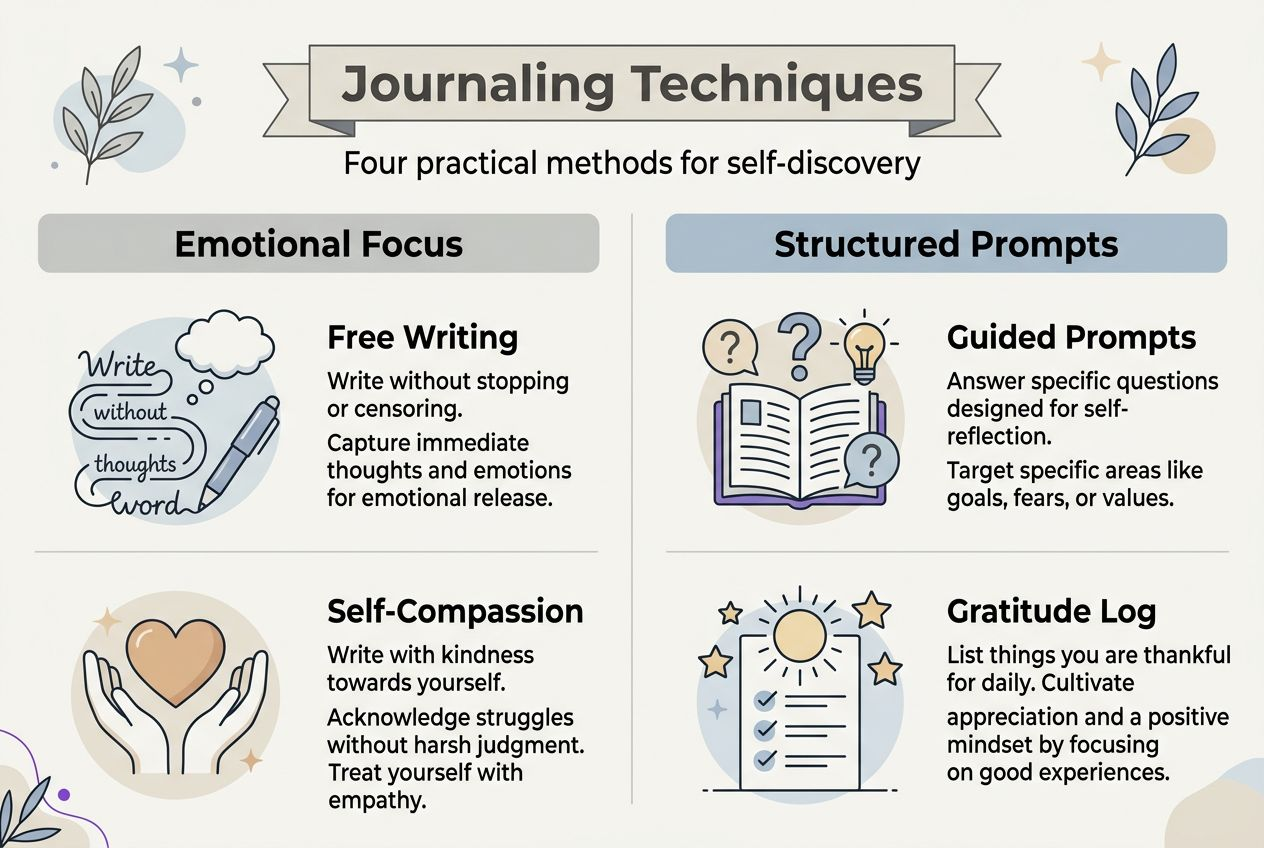
Different techniques serve different discovery needs. Master these four core approaches, then mix them based on what you’re exploring.
1. Free writing for emotional excavation
Set a timer for ten minutes. Write continuously without stopping, editing, or censoring. Let thoughts flow onto the page exactly as they arrive. Spelling errors? Keep going. Tangents? Follow them. This stream-of-consciousness method bypasses your inner critic, surfacing buried emotions and unexpected insights. You’ll often discover what you truly feel only after seeing it written.

2. Guided prompts for targeted exploration
Guided journaling increases emotional intelligence and reduces depression by directing attention toward specific growth areas. Use prompts like: “What core value did I compromise this week, and why?” or “When do I feel most authentically myself?” These questions crack open topics you might avoid in free writing. Answer thoroughly, exploring nuances rather than surface responses.
3. Gratitude logging for positive reframing
List three specific things you appreciate daily. Go beyond generic entries like “family” or “health.” Instead, write “My partner remembered I had a tough meeting and texted encouragement” or “My body carried me through a challenging hike.” Gratitude journaling correlates with happiness and life satisfaction by training attention toward positive experiences. This doesn’t ignore difficulties but balances perspective.
4. Self-compassion exercises for inner kindness
When you notice harsh self-criticism, write a letter to yourself from a compassionate friend’s perspective. What would someone who loves you say about your struggle? This technique creates distance from negative self-talk, replacing judgment with understanding. It’s particularly powerful after mistakes or setbacks.
Pro Tip: Rotate techniques throughout the week rather than using one exclusively. Monday might be free writing, Wednesday gratitude, Friday guided prompts. This variety keeps practice fresh while addressing multiple growth dimensions.
| Journaling Style | Best For | Frequency |
| Free writing | Processing complex emotions, discovering hidden thoughts | 2-3 times weekly |
| Guided prompts | Targeted self-exploration, addressing specific challenges | 2-3 times weekly |
| Gratitude logging | Building positive perspective, increasing life satisfaction | Daily |
| Self-compassion | Counteracting self-criticism, healing shame | As needed |
Experiment to find your rhythm. Some people thrive with daily practice across all methods, while others prefer focused weekly sessions. The goal is sustainable insight, not rigid adherence. Let your needs guide your approach, and turn your mood into action by tracking which techniques yield the deepest breakthroughs.
Troubleshooting common journaling challenges and pitfalls
Even with preparation and technique, obstacles emerge. Recognize these common struggles and apply targeted solutions.
Writer’s block and blank page paralysis
Staring at emptiness kills momentum. When words won’t come, start with the absolute simplest observation: “Right now I feel…” or “Today I noticed…” These low-stakes openings bypass perfectionism. Another strategy: write badly on purpose. Give yourself permission to produce the worst entry imaginable. This reverse psychology often unlocks flow.
Overemphasis on form over content
The process matters more than perfect grammar or structure. If you’re spending energy on sentence construction, you’re missing the point. Journaling isn’t creative writing class. Fragments work. Repetition is fine. Messy handwriting doesn’t diminish value. Your inner experience matters, not presentation.
Emotional overwhelm during writing
Sometimes journaling surfaces intense pain or trauma. If you feel flooded, pause immediately. Close your journal, practice grounding techniques like naming five things you see, or step outside for fresh air. Effectiveness varies by personality and challenge type. Journaling complements professional support but doesn’t replace it for serious mental health concerns.
Inconsistent practice and motivation dips
Life disrupts routines. When journaling falls away, restart without guilt. One missed week doesn’t erase previous progress. Anchor practice to existing habits: journal after morning coffee or before bed. Start with five minutes if longer sessions feel impossible. Consistency beats duration.
Key troubleshooting reminders:
-
Begin with simple prompts when blocked
-
Prioritize honesty over eloquence always
-
Pause and ground yourself if overwhelmed
-
Restart practice without self-judgment after breaks
-
Seek professional help for persistent distress
“Journaling isn’t therapy, but it can be therapeutic. Know the difference, and get appropriate support when needed.”
These challenges don’t signal failure. They’re normal parts of deepening self-awareness. Each obstacle you navigate strengthens your practice and reveals more about your inner world.
Verifying your progress and embracing ongoing self-discovery
Self-discovery isn’t a destination but an evolving journey. Tracking progress validates effort and reveals growth you might otherwise miss.
Review entries systematically
Monthly, read past entries with fresh eyes. Notice recurring themes. Do certain triggers appear repeatedly? Have your responses to similar situations shifted? This bird’s-eye view shows patterns invisible in daily writing. Highlight insights that surprise you or confirm suspicions. These become reference points for continued growth.
Use self-assessment measures
Periodically rate your emotional clarity, self-compassion, and life satisfaction on a scale of one to ten. Record these scores in your journal with brief explanations. Over months, you’ll see quantifiable shifts. Reflective journaling increases self-awareness and lowers anxiety, but subjective tracking makes this concrete.
Celebrate milestones authentically
When you notice genuine change, acknowledge it. Maybe you handled conflict differently than six months ago. Perhaps you recognized a destructive pattern before acting on it. These victories deserve recognition. Write about them specifically: what changed, how you noticed, what it means for your growth.
Adapt prompts as you evolve
Your discovery needs shift over time. Early journaling might focus on identifying emotions. Later, you’ll explore relationship patterns or life purpose. Adjust your questions accordingly. If prompts feel stale or easy, they’ve served their purpose. Introduce new challenges that stretch current understanding.
Commit to continuous practice
Self-awareness isn’t achieved then maintained passively. New life stages bring fresh challenges requiring renewed exploration. Your journal becomes a lifelong companion, documenting evolution across decades. This long view transforms journaling from a project into an identity.
Progress verification strategies:
-
Monthly review sessions to identify patterns and growth
-
Quarterly self-assessment ratings with contextual notes
-
Celebration entries when breakthroughs occur
-
Prompt rotation to match evolving discovery needs
-
Long-term commitment to journaling as ongoing practice
| Progress Indicator | How to Measure | Review Frequency |
| Emotional clarity | Rate understanding of feelings on 1-10 scale | Monthly |
| Pattern recognition | Count recurring themes in entries | Quarterly |
| Behavioral change | Note specific situations handled differently | As they occur |
| Self-compassion | Assess inner dialogue tone and content | Monthly |
| Life satisfaction | Overall contentment rating with brief explanation | Quarterly |
Verification isn’t about perfection or constant improvement. Some periods show plateau or regression, especially during stress. That’s normal. The practice itself, maintained through ups and downs, constitutes success. Your journal witnesses your full humanity, and turn your mood into action by honoring both growth and struggle as equally valuable parts of your story.
Explore Voisley to enhance your self-discovery process
You’ve learned powerful techniques for journaling-based self-discovery. Now consider amplifying your practice with purpose-built tools. Voisley mood tracking and journaling transforms daily emotional check-ins into actionable insights through AI-powered pattern recognition. The platform offers guided prompts aligned with your specific growth goals, whether you’re exploring gratitude, shadow work, or future visioning.
Voisley’s visualizations reveal emotional trends you might miss in traditional journaling, showing how mood fluctuates across contexts and time. The app combines structure with flexibility, supporting both free writing and targeted exploration. Community features let you share reflections safely when desired, while privacy settings ensure your deepest thoughts remain protected. Voisley personal growth tools turn scattered entries into a coherent narrative of your emotional journey, helping you move from awareness to meaningful action in your daily life.
FAQ
What is the best journaling method for self-discovery?
No single method works universally because personality and goals vary. Free writing excels at uncovering buried emotions, while guided prompts target specific growth areas systematically. Experiment with both approaches for several weeks, noticing which generates deeper insights. Most people benefit from combining methods rather than choosing one exclusively.
How often should I journal for effective self-discovery?
Daily practice or three to four times weekly produces the strongest results for building self-awareness. Consistency matters more than session length. A focused ten-minute entry daily outperforms sporadic hour-long sessions. Start with a manageable frequency you can sustain, then increase gradually as the habit solidifies.
Can journaling replace professional therapy?
Journaling complements therapy but doesn’t substitute for professional mental health treatment when dealing with severe anxiety, depression, trauma, or other clinical conditions. Use journaling as a supportive tool alongside therapy, not instead of it. If your writing consistently surfaces overwhelming distress, that’s a signal to seek professional guidance.
What if I feel overwhelmed or stuck while journaling?
Pause immediately and practice grounding techniques like deep breathing or naming objects around you. Sometimes stepping away for a few minutes restores equilibrium. If specific prompts consistently trigger distress, adjust to gentler questions or try free writing instead. Consider working with a therapist to process material that feels too intense for solo exploration.