

TL;DR:
- Journaling enhances emotional self-awareness and reduces stress through structured reflection.
- Consistent practice with prompts and habit stacking builds emotional clarity and growth.
- Reviewing journal patterns over time reveals emotional triggers and supports long-term well-being.
Strong emotions can feel like a current pulling you under before you even realize you've stepped in. You know something is off, but naming it, let alone managing it, feels impossible. Journaling for emotional self-reflection changes that. It gives you a structured way to observe your inner world without judgment, and the research behind it is genuinely compelling. This guide walks you through exactly why it works, how to set yourself up, the step-by-step process, common obstacles you'll face, and how to measure real progress over time.
Table of Contents
- Why emotional self-reflection matters
- Preparing for your emotional self-reflection journey
- Step-by-step process: Journaling for emotional clarity
- Overcoming common barriers to emotional journaling
- Tracking progress and making emotional self-reflection stick
- A fresh perspective: What most self-reflection guides overlook
- Turn your reflection into action with Voisley
- Frequently asked questions
Key Takeaways
| Point | Details |
|---|---|
| Journaling boosts well-being | Empirical studies show regular emotional self-reflection through journaling measurably increases happiness and lowers anxiety. |
| Preparation prevents frustration | Selecting tools, setting habits, and knowing initial discomfort is normal leads to a sustainable journaling routine. |
| Custom techniques work best | Choosing methods that match your emotional state ensures more effective self-reflection and growth. |
| Review accelerates progress | Tracking moods and regularly reviewing your entries helps reveal emotional patterns and maintains motivation. |
Why emotional self-reflection matters
Emotional self-reflection is the practice of intentionally examining your thoughts, feelings, and reactions to understand them more clearly. It's not rumination, which loops the same thought endlessly. It's directed observation with the goal of learning something useful about yourself.
The science backs this up strongly. Journaling techniques for well-being have been studied across multiple formats, and the results consistently show measurable improvements in mental and physical health. The evidence on gratitude journaling shows that gratitude journaling increases positive emotion and happiness, reflective journaling reduces anxiety, and expressive writing lowers stress hormones.
Think of it this way: your emotions are data. Without a system to collect and review that data, you're making decisions about your life based on incomplete information. Journaling is the collection system.
Here are the core benefits that research consistently supports:
- Reduced anxiety through structured emotional processing
- Improved self-efficacy, meaning you feel more capable of handling challenges
- Lower stress hormones from expressive writing sessions
- Greater emotional clarity, which supports better decision-making
- Stronger self-awareness, the foundation of emotional intelligence
"Regular journaling, whether gratitude-based, reflective, or expressive, produces measurable improvements in emotional regulation, stress response, and overall well-being across diverse populations." This finding, supported by journaling for emotional wellness research, underscores why this practice is worth building into your routine.
One statistic worth sitting with: people who journal three times per week for just 15 minutes report significant gains in positive emotion and happiness within weeks. That's a small time investment for a meaningful return.
With this foundation of why emotional self-reflection matters, let's get practical by setting yourself up for success.
Preparing for your emotional self-reflection journey
Before you write a single word, your setup matters more than most people realize. The right environment and tools lower the friction that kills new habits before they start.

| Tool | Purpose | Recommended option |
|---|---|---|
| Journal app or notebook | Capture entries privately | Voisley app or physical notebook |
| Pen or keyboard | Whatever feels natural | Choose one and stick with it |
| Prompt list | Reduce blank-page anxiety | Pre-written emotional prompts |
| Time block | Build consistency | 10 to 15 minutes, same time daily |
| Privacy setting | Feel psychologically safe | Locked app or private physical journal |
The table above isn't just a checklist. Each element addresses a specific reason people quit. Prompts remove the "I don't know what to write" problem. Time blocks remove the "I'll do it later" trap. Privacy settings remove the fear of being seen.
Building consistency also means working with your existing habits, not against them. When you're reflecting on feelings for the first time, pairing journaling with something you already do, like morning coffee or brushing your teeth at night, dramatically increases follow-through.
Here are habits that support a sustainable journaling practice:
- Start with two to three sentences, not pages
- Write at the same time each day to build automaticity
- Avoid judging what you write while you're writing it
- Review entries weekly rather than immediately after writing
- Treat missed days as data points, not failures
Pro Tip: Habit stacking works exceptionally well here. Attach journaling to an existing anchor habit, like writing three sentences right after you pour your morning coffee. You're not adding a new habit; you're extending one you already have.
Initial discomfort is completely normal. Metacognitive journaling challenges research confirms that early resistance is common and can be overcome through short entries and habit stacking, and that reviewing entries for patterns is what actually drives growth. The discomfort isn't a sign you're doing it wrong. It's a sign you're doing something real. Working on improving self-awareness takes courage, and the first few entries are always the hardest.
Armed with your tools and mindset, you can now dive into the core steps of effective self-reflection.
Step-by-step process: Journaling for emotional clarity
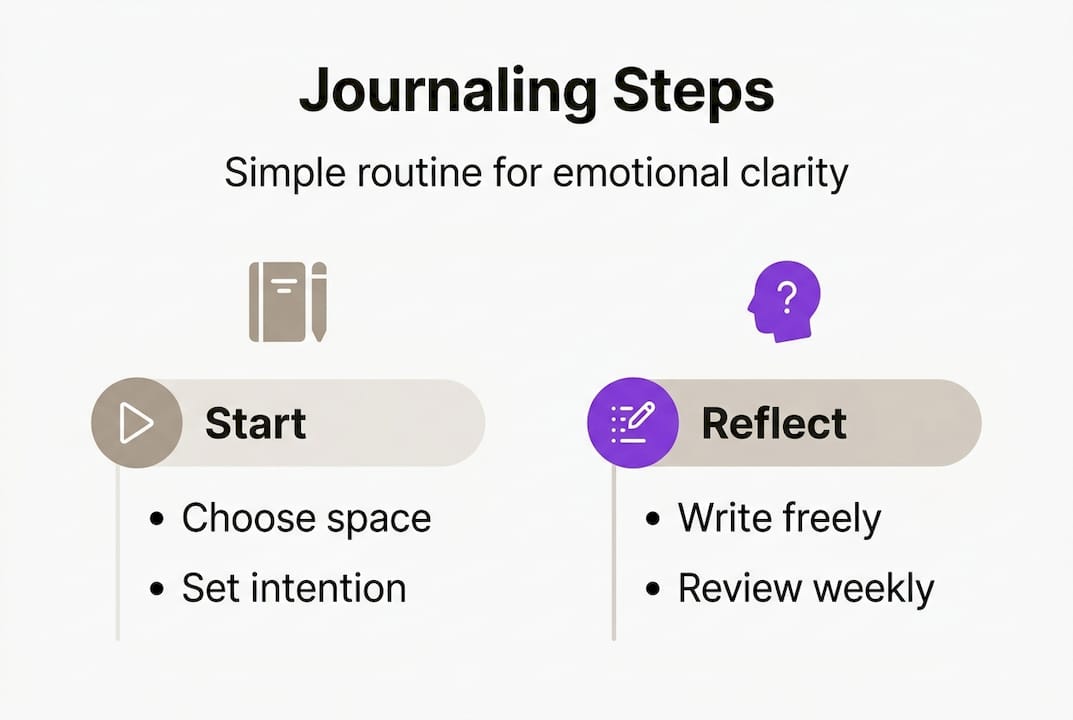
This is the practical engine of the whole guide. Follow these steps in order, especially when you're starting out.
-
Choose a prompt. Don't start with a blank page. Use a question like "What emotion showed up most strongly today?" or "What situation triggered a reaction I didn't expect?" Good prompts point your attention inward without feeling clinical.
-
Label your current emotion. Before writing anything else, name what you feel right now. Not "bad" or "stressed," but specific: frustrated, disappointed, anxious, or relieved. This is the first step in the STEAM method (Sensations, Thoughts, Emotions, Actions, Meaning), which pairs well with mindfulness with journaling.
-
Express your thoughts freely. Write without editing. Let the thoughts come out messy. This is where emotional regulation journaling tips emphasize volume over polish. You're excavating, not presenting.
-
Reframe if possible. After expressing, ask: "What is one thing I can learn from this feeling?" or "Is there another way to interpret what happened?" Reframing isn't toxic positivity. It's a cognitive tool for shifting perspective.
-
Close with a gratitude note. Even one sentence. Gratitude practices show empirical support for reduced stress and better sleep when used consistently at the end of a reflection session.
Pro Tip: Personalize your prompts. If "what are you grateful for" feels hollow, try "what went slightly better than expected today?" The goal is genuine engagement, not a formula. Aim for two to three sentences per step when starting out.
Over time, this process does something powerful: it creates a map of unlocking emotional patterns in your own behavior. You start noticing that certain situations consistently trigger specific emotions. That awareness alone changes how you respond.
Even with a plan, most people hit obstacles or make common mistakes. Next, we'll troubleshoot and set you up for real growth.
Overcoming common barriers to emotional journaling
Knowing what to do and actually doing it are two different things. Here's an honest look at what gets in the way and what actually helps.
| Barrier | Why it happens | Effective solution |
|---|---|---|
| Avoidance | Emotions feel too big to face | Start with one sentence about a minor feeling |
| Technique mismatch | Gratitude doesn't fit anger or grief | Match the method to the emotion |
| Lack of time | Sessions feel like a commitment | Cap entries at five minutes initially |
| Privacy concern | Fear of being seen or judged | Use a locked app or password-protected journal |
| Waning motivation | Progress feels invisible | Schedule weekly reviews to see patterns |
The technique mismatch issue deserves special attention. Gratitude journaling is powerful, but it's not the right tool for every emotional state. If you're angry, forcing gratitude can feel dismissive of a legitimate feeling. Overcoming journaling challenges research shows that mismatched techniques and metacognitive barriers require intentional strategy, not just willpower. Anger responds better to expressive writing first, then reflection.
When motivation drops, try these troubleshooting approaches:
- Re-read your last five entries and notice any patterns you missed
- Switch journal types temporarily, try a prompt-based format instead of free writing
- Lower the bar dramatically: one sentence counts
- Use guided journaling for self-discovery to get structure when you feel stuck
- Remind yourself why you started by reading your very first entry
Reviewing past entries is genuinely underrated. Most people write and never look back. But the insight isn't always in the writing. It's in the pattern you can only see when you read three weeks of entries in one sitting. That's where the emotional well-being workflow really clicks into place.
With challenges addressed, focus on verifying progress, measuring outcomes, and integrating reflection for long-term emotional health.
Tracking progress and making emotional self-reflection stick
Progress in emotional self-reflection is real, but it's subtle. You won't wake up one day and feel completely transformed. You'll notice smaller things: you paused before reacting, you named a feeling before it overwhelmed you, you chose differently in a situation that used to derail you.
| Frequency | Mood log strategy | Weekly progress marker |
|---|---|---|
| 3x per week | Rate mood 1 to 10 before each entry | Compare average mood score week over week |
| Daily | Note one dominant emotion per entry | Track which emotions appear most often |
| Weekly review | Re-read all entries from the week | Identify one pattern or shift in thinking |
Journaling outcomes research shows that weekly gratitude journaling for 10 weeks or daily journaling for two weeks yields measurable gains in well-being and mood. These are realistic benchmarks, not aspirational ones.
Here's how to build your weekly review into a sustainable habit:
- Schedule it. Pick one day per week, Sunday evening works well, and treat it like an appointment.
- Mark patterns. Highlight recurring emotions, triggers, or thoughts with a simple color code or tag.
- Adjust your technique. If you notice a pattern that isn't shifting, try a different journaling approach for the next week.
- Celebrate micro-wins. Did you name an emotion before reacting? Write that down. Small wins compound.
Personalization is the key to sustainability. Tracking emotional progress works best when the system fits your life, not someone else's ideal routine. A five-minute daily check-in beats an hour-long session you never actually do.
Having covered the process and troubleshooting, let's step back for a big-picture perspective on emotional self-reflection that most guides miss.
A fresh perspective: What most self-reflection guides overlook
Most journaling guides treat the practice as emotional release. Write it out, feel better, move on. That framing undersells what's actually happening when you journal consistently.
The real value is metacognitive skill-building: learning to observe your own thinking and feeling processes from a slight distance. You're not just venting. You're training your brain to notice patterns between your personal and professional emotional states, and that skill transfers everywhere.
"Intentional journaling strategies consistently outperform willpower-based approaches for overcoming barriers, and journaling helps monitor the intersection of personal and professional self in ways that prevent emotional burnout." This insight from metacognitive journaling research reframes journaling as a cognitive tool, not just a coping mechanism.
Conventional wisdom skips how intentional journaling prevents burnout before it starts. When you can see your emotional patterns on paper, you recognize the warning signs early. You adapt instead of collapse. The deeper journaling benefits show up not in dramatic breakthroughs, but in the quiet consistency of responding rather than reacting. That's the real goal.
Turn your reflection into action with Voisley
Reading about emotional self-reflection is one thing. Having a structured space to actually practice it daily is another.

Voisley journaling platform brings everything in this guide into one place: guided prompts tailored to your emotional state, mood tracking that visualizes your patterns over time, and AI-powered insights that help you understand what your entries are actually telling you. Onboarding takes minutes, and the platform adapts to your pace, whether you're starting with two sentences or building toward a deeper daily practice. If you're serious about turning self-reflection into lasting emotional growth, Voisley gives you the tools to make it real.
Frequently asked questions
How long should I journal for emotional self-reflection?
Aim for 10 to 15 minutes, three times per week. Research shows this frequency improves positive emotions and happiness within a few weeks.
What if journaling makes me uncomfortable at first?
Start with very short entries and pair journaling with an existing habit. This approach is shown to overcome early resistance and build consistency more effectively than pushing through discomfort alone.
How can I track personal growth through journaling?
Review journal entries weekly, use a simple mood log, and compare your emotional patterns over two to ten weeks. Measurable gains appear within that window when you journal consistently.
What if gratitude or other techniques don't match my emotions?
Choose your journaling approach based on your actual emotional state. Mismatched techniques like using gratitude journaling for anger tend to fail, so reviewing your entries for patterns helps you find what actually works for you.