

Most people avoid writing about painful emotions because they fear making things worse. Here's the paradox: sitting with those feelings on paper is exactly what reduces their grip. Structured journaling like the Pennebaker protocol reduces doctor visits by 50% and improves immune function. That's not a wellness trend. That's decades of peer-reviewed research. If you've ever felt stuck in the same emotional loops, this article will show you what emotional patterns actually are, why how you journal matters as much as whether you journal, and how to use proven frameworks to build real self-awareness.
Table of Contents
- The basics: What are emotional patterns?
- Why structure matters: Journaling protocols vs. unstructured venting
- Techniques to identify and change emotional patterns
- Common pitfalls and how to overcome them
- The uncomfortable truth: Why emotional journaling works and when it doesn't
- Next steps: Guided journaling for your emotional well-being
- Frequently asked questions
Key Takeaways
| Point | Details |
|---|---|
| Structure beats venting | Guided journaling protocols help avoid rumination and reveal actionable emotional patterns. |
| Patterns need insight | Understanding triggers and responses through reflection leads to real emotional change. |
| Frameworks have limits | Evidence shows structured reflection eases negative symptoms but isn’t a substitute for therapy in severe cases. |
| Mindfulness matters | Combining journaling with body awareness and mindfulness deepens self-understanding. |
| Start with prompts | Daily prompts and mood tracking maximize the benefits of emotional journaling. |
The basics: What are emotional patterns?
Emotional patterns are recurring cycles of feeling, thinking, and reacting that show up across different situations in your life. Think of them as your emotional default settings. You might feel a wave of anxiety every time a deadline approaches, or notice irritability creeping in after receiving critical feedback. These aren't random reactions. They're grooves worn into your nervous system over time.
Most people misread these patterns entirely. They label the emotion ("I'm just an anxious person") without ever identifying the specific trigger or the thought that bridges the trigger to the feeling. That gap between trigger and response is where the real insight lives. Understanding the benefits of self-reflection starts with recognizing that your reactions have a structure, and that structure can be mapped.
Here's what emotional patterns often look like in practice:
- Stress after criticism: A colleague questions your work, and within minutes you're replaying every mistake you've made this month.
- Anxiety before deadlines: The closer a due date gets, the more you procrastinate, which feeds more anxiety.
- Emotional withdrawal: When conflict arises, you go quiet and distant, which others interpret as indifference.
- Mood crashes after social events: You feel drained or sad after gatherings, even ones you enjoyed.
The challenge is that most of these cycles run below conscious awareness. You feel the emotion but not the chain of events that produced it. That's where introspection and self-reflection become practical tools, not just philosophical exercises.
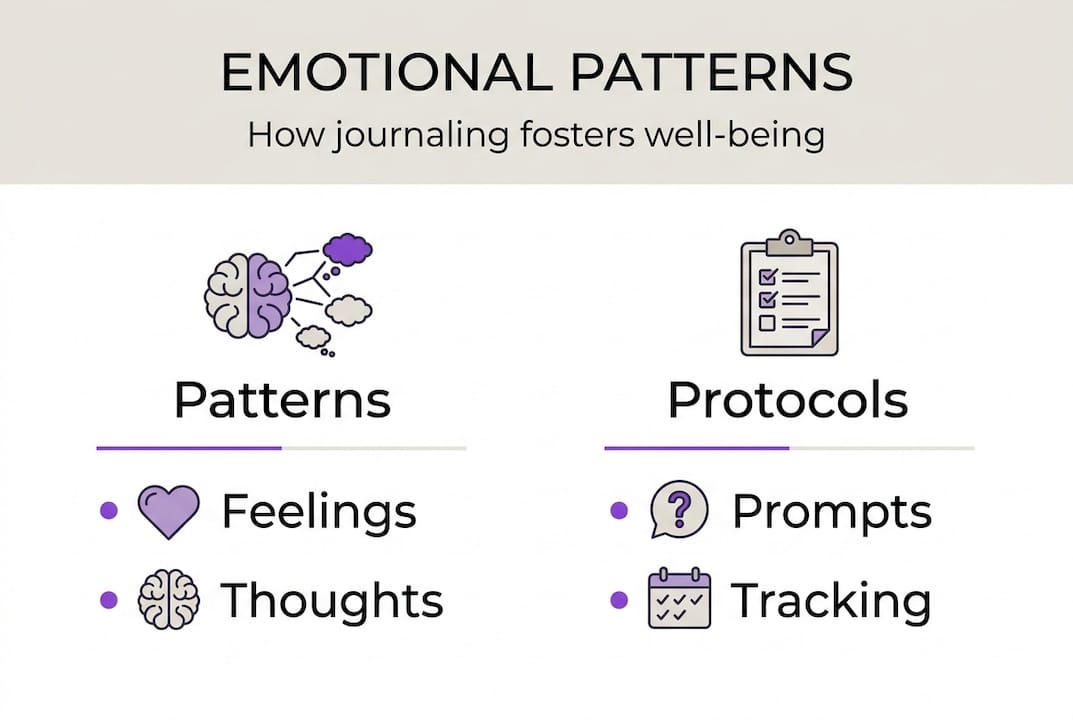
The numbers back this up. 70% of people report improved emotional clarity after one month of structured journaling that includes body scans, event-specific feeling logs, and mindfulness check-ins. Pairing journaling wellness strategies with consistent practice is what separates people who understand their patterns from those who just feel them.
Why structure matters: Journaling protocols vs. unstructured venting
Understanding your own patterns opens the door to deeper change, but how you journal makes a critical difference. Not all journaling is equal. There's a meaningful gap between opening a blank page and writing whatever comes to mind versus following a structured protocol with specific prompts and a clear purpose.
Structured journaling reduces anxiety and depression, while unstructured venting can actually worsen symptoms. That's a finding worth sitting with. When you vent without any framework, you risk looping through the same painful story without extracting any insight from it. The emotion stays activated, but nothing changes.

| Feature | Structured journaling | Unstructured venting |
|---|---|---|
| Anxiety reduction | Yes, documented | Can worsen |
| Depression symptoms | Improves over time | May reinforce |
| Immune function | Improves | No effect |
| Rumination risk | Low | High |
| Insight generation | Consistent | Inconsistent |
The expressive writing protocol developed by James Pennebaker asks writers to focus on the deepest emotions and thoughts connected to a specific event, not just describe what happened. That distinction matters. Description keeps you on the surface. Emotional processing takes you deeper.
"Expression without processing worsens symptoms; reflection improves mood while rumination reinforces distress."
Rumination is the enemy here. It feels like reflection because you're thinking about your feelings, but it lacks forward movement. You're not asking "what does this mean and what can I do?" You're asking "why does this keep happening to me?" That subtle shift in question type is the difference between insight and a spiral.
Pro Tip: If you notice you've written the same complaint three sessions in a row without any new angle, switch to a prompted format. Ask yourself: "What would I tell a friend in this situation?" That reframe alone can interrupt the loop.
Using journaling techniques for emotional regulation and exploring life journaling methods can help you find the format that keeps you moving forward rather than circling back.
Techniques to identify and change emotional patterns
With the right structure, you can start changing your patterns. Here's how to do it step by step.
The Pennebaker protocol is the most researched starting point. Expressive writing protocols improve immune function and reduce stress and anxiety by as much as 9%. Here's how to use it:
- Set a timer for 20 minutes. No editing, no stopping.
- Choose one specific event that still carries emotional weight.
- Write about your deepest feelings connected to that event, not just the facts.
- Link the event to your broader life: your relationships, your past, your future goals.
- Repeat for 3 to 4 consecutive days for maximum effect.
Beyond Pennebaker, mood tracking adds a layer of pattern visibility that single sessions can't provide. When you log your emotional state daily, even with a simple 1 to 10 scale plus a one-line note, you start seeing trends. Monday mornings might consistently score lower. Social interactions might reliably lift your mood. That data is powerful.
| Technique | Best for | Frequency |
|---|---|---|
| Pennebaker protocol | Processing specific events | 3 to 4 days per event |
| Mood tracking | Spotting long-term patterns | Daily |
| Body scan journaling | Identifying physical emotion signals | Weekly |
| Prompt-based reframing | Breaking negative loops | As needed |
Body scan journaling pairs well with self-awareness techniques because it grounds emotional awareness in physical sensation. Before writing, spend two minutes noticing where tension lives in your body. Then write from that physical anchor. It bypasses the analytical mind and gets closer to what you're actually feeling.
For deeper guided journaling for clarity, prompts like "What am I avoiding right now?" or "What story am I telling myself about this situation?" can surface hidden patterns fast. Pair these with an emotional well-being workflow and motivational cards for self-reflection to keep momentum between sessions.
Common pitfalls and how to overcome them
Even with effective tools, there are challenges to watch for. Here's what most people miss.
The biggest trap is confusing rumination with reflection. They feel similar from the inside, but their outcomes are completely different. Reflection improves mood; rumination loops worsen emotional symptoms, and cultural factors can also moderate how effective journaling is for different people. Knowing which one you're doing requires honest self-observation.
Here are the most common journaling mistakes and how to fix them:
- Venting without processing: Writing out frustration without asking what it means or what you want instead. Fix: End every session with one forward-looking question.
- Journaling in acute distress: Writing when you're in the middle of a crisis can amplify overwhelm. Fix: Wait until the emotional intensity drops below a 7 out of 10 before writing.
- Hyper-focus on negatives: Only journaling when something goes wrong creates a skewed emotional record. Fix: Add a brief "what went right" note to every entry.
- Expecting instant results: Patterns built over years don't shift in a week. Fix: Commit to 30 days before evaluating your progress.
Pro Tip: Use a simple "trigger, thought, feeling, response" template for any entry where you're processing a difficult event. It forces you to separate the facts from the story you're telling about them, which is where real change begins.
Understanding the effects of introspection on mental health helps you stay realistic about what journaling can and can't do. And if you're unsure where to start, self-exploration for mental clarity offers a grounded entry point. For building the habit itself, developing self-awareness is a practical external resource worth bookmarking.
The uncomfortable truth: Why emotional journaling works and when it doesn't
Here's what most journaling content won't tell you: the research on journaling is genuinely mixed. A recent meta-analysis found no strong link between journaling and positive mental health indicators like happiness or life satisfaction. That's not a reason to stop. It's a reason to be precise about what you're using it for.
Journaling is most effective at reducing negative symptoms: anxiety, intrusive thoughts, stress responses, and emotional avoidance. It's less reliable as a tool for generating positive emotions from scratch. If you're using it to feel happier, you may be disappointed. If you're using it to understand why you keep feeling anxious before conversations with your manager, it's one of the best tools available.
The other hard truth is that journaling is not therapy. For severe depression, trauma, or persistent emotional dysregulation, structured self-reflection is a complement to professional support, not a replacement. Knowing that boundary isn't a limitation. It's what makes the tool trustworthy. Explore mental wellness tips that integrate journaling with broader support strategies for a more complete picture.
Next steps: Guided journaling for your emotional well-being
Armed with new clarity, your next step is to apply these insights using guided tools and journaling solutions.
Recognizing your emotional patterns is one thing. Having a structured space to track, process, and visualize them over time is what creates lasting change.

Guided journaling with Voisley gives you personalized prompts, mood tracking, and AI-powered insights that make pattern recognition feel less like homework and more like a conversation with yourself. Whether you want to explore shadow work, gratitude, or future goals, the platform adapts to where you are. Read more about the self-reflection benefits that structured journaling can unlock, and take the first step toward understanding your emotional landscape with tools built to support real growth.
Frequently asked questions
What's the difference between reflection and rumination?
Reflection improves mood by seeking insight and forward movement, while rumination is repetitive thinking that loops without progress and can worsen emotional symptoms over time.
How quickly do journaling and self-reflection techniques show results?
70% of people report improved emotional clarity after just one month of structured journaling, making it one of the faster-acting self-help tools available.
Can journaling worsen my symptoms?
Yes, if done without structure. Expression without processing worsens symptoms, so unstructured venting during acute distress is best avoided in favor of prompted, reflective formats.
Do cultural factors affect journaling outcomes?
Cultural and measurement moderators can influence how effective journaling is, particularly for symptom reduction, which is why personalized approaches tend to outperform one-size-fits-all methods.