

You've journaled before. You've sat with your feelings, written pages of raw thoughts, and still woken up the next morning feeling just as stuck. That disconnect isn't a personal failure. It's a structural one. Most self-reflection practices lack the scaffolding needed to turn emotional awareness into real, lasting change. This guide walks you through a research-backed, step-by-step workflow for emotional well-being journaling, so your introspection actually moves the needle on mood, clarity, and personal growth.
Table of Contents
- Why structure matters: The pitfalls of unstructured self-reflection
- What you need: Tools and mindset for emotional well-being journaling
- Step-by-step emotional well-being workflow: Your daily practice
- Troubleshooting and avoiding common mistakes
- How to measure your progress and sustain your workflow
- Ready to build your personal emotional well-being workflow?
- Frequently asked questions
Key Takeaways
| Point | Details |
|---|---|
| Structure beats unstructured | A step-by-step emotional workflow is proven to help you grow more than unguided reflection. |
| Journaling tools matter | Using the right tools and mindset can increase your success rate and consistency. |
| Track mood and habits | Regular check-ins and mood tracking reveal real progress as your workflow evolves. |
| Proven clinical benefits | Structured journaling reduces anxiety, boosts immunity, and improves well-being according to multiple studies. |
Why structure matters: The pitfalls of unstructured self-reflection
To understand what makes a workflow effective, it helps to see why less structured methods often stall progress. Many people assume that simply writing about their feelings is enough. But without direction, self-reflection can loop back on itself, amplifying the very emotions you're trying to process.
Unstructured journaling can actually make things worse. A meta-analysis of 39 studies involving 12,496 subjects found that self-reflection positively correlates with depression and anxiety unless it's paired with structure. That's a significant finding. It means the act of reflecting alone isn't the solution. How you reflect is what determines the outcome.
Here's what unstructured self-reflection often looks like in practice:
- Rumination loops: Revisiting the same painful thoughts without resolution
- Emotional flooding: Writing without boundaries can intensify distress rather than ease it
- No clear takeaway: Sessions end without insight or actionable direction
- Inconsistency: Without a framework, motivation fades quickly
"Self-reflection positively correlates with depression and anxiety unless paired with structure." This finding underscores why the method of journaling matters as much as the habit itself.
The good news is that structured journaling provides the direction your brain needs. It channels emotional energy toward mental clarity and self-exploration rather than circular thinking. Pairing structure with the right journaling techniques for mood regulation creates a practice that builds emotional intelligence over time. Understanding introspection and mental health more deeply can also help you recognize when your reflection is working and when it needs a reset.
What you need: Tools and mindset for emotional well-being journaling
Now that the risks of unstructured reflection are clear, let's set up the essentials for a workflow that actually works. Getting the right tools in place removes friction and makes it easier to show up consistently.
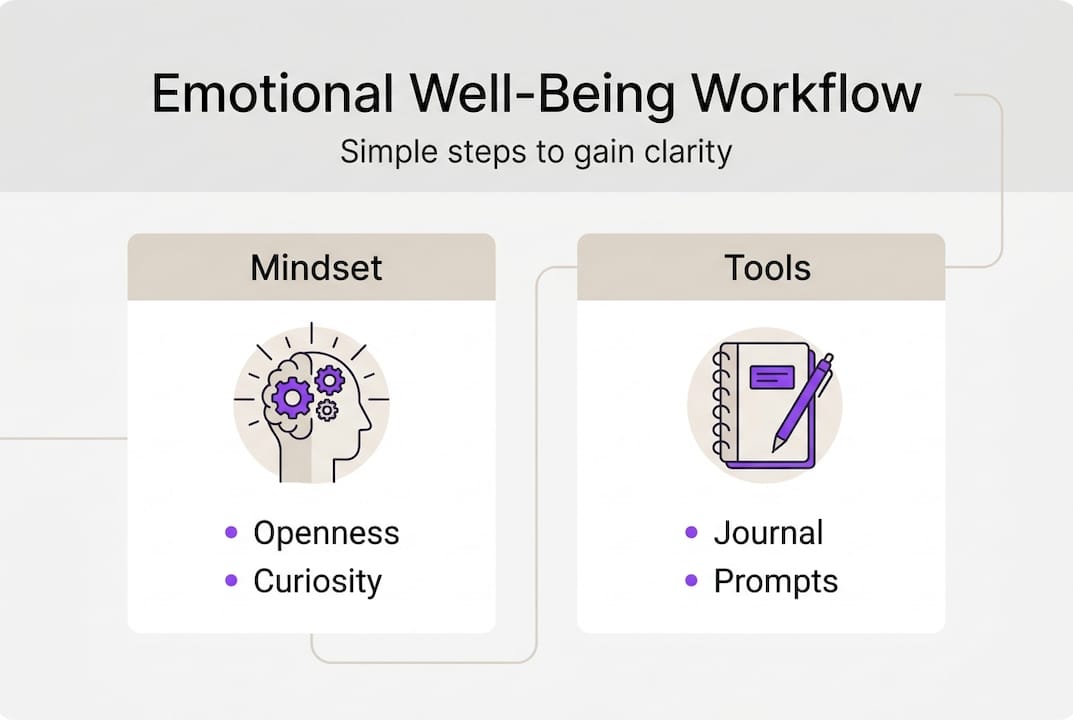
Physical and digital tools you'll need:
- A dedicated journal or notebook (physical or digital)
- A reliable pen or a note-taking app you enjoy using
- A timer (your phone works fine)
- A quiet, private space where you won't be interrupted
- Optional: a mood tracking app or platform with guided prompts
The mindset side is just as important as the tools. You need three core qualities going in: openness (willingness to explore uncomfortable feelings), non-judgment (treating your thoughts as data, not verdicts), and consistency (showing up even when you don't feel like it).

| Tool or mindset element | Why it matters | Benefit to your practice |
|---|---|---|
| Dedicated journal | Creates ritual and focus | Reduces decision fatigue |
| Timer | Prevents over-extension | Keeps sessions sustainable |
| Guided prompts | Provides structure | Reduces rumination risk |
| Non-judgment mindset | Lowers emotional defenses | Increases honest reflection |
| Consistent schedule | Builds habit loop | Compounds results over time |
Journaling 3 to 4 times per week yields an 85% reported mental health improvement rate, according to a 2021 JMIR Mental Health meta-analysis. That's not a minor benefit. It's a measurable shift in how you feel day to day. Pairing good journaling strategies for well-being with a clear guided journaling process gives you the best shot at those outcomes.
If you're new to expressive writing, the expressive writing protocol from UC Berkeley's Greater Good Science Center is a solid starting point for understanding the method before you build it into your routine.
Pro Tip: Time-box your sessions to 15 to 20 minutes. Longer isn't better. Short, focused sessions reduce the chance of emotional flooding and make the habit far easier to sustain.
Step-by-step emotional well-being workflow: Your daily practice
With your tools and mindset ready, it's time to put your workflow into daily action. This process is designed to be repeatable, adaptable, and grounded in validated techniques.
Your daily journaling workflow:
- Prepare your space (2 minutes): Sit somewhere quiet, set your timer, and take three slow breaths. This signals to your nervous system that it's time to reflect, not react.
- Choose your prompt (1 minute): Select a prompt based on your current emotional state. Feeling anxious? Use an expressive writing prompt. Feeling flat or low-energy? Try a gratitude prompt.
- Write without editing (15 minutes): Let your thoughts flow. Don't correct grammar or censor yourself. The goal is honest output, not polished prose.
- Reflect and extract (3 minutes): Read back what you wrote. Underline one insight or pattern you notice. Write one sentence summarizing what you learned.
- Set a micro-intention (1 minute): Write one small action you can take today based on your reflection. This closes the loop between insight and behavior.
The Pennebaker Expressive Writing Protocol, validated by over 200 studies, reduces doctor visits by 50% and improves immune function. It involves writing about your deepest thoughts and feelings for 15 to 20 minutes over four consecutive days. It's one of the most evidence-backed tools in emotional well-being research.
Statistic to know: Structured journaling produces a 9% reduction in anxiety symptoms and a 6% reduction in PTSD symptoms across clinical populations. These aren't huge numbers in isolation, but they represent consistent, measurable relief for people who previously had none.
| Method | Best for | Time required | Key benefit |
|---|---|---|---|
| Expressive writing | Processing trauma, stress | 15-20 min/day | Emotional release, immune boost |
| Gratitude journaling | Low mood, negativity bias | 5-10 min/day | 25% well-being boost |
| Shadow work journaling | Deep self-awareness | 20-30 min/session | Uncovers hidden patterns |
| Future goals journaling | Motivation, clarity | 10-15 min/day | Strengthens sense of direction |
For science-backed emotional regulation, rotating between expressive writing and gratitude journaling based on your mood gives you a flexible, responsive practice rather than a rigid one.
Pro Tip: Keep a short list of 5 to 10 go-to prompts sorted by mood state. When you sit down to journal, you won't waste time deciding what to write about. You'll just pick the prompt that fits and start.
Troubleshooting and avoiding common mistakes
As with any new habit, challenges arise. Here's how to handle the common ones for lasting results.
Most people hit a wall within the first few weeks. The wall isn't a sign that journaling isn't working. It's usually a sign that one of these mistakes has crept in:
- Over-editing as you write: Stopping to reread and revise kills the flow and filters out your most honest thoughts. Write first, read later.
- Inconsistency without a recovery plan: Missing one session often leads to missing a week. Build a "minimum viable session" of just five minutes for low-energy days.
- Unrealistic expectations: Journaling isn't therapy and won't resolve deep trauma on its own. It's a tool for awareness and regulation, not a cure.
- Skipping the reflection step: Writing without reviewing what you wrote means you miss the insight. The reflection step is where the real value lives.
- Measuring progress by volume: More pages don't mean more growth. Track how you feel, not how much you write.
"Progress is measured by reactivity and mood, not just journal length."
The strongest evidence for journaling's effectiveness comes from tracking reduced reactivity and better sleep and mood, with the most consistent results seen in anxiety and PTSD rather than depression. That doesn't mean it won't help with depression. It means your benchmarks should reflect what the research actually supports.
Building emotional resilience is a long game. Slip-ups are part of the process. The goal is to make returning to your practice easier than abandoning it.
How to measure your progress and sustain your workflow
With challenges addressed, it's important to know how to track and reinforce your results. Without a measurement system, it's easy to feel like nothing is changing even when it is.
The signs of real progress are often subtle at first. You might notice you react less intensely to a stressful situation. You might sleep more soundly after a difficult day. Your mood might stabilize faster after a setback. These are the markers that matter.
Reduced reactivity and better sleep are the primary benchmarks for journaling success, according to mental health researchers. Build a simple tracking system directly into your journal to capture these signals.
Weekly check-in system:
- Mood rating: Score your overall mood from 1 to 10 at the start and end of each week
- Reactivity log: Note two or three situations where you felt triggered and how you responded
- Sleep quality note: One sentence on how your sleep felt compared to the previous week
- Pattern review: Every Sunday, read back your week's entries and write one recurring theme you notice
- Adjustment prompt: Ask yourself, "What one change would make next week's practice more effective?"
This system takes less than ten minutes per week and gives you a clear picture of whether your workflow is producing results. Over months, the data becomes genuinely useful. You'll start to see which prompts move the needle most for you, which days are hardest, and which emotional patterns keep showing up.
For a deeper look at how this connects to long-term growth, the guide to self-awareness on the Voisley blog offers a strong framework for understanding what personal insight actually looks like in practice.
Sustaining momentum comes down to one thing: making the practice easier to do than to skip. Keep your journal visible. Set a recurring reminder. Celebrate small wins. And remember that the goal isn't a perfect streak. It's a practice that grows with you.
Ready to build your personal emotional well-being workflow?
You now have a research-backed framework, a daily workflow, and a measurement system. The next step is putting it all into a consistent practice that fits your life. That's exactly where Voisley comes in.
Voisley's structured journaling tools give you guided prompts, mood tracking, and AI-powered insights built around the same evidence-based principles covered in this article. Instead of starting from a blank page every day, you get a personalized structure that adapts to your emotional state and goals. Whether you're working through anxiety, building self-awareness, or simply trying to feel more grounded, Voisley provides the scaffolding to make your practice stick. Explore the platform and see how guided journaling can accelerate your emotional growth.
Frequently asked questions
What is the Pennebaker Expressive Writing Protocol and how can I use it?
It's a validated journaling method where you write about your deepest thoughts and feelings for 15 to 20 minutes per day over four consecutive days to process emotions and improve well-being.
How quickly can I expect to see results from structured journaling?
Most people notice mood and anxiety improvements within a few weeks of consistent practice, with 85% of regular journalers reporting improved mental health outcomes in clinical research.
Does emotional journaling work for depression as well as anxiety?
Structured journaling shows the strongest effects for anxiety and PTSD, though it still supports overall well-being and emotional regulation for people experiencing depression.
What should I do if I miss a journaling session?
Simply resume at your next opportunity. A five-minute minimum viable session counts, and consistency over weeks and months matters far more than a perfect daily streak.
Can gratitude journaling improve emotional well-being?
Yes. Gratitude journaling boosts well-being by up to 25% according to clinical research, making it one of the most accessible and effective tools in any emotional wellness practice.