

Many people dismiss self-exploration as abstract navel-gazing, yet research shows guided journaling reduces anxiety scores by measurable percentages within weeks. Self-exploration is not passive reflection but an active process that strengthens emotional regulation, clarifies priorities, and builds mental resilience. Through structured practices like journaling and mindfulness, you gain insight into thought patterns, process complex emotions, and make decisions aligned with your authentic values. This article reveals the science behind self-exploration’s impact on mental clarity and personal growth, offering practical techniques to integrate these tools into your daily routine for lasting emotional well-being.
Table of Contents
-
How guided journaling supports emotional regulation and mental clarity
-
The broader benefits of self-exploration on physical health and life purpose
-
Common challenges and expert tips for effective self-exploration
Key takeaways
| Point | Details |
| Emotional regulation | Self-exploration activates cognitive restructuring, helping you process feelings and reduce anxiety through structured reflection. |
| Physical health benefits | Writing about emotions improves immune function and lowers blood pressure through stress reduction mechanisms. |
| Values clarification | Journaling reveals personal priorities, guiding decisions toward meaningful goals and increasing life satisfaction. |
| Negative reframing | Structured prompts transform rumination into productive problem solving by creating psychological distance from overwhelming thoughts. |
| Enhanced self-awareness | Regular reflection strengthens metacognition, enabling you to recognize patterns and make intentional choices aligned with growth. |
What is self-exploration and why does it matter?
Self-exploration is the deliberate practice of examining your thoughts, emotions, and experiences to understand yourself more deeply. Unlike casual daydreaming or passive thinking, self-exploration involves structured techniques that engage metacognition, the ability to think about your own thinking. Reflective journaling involves metacognition, allowing you to step back from immediate reactions and consider the broader meaning of your experiences.
This practice activates specific brain regions responsible for insight and emotional processing. Journaling engages the prefrontal cortex, the area responsible for executive function, helping you categorize thoughts and impose structure on chaotic feelings. When you write about a stressful situation, you are not just venting but actively reorganizing neural pathways that influence how you perceive and respond to challenges.
Self-exploration takes many forms, each offering unique benefits:
-
Guided journaling uses specific prompts to direct reflection toward productive insights rather than circular worry
-
Mindfulness meditation cultivates present-moment awareness, revealing automatic thought patterns you might otherwise miss
-
Creative expression through art or music accesses emotions that resist verbal articulation
-
Values clarification exercises help identify what truly matters to you beneath surface-level goals
The distinction between simple journaling and reflective journaling matters significantly. Writing a daily log of events provides minimal benefit compared to examining why those events affected you, what they reveal about your needs, and how you might respond differently. Reflective journaling transforms raw experience into wisdom by asking deeper questions about patterns, triggers, and personal growth opportunities. When you turn your mood into action through structured reflection, you move from passive observation to active emotional management.
How guided journaling supports emotional regulation and mental clarity
Guided journaling operates through specific psychological mechanisms that improve mental health outcomes. The practice facilitates cognitive restructuring, the process of identifying and challenging unhelpful thought patterns that fuel anxiety and depression. When you respond to a prompt asking how you might view a situation differently, you are literally rewiring neural connections that determine your emotional responses.
Research demonstrates measurable benefits from consistent journaling practice. Guided journaling reduces anxiety with statistically significant decreases in symptom scores over eight weeks. The American Psychological Association found that journaling enhances self-awareness and emotional regulation by facilitating both cognitive restructuring and emotional processing, two core components of effective therapy.
The act of writing creates psychological distance from overwhelming emotions. When you describe a painful experience on paper, you externalize it, transforming an internal storm into an object you can examine objectively. This distance reduces emotional intensity and allows rational analysis to complement emotional reactions. You gain perspective impossible to achieve while trapped inside the experience itself.
Expressive writing specifically targets stress reduction through several pathways:
-
Translating nebulous feelings into concrete words reduces cognitive load by organizing mental clutter
-
Naming emotions activates the prefrontal cortex, which dampens activity in the amygdala, your brain’s fear center
-
Processing traumatic or difficult experiences through writing prevents them from cycling endlessly as intrusive thoughts
-
Regular emotional expression prevents the buildup of unprocessed feelings that manifest as physical tension or anxiety
Writing about emotional experiences improves mental well-being by helping you process events and reduce stress. The benefits compound over time as you develop stronger emotional literacy and more sophisticated coping strategies.

Pro Tip: When journaling about difficult emotions, end each entry by writing one small action you can take today. This prevents rumination by shifting from analysis to agency, reinforcing that reflection serves growth rather than paralysis.
Structured prompts guide your attention toward productive reflection rather than repetitive worry. A prompt asking “What did this situation teach me about my needs?” generates very different insights than unstructured venting. The framework provided by guided journaling ensures you extract meaning from experiences rather than simply rehashing them. This is why platforms that turn your mood into action through targeted prompts often produce better outcomes than freeform diary keeping.
The broader benefits of self-exploration on physical health and life purpose
Self-exploration’s impact extends beyond mental health into measurable physical improvements. Writing about emotions improves physical health, including reduced blood pressure and enhanced immune function. The mind-body connection means that processing emotional stress through journaling reduces the physiological burden of carrying unresolved feelings. Chronic stress suppresses immune response and elevates cardiovascular risk, so practices that mitigate stress directly improve physical health markers.
Neuroimaging studies reveal how contemplative practices reshape brain structure. Mindfulness practice changes brain structure in regions related to emotional regulation and self-awareness. Regular self-exploration strengthens the prefrontal cortex while reducing amygdala reactivity, creating lasting changes in how you experience and manage emotions. These are not temporary mood boosts but fundamental alterations in neural architecture.
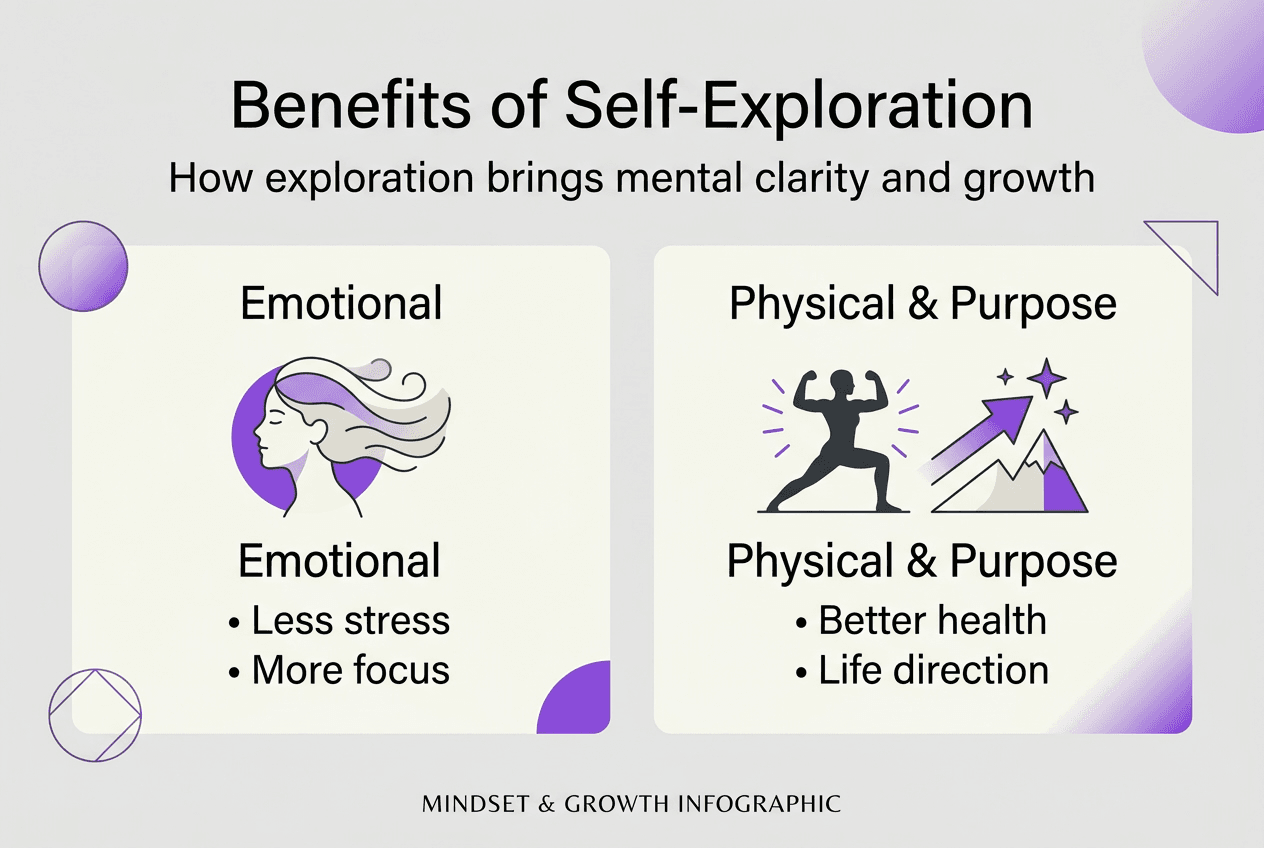
Self-exploration also connects you with personal values, the core principles that give life meaning. Identifying personal values through self-exploration guides decisions and goals, fostering purpose and well-being. When you clarify what truly matters, you stop pursuing goals imposed by others and start building a life aligned with your authentic self. This alignment dramatically increases life satisfaction and resilience during challenges.
The table below summarizes how self-exploration benefits different dimensions of well-being:
| Benefit Category | Specific Outcomes | Mechanism |
| Emotional | Reduced anxiety and depression, improved mood stability | Cognitive restructuring and emotional processing |
| Physical | Lower blood pressure, stronger immune function | Stress reduction and cortisol regulation |
| Cognitive | Enhanced problem solving, clearer thinking | Prefrontal cortex activation and mental organization |
| Existential | Increased life purpose, values alignment | Self-knowledge and authentic goal setting |
Integrating self-exploration with mindfulness practices amplifies benefits. Mindfulness brings awareness to present-moment experience, while journaling helps you make sense of that awareness over time. Together, they create a feedback loop where:
-
Mindfulness reveals patterns in your emotional responses
-
Journaling helps you understand why those patterns exist
-
Self-knowledge enables intentional change in how you respond to triggers
-
Improved responses create positive experiences that reinforce growth
When you turn your mood into action by combining awareness with structured reflection, you transform self-exploration from passive observation into active personal development. The goal is not endless analysis but practical wisdom that improves daily life.
Common challenges and expert tips for effective self-exploration
Not all reflection produces positive outcomes. Rumination is repetitive, passive, negative thinking that hinders problem solving rather than facilitating it. When you rehash the same painful thoughts without moving toward resolution, you strengthen neural pathways associated with distress. This differs fundamentally from productive reflection that generates insight and action.
Researchers distinguish between two types of self-focused thinking. Brooding is linked to negative outcomes, while reflection can be neutral or beneficial depending on how you approach it. Brooding involves asking “Why did this happen to me?” in a way that reinforces victimhood. Productive reflection asks “What can I learn from this?” or “How might I respond differently next time?” The difference lies in orientation toward growth versus fixation on grievance.
Structured prompts prevent harmful rumination by directing attention toward specific, answerable questions. Instead of spiraling through “Why am I like this?” a good prompt asks “What need was I trying to meet with that behavior?” This reframe shifts from judgment to curiosity, opening pathways to understanding rather than self-criticism.
Personalization matters significantly for effectiveness. Journaling effectiveness varies by personality and mental health, making tailoring essential. Someone prone to anxiety might benefit from gratitude prompts that redirect attention toward positive experiences, while someone struggling with identity might need prompts exploring values and aspirations. One-size-fits-all approaches miss opportunities to match techniques with individual needs.
Common pitfalls that undermine self-exploration include:
-
Focusing exclusively on problems without acknowledging progress or strengths
-
Writing only when distressed, creating negative associations with the practice
-
Expecting immediate transformation rather than recognizing gradual growth
-
Judging your entries as “good” or “bad” instead of accepting them as honest expression
-
Neglecting to translate insights into concrete behavioral changes
Pro Tip: Set a timer for 10 minutes and commit to writing without stopping, even if you repeat “I don’t know what to write” until real thoughts emerge. This technique bypasses the inner critic and accesses deeper authentic feelings that surface once you push past initial resistance.
Action-oriented journaling prevents the trap of endless analysis. After exploring a challenge, always ask “What is one small step I can take today?” This grounds reflection in practical reality and reinforces that self-exploration serves growth, not paralysis. When you turn your mood into action by connecting insights to behavior, you complete the cycle that transforms awareness into lasting change.
Maintaining consistency requires building sustainable habits rather than relying on motivation. Choose a specific time and place for journaling, making it a routine like brushing teeth. Start with manageable commitments, perhaps five minutes daily, and expand as the practice becomes natural. The goal is regular engagement, not perfect entries.
Explore guided journaling with Voisley
Voisley offers a comprehensive platform designed specifically for individuals seeking mental clarity through guided journaling and mood tracking. The app combines science-backed prompts with AI-powered insights, creating a personalized space for emotional exploration and growth. Whether you are new to self-reflection or looking to deepen an existing practice, Voisley provides structure that transforms raw feelings into actionable understanding.
The platform’s mood tracking features help you identify emotional patterns over time, revealing triggers and trends you might miss in daily life. Different journal types, from gratitude to shadow work, address various aspects of personal development, while visualizations make abstract emotional data concrete and comprehensible. When you turn your mood into action with Voisley, you gain tools that support consistent self-exploration without requiring expertise in psychology or journaling techniques. Start your journey toward greater self-awareness and emotional well-being today.
FAQ
What are the best journaling techniques for beginners?
Start with guided prompts that focus on emotions and daily reflections rather than freeform writing, which can feel overwhelming. Choose one specific question each day, such as “What made me feel grateful today?” or “What challenge did I face and how did I respond?” Consistency matters more than length, so commit to writing for just five minutes daily rather than attempting lengthy entries sporadically. As the habit solidifies, you can explore different prompt types to discover what resonates most with your personal growth goals.
How often should I practice self-exploration to see benefits?
Daily or several times per week practice yields the best results, with consistency over time being key for lasting change. Regular guided journaling reduces anxiety scores significantly over eight weeks, demonstrating that sustained practice creates measurable improvements. Even brief sessions, when maintained regularly, outperform occasional intensive journaling because they build neural pathways gradually. Think of self-exploration like physical exercise where frequent moderate effort surpasses rare intense bursts.
Can self-exploration replace professional therapy?
Self-exploration is a valuable tool but not a substitute for professional care when dealing with serious mental health conditions. Therapeutic journaling complements but does not replace professional therapy, especially for anxiety, depression, or trauma that significantly impairs functioning. Use journaling to support and enhance therapeutic progress by processing insights between sessions and tracking patterns to discuss with your therapist. The combination of professional guidance and personal reflection often produces better outcomes than either approach alone.
How does self-exploration help in identifying personal values?
Journaling encourages deep reflection on experiences and priorities, revealing what truly matters beneath surface-level goals. Self-exploration helps identify personal values that guide decisions and foster purpose, creating clarity about the principles you want to organize your life around. When you regularly examine what brings meaning, satisfaction, and fulfillment, patterns emerge that point toward core values like creativity, connection, autonomy, or service. Discovering these values leads to clearer life goals and greater satisfaction because your choices align with your authentic self rather than external expectations.