

Most people assume journaling means scribbling daily events into a notebook. That assumption sells it short. Journaling is scientifically proven to reduce stress, strengthen immune function, and support lasting emotional healing, making it one of the most accessible mental wellness tools available. This guide breaks down the science, the methods, and the practical steps so you can use life journals not just to record your days, but to genuinely transform how you feel and grow.
Table of Contents
- Why journals about life matter for emotional well-being
- Core journaling methods: From gratitude to expressive writing
- Matching journaling practices to emotional needs
- Integrating journaling into daily life
- Take your life journaling further with Voisley
- Frequently asked questions
Key Takeaways
| Point | Details |
|---|---|
| Journaling transforms mindset | Life journals offer science-backed benefits for emotional well-being and mental clarity. |
| Choose the right method | Different journaling styles work best for specific emotional needs and goals. |
| Consistency over perfection | Emotional honesty and regular practice matter more than daily frequency or perfect grammar. |
| Blend techniques for results | You can mix gratitude, expressive, and positive self-talk journaling for personalized benefits. |
Why journals about life matter for emotional well-being
Journaling works because it forces your brain to organize raw emotion into language. That process alone creates psychological distance from pain, which is why researchers have studied it for decades. The results are striking. Expressive writing reduces stress and supports emotional healing by helping people process difficult experiences rather than suppress them.
James Pennebaker, one of the leading researchers in this field, found something counterintuitive: it is not how often you journal or how many pages you fill that matters. What drives results is emotional honesty. Writing with depth and authenticity, even for just 15 minutes, produces measurable changes in mood and health. Flexible journaling protocols that focus on emotional depth yield benefits similar to rigid daily schedules.
"The act of translating emotions into words changes how the brain processes those emotions, reducing their intensity and helping people move forward." — James Pennebaker, University of Texas at Austin
Here are the core science-backed benefits of intentional journaling:
- Stress reduction: Writing about stressors lowers cortisol and calms the nervous system.
- Improved self-awareness: Patterns in your writing reveal emotional triggers you might not consciously notice.
- Stronger immune response: Studies link expressive writing to better immune markers.
- Emotional regulation: Regular journaling builds the skill of journaling for emotional regulation, helping you respond rather than react.
- Clarity and problem-solving: Externalizing thoughts frees up mental bandwidth for clearer thinking.
These benefits are not reserved for people in crisis. They apply to anyone willing to write honestly about what they feel.
Core journaling methods: From gratitude to expressive writing
Not all journaling is the same. Three methods stand out for their research backing and practical accessibility.
| Method | Goal | Protocol | Ideal use case | Key effects |
|---|---|---|---|---|
| Expressive writing | Process difficult emotions | 15-20 min, 3-5 days, no editing | Stress, anxiety, trauma | Lowers cortisol, improves mood |
| Gratitude journaling | Shift focus to positive experiences | List 3-5 things daily or weekly | Depression, low motivation | Boosts physical and emotional health |
| Positive self-talk journaling | Reframe negative inner dialogue | Write affirmations and evidence | Low self-esteem, self-criticism | Builds confidence, reduces rumination |
Research adds an interesting nuance to gratitude journaling. Menu-based gratitude, where you choose from a variety of gratitude prompts rather than repeating the same format, outperforms standard gratitude journaling for overall well-being. Variety keeps the practice fresh and prevents it from becoming mechanical.
Here is how to start each method:
- Expressive writing: Set a timer for 15 minutes. Write about a stressful or emotional experience without stopping to edit. Let the words flow without judgment.
- Gratitude journaling: Each morning or evening, write three to five specific things you are grateful for. Be concrete, not vague. "My friend called to check on me" beats "I am grateful for friends."
- Positive self-talk journaling: Write one negative belief you hold about yourself, then list three pieces of evidence that contradict it. Finish with a reframed statement.
For deeper guidance on building these habits, mental wellness journaling tips and guided journaling for clarity offer structured frameworks to get you started.

Pro Tip: You do not need to pick one method and stick with it forever. On high-stress days, expressive writing may feel most useful. On lighter days, gratitude journaling might fit better. Matching your method to your emotional state is smarter than following a rigid schedule.
Matching journaling practices to emotional needs
Choosing the right journaling method for your specific emotional challenge makes a real difference. Here is a quick-reference guide:
| Emotional challenge | Recommended method | Special considerations |
|---|---|---|
| Anxiety | Expressive writing | Write about the specific fear, not just general worry |
| Depression | Gratitude journaling | Start small; even one item counts |
| Trauma | Expressive writing with care | Pair with therapy for severe cases |
| Low self-esteem | Positive self-talk journaling | Focus on evidence-based reframing |
| Emotional numbness | Free-form stream of consciousness | No structure needed; just write anything |
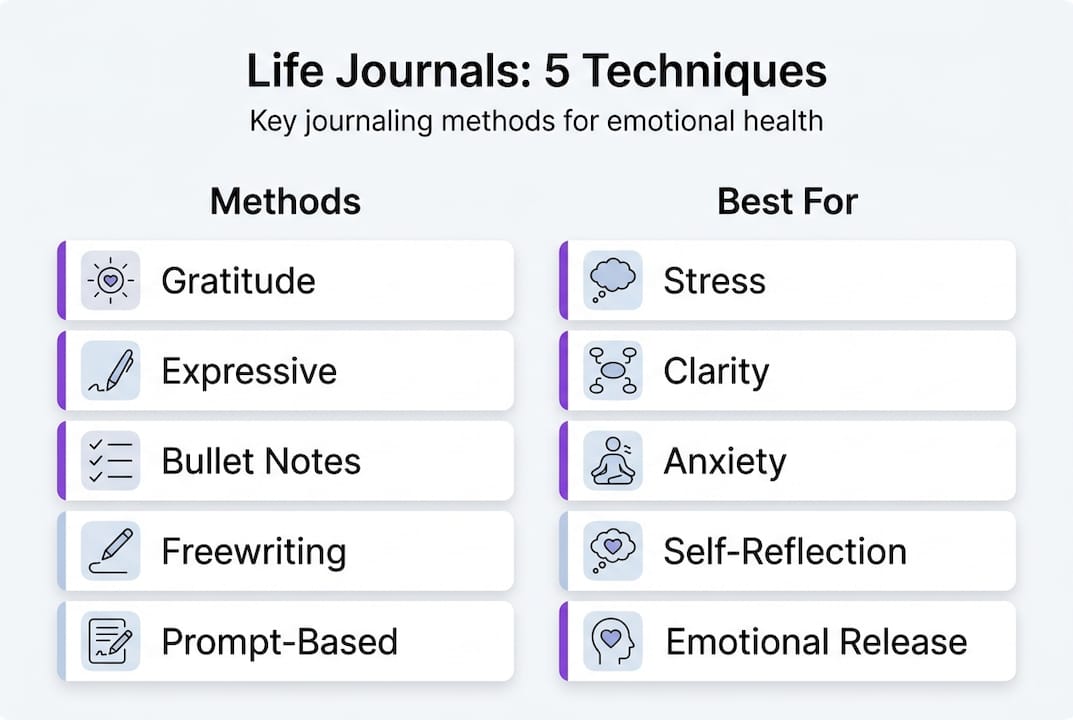
Expressive writing helps anxiety and PTSD, while gratitude journaling tends to suit depression better. That said, these are starting points, not rigid rules. You know your emotional landscape better than any chart does.
Journaling is powerful, but it is not a replacement for professional care in every situation. Watch for these signs that you may benefit from therapist support alongside your journaling practice:
- Journaling consistently leaves you feeling worse, not better.
- You are processing a traumatic event that feels too big to handle alone.
- Intrusive thoughts or flashbacks increase after writing sessions.
- You feel stuck in the same emotional loops despite regular journaling.
- Your daily functioning is significantly impaired by distress.
Pro Tip: One of the most effective combinations is blending a short gratitude list with a brief expressive writing session. Start with three things you appreciate, then spend 10 minutes writing honestly about something that is weighing on you. The gratitude entry creates a psychological safety net before you go deeper.
For a broader view of your emotional health, a mental wellness checklist can help you identify where journaling fits within your overall emotional wellbeing workflow.
Integrating journaling into daily life
Knowing the methods is one thing. Making journaling a real, consistent habit is another. Here are five practical strategies that actually work:
- Use a 15-minute prompt to start. Do not stare at a blank page. Begin with a simple question: "What am I feeling right now, and where do I feel it in my body?" That single prompt bypasses the blank-page freeze.
- Cue-stack with an existing routine. Attach journaling to something you already do, like morning coffee or winding down before bed. Habits stick when they piggyback on existing behaviors.
- Choose your medium intentionally. Some people think more freely with pen and paper; others prefer typing. Neither is superior. Pick what makes you more likely to actually show up.
- Embrace imperfection. Authentic journaling, not perfectionistic daily entries, is what delivers the most benefit. A messy, honest paragraph beats a polished, surface-level page every time.
- Link journaling to mindfulness. Spend two minutes breathing slowly before you write. This activates the part of your brain responsible for reflection and emotional processing, making your entries richer.
Common roadblocks and how to move past them:
- Perfectionism: Remind yourself that no one will read this. Write badly on purpose if you have to.
- Self-censorship: If you are editing yourself as you write, try switching to a stream-of-consciousness style with no pausing.
- Blank page paralysis: Keep a list of five go-to prompts saved somewhere accessible. Having a starting point removes the friction.
- Inconsistency: Missing a day is not failure. The goal is a general pattern, not a perfect streak.
- Feeling silly: This discomfort usually fades within the first week. Push through it.
When journaling connects to broader self-reflection practices, the benefits compound. Exploring self-exploration and clarity and building a guide to self-awareness alongside your journaling creates a fuller picture of your inner world. Pairing it with mindfulness practices for well-being deepens the impact even further.
Take your life journaling further with Voisley
Starting a journaling practice is easier when you have the right structure around you. The blank page becomes a lot less intimidating with guided prompts, mood tracking, and a framework designed around your emotional needs.

Voisley is built specifically for this. The platform combines AI-powered journaling prompts, mood visualizations, and multiple journal types including gratitude, shadow work, and future goals, so you can match your practice to exactly what you need on any given day. Whether you are just starting out or looking to go deeper with your self-reflection, Voisley gives you a private, structured space to explore your thoughts and track your emotional patterns over time. It is the kind of support that turns a good intention into a lasting habit.
Frequently asked questions
What type of journaling is best for stress relief?
Expressive writing, where you write for 15 to 20 minutes about stressful or traumatic events without censoring yourself, is consistently shown to reduce stress. Write about your deepest thoughts and feelings on the stressor for three to five days.
Does gratitude journaling really improve physical health?
Yes. A clinical randomized trial found that gratitude journaling improved trait gratitude and reduced inflammation markers in participants. The physical benefits are real, not just anecdotal.
What if journaling makes me feel worse?
If journaling consistently triggers distress or overwhelm, pause the practice and consider pairing it with therapy. Journaling is a tool, not a requirement, and it works best when it feels emotionally safe.
How often should I write in a life journal?
Frequency matters less than depth. Flexible protocols that focus on emotional honesty produce similar benefits to rigid daily schedules, so write when you can and write truthfully.
Is digital or handwritten journaling better?
Both formats are effective. The best choice is whichever medium feels most natural to you and makes it easier to show up consistently. Consistency beats format every time.