

TL;DR:
- Structured reflection activates brain regions that promote behavioral change and emotional well-being.
- Using models like Gibbs, Kolb, or Schön guides meaningful self-examination rather than unproductive rumination.
- Consistency with journaling and mindfulness enhances self-awareness, emotional regulation, and mental health.
Most people assume reflection means sitting quietly and thinking about your day. But that's not what the research shows. Structured reflection activates memory and learning centers in the brain, triggering real behavioral change over time. It's an active, intentional process, not passive self-talk. When you reflect with purpose and structure, you're doing something fundamentally different from daydreaming or worrying. This guide breaks down the science, the frameworks, and the daily habits that turn reflection into one of the most powerful tools for personal growth and emotional well-being you can develop.
Table of Contents
- Why reflection matters for personal growth
- Understanding reflection models: How to turn experience into growth
- Journaling and mindfulness: Tools to supercharge self-reflection
- Avoiding common pitfalls: Reflection, rumination, and balance
- Our take: The hidden power (and limits) of reflective growth
- Ready to put reflection into action?
- Frequently asked questions
Key Takeaways
| Point | Details |
|---|---|
| Structured reflection drives growth | Reflection models help convert experience into practical learning and behavioral change. |
| Journaling and mindfulness matter | Practical tools like journaling and mindfulness enhance self-awareness and emotional well-being. |
| Balance is crucial | Unstructured or excessive reflection can become unhelpful rumination, so choose guided techniques. |
| Reflection is a skill | Deliberate practice turns reflection from a basic routine into a powerful growth habit. |
Why reflection matters for personal growth
Reflection is one of those words that sounds simple until you try to do it well. At its core, reflection means deliberately examining your experiences, thoughts, and emotions to extract meaning and guide future behavior. That's a very different thing from just thinking about what happened.
The psychological case for reflection is strong. Reflective practices enhance emotional regulation and learning engagement, helping you process difficult experiences rather than replay them on a loop. When you understand why you reacted a certain way, you gain the ability to choose differently next time. That's not just emotional intelligence. That's behavioral change in action.
On a neurological level, structured reflection activates the prefrontal cortex and hippocampus, the brain regions responsible for decision-making, memory consolidation, and emotional processing. Think of it as giving your brain a structured workout instead of letting it wander.
Here's what regular, guided reflection actually delivers:
- Deeper learning engagement: You connect new experiences to existing knowledge, making lessons stick longer.
- Emotional clarity: You identify patterns in your reactions, reducing confusion and reactivity.
- Reduced anxiety: Processing events through structured reflection lowers the mental load of unresolved experiences.
- Stronger self-awareness: You start to see your own habits, biases, and triggers more clearly.
- Better decision-making: Reflection creates a feedback loop that improves future choices.
"Reflection is not the same as rumination. One moves you forward. The other keeps you circling the same drain."
This distinction matters enormously. Unstructured self-focus, where you replay events without any framework or goal, can actually worsen mood and increase anxiety. That's rumination. Structured reflection, by contrast, gives your mind a direction and an exit point. You explore the benefits of self-reflection not by thinking harder, but by thinking smarter. Understanding how introspection and mental health connect is the first step toward using reflection as a genuine growth tool rather than an anxiety spiral.
Understanding reflection models: How to turn experience into growth
Knowing that reflection is valuable is one thing. Knowing how to do it is another. Structured models give your reflection direction so it doesn't collapse into overthinking. Three frameworks stand out for personal growth work.
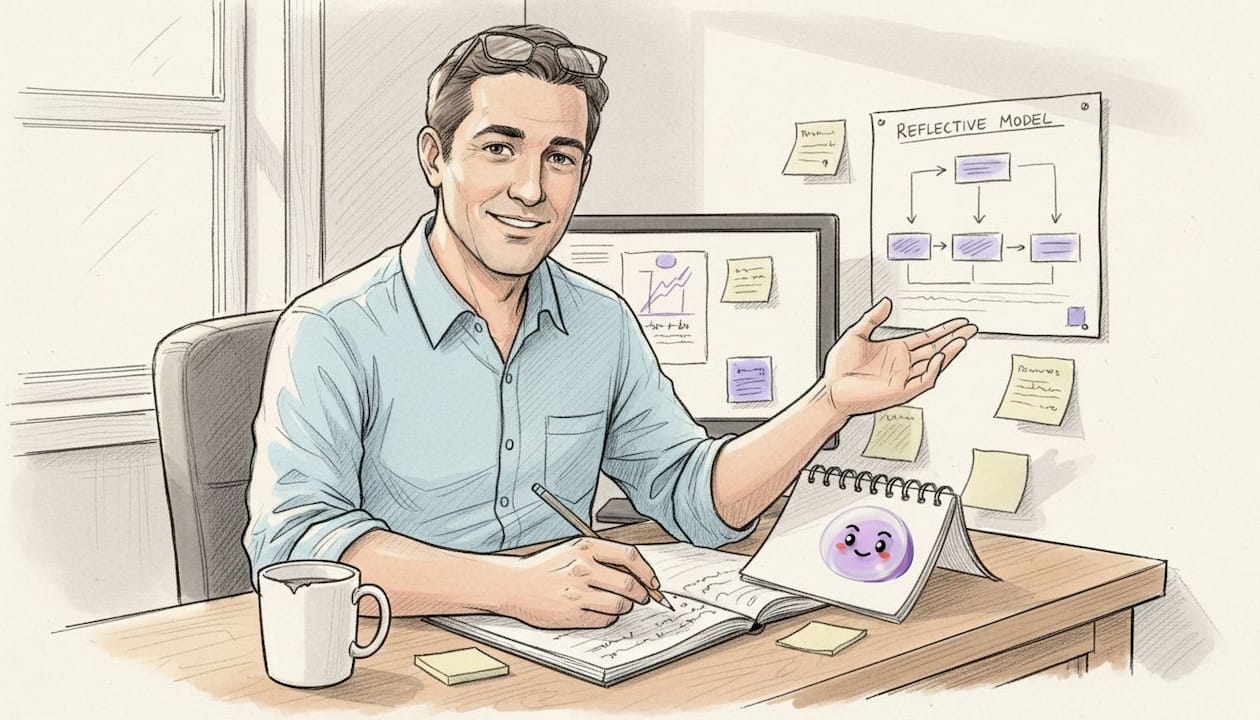
Gibbs' Reflective Cycle walks you through six stages: description, feelings, evaluation, analysis, conclusion, and action plan. It's thorough and great for processing specific events. Kolb's Experiential Learning Cycle focuses on four stages: concrete experience, reflective observation, abstract conceptualization, and active experimentation. It's ideal when you want to learn from experience and apply that learning immediately. Schön's Reflection Model distinguishes between reflection-in-action (thinking while doing) and reflection-on-action (thinking after the fact), which is especially useful for real-time decision-making.
Gibbs' and Kolb's cycles structure the journey from experience to insight, making reflection repeatable and measurable rather than vague.
| Model | Stages | Best for | Strength |
|---|---|---|---|
| Gibbs' Cycle | 6 stages | Processing specific events | Deep emotional analysis |
| Kolb's Cycle | 4 stages | Learning from experience | Action-oriented growth |
| Schön's Model | 2 types | Real-time decisions | In-the-moment awareness |
Here's a quick example using Gibbs' Cycle after a stressful work situation:
- Describe what happened without judgment.
- Identify how you felt during and after.
- Evaluate what went well and what didn't.
- Analyze why things unfolded the way they did.
- Conclude what you would do differently.
- Plan a specific action for next time.
This process takes about 10 to 15 minutes in a journal and produces far more clarity than replaying the event mentally. When you reflect on feelings through a structured lens, you move from confusion to understanding quickly. Using guided reflection prompts can make this process even easier if you're just starting out.
Pro Tip: Match your model to your goal. Use Gibbs for emotional processing, Kolb for skill-building, and Schön when you want to improve your real-time responses.
Journaling and mindfulness: Tools to supercharge self-reflection
Models give you structure. Tools give you consistency. Two practices stand above the rest for making reflection a daily habit: journaling and mindfulness.
Journaling and mindfulness increase self-awareness and emotional regulation, with measurable reductions in anxiety and depression symptoms. These aren't soft benefits. They show up in clinical research. And the good news is that neither requires hours of your day.
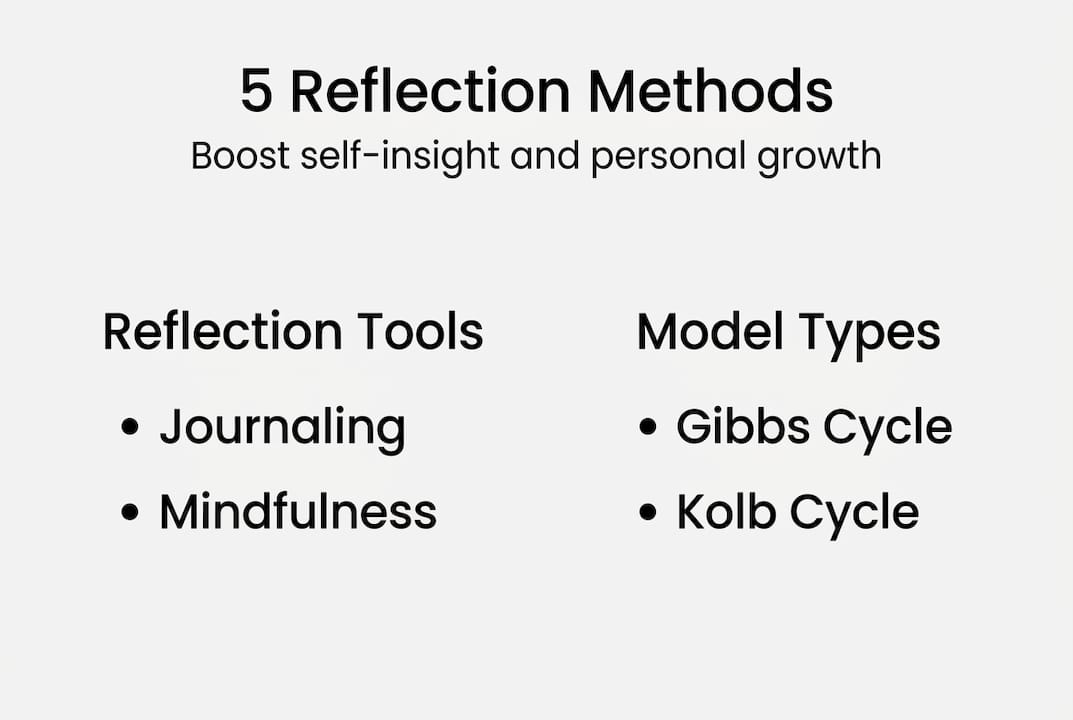
Reflective diaries reduce negative academic emotions and boost engagement, which suggests the benefits extend well beyond emotional processing into motivation and performance.
| Practice | Key benefit | Evidence strength | Time needed |
|---|---|---|---|
| Journaling | Emotional regulation, clarity | Strong (multiple RCTs) | 10 to 20 min/day |
| Mindfulness | Anxiety reduction, presence | Strong (meta-analyses) | 5 to 15 min/day |
| Reflective prompts | Structured insight | Moderate to strong | 5 to 10 min/day |
| Gratitude journaling | Mood improvement | Moderate | 5 min/day |
For journaling, try prompts like: "What challenged me today and what did it reveal about my values?" or "Where did I feel most like myself this week?" These questions push you past surface-level recapping into genuine insight.
For mindfulness, a simple practice is a two-minute pause after a significant event. Breathe slowly, notice your body's response, and ask yourself: "What am I actually feeling right now?" That pause interrupts automatic reactions and creates space for reflection.
How do you know if you're ruminating instead of reflecting? Watch for these signs:
- You keep returning to the same thought without reaching any new understanding.
- Your thinking feels circular and exhausting rather than clarifying.
- You focus on blame (of yourself or others) rather than learning.
- The process leaves you feeling worse, not more grounded.
Explore journaling for emotional well-being and mindfulness practices to build a toolkit that fits your life. A journaling self-reflection guide can also help you move from blank page to breakthrough faster.
Pro Tip: Set a five-minute micro-reflection at the same time every day, right after lunch or before bed. Consistency matters more than duration when building this habit.
Avoiding common pitfalls: Reflection, rumination, and balance
Here's something most reflection guides won't tell you: more is not always better. A meta-analysis on self-reflection found that excessive unstructured reflection can become rumination, which is linked to higher rates of depression and anxiety. The dose and the structure both matter.
Rumination looks like reflection from the outside, but it functions very differently internally. Here's how to tell them apart:
Signs of productive reflection:
- You feel clearer after the session than before.
- You arrive at a specific insight or action.
- The process feels effortful but not draining.
- You can close the loop and move on.
Signs of rumination:
- Thoughts repeat without resolution.
- You feel more anxious or hopeless afterward.
- You focus on what's wrong rather than what's possible.
- You can't stop even when you want to.
The fix is almost always structure. When you give your reflection a beginning, a middle, and an end, you prevent it from spiraling. Models like Gibbs' Cycle do this naturally. So do timed journaling sessions with specific prompts.
"Reflection is like a rubber band. It stretches you for growth, but it requires discomfort. Stretch too far without direction, and it snaps."
Expert guidance also helps. Therapists, coaches, and even well-designed apps can provide the external structure that keeps reflection productive. If you find yourself stuck in loops, that's a signal to improve self-awareness through guided methods rather than solo introspection. Learning to recognize self-awareness pitfalls early can save you weeks of unproductive mental spinning.
Balance also means knowing when not to reflect. Sometimes you need rest, connection, or action more than analysis. Reflection is a tool, not a lifestyle requirement every waking hour.
Our take: The hidden power (and limits) of reflective growth
Everyone says "look within" like it's a complete instruction. It's not. Looking within without a map just means wandering. The real power of reflection comes from pairing honest self-examination with structure, feedback, and then action. That last part is where most people stop short.
We've seen this pattern repeatedly: someone starts journaling, gains real insight, and then... nothing changes. Because insight without application is just interesting data. Growth requires the loop to close. You reflect, you learn, you try something different, and then you reflect again on what happened. That cycle is what actually moves the needle.
Small, daily habits beat infrequent deep dives every time. A ten-minute structured journal session five days a week produces more lasting change than a two-hour soul-searching session once a month. Consistency builds the neural pathways that make reflection feel natural.
The biggest mistake people make is assuming all self-focus is healthy. It isn't. Personal insight only grows when reflection is guided, purposeful, and connected to real-world feedback.
Pro Tip: Treat reflection as a skill you're learning, not a personality trait you either have or don't. Awkward at first is completely normal. Keep going.
Ready to put reflection into action?
If this guide has shown you anything, it's that reflection is a learnable, practicable skill with real psychological benefits when done with intention and structure.

Voisley is built for exactly this kind of growth. With guided journaling prompts, mood tracking, and AI-powered insights, the platform gives you the structure that turns reflection into lasting change. Whether you're working through a difficult emotion, building a gratitude practice, or mapping your personal goals, Voisley's reflection platform meets you where you are. Start with one prompt today. Your future self will thank you for the habit you build right now.
Frequently asked questions
How does reflection differ from rumination?
Reflection is guided and goal-oriented, leading to insight and action, while unstructured reflection can slide into rumination, which loops without resolution and often worsens mood.
What's the best way to start reflective practice for personal growth?
Begin with a structured model like Gibbs' or a simple journaling prompt to give your reflection direction and help you translate insights into concrete next steps.
What are the mental health benefits of regular reflection?
Reflective practices support emotional regulation, reduce anxiety, and improve learning engagement, especially when guided by prompts or established frameworks rather than open-ended self-focus.
Can too much reflection be harmful?
Yes. Excessive unstructured introspection has been linked to higher anxiety and depression, which is why structure, time limits, and clear goals are essential parts of a healthy reflection practice.