

TL;DR:
- Guided prompts enhance self-insight, reduce repetitive thoughts, and physiologically calm the brain.
- Different prompt types, like CBT or positive psychology, target specific emotional and growth outcomes.
- Personalizing prompts over time sustains deeper engagement and meaningful self-discovery.
Most people assume that journaling freely, without structure or direction, produces the deepest self-insight. Just write what comes to mind, and the truth will surface. But research tells a different story. Prompts challenge inner narratives and sharpen introspection in ways that open-ended writing rarely does. When you sit down with a blank page and no direction, you often revisit the same loops of thought. Guided prompts break that cycle. This guide walks through the science behind prompts, the types that work best, the real benefits backed by data, and the pitfalls to avoid so your self-reflection practice actually moves you forward.
Table of Contents
- Why prompts matter in self-reflection
- Types of prompts and when to use them
- Evidence-based benefits of using reflective prompts
- Pitfalls and best practices for using prompts
- What most guides miss: Personalizing your self-reflection prompts
- Try tailored prompts for your self-reflection journey
- Frequently asked questions
Key Takeaways
| Point | Details |
|---|---|
| Prompts structure reflection | Guided prompts disrupt automatic thoughts, making journaling more meaningful and focused. |
| Tailored prompts boost clarity | Personalized, framework-based prompts deliver deeper self-awareness and emotional clarity than generic ones. |
| Empirical health benefits | Regular, prompt-based self-reflection can reduce anxiety and improve overall mental and even physical health. |
| Avoid rumination | Actionable, curiosity-driven questions steer reflection away from negative loops for healthy emotional processing. |
Why prompts matter in self-reflection
A journaling prompt is more than a question. It is a structured invitation to examine something specific, whether that is a belief, a feeling, a pattern, or a decision. Prompts in self-reflection act as structured guides that facilitate emotional processing by directing your attention away from surface-level venting and toward genuine inquiry.
Without that direction, most people default to what psychologists call "narrative ruts," the same stories we tell ourselves about why things happened or who we are. Prompts interrupt that default mode. They ask you to look from a different angle, consider a feeling you have been avoiding, or trace a pattern you have never named.
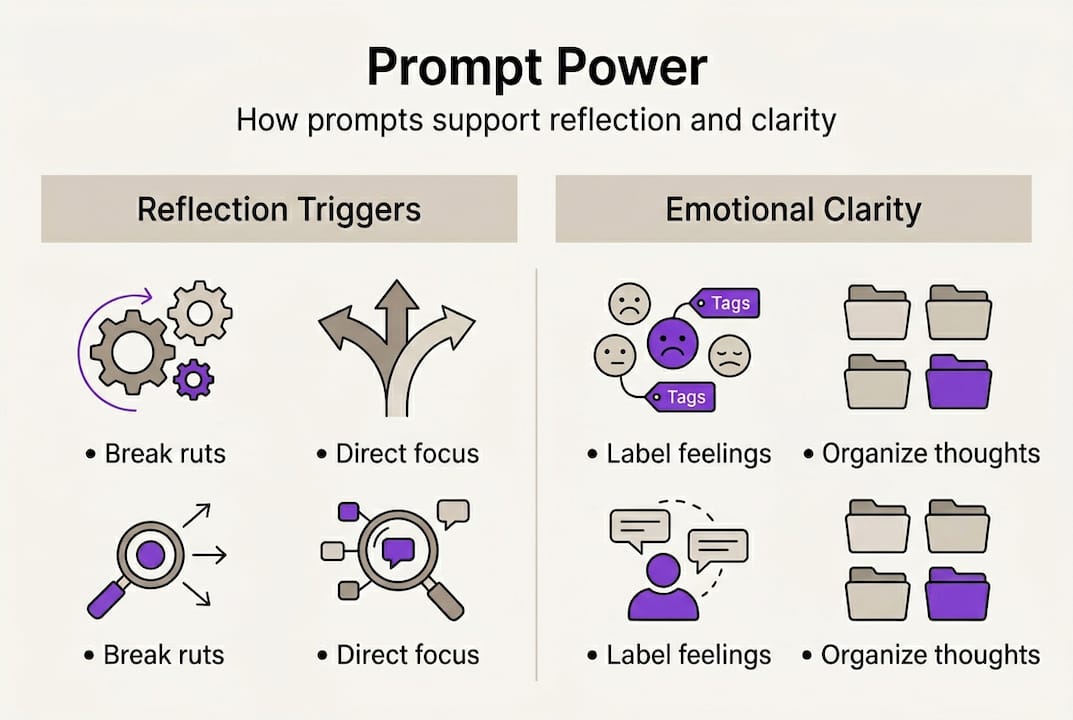
The neuroscience here is compelling. When you label emotions and engage the prefrontal cortex through structured reflection, activity in the amygdala, the brain's threat-detection center, actually decreases. That means writing with a focused prompt is not just emotionally useful. It is physiologically calming.
Researchers like James Pennebaker and Matthew Lieberman have spent decades studying expressive writing. Their findings consistently show that structured introspection produces measurable improvements in mood, immune function, and psychological resilience. The connection between prompts and mental health is not anecdotal. It is one of the most replicated findings in health psychology.
Here is a quick summary of what prompts bring to your practice:
- Clarity: Prompts narrow your focus so you can actually see what you are feeling, rather than swimming in it.
- Emotional regulation: Naming and examining emotions reduces their intensity and gives you more control over your responses.
- Pattern disruption: Prompts surface assumptions and habits that usually operate below your awareness.
- Motivation: A good question creates momentum. It gives you somewhere to go on the page.
- Depth: Prompts push past the "I feel bad" level into the specific, actionable, and meaningful.
"Expressive writing guided by structured prompts produces effect sizes of around 0.54 for emotional outcomes, a meaningful and consistent result across dozens of studies." This level of impact puts prompt-based journaling in the same effectiveness range as brief therapeutic interventions.
Types of prompts and when to use them
Not all prompts are created equal. The type you choose shapes the kind of reflection you get. Structured prompts based in CBT or positive psychology outperform generic ones for emotional clarity and sustained growth.
Here is a breakdown of the main categories:
| Prompt type | Structure level | Best use case | Typical outcome |
|---|---|---|---|
| Generic | Low | Daily freewriting, beginners | Surface-level awareness |
| CBT-based | High | Challenging negative thoughts | Cognitive reframing |
| Positive psychology | Medium | Gratitude, strengths focus | Improved mood, resilience |
| Therapeutic | High | Trauma processing, grief | Emotional release, healing |
| AI-generated | Variable | Personalized daily check-ins | Adaptive, context-aware insights |
Generic prompts like "How was your day?" work fine for building a habit, but they rarely produce insight on their own. CBT-based prompts ask things like "What evidence supports or challenges this belief?" They are designed to interrupt cognitive distortions, which makes them powerful for anyone dealing with anxiety or self-critical thinking.
Positive psychology prompts focus on what is working rather than what is broken. They are excellent for building emotional resilience and shifting attention toward strengths and possibilities. Therapeutic prompts go deeper, often into shadow work or grief, and are best used with professional support or in a safe, private space.
Prompts grounded in frameworks like Kolb's Experiential Learning Cycle or Gibbs' Reflective Cycle add a layer of structure that moves you through experience, reflection, analysis, and action. These are especially effective for processing complex situations or decisions.
For reflecting on feelings in a more fluid, daily way, AI journaling prompts can adapt to your current mood and goals, offering a personalized starting point that shifts as you do.
Pro Tip: Match your prompt type to your emotional state. On high-stress days, use a grounding or CBT-based prompt. On lighter days, try a positive psychology or gratitude prompt. Forcing a deep therapeutic prompt when you are emotionally depleted can backfire.
Evidence-based benefits of using reflective prompts
The benefits of prompt-based journaling are not just felt. They are measurable. Expressive writing with prompts leads to reduced doctor visits, improved immune function, and lower levels of psychological distress across multiple populations.

Pennebaker's original protocol was simple: write about your deepest thoughts and feelings for 15 to 20 minutes over four consecutive days. The results were striking. Participants showed fewer illness-related doctor visits in the months that followed, and blood markers of immune function improved. The key was not just writing. It was writing with direction.
Here is how prompt type, frequency, and outcomes connect:
| Prompt type | Recommended frequency | Measured outcome |
|---|---|---|
| CBT-based | 3 to 4 times per week | Reduced anxiety, cognitive clarity |
| Gratitude prompts | Daily | Improved mood, better sleep |
| Expressive writing | 4 consecutive days | Reduced stress, immune boost |
| Reflective diary | Weekly | Increased self-awareness, engagement |
One of the most striking data points: 34% greater emotional clarity using targeted prompts compared to unstructured writing. That is not a small difference. It means that what you write about matters as much as the act of writing itself.
Reflective diaries reduce anxiety and enhance positive engagement in students, which suggests these benefits extend well beyond clinical populations into everyday personal growth.
To apply the Pennebaker method in your own practice, follow these steps:
- Choose a prompt that connects to something emotionally significant, not just logistically busy.
- Write for 15 to 20 minutes without stopping or editing.
- Focus on your feelings and thoughts, not just the facts of what happened.
- Repeat for at least three to four sessions over consecutive days.
- Review what you wrote after a week and note any patterns or shifts.
For deeper emotional clarity insights, pairing this protocol with mood tracking gives you a visual record of how your emotional state shifts over time. And for a broader look at how journaling and mental wellness interact, the research points consistently toward structure as the differentiating factor.
Pitfalls and best practices for using prompts
Prompts are powerful, but they can also lead you in the wrong direction if you are not careful. The most common trap is rumination. This happens when a prompt invites you to revisit a painful experience without giving you a constructive direction to move in. You end up circling the same wound rather than processing it.
Prompts must avoid rumination by being actionable and curiosity-driven. The difference between a ruminative prompt and a growth-oriented one is subtle but important. "Why does this always happen to me?" pulls you into a loop. "What can I learn from how I responded?" opens a door.
Other common pitfalls include:
- Using irrelevant prompts: A prompt about career goals does nothing for you on a day when you are processing grief. Context matters.
- Over-introspection: Spending too much time analyzing yourself can create anxiety rather than clarity. Reflection needs limits.
- Treating prompts as checklists: Rushing through five prompts to feel productive defeats the purpose. Depth beats volume every time.
- Avoiding discomfort: The prompts that feel hardest to answer are often the most valuable. Skipping them keeps patterns intact.
One deep prompt outperforms multiple shallow ones, and not all prompt types fit every person or situation. This is worth taking seriously. More is not better in reflective practice.
To craft effective prompts for yourself, keep these principles in mind:
- Start with "What" or "How" rather than "Why" to reduce defensiveness.
- Anchor the prompt to something specific, a moment, a feeling, a decision.
- Build in a forward-looking element: "What would I do differently?" or "What do I want to feel instead?"
- Keep it short. One clear question is more powerful than a paragraph of setup.
For guidance on preventing over-introspection, the key is pairing reflection with action. And if you want a structured emotional well-being workflow, building in regular review points helps you see progress rather than just problems.
Pro Tip: Use the "one deep prompt per day" rule. Pick a single question that genuinely challenges you, sit with it for 15 minutes, and stop. Consistency with one good prompt beats sporadic sessions with ten mediocre ones.
What most guides miss: Personalizing your self-reflection prompts
Here is something most journaling guides skip entirely: the prompts that work for you today will not work for you six months from now. Your emotional needs evolve. Your blind spots shift. A prompt that once cracked something open can become a comfortable routine that no longer challenges you.
Generic prompts quickly lose relevance, and personalization is essential for sustained growth. This means you cannot just download a list of 30 prompts and call it a practice. You have to iterate.
Blending structured frameworks like Gibbs' Reflective Cycle with your personal goals gives you a scaffold that adapts. Start with the framework, then modify the questions to reflect what actually matters to you right now. A prompt about "what went well" hits differently when it is tied to a specific goal you are working toward.
Depth always outweighs bulk. One prompt that genuinely unsettles your assumptions is worth more than a week of comfortable questions. The self-discovery journaling process is not about volume. It is about honest engagement with the right question at the right time. Keep revisiting your prompt library, retire what no longer serves you, and build new questions as your self-awareness grows.
Try tailored prompts for your self-reflection journey
Understanding the science of prompts is one thing. Having the right tools to apply that knowledge daily is another. Voisley is built specifically for people who want their journaling practice to go deeper, not just longer.

With Voisley, you get access to guided prompts across multiple journal types, including gratitude, shadow work, and future goals, all paired with mood tracking that shows you how your emotional patterns shift over time. The platform's AI-powered insights adapt to where you are emotionally, so your prompts stay relevant and challenging. Whether you are just starting out or refining a practice you have had for years, Turn Your Mood Into Action with tools designed to make self-reflection structured, meaningful, and genuinely transformative.
Frequently asked questions
How do prompts help with emotional processing?
Prompts direct your attention to specific feelings and thoughts, helping organize emotions and reduce stress responses by engaging the brain's reflective centers. Prompt-based writing reduces amygdala reactivity and supports clearer emotion labeling.
What is the best type of prompt for personal growth?
Targeted prompts rooted in frameworks like CBT or positive psychology produce clearer insights and stronger emotional well-being than generic questions. Structured prompts outperform generic versions consistently across research populations.
Can using too many prompts lead to overthinking?
Yes. One well-crafted prompt is more effective and avoids rumination, while numerous shallow prompts can lead to mental fatigue or negative loops. One deep prompt yields greater insight than several surface-level ones.
Are AI-generated prompts as effective as human-written ones?
AI prompts can be useful starting points, but research suggests human-written prompts tend to offer greater depth and personal relevance. Human prompts preferred for depth, though AI prompts improve significantly with personalization and context.