

TL;DR:
- Most people overestimate their self-awareness, which affects relationships and decision-making.
- Practices like mindfulness and journaling can effectively improve internal awareness and emotional regulation.
- Balanced, structured reflection paired with action prevents rumination and supports genuine personal growth.
Most people walk through life convinced they know themselves well. In fact, 95% of people overestimate their own self-awareness, yet only a small fraction actually demonstrate it in practice. That gap between perceived and actual self-awareness quietly shapes every relationship, decision, and emotional reaction you have. The good news? Targeted practices like mindfulness and journaling can close that gap faster than most people expect. This article breaks down what self-awareness truly means, what the science says about building it, and how to apply practical techniques that support lasting emotional well-being.
Table of Contents
- What self-awareness is—and why we get it wrong
- The science behind cultivating self-awareness
- Navigating pitfalls: When self-reflection becomes counterproductive
- Practical techniques to cultivate self-awareness daily
- Our perspective: The truth few talk about self-awareness
- Ready to take the next step toward emotional well-being?
- Frequently asked questions
Key Takeaways
| Point | Details |
|---|---|
| Self-awareness is nuanced | True self-awareness includes both internal understanding and awareness of how others see us. |
| Mindfulness and journaling matter | Evidence shows mindfulness and journaling reliably boost emotional well-being and clarity. |
| Balance reflection to avoid harm | Self-reflection can help, but overdoing it risks mental health challenges like anxiety and rumination. |
| Practical daily strategies work best | Using simple, consistent techniques each day transforms self-awareness into lasting growth. |
What self-awareness is—and why we get it wrong
Self-awareness sounds simple until you try to define it precisely. At its core, it has two distinct dimensions. Internal self-awareness is your understanding of your own values, passions, thoughts, and emotional patterns. External self-awareness is your ability to understand how others perceive you. Most people assume they have both. Research consistently shows they don't.
The confusion runs deeper than simple overconfidence. Many people mistake self-criticism for self-awareness, or confuse emotional reactivity with emotional insight. Knowing you feel angry is not the same as understanding why anger shows up in a particular situation, what it's protecting, or how it shapes your behavior. That deeper layer is what genuine self-awareness requires.
Common myths that distort how people understand self-awareness:
- Introspection always leads to insight. Not true. Unstructured reflection often reinforces existing beliefs rather than challenging them.
- Emotionally expressive people are more self-aware. Expression and awareness are separate skills.
- Self-awareness is fixed. It's a skill that grows with deliberate practice, not a personality trait.
- Thinking more about yourself improves self-knowledge. Volume of thought doesn't equal quality of insight.
One often-overlooked case involves trauma. For people who have experienced significant emotional or physical trauma, body relearning after trauma is a necessary first step before internal self-awareness can develop. The body stores stress in ways the conscious mind doesn't always recognize, so gentle somatic (body-based) exercises often need to come before cognitive reflection.
"Self-awareness isn't about knowing everything about yourself. It's about staying curious enough to keep looking."
Understanding the self-reflection benefits that come from structured practice, rather than random rumination, is what separates people who grow from those who spin in place. If you want a broader map of where to start, exploring ways to improve self-awareness gives you a practical framework. And if the concept still feels abstract, a deeper look at personal insight can ground it in real experience.
The science behind cultivating self-awareness
The research on self-awareness tools is both encouraging and nuanced. Mindfulness and journaling are the two most studied approaches, and both show real, measurable benefits. But they work through different mechanisms, and understanding those differences helps you use them more effectively.
Mindfulness works by training your attention toward present-moment sensations, including the physical signals your body sends when emotions arise. This process, called interoception (awareness of internal body states), is a core pathway to emotional intelligence. Mindfulness improves interoception and emotional regulation, helping you catch feelings earlier before they escalate into reactions. A meta-analysis found that mindfulness interventions improve interoception with an effect size of g=0.31, which is a meaningful, reliable result across diverse populations.
Journaling works differently. It creates cognitive distance, meaning it helps you observe your thoughts from a slight remove rather than being fully inside them. That distance makes it easier to spot patterns, challenge assumptions, and reduce the emotional charge of difficult experiences. Journaling reduces stress by 25 to 30% and has been shown to improve immune function in multiple studies.
| Practice | Primary mechanism | Key benefit | Risk |
|---|---|---|---|
| Mindfulness | Interoception | Emotional regulation | Low, if practiced gently |
| Journaling | Cognitive distance | Pattern recognition, stress relief | Rumination if unstructured |
| Body-based exercises | Somatic awareness | Grounding, trauma processing | Minimal with guidance |
However, not all self-reflection is created equal. Meta-analyses link self-reflection to negative mental health outcomes when it slides into rumination, while mindfulness-based reflection consistently produces productive insight. The difference lies in structure and intention.
Exploring mindfulness practices designed specifically for emotional well-being, or pairing them with journaling strategies that keep reflection focused, dramatically improves your results.
Navigating pitfalls: When self-reflection becomes counterproductive
Here's the part most wellness content skips. Self-reflection has a dark side. When reflection becomes repetitive, circular, and focused on problems without moving toward resolution, it turns into rumination. And rumination is strongly linked to increased depression and anxiety.
Self-reflection correlates with higher depression and anxiety when it lacks structure or purpose, according to a recent meta-analysis. The correlation coefficient of r=0.155 may sound modest, but across a population of people already struggling with mental health, that signal matters. The goal isn't to reflect less. It's to reflect smarter.

How do you tell the difference between productive insight and harmful rumination? Ask yourself one question after a reflection session: Did I learn something new, or did I just replay the same story? If it's the latter, you've crossed into rumination territory.
Here are four steps to keep reflection productive:
- Set a timer. Give yourself 10 to 15 minutes for focused reflection, then stop. Boundaries prevent spiraling.
- Use a prompt. Open-ended reflection invites circular thinking. A specific question, like "What emotion showed up most today and why?" keeps you anchored.
- Ground in the body. After reflection, do a brief body scan or place one hand on your chest. This activates the parasympathetic nervous system and signals safety.
- Shift to action. End every reflection session with one small, concrete next step. It moves energy from analysis to momentum.
"The mind that only watches itself can become its own trap. Insight needs an exit ramp into action."
Pro Tip: Set a phone alarm labeled "reflection ends here." When it goes off, write one sentence about what you'll do differently today. That single sentence is worth more than another hour of analysis.
Understanding how introspection affects mental health gives you a clearer picture of where the line sits. Pairing that knowledge with emotional regulation strategies gives you the tools to stay on the right side of it.
Practical techniques to cultivate self-awareness daily
Knowing the theory is one thing. Building a daily practice is another. The techniques below are designed to be short, sustainable, and effective, even on your busiest days.
Mindfulness body check-in (5 minutes): Sit quietly and scan from your feet upward. Notice tension, warmth, or tightness without trying to fix anything. Present-moment body awareness activates early emotional awareness before feelings become overwhelming. Place one hand on your chest if you notice distress. That simple gesture activates a calming response.
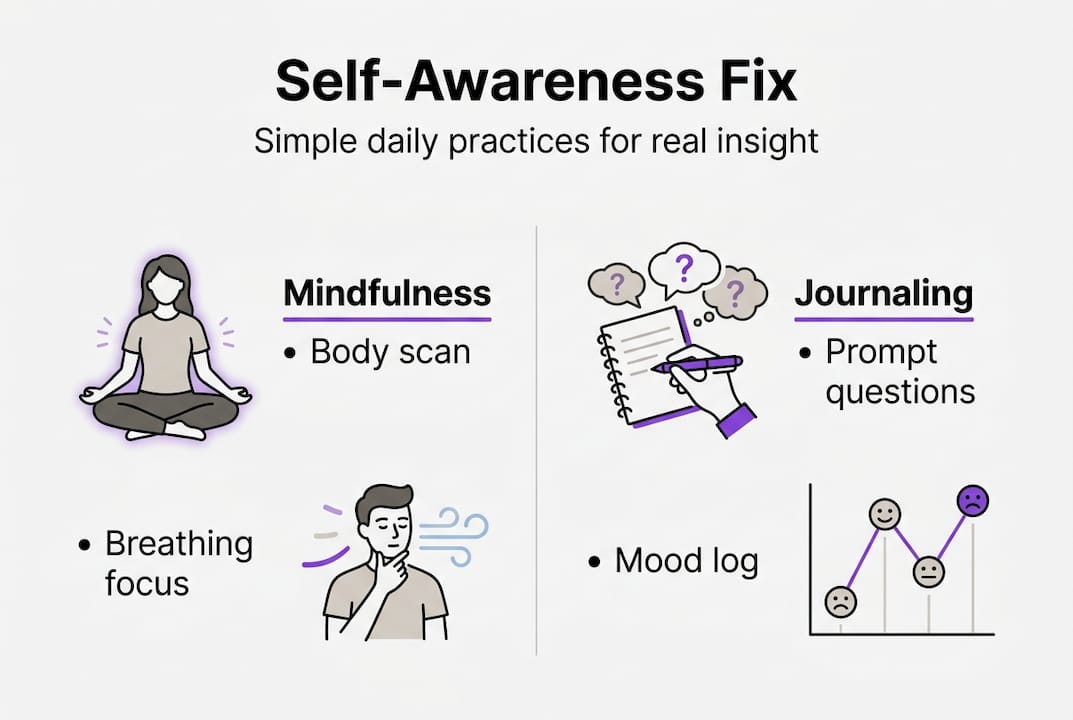
Daily journaling prompt (10 minutes): Write responses to one focused question. Examples: "What am I avoiding today?" or "What feeling kept returning this week?" Keep entries brief. The goal is clarity, not volume.
Mood tracking: Log your mood three times a day using a simple 1 to 10 scale with one word describing the emotion. Over two weeks, patterns emerge that you'd never notice in real time. Consistent self-awareness practice also reduces self-objectification and increases your sense of meaning in life.
| Technique | Time needed | Best for | Frequency |
|---|---|---|---|
| Body check-in | 5 minutes | Emotional grounding | Daily |
| Journaling prompt | 10 minutes | Pattern recognition | Daily |
| Mood tracking | 2 minutes | Trend awareness | 3x daily |
| Timed reflection | 15 minutes | Deep insight | 2 to 3x per week |
Key habits that make these techniques stick:
- Attach them to an existing routine, like morning coffee or bedtime.
- Keep your journal or tracking tool visible and accessible.
- Review your mood logs weekly, not just daily, to spot longer patterns.
Pro Tip: Combine a 5-minute body check-in with your journaling prompt. Do the body scan first, then write. The physical grounding primes your nervous system for honest, clear reflection rather than anxious analysis.
For deeper guidance, journaling techniques offer structured formats for different emotional goals. If mood regulation is your focus, journaling and mood regulation provides targeted methods. And for a broader view of what's working in 2026, mental wellness tips covers the latest approaches.
Our perspective: The truth few talk about self-awareness
Here's what we've observed working in the mental wellness space: most people treat self-awareness as a destination. They believe that if they just reflect enough, they'll eventually arrive at some stable, clear version of themselves. That's not how it works.
Self-awareness is a practice, not a state. And the biggest obstacle to it isn't lack of reflection. It's too much reflection without enough action. We've seen people journal for years without changing a single pattern, because they kept circling the same insights without ever testing them in real life.
The most meaningful growth happens when reflection and action are paired deliberately. You notice a pattern, you test a new response, you reflect on what changed. That cycle, repeated consistently, builds genuine self-knowledge faster than any amount of solo introspection.
Set firm time limits on your reflection. Treat self-reflection for clarity as a tool with a specific job, not an open-ended process. When the timer ends, close the journal and do something. That boundary is what keeps reflection healthy and productive over the long term.
Ready to take the next step toward emotional well-being?
You now have a clearer picture of what self-awareness actually is, how to build it safely, and which practices deliver real results. The next step is putting it into motion with tools designed to support you.

Voisley brings together guided journaling, mood tracking, and AI-powered insights in one private space built for exactly this kind of work. Whether you want structured prompts to deepen your reflection, visualizations to spot emotional trends, or a daily mindfulness habit that actually sticks, the platform meets you where you are. You can turn your mood into action starting today, with tools grounded in the same science this article covers. Your emotional well-being doesn't need another insight. It needs a consistent practice.
Frequently asked questions
Can self-awareness improve my emotional intelligence?
Yes. Mindfulness builds emotional intelligence by training you to recognize emotional signals in your body before they escalate, giving you more choice in how you respond.
Is self-reflection always beneficial for mental health?
No. While structured reflection builds insight, excessive self-reflection correlates with higher anxiety and depression. Balanced, time-limited practices are the safest approach.
How can I avoid rumination when reflecting on my emotions?
Set a clear time limit before you begin, then transition to a grounding exercise or one concrete action. Timed reflection with action shifts your brain out of looping thought patterns.
What is the best daily practice to build self-awareness?
Combining a short body check-in, a focused journaling prompt, and mood tracking gives you the broadest coverage. Pairing journaling with mindfulness consistently produces the strongest outcomes for self-awareness and emotional well-being.