

TL;DR:
- Only 10-15% of people are truly self-aware, impacting decision making and relationships.
- Effective self-awareness combines daily micro-practices like journaling and mindfulness with external feedback.
- Balance and consistency in practice are key, while over-reflection can lead to negative mental health effects.
Most people are confident they know themselves well. Yet only 10-15% of people are truly self-aware, according to research from Harvard. That gap between perceived and actual self-awareness quietly shapes every decision you make, every relationship you build, and every emotional pattern you repeat. This guide walks you through exactly why that gap exists, what tools close it, and how to build self-awareness that actually sticks. You will leave with a clear, step-by-step process grounded in evidence, not vague inspiration.
Table of Contents
- Why self-awareness matters and the gap you face
- Preparing your self-awareness toolkit: Evidence-based essentials
- Step-by-step process: Building self-awareness that lasts
- Troubleshooting: Common pitfalls and how to verify progress
- Our take: The overlooked key to self-awareness success
- Ready to start your self-awareness journey?
- Frequently asked questions
Key Takeaways
| Point | Details |
|---|---|
| True self-awareness is rare | Most people overestimate their self-awareness, so practical improvement steps offer a major advantage. |
| Micro-practices work best | Short, daily habits like mindfulness scans and emotion naming are backed by research for sustainable growth. |
| Balance is key | Combine personal reflection with external feedback to support positive mental health and avoid pitfalls. |
| Measure your progress | Use self-assessment, journaling review, and honest feedback to verify your self-awareness gains. |
Why self-awareness matters and the gap you face
Self-awareness is your ability to accurately perceive your own emotions, thoughts, behaviors, and how they affect others. It sounds simple. In practice, it is one of the hardest skills to develop because your brain is wired to protect your self-image, not challenge it.
Research consistently shows that most people dramatically overestimate how well they know themselves. The self-awareness gap is real, and it has measurable consequences. People with low self-awareness make worse decisions, struggle more in relationships, and are less effective as leaders. Ironically, awareness of biases can sometimes link to rumination and negative personality traits if it is not paired with healthy reflection habits.
"The higher someone rises in an organization, the less accurate their self-perception tends to become." This is one of the more unsettling findings in leadership psychology.
Why does the gap happen? Several forces work against you. Confirmation bias leads you to notice information that confirms what you already believe. Social feedback is often softened to protect feelings. And introspection itself, without structure, can spiral into overthinking rather than genuine insight. Understanding these self-awareness misconceptions is the first step toward correcting them.
Here is who benefits most from intentional self-awareness work:
- People who feel emotionally reactive or easily overwhelmed
- Anyone stuck in repeating relationship or career patterns
- Leaders and managers who rely on accurate self-perception to guide others
- Individuals in therapy or personal growth programs who want to accelerate progress
- Anyone who wants to align their daily actions with their deeper values
| Self-awareness level | Common outcomes | Emotional impact |
|---|---|---|
| Low | Reactive decisions, conflict | High stress, frustration |
| Moderate | Some insight, inconsistent | Occasional clarity |
| High | Intentional choices, growth | Emotional regulation, confidence |
The benefits of self-reflection extend far beyond feeling better in the moment. Consistent self-awareness practice builds emotional intelligence, improves communication, and helps you make decisions that actually match your values.
Preparing your self-awareness toolkit: Evidence-based essentials
Before you can build self-awareness, you need the right tools. Not every practice works for every person, and combining approaches tends to produce better results than relying on just one.
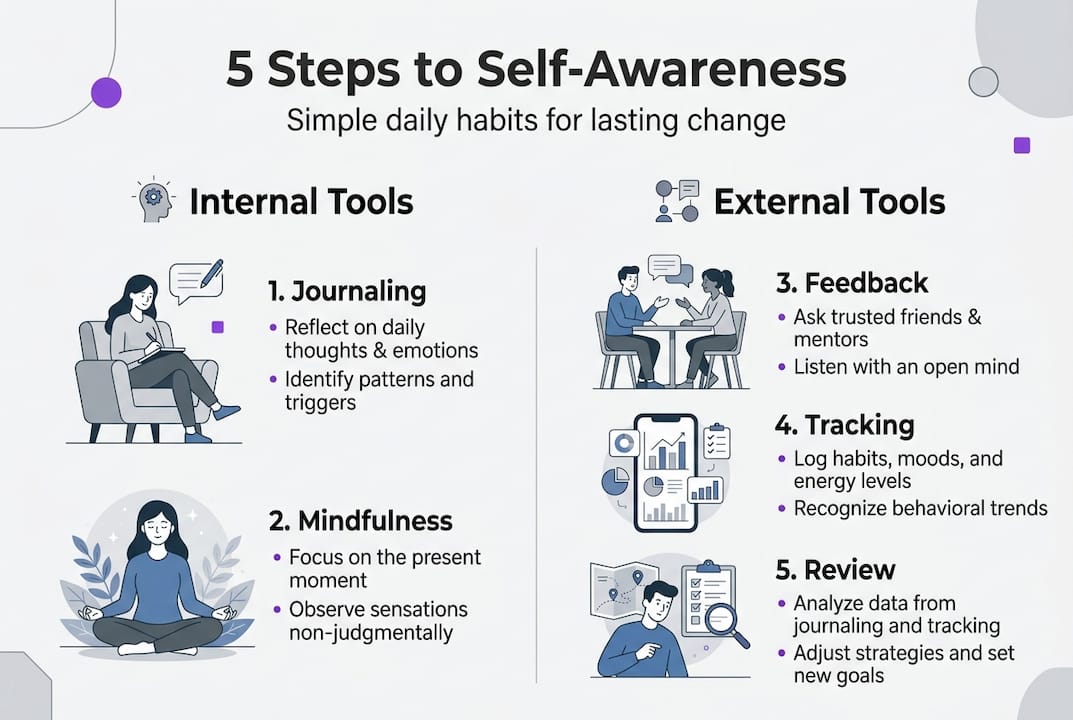
The core toolkit includes four categories. First, a journal or structured writing template gives your thoughts a place to land outside your head. Second, a mindfulness timer or app helps you carve out consistent practice windows. Third, self-assessment templates or scales let you track emotional patterns over time. Fourth, a trusted feedback source, whether a friend, coach, or structured 360-review, gives you the outside perspective your internal lens cannot provide.

Somatic tracking, body scans, and journaling are all supported by randomized controlled trials for improving self-awareness and emotional regulation. These are not soft suggestions. They are evidence-based methods that produce measurable results.
| Practice | Best for | Time commitment | Evidence strength |
|---|---|---|---|
| Journaling | Emotional processing, pattern recognition | 5-15 min/day | Strong |
| Mindfulness meditation | Present-moment awareness, reactivity reduction | 5-20 min/day | Strong |
| Body scan | Physical emotion awareness, stress reduction | 10-20 min/day | Moderate-strong |
| 360-feedback | External blind spots, leadership growth | Periodic | Moderate |
Choosing the right combination depends on your goal. If emotional reactivity is your main challenge, mindfulness and body scans are your starting point. If you want to understand long-term patterns, journaling paired with self-assessment scales works best. For professional growth, adding structured feedback is essential.
Explore ways to improve self-awareness to find which practices match your current lifestyle and energy level. You can also advance your self-awareness by starting with just one tool and layering in others as the habit solidifies.
Pro Tip: Start with a two-minute mindfulness check-in at the same time every day. Consistency at a small scale beats occasional deep-dives every time. Once the habit is locked in, extend the duration or add a second practice.
The key is to treat your toolkit as a living system. Review what is working every two to three weeks and adjust. Self-awareness is not a destination. It is a practice that evolves with you. Pairing mindfulness practices with journaling creates a feedback loop that accelerates growth significantly.
Step-by-step process: Building self-awareness that lasts
With your toolkit in place, here is how to put it into action. This process is designed to be sustainable, not overwhelming.
- Set a clear intention. Decide what you want to understand about yourself. Vague goals produce vague results. Write down one specific area: emotional triggers, communication patterns, or recurring stress responses.
- Choose a daily micro-practice. Pick one tool from your toolkit and commit to it for 21 days. Two to five minutes of focused practice daily outperforms a two-hour session once a week.
- Apply a mindful body scan. Once per day, pause and scan from head to toe. Notice where tension, discomfort, or ease lives in your body. Physical sensations are often the first signal of an emotional state you have not yet named.
- Name emotions in real time. When you notice a feeling, label it specifically. Not just "stressed" but "frustrated because I felt unheard." Specificity builds emotional vocabulary, which builds regulation.
- Keep a self-reflection log. At the end of each day, write three to five sentences about a moment that felt emotionally significant. Use the prompt: what happened, what I felt, what I did, and what I would do differently.
- Build a feedback loop. Every two weeks, ask one trusted person for honest input on a specific behavior. Compare their feedback to your self-perception. The gap between the two is your growth edge.
Mindfulness and journaling together improve interoceptive awareness, which is your ability to sense internal body signals, and emotional regulation. Used consistently, they rewire how you process experience.
One important caution: self-reflection can correlate with negative mental health outcomes when it tips into rumination. The difference is direction. Healthy reflection asks "what" and "how." Rumination asks "why" in a way that loops without resolution. Keep your journaling forward-focused.
Pro Tip: Use journaling techniques like timed free-writing or structured prompts to prevent your reflection sessions from drifting into unproductive overthinking.
For a deeper look at how to reflect on feelings without spiraling, structured prompts are far more effective than open-ended journaling alone. Research on tailoring approaches confirms that cultural context and individual differences also shape which methods work best for you.
Troubleshooting: Common pitfalls and how to verify progress
Even with the right tools and a clear process, several common mistakes can stall or reverse your progress. Knowing them in advance saves you weeks of frustration.
Common pitfalls to watch for:
- Over-reflection: Spending too much time analyzing yourself without acting on what you find leads to paralysis, not growth.
- Ignoring external feedback: Your internal view is always partial. Skipping outside input means your blind spots stay blind.
- Perfectionism: Expecting immediate, dramatic change makes you quit when progress feels slow. Self-awareness builds in small, compounding steps.
- Negative rumination: Replaying past mistakes without extracting a lesson is not reflection. It is punishment.
- Inconsistency: Practicing intensely for a week and then stopping resets most of the progress you made.
"Over-reflection can trigger rumination, anxiety, and depression, and leaders are often the least self-aware people in the room."
Measuring your progress matters. Without a way to track change, you are flying blind. Use these methods:
| Measurement method | What it tracks | How often |
|---|---|---|
| Journaling review | Emotional pattern shifts | Monthly |
| Self-assessment scales | Internal awareness accuracy | Every 4-6 weeks |
| Feedback comparison | External perception gap | Every 2-4 weeks |
| Behavioral observation | Real-world behavior change | Ongoing |
Self-assessment should be tested against real outcomes, and external feedback is a critical check on your internal narrative. Without that external mirror, it is easy to believe you are growing when you are actually just becoming more comfortable with your existing story.
For a balanced approach, explore the effects of introspection on mental health and understand why the importance of self-exploration lies in its structure, not just its frequency. You can also advance your self-awareness by using validated scales to benchmark where you are starting from.
Our take: The overlooked key to self-awareness success
Here is something most self-help content gets wrong: more introspection is not always better. The assumption that sitting with your thoughts longer or journaling more pages will automatically produce deeper self-awareness is simply not supported by the evidence.
What actually works is balance. Internal practices like journaling and meditation give you raw material. External feedback gives you accuracy. Without both, you are either guessing from the inside or relying entirely on what others think of you. Neither is complete.
We have also seen that people who build emotional awareness and growth through small, daily habits consistently outperform those who do occasional deep-dive sessions. A two-minute check-in every day for a month creates more durable change than a weekend retreat followed by nothing.
The uncomfortable truth is that self-awareness requires discomfort. Not the suffering kind, but the kind that comes from sitting with honest feedback and choosing to update your self-image. That is the work most people avoid. And it is exactly where the real growth lives.
Ready to start your self-awareness journey?
Building self-awareness is one of the most impactful investments you can make in your emotional well-being, but doing it alone with a blank notebook and good intentions only gets you so far. Structure, consistency, and the right prompts make all the difference.

Voisley brings together guided journaling, mood tracking, and AI-powered insights into one private space designed specifically for this kind of growth. Whether you are working through emotional triggers, tracking patterns over time, or simply trying to understand yourself better, self-awareness tools like these make the process clearer and more sustainable. You do not have to figure it all out from scratch. Start with one journal entry today and let the process build from there.
Frequently asked questions
What are the fastest ways to become more self-aware?
Daily micro-practices like 2-5 minute mindfulness check-ins and real-time emotion naming build self-awareness fastest. Micro-practices outperform intensive sessions for sustainable, long-term self-awareness growth.
Can too much self-reflection be harmful?
Yes. Over-reflection can cause rumination, anxiety, and depression, and excessive introspection is a well-documented risk. Focusing on "what" and "how" rather than "why" keeps reflection productive.
How do I know if my self-awareness is improving?
Look for easier emotional regulation, a greater ability to accept honest feedback, and more accurate predictions about your own reactions. Test self-assessments against real outcomes and seek external feedback regularly.
What tools are best for building self-awareness?
Journaling, mindfulness meditation, guided body scans, and 360-feedback tools are all evidence-based options. Somatic tracking and journaling are specifically supported by randomized controlled trials for improving self-awareness and emotional regulation.