

TL;DR:
- Emotional awareness helps you recognize and understand feelings to make better decisions.
- Journaling and self-reflection deepen emotional awareness by identifying patterns and bodily sensations.
- Regular practice improves mental health, enhances relationships, and promotes personal growth.
Most people treat emotions as background noise, something to manage or push through. But your feelings are actually data. Every flicker of frustration, pride, or unease carries information about your values, your boundaries, and what truly matters to you. Emotional awareness is the skill of reading that data clearly. When you develop it, you stop reacting on autopilot and start making choices that actually align with who you want to be. This guide breaks down what emotional awareness really is, why science backs it so strongly, and how journaling and self-reflection can make it a daily practice that reshapes your relationships and personal growth.
Table of Contents
- What is emotional awareness and why does it matter?
- How journaling and self-reflection build emotional awareness
- Empirical evidence and proven benefits of emotional awareness
- Practical strategies to cultivate emotional awareness daily
- A fresh perspective: Why emotional awareness isn't just self-talk
- Start your emotional awareness journey today
- Frequently asked questions
Key Takeaways
| Point | Details |
|---|---|
| Emotional awareness is foundational | Recognizing your emotions is the first step toward emotional intelligence and personal growth. |
| Journaling boosts self-knowledge | Structured journaling techniques reveal triggers, patterns, and help regulate emotions. |
| Evidence supports real benefits | Empirical studies show emotional awareness improves mental health, engagement, and relationships. |
| Balance and mindfulness matter | Combining reflection and mindfulness leads to practical, actionable insight without over-analysis. |
What is emotional awareness and why does it matter?
Emotional awareness means more than just knowing you feel sad or anxious. It means recognizing a feeling as it arises, naming it precisely, and understanding what triggered it. That three-step process, notice, name, understand, is the engine behind emotional intelligence.
When you can do this consistently, something shifts. You stop confusing "stressed" with "angry" or "lonely" with "bored." That precision matters because vague emotions lead to vague responses. Precise awareness leads to targeted action.
Emotional awareness is foundational to emotional intelligence, enabling self-regulation, better relationships, and personal growth. Think of it as the foundation that every other emotional skill is built on. Without it, techniques like empathy or conflict resolution feel hollow because you are operating without clear internal data.
Here is what strong emotional awareness actually gives you:
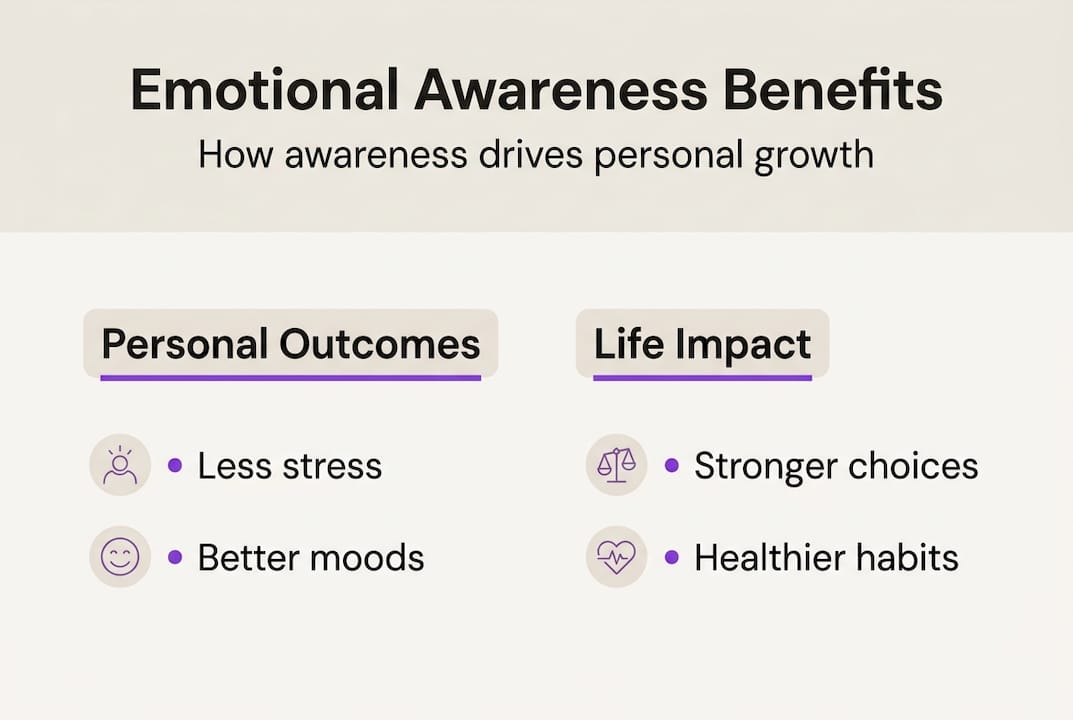
- Better decisions: You recognize when fear or excitement is coloring your judgment before you act on it.
- Stronger relationships: You communicate what you actually feel instead of projecting or shutting down.
- Faster personal growth: You spot patterns in your reactions and can work on them intentionally.
- Improved mental health: Awareness reduces the risk of emotions building silently into chronic stress or burnout.
Researchers studying improving emotional intelligence consistently find that people who can label their emotions with specificity tend to regulate them more effectively. This is sometimes called "affect labeling," and brain imaging studies show it actually reduces the intensity of emotional responses in real time.
"Emotional awareness expands your cognitive map. In therapy, it allows clients to locate feelings in the body, trace them to their source, and respond rather than react." This insight applies far beyond clinical settings. It is relevant every time you pause before sending a heated message or choose curiosity over defensiveness in a hard conversation.
Low emotional awareness, by contrast, is linked to a range of psychological difficulties. When feelings go unnamed and unexamined, they tend to drive behavior from the shadows. Practicing self-awareness improvement tips and exploring guided journaling for self-discovery are two of the most accessible ways to close that gap.
With this foundation, let's examine how emotional awareness affects daily life.
How journaling and self-reflection build emotional awareness
Knowing that emotional awareness matters is one thing. Building it is another. This is where journaling and self-reflection become genuinely powerful tools, not just feel-good habits.
When you write about your day, you are not just venting. You are creating a record of your emotional landscape. Over time, that record reveals patterns you would never catch in the moment. You start to notice that your energy drops every Sunday evening, or that a specific type of conversation leaves you drained. Those patterns are data.
Journaling and self-reflection enhance emotional awareness by helping individuals identify bodily sensations of emotions and track daily emotional responses. That connection between body and feeling is crucial. Emotions are not just mental events. They show up as tension in your shoulders, tightness in your chest, or a sudden heaviness in your limbs. Journaling trains you to notice those signals.

Research also shows that reflective journaling reduces anxiety and boosts self-efficacy, learning engagement, and positive emotions. Those are not small benefits. They represent meaningful shifts in how you experience daily life.
Here is a simple process to get started:
- Set a consistent time. Morning or evening works well. Even ten minutes is enough.
- Start with a prompt. "What emotion was strongest today?" or "What triggered that feeling?" gives you a clear entry point.
- Name the emotion specifically. Not just "bad" but "disappointed," "overlooked," or "overwhelmed."
- Note the body sensation. Where did you feel it physically? This anchors the emotion in real experience.
- Look for the trigger. What happened just before the feeling arrived? This builds your emotional map over time.
To unlock emotional patterns effectively, consistency matters more than length. A short, honest entry every day beats a long one written once a week.
"Self-reflection is not about judging what you find. It is about getting curious about it."
Pro Tip: Pair journaling with two minutes of mindful breathing before you write. This settles your nervous system and helps you access genuine feelings rather than just surface-level thoughts. It also prevents the session from sliding into unproductive rumination. You can explore more about the benefits of self-reflection to understand why this pairing works so well.
Now that you know its importance, let's look at practical ways to grow emotional awareness.
Empirical evidence and proven benefits of emotional awareness
Let's ground these practices in scientific data to understand their impact.
Empirical studies show that emotional awareness training improves emotion regulation and mindfulness, and reduces symptoms in disorders like depression and anxiety. Experience sampling methods, where participants log emotions multiple times a day, also improve emotion differentiation, the ability to tell feelings apart with precision.
These are not minor effects. The reductions in anxiety and depression symptoms observed in structured emotional awareness programs are statistically significant, meaning they are unlikely to be random. That matters if you are skeptical about whether journaling and reflection can actually move the needle on mental health.
Here is a summary of outcomes from recent research:
| Outcome | Effect observed |
|---|---|
| Emotion regulation | Significantly improved |
| Mindfulness scores | Increased after training |
| Anxiety symptoms | Reduced in clinical samples |
| Depression symptoms | Reduced with consistent practice |
| Emotion differentiation | Improved via experience sampling |
Beyond clinical outcomes, emotional awareness delivers practical everyday benefits:
- Improved mood stability: You recover from setbacks faster because you understand what happened emotionally.
- Better relationship quality: You express needs clearly and respond to others with more empathy.
- Stronger learning engagement: Positive emotional states linked to self-awareness support curiosity and focus.
- Greater sense of agency: You feel less controlled by your emotions and more capable of directing your responses.
Building an emotional well-being workflow into your routine is one of the most effective ways to capture these benefits consistently. Combining that with mindfulness for emotional well-being creates a reinforcing loop where each practice makes the other more effective.
The science is clear. Emotional awareness is not a soft skill. It is a measurable, trainable capacity with real consequences for mental and relational health.
Practical strategies to cultivate emotional awareness daily
Finally, discover how to weave emotional awareness into your daily routine.
Different strategies suit different people and different moments. The key is matching the tool to the need. Here is a comparison of three core approaches:
| Strategy | Best for | Time required | Key benefit |
|---|---|---|---|
| Mindfulness practice | In-the-moment awareness | 5 to 15 minutes | Reduces reactivity |
| Guided journaling | Pattern recognition | 10 to 20 minutes | Builds emotional vocabulary |
| Trigger tracking | Identifying root causes | 2 to 5 minutes | Reveals behavioral patterns |
Each of these works. But they work best together. Mindfulness gives you the pause. Journaling gives you the language. Trigger tracking gives you the pattern.
Here are practical pitfalls to watch for:
- Over-analysis: Spending too long dissecting one emotion can amplify it rather than resolve it. Set a time limit.
- Rumination: Replaying negative events without seeking insight keeps you stuck. Always end a reflection session with one forward-looking question.
- Skipping the body: Focusing only on thoughts misses half the emotional signal. Always check in physically.
- Inconsistency: Sporadic practice yields sporadic results. Habit formation is the real goal.
Research on emotional awareness in therapy shows that awareness expands cognitive maps across therapeutic modalities, and that low awareness is linked to psychopathology. This tells us that emotional awareness is not optional for mental health. It is structural.
Pro Tip: Use guided prompts rather than blank pages. Open-ended questions like "What am I feeling right now and where do I feel it?" or "What would I tell a friend who felt this way?" create structure that keeps reflection productive. Explore emotional regulation journaling techniques and life journal techniques for ready-to-use frameworks.
For those building a broader practice, mental wellness journaling offers a structured entry point that integrates emotional awareness with overall well-being habits.
A fresh perspective: Why emotional awareness isn't just self-talk
Here is something most guides on this topic miss. Emotional awareness gets framed as an introspective exercise, something you do inside your head. But the real value shows up in behavior, in what you say, how you respond, and what you choose.
There is a meaningful difference between endlessly analyzing your feelings and actually using them as information. The first can keep you circling. The second moves you forward. True emotional awareness is a practical skill, not an abstract concept. It is the moment you recognize irritation rising and choose your words deliberately. It is noticing that you are avoiding a task because of fear, not laziness, and then addressing the fear directly.
Guided reflection, the kind that pairs honest writing with mindful observation, is what bridges the gap between insight and action. Venting without structure rarely produces clarity. But structured self-exploration for mental clarity creates the kind of self-knowledge that actually changes how you live.
Emotional awareness is not about becoming more emotional. It is about becoming more precise, more intentional, and ultimately more free.
Start your emotional awareness journey today
Emotional awareness is most powerful when it is practiced daily, not just explored once and forgotten. The insights you gain from a single journaling session are real, but the transformation comes from consistency.

Voisley is built for exactly this kind of daily practice. With personalized prompts, mood tracking, and AI-powered insights, it gives you a structured space to explore your emotions, spot patterns, and grow your self-awareness over time. Whether you are just starting out or deepening an existing practice, Voisley meets you where you are. Turn your mood into action and see what becomes possible when emotional awareness becomes a habit.
Frequently asked questions
How does emotional awareness improve relationships?
When you recognize and understand your own emotions clearly, you communicate with more honesty and less reactivity, which builds deeper trust and connection with the people around you.
What is the best way to start journaling for emotional awareness?
Begin with simple prompts that ask you to name, describe, and track your daily emotions and the situations that trigger them. Journaling enhances emotional awareness most effectively when you also note where you feel the emotion in your body.
Can emotional awareness training reduce anxiety and depression?
Yes. Emotional awareness training has been shown to lower symptoms of anxiety and depression through improved emotion regulation, with statistically significant results in structured programs.
Why is mindfulness recommended alongside journaling?
Mindfulness helps you observe emotions without judgment, which prevents rumination and keeps your journaling sessions focused on insight rather than repetition. Improving emotional intelligence consistently points to this pairing as one of the most effective approaches available.