

TL;DR:
- Introspective coaching emphasizes self-awareness, emotional clarity, and understanding underlying beliefs.
- Techniques include reflective inquiry, intentional silence, journaling, and open-ended questions.
- Evidence shows it improves self-awareness and well-being, especially for those committed to deep personal growth.
Most people assume coaching is coaching. You set a goal, someone holds you accountable, and you move forward. But a quieter, more inward-facing approach has been gaining real traction among those who feel that traditional coaching skips a crucial step: the one where you actually understand yourself. Reflective inquiry in coaching is not a widely standardized or formally defined methodology, yet the people drawn to it tend to describe it as the most transformative work they've ever done. If you've ever left a goal-setting session feeling like something essential was missing, introspective coaching might be the missing piece.
Table of Contents
- What is introspective coaching?
- Core techniques and methods used
- Does introspective coaching work? Evidence and benefits
- Who should consider introspective coaching and what to watch for
- How to start your introspective coaching journey
- What most discussions about introspective coaching miss
- Explore deeper self-awareness with Voisley
- Frequently asked questions
Key Takeaways
| Point | Details |
|---|---|
| Defined by self-reflection | Introspective coaching focuses on structured self-examination to support emotional growth. |
| Evidence-backed benefits | Research shows reflective practices in coaching moderately boost self-awareness and well-being. |
| Ethical guidance matters | Professional supervision and qualified coaches are crucial for safe, effective deep work. |
| Practical techniques | Journaling, reflective questioning, and peer discussion are among the key tools used. |
| Personal fit required | Best for those committed to personal growth and ready to engage with introspection. |
What is introspective coaching?
Introspective coaching sits at the intersection of self-reflection and structured personal development. Unlike traditional coaching, which tends to be directive and results-focused, this approach turns the lens inward. The goal isn't just to hit a target. It's to understand why certain patterns keep showing up, what beliefs drive your choices, and where your emotional responses come from.
As a practice, introspective coaching is a niche offering centered on self-examination and emotional clarity rather than performance metrics. You won't find a globally recognized certification called "Introspective Coach." Instead, you'll find practitioners who blend elements of reflective inquiry, mindfulness, and wellness coaching basics to create a deeply personal experience.
What draws people to it? Usually a sense that advice and action plans aren't enough. They want to understand the internal landscape behind their choices.
Here's what introspective coaching typically focuses on:
- Structured self-reflection: Sessions are built around deliberate pauses, not packed agendas.
- Examining core beliefs: The work goes beneath surface-level goals to question what you believe about yourself and the world.
- Emotional clarity: Rather than bypassing difficult feelings, you learn to sit with them and decode what they're telling you.
- Internal motivations: You explore why you want what you want, not just what you want.
- Pattern recognition: Recurring behaviors and thought loops become data points, not failures.
The people who gravitate toward this work are often already fairly self-aware. They've read the books, done some therapy, maybe tried traditional coaching. They come to introspective coaching because they're ready for something more granular, more honest, and more personally tailored. If you're curious about how this kind of inner work affects well-being, the insights on introspection from a mental health perspective add important context.
With the basics outlined, let's look at the tools that make introspective coaching work.
Core techniques and methods used
The mechanics of introspective coaching involve reflective inquiry, active listening, powerful open-ended questions, silence for processing, and structured self-reflection. Each tool serves a specific purpose, and knowing how they work together helps you get the most from any session.
Here's a breakdown of the most commonly used techniques:
- Reflective inquiry: The coach asks questions designed to draw out your own thinking, not provide answers. Think "What does this situation reveal about what matters to you?" rather than "Here's what you should do."
- Intentional silence: Pauses are not awkward gaps. They're deliberate space for you to process. Skilled coaches use silence as a tool, not a void.
- Journaling between sessions: Written reflection between meetings deepens insight. Prompts like "What surprised me this week?" or "Where did I feel most like myself?" extend the work far beyond the session itself.
- Open-ended questioning: Questions that can't be answered with yes or no force your brain to actually search for meaning. They activate genuine introspection rather than pat answers.
- Structured learning cycles: Frameworks like Kolb's experiential learning model or Gibbs' reflective cycle offer a map for turning experience into insight. You move from experience to observation to abstract thinking to action, and then back again.
| Technique | Primary benefit | Best used when |
|---|---|---|
| Reflective inquiry | Surfaces hidden assumptions | You feel stuck without knowing why |
| Intentional silence | Allows deep processing | Emotional material surfaces |
| Journaling | Builds continuity between sessions | You want to track patterns over time |
| Open-ended questions | Promotes self-generated insight | You seek clarity, not instructions |
| Learning cycles | Structures growth from experience | After significant life events or transitions |
Peer group formats are also used in some programs. These create safe spaces where participants reflect together, offering perspectives that a solo session might not surface. Hearing someone else name a feeling you've been struggling to articulate can be remarkably clarifying. This aligns with holistic coaching approaches that emphasize the full person, not just the presenting problem.
Building habits of reflection for personal growth is one of the most practical outcomes of these techniques, and it's something you can carry into everyday life, not just coaching sessions.

Pro Tip: A skilled introspective coach monitors depth carefully. Going too far too fast can trigger overwhelm rather than insight. If you feel flooded rather than curious, signal your coach. Good coaches adjust the pace and offer grounding techniques, because self-awareness fixes require a steady foundation, not emotional flooding.
Once you understand these tools, the next step is to evaluate: Does it actually work? Let's see what the studies and experts say.
Does introspective coaching work? Evidence and benefits
Here's the honest answer: there are no specific empirical benchmarks for "introspective coaching" as a distinct category. However, meta-analyses on coaching broadly show moderate and meaningful improvements in self-awareness, well-being, and performance. For anyone seeking emotional clarity and inner growth, that evidence is directly relevant.
| Outcome area | Typical finding | Study basis |
|---|---|---|
| Self-awareness | Moderate to strong gains | Systematic reviews of reflective coaching |
| Well-being | Consistent improvement | Multiple coaching meta-analyses |
| Performance | Moderate gains | Professional and personal coaching studies |
| Goal attainment | Notable improvement | ICF-affiliated research |
What does "moderate improvement" actually mean in practice? It means people feel more equipped to name what they're feeling, less reactive in high-pressure moments, and more aligned between their stated values and their daily choices. These aren't small shifts. For someone stuck in a cycle of self-doubt or emotional reactivity, they can be genuinely life-changing.
"The most meaningful gains from reflective coaching often can't be captured in performance metrics. They show up in how people relate to themselves when things go wrong."
Researchers recommend using validated self-awareness scales to track change over time. This gives you actual data on your progress rather than relying on feelings alone. Scales like the Self-Reflection and Insight Scale or the Trait Emotional Intelligence Questionnaire can be useful starting points.
Key benefits people report from introspective coaching include:
- Reduced emotional reactivity: Better ability to pause before responding to triggers.
- Clearer decision-making: Understanding your values makes choices feel less overwhelming.
- Improved relationships: When you understand your own patterns, you stop projecting them onto others.
- Greater resilience: Processing difficult experiences thoughtfully builds the mental flexibility to recover faster.
- Stronger sense of identity: You stop performing who you think you should be and start living closer to who you actually are.
The limitation to acknowledge is this: the evidence base is still growing. More research targeted specifically at introspective coaching as a defined practice would strengthen its credibility. For now, the emotional health evidence and the data from broader reflective coaching research make a compelling case. If you want a structured path to improve emotional clarity, the techniques in this space consistently deliver results.
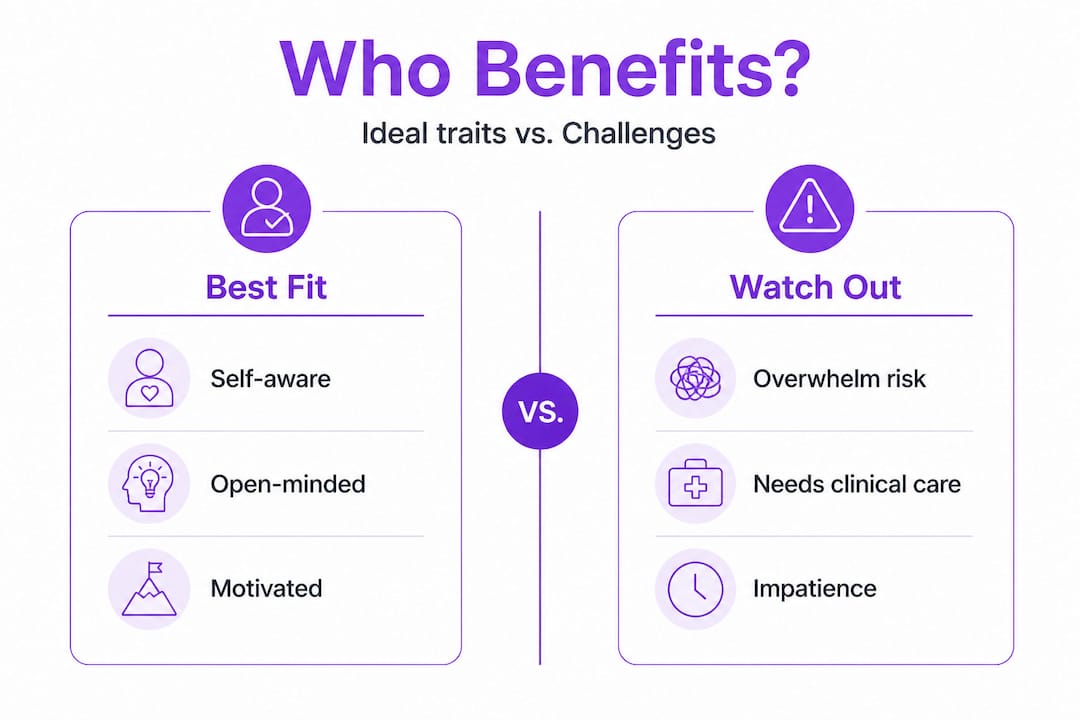
Evidence is only part of the story. Let's map out who will benefit most and the real challenges involved.
Who should consider introspective coaching and what to watch for
Not everyone is the right fit for this kind of work, and that's okay. Introspective coaching is best for those seeking growth through reflection, with the important caveat that depth work genuinely benefits from trained oversight and clear ethical boundaries.
You're likely a strong candidate if you:
- Already have some capacity for self-reflection and want to go deeper.
- Feel like traditional goal-setting leaves something important unexplored.
- Are navigating a life transition and want to understand it from the inside out.
- Seek emotional clarity, not just behavior change.
- Are committed to regular, honest self-examination, including the uncomfortable parts.
- Want tools you can use independently, not just in sessions.
There are also situations where introspective coaching is not the right first step. If you're experiencing clinical depression, anxiety disorders, trauma responses, or any other mental health condition that requires diagnosis and treatment, please work with a licensed therapist first. Holistic health coaching can complement clinical care, but it doesn't replace it. This distinction matters and ethical coaches will tell you the same thing clearly before you begin.
The quality of the coach makes an enormous difference. Look specifically for practitioners who:
- Have formal training with reflective practice at the core of their method.
- Participate in ongoing supervision (this is a mark of professional seriousness).
- Demonstrate awareness of when to refer clients to mental health professionals.
- Hold a container for depth work without pushing you past what's safe.
Improving self-awareness is genuinely valuable, and tracking mental wellness throughout the process helps you know whether your investment is paying off in real, measurable ways.
Pro Tip: Ask a prospective coach directly: "Do you work with a supervisor?" and "What do you do when a client enters emotionally difficult territory?" The answers will tell you a lot about whether they're equipped for this level of depth work.
Having determined the fit, here's how you might get started and what resources to consider.
How to start your introspective coaching journey
Starting feels simpler once you break it into clear steps. The first priority is finding the right coach. ICF-accredited and Co-Active reflective training programs are reliable indicators of quality. Niche programs designed around spiritual self-inquiry or emotional intelligence add another layer of depth.
Here's a practical starting sequence:
- Clarify your intention. Before searching for a coach, write down what you're actually hoping to understand about yourself. Vague goals produce vague results. "I want to stop feeling anxious" is less useful than "I want to understand what triggers my withdrawal in relationships."
- Research coaching credentials. Look for ICF membership, Co-Active training, or equivalent reflective practice certification. Check that they have supervised hours, not just completed a weekend course.
- Book a discovery call. Most coaches offer a short initial conversation. Notice whether the coach listens more than they talk. Notice whether they ask questions that make you think. That's your preview of the actual work.
- Start journaling now. Don't wait for a coach to begin the reflection process. A simple daily practice of writing 10 to 15 minutes on your current emotional state, patterns you're noticing, or questions you're sitting with builds the self-reflective muscle that makes coaching more productive.
- Set a review point. Agree with yourself (and your coach) on a review date, typically after 6 to 8 sessions, to assess whether the work is producing the kind of clarity you came for.
For an excellent guide to mental clarity that can ground your early sessions, start there before your first appointment. It will help you arrive with more self-awareness already in place.
Now that we've explored pathways and resources, let's zoom out for a hard-won perspective beyond the theory.
What most discussions about introspective coaching miss
Here's what rarely gets said clearly: the technique is almost never the thing that makes the difference. What makes introspective coaching transformative is the quality of presence, both the coach's and yours.
Coach presence and ongoing self-management are critical, and ethical boundaries require integration with supervision and advanced reflective training. This is not just professional fine print. It's the thing that separates genuinely transformative coaching from a well-intentioned conversation that accidentally leaves you more confused or emotionally destabilized than when you started.
The real risk in introspective work is not thinking too hard. It's thinking without support. Self-exploration without guardrails can lead people into ruminative loops, where they examine the same painful patterns repeatedly without the perspective to move through them. A skilled coach doesn't just prompt reflection. They help you metabolize what comes up.
Many people also underestimate how emotionally intense this work can be. Reading about reflective inquiry sounds calm and intellectual. Sitting in a session where you realize that a belief you've built your adult identity on might not actually be true? That's a different experience entirely. It's not a crisis, but it requires a steady, trained presence to navigate safely.
The emotional health trends in 2026 show increasing interest in inward-focused practices. That's genuinely encouraging. But it also means more people are entering this space without fully understanding what it asks of them. The bravest thing you can do isn't finding the best technique. It's committing to the quality of attention you bring to yourself, consistently, over time.
Explore deeper self-awareness with Voisley
If this article has sparked something in you, the next step doesn't have to wait for a coaching appointment.

Voisley offers a private, structured digital space to begin the kind of reflective practice that makes introspective coaching more effective. From guided journaling prompts and mood tracking to shadow work journals and AI-powered emotional insights, the platform supports your self-awareness practice between sessions and on your own terms. Whether you're new to structured self-reflection or looking to deepen an existing practice, Voisley's tools meet you where you are. Start building the inner clarity you're looking for, one honest reflection at a time.
Frequently asked questions
Is introspective coaching suitable for mental health conditions?
Introspective coaching supports growth and emotional clarity, but it is not a substitute for clinical therapy or mental health treatment. If you're managing a diagnosed condition, work with a licensed professional first and consider coaching as a complement, not a replacement.
What credentials should I look for in an introspective coach?
Seek coaches with ICF-accredited reflective training, such as Co-Active certification, and a demonstrated background in self-reflection work. Participation in ongoing supervision is an especially strong indicator of professional seriousness.
Are results from introspective coaching backed by research?
General coaching meta-analyses show moderate to meaningful benefits in self-awareness and well-being, though specific empirical benchmarks for introspective coaching as a distinct category are still limited. The broader evidence is relevant and encouraging.
How do I know introspective coaching is helping me?
Track your progress using validated self-awareness scales and note concrete improvements in emotional clarity, reduced reactivity, or greater alignment between your values and your daily choices. Real growth tends to show up in how you respond, not just how you feel in session.