

TL;DR:
- True mental clarity involves focused attention, emotional regulation, and self-awareness working together.
- Clarity is actively built through habits like journaling, mindfulness, and lifestyle adjustments, not just maintained naturally.
- Addressing underlying factors such as sleep, nutrition, stress, and hormonal cycles is key to improving mental clarity.
Nearly 28.2% of adults report experiencing brain fog on a regular basis, yet most people have never stopped to ask what mental clarity actually is beyond a vague sense of "thinking well." Mental clarity is not just about processing information faster or feeling calm. It is a layered state that connects your focus, your emotional balance, and your self-awareness into something functional and sustainable. If you have ever felt mentally scattered despite doing everything "right," you already know how elusive clarity can be. This guide breaks down the real definition, the science, the most common myths, and the practical steps that actually move the needle.
Table of Contents
- Defining mental clarity: Beyond just 'clear thinking'
- Common myths and the real science behind mental clarity
- Journaling and mindfulness: Proven tools for clear thinking
- Lifestyle factors and edge cases: Adapting clarity strategies to your life
- Mental clarity: What most articles miss (and what actually works))
- Take the next step toward clarity and well-being
- Frequently asked questions
Key Takeaways
| Point | Details |
|---|---|
| Clarity is dynamic | Your mental clarity naturally fluctuates with lifestyle, stress, and emotional state. |
| Mindfulness and journaling help | Daily mindfulness or journaling consistently improves clarity and emotional balance for most people. |
| Practical changes matter | Lifestyle factors like sleep, hydration, and single-tasking have a major impact on mental clarity outcomes. |
| Personalization is key | The best clarity strategies are tailored to your needs and adapt as life circumstances change. |
Defining mental clarity: Beyond just 'clear thinking'
Most people define mental clarity as simply the absence of confusion. That is a start, but it misses most of the picture. True mental clarity is an active, positive state made up of at least three interlocking components: focused attention, emotional regulation, and self-awareness. When all three are working together, you feel present, decisive, and grounded. When even one drops out, the whole system wobbles.
One important distinction worth making early: mental clarity is not the same as the absence of mental illness. You can struggle with anxiety or low mood and still experience moments of genuine clarity. Conversely, someone with no diagnosed condition can be chronically foggy. Research published in Nature confirms that clarity exists on a spectrum, requiring emotional balance and functioning as a separate factor from the mere absence of psychiatric symptoms.
Here is how the three core components break down:
- Focused attention: The ability to direct your thinking toward what matters without constant interruption from irrelevant thoughts.
- Emotional regulation: Recognizing and managing your emotional responses so they inform rather than overwhelm your decisions.
- Self-awareness: Knowing your own patterns, triggers, and inner states well enough to respond intentionally. The role of self-exploration in building this layer is consistently underestimated.
Clarity also changes throughout the day and across life stages. It is not a fixed trait you either have or lack. Most people are clearest in the morning, dip in the early afternoon, and recover partially in the evening. This rhythm shifts with age, stress loads, and health changes.
| Component | What it looks like at high clarity | What it looks like at low clarity |
|---|---|---|
| Focused attention | Deep work feels natural and sustained | Constant task-switching, easily distracted |
| Emotional regulation | Feelings inform decisions without hijacking them | Reactivity, emotional flooding, avoidance |
| Self-awareness | Honest reflection on patterns and needs | Blind spots, defensiveness, confusion about reactions |
Better mental health is positively associated with stronger cognitive abilities across multiple domains. That connection is not coincidental. Emotional and cognitive clarity reinforce each other in a feedback loop, which is why addressing only the "thinking" side while ignoring emotional well-being rarely delivers lasting results.

Common myths and the real science behind mental clarity
Now that we have defined what mental clarity is and is not, it is worth addressing the misconceptions that keep people stuck.
Myth 1: Clarity is your natural default state and stress just temporarily disrupts it. The reality is that brain fog fluctuates daily based on sleep quality, nutrition, hydration, stress load, and even hormonal cycles. Clarity is not waiting underneath all that noise. It is actively built and maintained.
Myth 2: Mental clarity means thinking faster. Speed is not the goal. Clarity is about thinking accurately and intentionally, not rapidly. Racing thoughts are often a symptom of low clarity, not high performance.
Myth 3: If you do enough mindfulness, clarity becomes effortless. Mindfulness and journaling are genuinely effective, but individual variation is high in how much and how quickly people benefit. These practices raise your baseline. They do not eliminate hard days.
Here is how clarity, brain fog, and mental fatigue differ in practice:
| State | Core feature | Common triggers | Recovery approach |
|---|---|---|---|
| Mental clarity | Focused, emotionally balanced, self-aware | Consistent healthy habits | Maintain routines |
| Brain fog | Cognitive sluggishness, forgetfulness | Poor sleep, nutrition gaps, stress | Address root cause |
| Mental fatigue | Depletion after sustained effort | Overwork, decision overload | Rest and recovery |
"Clarity is not a destination. It is a moving target shaped by your biology, your habits, and your inner life all at once."
This is why a wellness checklist for clarity can be so useful. Rather than relying on motivation or guesswork, a structured approach helps you audit the specific variables that are dragging your clarity down on any given day.
Key science-backed factors that impact clarity include:
- Sleep duration and quality (even one night of poor sleep measurably impairs working memory)
- Dietary patterns (blood sugar crashes create cognitive dips that feel identical to emotional overwhelm)
- Chronic stress (sustained cortisol elevation shrinks the prefrontal cortex over time)
- Hormonal shifts (menstrual cycle, perimenopause, and thyroid function all directly affect clarity)
Guided journaling for clarity works not because writing is magical, but because it forces you to externalize and organize internal noise, which is exactly what a foggy brain struggles to do on its own.
Journaling and mindfulness: Proven tools for clear thinking
With the science understood, here is how to translate these findings into daily practice.
Structured approaches outperform vague intentions. Writing "I will journal more" leads nowhere. Building a specific practice with clear prompts, timing, and a review habit is what creates measurable change. A 12-week combination of mindful meditation and journaling increased mindfulness traits and significantly reduced worry in participants. That is not a small effect.
Here is a practical sequence you can start this week:
- Morning anchor (5 minutes): Before checking your phone, write three things you are noticing in your body and mind. No filtering required. This primes your self-awareness for the day.
- Midday reset (3 minutes): One slow breath cycle (inhale 4 counts, hold 4, exhale 6), followed by a single sentence: "What do I actually need right now?" This interrupts autopilot mode.
- Evening reflection (10 minutes): Use a structured prompt from a dedicated journaling strategies resource. Review the day's emotional highs and lows without judgment.
- Weekly pattern review (15 minutes): Look back at your entries and identify any recurring themes. This is where insight compounds.
- Adapt as needed: Rotate prompt types. Gratitude journaling, shadow work entries, and future-goals writing each activate different aspects of self-awareness.
A recent study on digital mindfulness writing found that even brief interventions improved non-reactivity and reduced negative bias measurably. You do not need long sessions. You need consistent, intentional ones.
Pro Tip: If you find that blank pages feel paralyzing, start with a single sentence stem: "Right now, I am noticing..." That one phrase bypasses the inner critic and gets words moving. You can build your emotional self-reflection journaling practice from there.
Lifestyle factors and edge cases: Adapting clarity strategies to your life
Even with regular mental clarity practices, your lifestyle can make or break your progress.
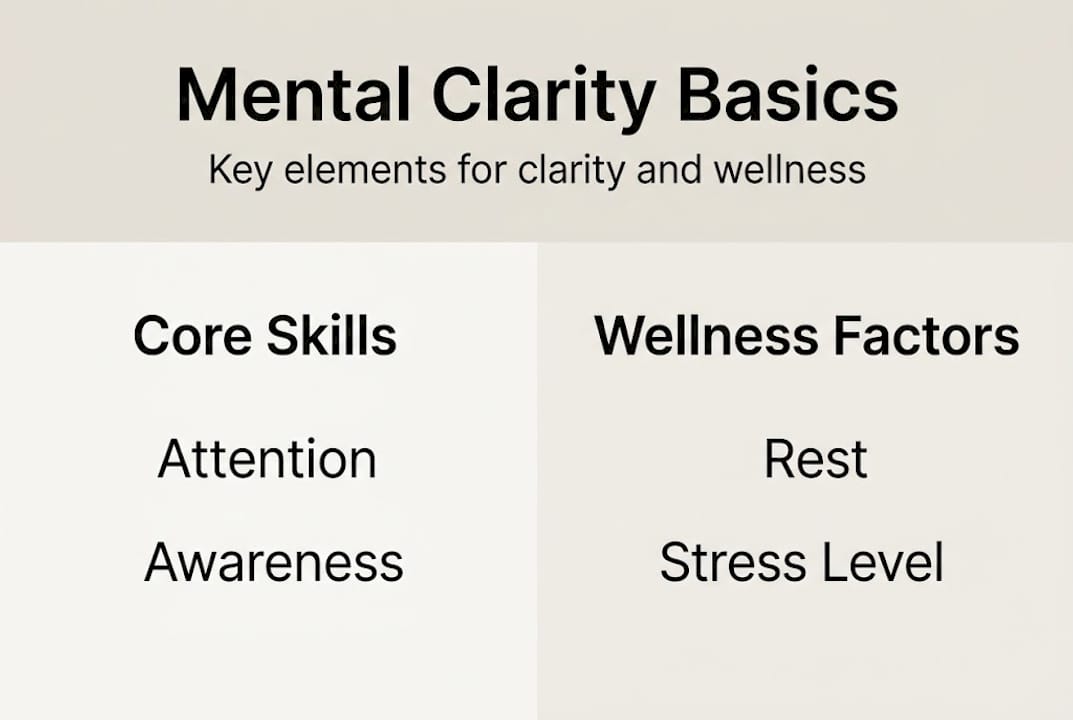
The most evidence-backed lifestyle levers for clarity are not glamorous, but they are foundational. Clarity fluctuates with sleep, nutrition, and stress, and this effect is amplified in knowledge workers, older adults, and people navigating hormonal changes. If your baseline clarity is chronically low, no amount of journaling will fully compensate for a body running on four hours of sleep and three cups of coffee.
Here are the lifestyle factors worth auditing first:
- Sleep consistency: Going to bed and waking at the same time daily stabilizes your circadian rhythm, which directly governs cognitive performance and mood regulation.
- Hydration: Even mild dehydration reduces attention and working memory. Most adults are mildly dehydrated before they feel thirsty.
- Single-tasking: Multitasking does not exist in any meaningful cognitive sense. Task-switching costs attention and increases error rates. Block time for one thing at a time.
- Movement: Even a 20-minute walk increases blood flow to the prefrontal cortex, the brain region most responsible for clear thinking and emotional regulation.
- Digital boundaries: Constant notification exposure fragments attention in ways that accumulate across the day, making deep focus feel increasingly difficult.
For those in edge cases, strategies need extra personalization. Older adults benefit from mindfulness practices for emotional well-being that are shorter and more structured. Knowledge workers dealing with decision fatigue need deliberate cognitive offloading, which is where journaling becomes practically essential rather than optional. People experiencing hormonal shifts should track their clarity alongside their cycle or relevant health markers to identify patterns rather than assuming bad days are random.
Pro Tip: Build your clarity system using an emotional well-being workflow that maps your habits to your actual energy patterns. When you stop fighting your natural rhythms and start working with them, consistency becomes far easier.
Improving self-awareness for clarity also means recognizing when your strategies are not working and adjusting without self-criticism. That adaptability is itself a sign of growing clarity.
Mental clarity: What most articles miss (and what actually works)
Most guides on mental clarity are essentially productivity articles wearing a wellness costume. They hand you a list of habits and imply that discipline is all you need. What they skip is the emotional honesty required to make any of it stick.
Here is what we have seen consistently: people who make real progress with clarity are not the ones who follow the strictest routines. They are the ones who build the habit of looking inward without flinching. Clarity is not just a cognitive achievement. It requires sitting with uncomfortable feelings long enough to understand what they are actually telling you.
Setbacks are not signs that the process is broken. They are data. When you lose your footing and your mind goes foggy again, that is not failure. That is the moment where genuine insights on introspection and mental health become possible. Self-compassion is not a soft add-on. It is the mechanism that keeps you coming back to the practice after a hard week instead of abandoning it.
Evidence-backed tools work. But they work because of consistent, honest engagement, not despite the messiness of real life.
Take the next step toward clarity and well-being
Understanding mental clarity is one thing. Building it into your daily life is another. The gap between knowing and doing is exactly where structured support makes the biggest difference.

Voisley brings together guided journaling, mood tracking, AI-powered insights, and personalized prompts into one private space designed for exactly this kind of work. Whether you are just starting to explore self-reflection or looking to deepen a practice you already have, you can explore mental clarity resources built around your emotional patterns. For practical strategies on combining journaling with modern tools, check out journaling and AI wellness tips that fit into real schedules and real lives. The next step toward clarity is already within reach.
Frequently asked questions
What causes brain fog and how is it related to mental clarity?
Brain fog is a disruption in mental clarity most commonly triggered by sleep deficits, poor nutrition, or chronic stress. Mental clarity is the broader positive state you are working toward, of which brain fog is simply the absence.
Can journaling improve my mental clarity?
Yes. Research shows that structured journaling increases mindfulness traits and reduces worry, both of which support sustained mental clarity over time.
Is mental clarity the same as being free from anxiety or depression?
No. Mental clarity is distinct from absence of mental illness and is better understood as a positive state of focus and emotional balance that can coexist with various mental health challenges.
How long does it take to see improvements in mental clarity?
A 12-week mindfulness and journaling intervention produced measurable improvements, though individual timelines vary significantly based on consistency and baseline habits.
Who is at greatest risk for persistent mental fog or impaired clarity?
Knowledge workers, older adults, and people experiencing chronic stress or hormonal changes are most likely to struggle with persistent mental fog and may need more tailored clarity strategies.