

TL;DR:
- Mental wellness tracking improves mood, sleep, and immune function regardless of format.
- Regular self-tracking enhances self-awareness by revealing emotional patterns and triggers.
- Personalizing tracking methods and focusing on honest, sustainable habits maximize long-term benefits.
Most people assume mental wellness tracking is reserved for those managing a diagnosis. That assumption leaves a lot of growth on the table. A 2025 study found that journaling is linked to lower stress hormones, improved mood, and reduced depressive symptoms, even in people without clinical conditions. Whether you journal on paper, use an app, or simply log your mood each morning, the act of paying attention to your inner world creates measurable change. This guide walks you through the science, the self-awareness gains, the common pitfalls, and the practical steps to make mental wellness tracking work for your real life.
Table of Contents
- The science behind tracking mental wellness
- How self-tracking increases self-awareness
- Common mistakes and how to avoid them
- Making mental wellness tracking truly effective
- Why mental wellness tracking is personal, not prescriptive
- Ready to start your own mental wellness journey?
- Frequently asked questions
Key Takeaways
| Point | Details |
|---|---|
| Science-backed benefits | Tracking mental wellness measurably improves mood, stress, and overall health. |
| Self-awareness boost | Regular tracking helps you identify emotional patterns and triggers for growth. |
| Balance is essential | Avoid tracking pitfalls by balancing awareness with action and self-care. |
| Personalize your practice | Customize your methods to achieve sustainable, meaningful mental wellness. |
The science behind tracking mental wellness
Let's get one thing straight: mental wellness tracking is not a trend. It is a practice with a growing body of research behind it. And the results are more impressive than most people expect.
A 2025 Nature Digital Medicine study found that journaling and self-tracking improve sleep quality, strengthen immune function, and reduce symptoms of both depression and anxiety. These are not minor quality-of-life bumps. They are meaningful, measurable shifts in how your body and mind function day to day.
Here is a snapshot of what the research shows:
| Benefit | Tracking method | Reported outcome |
|---|---|---|
| Reduced stress | Expressive journaling | Lower cortisol levels |
| Better sleep | Mood and sleep logging | Improved sleep quality |
| Fewer depressive symptoms | Daily journaling | Significant reduction |
| Stronger immunity | Emotional writing | Improved immune markers |
| Increased self-awareness | Prompted reflection | Greater emotional clarity |
The data is consistent across both digital tools and traditional paper journals. What matters is the practice itself, not the format.
Key benefits backed by science include:
- Mood regulation: Regular tracking helps you notice emotional shifts before they escalate.
- Stress reduction: Writing about feelings reduces the mental load of carrying unprocessed emotions.
- Sleep improvement: Logging your thoughts before bed clears mental clutter that disrupts rest.
- Cognitive clarity: Structured reflection strengthens your ability to think through problems calmly.
- Emotional resilience: Recognizing patterns over time builds your capacity to bounce back faster.
For anyone on a path of personal growth, these benefits are not abstract. They show up in how you handle a difficult conversation, how quickly you recover from a bad day, and how clearly you understand what you actually need.
If you want to go deeper on the methods that support these outcomes, journaling strategies for wellness and life journals techniques are worth exploring as practical starting points.
How self-tracking increases self-awareness
Knowing that tracking is good for you is one thing. Understanding why it builds self-awareness is where the real insight lives.
When you log your mood, note what triggered a reaction, or reflect on how a conversation made you feel, you are creating a record of your inner life. Over time, that record reveals patterns you would never catch in the moment. You start to see that your anxiety spikes on Sunday evenings, or that your energy dips after certain social interactions. That kind of clarity is genuinely hard to get any other way.

Research supports this directly. Self-reported tracking can detect early signs of depression and aligns closely with objective cognitive performance measures. In other words, what you notice about yourself is actually accurate and clinically meaningful.
Tracking also shifts you out of autopilot. Most emotional reactions happen fast, below conscious awareness. When you build a habit of reflection, you create a small but powerful gap between stimulus and response. That gap is where growth happens.
Here is what consistent self-tracking helps you identify:
- Emotional triggers: The specific situations, people, or environments that reliably shift your mood.
- Recurring patterns: Cycles in your energy, motivation, or anxiety that repeat across days or weeks.
- Needs and values: What consistently makes you feel fulfilled versus drained.
- Progress markers: Evidence that you are actually changing, even when it feels slow.
"Awareness is the first step. You cannot change what you cannot see."
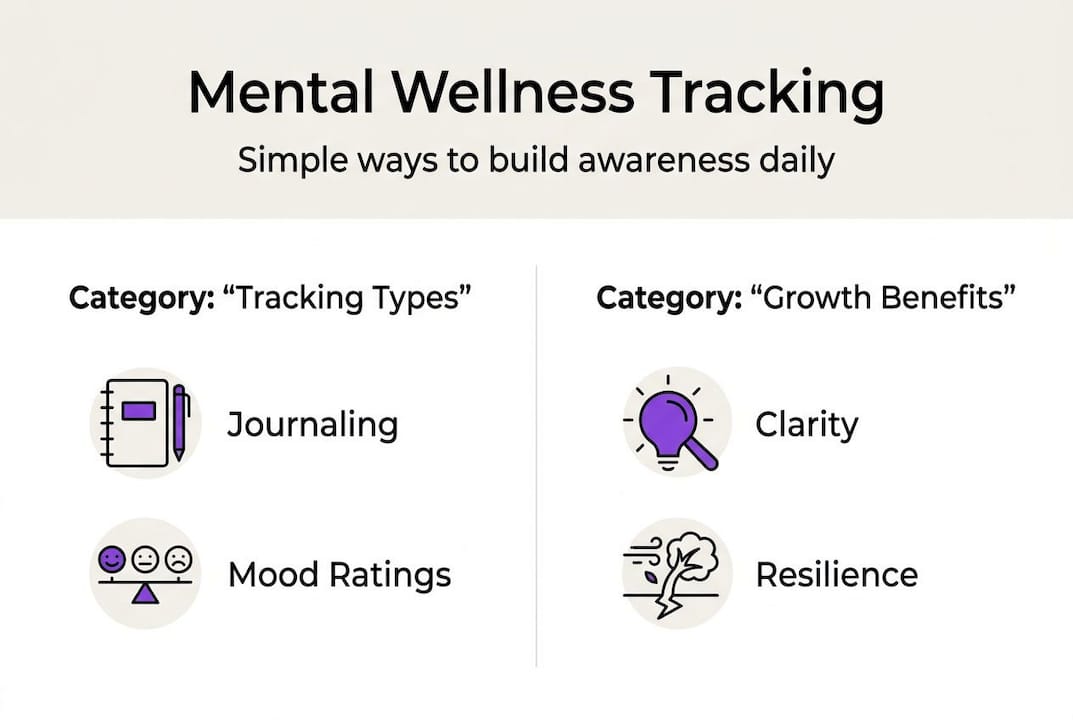
There are two broad types of tracking worth knowing about. Subjective tracking includes journaling, mood ratings, and written reflections. Physiological tracking includes wearable data like heart rate variability or sleep cycles. Both capture different dimensions of your wellness, and combining them gives you a richer picture.
Pro Tip: Start with just one daily prompt, such as "What emotion showed up most today and why?" Even a single sentence builds the habit and begins revealing patterns within weeks.
For a structured approach to recognizing your own emotional patterns journaling is a practical resource, and understanding introspection and mental health can help you use what you discover more intentionally.
Common mistakes and how to avoid them
Self-tracking is powerful, but it is not without its traps. The good news is that most pitfalls are predictable and easy to sidestep once you know what to watch for.
One of the most well-documented issues is orthosomnia, a term for the anxiety that develops when people become overly focused on their sleep tracker data. Tracking obsession can increase anxiety and paradoxically worsen the very outcomes you are trying to improve. This applies beyond sleep. Obsessing over any metric, whether it is your mood score, your stress level, or your journaling streak, can turn a helpful practice into a source of pressure.
Data fatigue is another real challenge. When you track too many things at once, the information becomes overwhelming and the habit collapses. Less is almost always more, especially at the start.
Here are the most common mistakes and how to handle them:
- Tracking without acting. Data only helps when it informs a decision or a behavior change. After each week, ask yourself: what does this pattern suggest I should do differently?
- Chasing perfect scores. A bad mood day is not a failure. It is information. Treat your data with curiosity, not judgment.
- Logging too many metrics. Pick two or three things to track consistently. Add more only after the habit is solid.
- Skipping reflection. Raw data without interpretation is noise. Build in a short weekly review to make sense of what you have logged.
- Comparing your data to others. Your baseline is yours. What looks like a low mood score for you might be perfectly normal for your patterns.
"The goal of tracking is understanding, not optimization."
Pro Tip: Set a "minimum viable log" for days when you are short on time. Even a single word describing your dominant emotion keeps the habit alive without adding pressure.
For more on building a sustainable practice, journaling and AI tips covers smart ways to stay consistent, and mindfulness practices for well-being offers complementary strategies that pair well with tracking.
Making mental wellness tracking truly effective
Tracking for its own sake will only take you so far. The real power comes when you pair observation with action.
Pairing tracking with actionable management strategies produces significantly better outcomes than passive logging alone. That means using what you discover to make real changes, whether that is adjusting your sleep schedule, setting a boundary, or adding a mindfulness practice to your morning.
Here is a comparison of tracking approaches and their practical impact:
| Approach | Format | Best for | Depth of insight |
|---|---|---|---|
| Daily mood log | App or notebook | Spotting emotional trends | Moderate |
| Prompted journaling | Guided questions | Processing specific events | High |
| Gratitude journaling | Short daily entries | Shifting negativity bias | Moderate |
| Shadow work journaling | Deep reflective writing | Uncovering core patterns | Very high |
| Wearable data review | Device app | Physiological awareness | Moderate |
To build a tracking practice that actually sticks, follow these steps:
- Choose one format. Pick digital or paper, prompted or free-form. Commit to it for at least 30 days before evaluating.
- Set a consistent time. Morning and evening are both effective. What matters is that it becomes a non-negotiable part of your routine.
- Review weekly. Spend 10 minutes at the end of each week identifying one pattern and one action it suggests.
- Adjust every month. What you track should evolve as your awareness grows. Drop what is not useful and add what feels missing.
- Celebrate small wins. Noticing a pattern you had never seen before is progress. Acknowledge it.
Pro Tip: Use a mental wellness checklist to structure your weekly review. It turns reflection into a repeatable, low-effort habit.
For a more structured system, an emotional well-being workflow can help you connect your tracking data to meaningful daily actions. And if you are new to the practice, a self-reflection journaling guide is a great place to start building your foundation.
Why mental wellness tracking is personal, not prescriptive
Here is something most wellness content will not tell you: there is no universally correct way to track your mental health. The research points to benefits, but it does not hand you a script.
We have seen people thrive with a single sentence a day. We have seen others need detailed prompted entries to feel like they are making progress. Both approaches work because both are honest. The moment tracking becomes a performance, something you do to feel like a good self-improvement person rather than to actually understand yourself, it loses its value.
Perfectionism is the enemy of this practice. Missing a day does not erase your progress. A week of low mood scores does not mean you are failing. Real growth is not linear, and your tracking data will reflect that. The goal is to stay curious about yourself, not to optimize yourself into a better-performing machine.
Using regulation journaling tips can help you stay grounded when the practice feels hard. But the most important thing is this: track for you, in a way that feels honest and sustainable. That is the only version that works long-term.
Ready to start your own mental wellness journey?
If reading this has made you want to actually try mental wellness tracking, you are already ahead of where most people start. The hardest part is not the tracking itself. It is building the habit and having the right tools to make sense of what you discover.

Voisley is built for exactly this. With guided journaling prompts, mood tracking, AI-powered insights, and multiple journal types including gratitude, shadow work, and future goals, it gives you a private, structured space to explore your emotional world. You can get started with Voisley today and join a community of people who are serious about understanding themselves and growing from the inside out.
Frequently asked questions
What is the most effective way to track mental wellness?
Combining journaling with actionable steps, like reviewing your entries weekly and adjusting your habits based on patterns, yields the best results compared to passive logging alone.
Can tracking mental wellness increase anxiety?
For some people, over-focusing on metrics can lead to data fatigue or orthosomnia, so keeping your tracking practice balanced and low-pressure is essential.
Do journaling apps work as well as paper journals?
Both digital and paper journaling show meaningful benefits for mood, sleep quality, and reducing symptoms of depression, so the best format is simply the one you will actually use.
How often should I track my mood or emotions?
Daily tracking tends to reveal the clearest patterns, but tracking a few times a week is also effective. Consistency over time matters far more than how often you log each week.