

TL;DR:
- Emotional health is the capacity to understand, regulate, and express emotions effectively.
- Structured practices like journaling and mindfulness build lasting emotional resilience.
- Consistent, targeted efforts improve relationships, stress coping, and overall well-being.
Emotional health is not simply about feeling good or dodging stress. Most people picture it as a mood dial you turn up or down, but the science tells a different story. Emotional health is the ability to understand, manage, reason with, and express your emotions effectively, and it shapes everything from how you handle conflict to how long you live. When you build it intentionally, through structured journaling, mindfulness, and self-awareness tools, you gain something far more durable than a good mood. You gain the capacity to grow through difficulty instead of just surviving it.
Table of Contents
- Defining emotional health: Beyond moods and emotions
- Why emotional health matters: Evidence and outcomes
- Core practices: Journaling, mindfulness, and self-awareness tools
- Addressing edge cases and tailoring interventions
- A fresh perspective: The real path to emotional growth is structured, not spontaneous
- Enhance your emotional health with Voisley
- Frequently asked questions
Key Takeaways
| Point | Details |
|---|---|
| Clear emotional health definition | Emotional health means understanding, regulating, and expressing emotions for optimal well-being. |
| Evidence-based methods | Mindfulness and structured journaling are scientifically proven to boost emotional wellness. |
| Tailored approaches matter | Interventions work best when customized for gender, culture, and personal needs. |
| Avoid suppression | Adaptive reappraisal is healthier than suppressing emotions, supporting long-term growth. |
| Start with tools | Try the STNE journaling framework or mindfulness exercises to begin improving your emotional health today. |
Defining emotional health: Beyond moods and emotions
People often use "emotions," "mood," and "emotional health" interchangeably. They are not the same thing, and blurring the lines makes it harder to actually improve any of them.
Emotions are brief, intense reactions to specific events. According to the APA's definition, they are complex psychological states involving a subjective experience, a physiological response, and a behavioral expression. Mood, on the other hand, is a longer-lasting background feeling that colors your day without a clear trigger. You might feel irritable for hours without knowing why. That is mood.
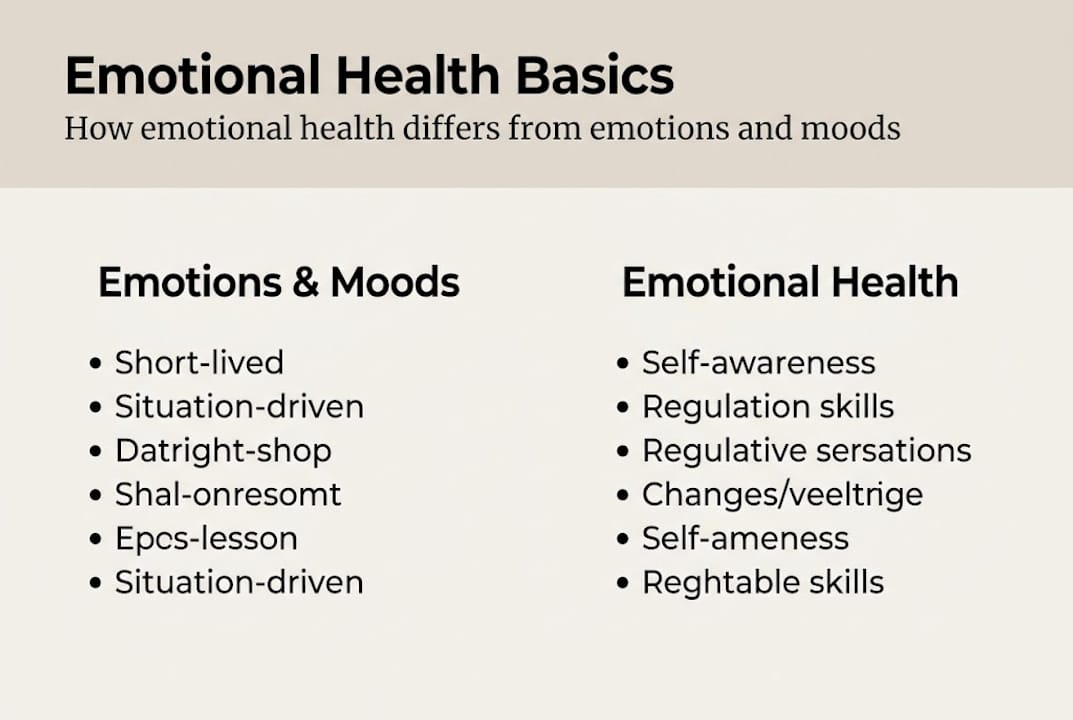
Emotional health sits above both. It is not a feeling itself but a capacity: the ability to recognize what you are feeling, understand why, regulate your response, and express it in ways that serve your relationships and goals. Think of it like physical fitness. Having strong legs is not the same as being in shape. Emotional health is the overall fitness level of your inner life.
Here is why this distinction matters in practice:
- Relationships: Emotionally healthy people communicate needs clearly and repair conflict faster.
- Decision-making: They are less hijacked by momentary feelings and more guided by values.
- Resilience: They bounce back from setbacks without prolonged rumination.
- Physical health: Chronic emotional dysregulation raises cortisol, which increases disease risk over time.
"Emotional health is not the absence of difficult feelings. It is the presence of the skills to move through them."
Emotional health overlaps with mental health but is narrower. Mental health covers the full spectrum of psychological and social functioning, including conditions like anxiety disorders or schizophrenia. Emotional health specifically concerns your relationship with your own emotional world. You can have strong emotional health and still struggle with a diagnosable mental health condition, and vice versa. Recognizing this helps you target your efforts more precisely.
Why emotional health matters: Evidence and outcomes
The research on emotional health is not soft or anecdotal. It connects directly to outcomes most people care deeply about.

A major finding from recent global well-being research shows that positive emotional health links to better relationships, stronger stress coping, higher self-esteem, lower disease risk, and greater longevity. The same research found that mindfulness for well-being mediates emotional intelligence, explaining up to 65% of the variance in internal emotional intelligence scores. That is a striking number. It means mindfulness is not just a relaxation technique. It is a core driver of how emotionally capable you become.
| Outcome | Emotional health impact |
|---|---|
| Relationship quality | Significantly improved communication and conflict repair |
| Stress resilience | Faster recovery, lower cortisol response |
| Self-esteem | Stronger sense of identity and self-worth |
| Physical health | Lower risk of chronic disease and inflammation |
| Longevity | Associated with longer, healthier life outcomes |
Some additional findings worth knowing:
- People with higher emotional intelligence report greater life satisfaction across cultures.
- Emotional well-being predicts workplace performance more reliably than IQ in many studies.
- Countries with higher average emotional well-being scores show lower rates of preventable illness.
The gender picture is nuanced. Women, particularly in individualistic cultures, report higher rates of negative emotional experiences on average. This does not mean women have worse emotional health, but it does mean that interventions need to account for context. A one-size approach misses real differences in how people process and express emotion.
The takeaway is clear: investing in emotional health is not a luxury. It is one of the highest-return investments you can make in your overall quality of life.
Core practices: Journaling, mindfulness, and self-awareness tools
Knowing emotional health matters is one thing. Building it is another. Three evidence-backed methods stand out above the rest.
1. Structured journaling Psychologist James Pennebaker's expressive writing research showed that writing about emotionally significant experiences improves immune function and psychological well-being. His model works because it forces cognitive processing, turning raw emotion into organized narrative. One practical framework is STNE journaling: Situation, Trigger, Name, Exploration. You describe what happened, identify what triggered your reaction, name the emotion precisely, and explore its roots. Journaling for wellness done this way is not venting. It is structured self-inquiry.
2. Mindfulness practices Mindfulness means paying attention to the present moment without judgment. For emotional health, it builds the gap between feeling and reacting. That gap is where choice lives. Mindfulness models show that consistent practice strengthens emotional regulation by training the prefrontal cortex to stay engaged even under stress.
3. Self-awareness tools Self-reflection journaling and mood tracking apps help you spot emotional patterns over time. Recognizing that you consistently feel anxious on Sunday evenings, for example, gives you something concrete to work with.
| Practice | Strengths | Ideal for |
|---|---|---|
| Structured journaling | Deep processing, narrative clarity | Those who think through writing |
| Mindfulness | Present-moment awareness, stress reduction | Those prone to rumination or reactivity |
| Self-awareness tools | Pattern recognition, emotional trend data | Those who benefit from visual feedback |
Pro Tip: If you are new to emotional health work, start with STNE journaling for just five minutes after a difficult moment. It builds the habit fast and delivers immediate clarity without requiring a big time commitment.
Addressing edge cases and tailoring interventions
Core practices work for most people most of the time. But emotional health is personal, and ignoring individual differences leads to frustration or even harm.
Gender and cultural context matter. Research shows that women report poorer emotional well-being more frequently, especially in individualistic cultures where emotional expression is less socially supported. This is not a fixed trait. It reflects context. Tailoring your approach means choosing practices that fit your social environment, not just copying a generic routine.
Mindfulness has a double-edged effect. When you start paying attention to your inner world, you may notice more distress before you notice less. This is normal. Awareness comes before regulation. Knowing this prevents people from quitting too early. If your discomfort spikes in the first two weeks of a mindfulness practice, that is often a sign it is working, not failing.
Here are the key distinctions to keep in mind:
- Adaptive reappraisal: Reframing a situation to change its emotional meaning. This is healthy and effective.
- Maladaptive suppression: Pushing feelings down without processing them. This increases stress long-term.
- Avoidance: Staying busy to escape uncomfortable emotions. Feels like relief but delays growth.
"The goal is not to feel less. It is to respond more skillfully to what you feel."
Using emotional regulation journaling can help you practice reappraisal in writing before you need it in real life. And self-awareness tips give you the language to name what is happening internally, which is the first step toward changing it.
Pro Tip: Keep a brief distress log when starting any new emotional health practice. If intensity increases for more than three weeks without any relief, consider working with a therapist alongside your self-practice.
A fresh perspective: The real path to emotional growth is structured, not spontaneous
Here is something most wellness content will not say directly: casual reflection does not build emotional health. Thinking about your feelings while driving or venting to a friend over coffee has value, but it rarely produces lasting change. The reason is simple. Without structure, the brain defaults to its existing patterns.
Empirical support is strongest for Pennebaker-style expressive writing and formal mindfulness training, not informal awareness. Structure is what makes the difference. A journal prompt forces you to engage with an emotion you would otherwise skim past. A timed mindfulness session prevents the mental drift that makes casual practice ineffective.
The people who see real results are not those who try harder. They are those who use adaptive tools consistently. Exploring life journaling techniques and science-backed regulation tips reveals a clear pattern: tailored, repeatable practices beat generic advice every time. Emotional growth is not spontaneous. It is designed.
Enhance your emotional health with Voisley
Putting these practices into daily life is where most people get stuck. The knowledge is there, but the structure is not.

Voisley brings together guided journaling, mood tracking, and AI-powered insights in one private space built specifically for emotional health. Whether you want to work through the STNE framework, track emotional patterns over time, or follow a structured well-being workflow, Voisley gives you the tools to make it repeatable. It is not about journaling more. It is about journaling with intention, backed by science, and tailored to how you actually feel.
Frequently asked questions
How is emotional health different from mental health?
Emotional health focuses specifically on understanding and managing emotions, while mental health covers the full range of psychological and social functioning. You can have strong emotional health and still face mental health challenges.
Can journaling really improve emotional health?
Yes. Structured journaling using frameworks like STNE and Pennebaker's expressive writing has proven benefits for emotional clarity, immune function, and overall well-being through cognitive processing of difficult experiences.
Are mindfulness practices suitable for everyone?
Mindfulness is broadly effective, but it may initially heighten distress awareness before regulation improves, particularly for women in individualistic cultures. A tailored, gradual approach is recommended.
What are the signs of good emotional health?
Good emotional health shows up as balanced reactions to stress, faster recovery from setbacks, strong relationships, and the use of adaptive coping strategies. Positive emotional health also correlates with lower disease risk and greater longevity.
How can I start improving my emotional health today?
Begin with five minutes of STNE journaling after a difficult moment and explore a short guided mindfulness session. Structured journaling and mindfulness are the most evidence-backed starting points available.