

TL;DR:
Emotional wellbeing is a dynamic capacity involving coping, purpose, relationships, and self-awareness.
Poor emotional wellbeing significantly increases health risks like mortality, stroke, and cardiovascular disease.
Practices like mindfulness, journaling, and helping others strengthen emotional resilience and overall health.
Emotional wellbeing is not simply the absence of anxiety or depression. Most people assume that if nothing is clinically wrong, they are doing fine emotionally. But emotional wellbeing is distinct from the absence of mental illness, and that gap matters enormously. How you process setbacks, connect with others, make decisions under pressure, and find meaning in daily life all depend on something far more active than just “not being sick.” This guide breaks down what emotional wellbeing actually is, what it costs you when it suffers, and which science-backed tools can help you build it intentionally.
Table of Contents
-
How emotional wellbeing empowers stress coping and decision-making
-
Methods that elevate emotional wellbeing: Mindfulness, journaling, and prosocial action
-
Most people get emotional wellbeing wrong: The deeper reason it matters
-
Take your emotional wellbeing to the next level with Voisley
Key Takeaways
| Point | Details |
|---|---|
| Wellbeing is multifaceted | Emotional wellbeing is more than the absence of illness and impacts every aspect of your life. |
| Research-backed tools work | Mindfulness, journaling, and prosocial action have measurable benefits for mental and physical health. |
| Consequences are tangible | Neglecting your emotional wellbeing carries increased risk for chronic diseases and social isolation. |
| Growth requires introspection | True personal transformation comes from self-reflection and daily emotional skill-building. |
Understanding emotional wellbeing: Beyond mental illness
Emotional wellbeing refers to your ability to manage feelings, cope with life’s demands, maintain meaningful relationships, and sustain a sense of purpose. It is not a fixed trait you either have or lack. It is a dynamic capacity that shifts with your habits, environment, and self-awareness practices.
The most important framework here is the dual-continua model. This model proposes that mental health and mental illness sit on two separate dimensions, not opposite ends of the same line. You can have low symptoms of depression and still feel emotionally flat, disconnected, or purposeless. Conversely, someone managing a diagnosed condition can still experience high levels of meaning, connection, and resilience. Emotional wellbeing is distinct from the absence of mental illness, enabling better coping, relationships, and functioning regardless of clinical status.
“Wellbeing is not merely the absence of disease or infirmity. It is a positive state of flourishing that includes purpose, connection, and the capacity to manage life’s challenges.”
This distinction matters because it shifts the goal. Instead of just avoiding symptoms, you are actively building something. Think of it like physical fitness. You can be free of injury and still be out of shape. Emotional wellbeing is the fitness level of your inner life.
Here are the core aspects of daily life that emotional wellbeing directly shapes:
-
Coping ability: How you respond to stress, loss, and uncertainty without being overwhelmed
-
Decision-making: Whether fear, impulsivity, or clarity drives your choices
-
Sense of purpose: How connected you feel to what you do and why it matters
-
Relationship quality: Your capacity for empathy, boundaries, and genuine connection
-
Self-awareness: Your ability to notice your own patterns before they control you
Understanding these dimensions is the foundation for self-exploration for clarity. The WHO well-being data consistently shows that populations with higher emotional wellbeing report better functioning across every life domain, from work performance to physical health outcomes.
Now that we have set the stage for why emotional wellbeing is a complex concept, let’s dig into how its absence affects our health and lives.
The consequences of poor emotional wellbeing
When emotional wellbeing suffers, the effects are not just psychological. They are measurable, physical, and expensive.
Global research is stark. Poor emotional wellbeing increases mortality risk by 14 to 32%, stroke risk by 32%, and cardiovascular disease risk by 29%. These are not marginal numbers. They rival the risk increases associated with well-known physical health behaviors like inactivity or poor diet.
| Health domain | Risk increase from poor wellbeing |
|---|---|
| All-cause mortality | 14 to 32% higher |
| Stroke | 32% higher |
| Cardiovascular disease | 29% higher |
| Anxiety and depression | Significantly elevated |
| Productivity loss | Major economic burden |
Beyond the heart and brain, poor wellbeing weakens immunity and raises vulnerability to chronic diseases. Sleep quality drops. Inflammation rises. The body and mind are not separate systems, and the data proves it.
The social cost is equally serious. Loneliness and social isolation, which often accompany poor emotional wellbeing, carry health risks comparable to smoking 15 cigarettes a day. That comparison is not metaphorical. It reflects real mortality data.
Here are the key health domains most harmed by sustained poor emotional wellbeing:
-
Cardiovascular health: Elevated stress hormones damage arterial walls over time
-
Immune function: Chronic emotional distress suppresses the body’s ability to fight infection
-
Sleep quality: Emotional dysregulation disrupts both sleep onset and depth
-
Cognitive performance: Persistent low wellbeing impairs memory, focus, and judgment
The financial toll is also real. Lost productivity, increased healthcare use, and reduced work engagement cost economies billions annually. For individuals, poor emotional wellbeing can quietly erode career momentum, relationship stability, and financial decision-making over years.
Building emotional resilience for growth is not a luxury. It is a practical investment in every area of your life. Recognizing how deeply poor emotional wellbeing can affect health, let’s explore the science behind tools that foster and protect it.
How emotional wellbeing empowers stress coping and decision-making
Emotional wellbeing does not just protect you from harm. It actively upgrades how you function. The mechanisms are specific and well-documented.
When your emotional wellbeing is strong, your nervous system regulates more efficiently. You recover faster from stress. You make decisions from a place of clarity rather than reactivity. You set boundaries without guilt and pursue goals without burning out. Emotional wellbeing supports stress coping, decision-making, and purpose, while poor wellbeing undermines immunity and sleep.

| Domain | High emotional wellbeing | Low emotional wellbeing |
|---|---|---|
| Stress coping | Flexible, recovery-focused | Rigid, avoidant, or reactive |
| Decision-making | Values-aligned, measured | Impulsive or fear-driven |
| Relationships | Empathic, boundaried | Withdrawn or conflict-prone |
| Sense of purpose | Clear and motivating | Vague or absent |
The good news is that wellbeing is trainable. Well-being interventions show moderate to large effect sizes (SMD 0.41 to 0.73), which means structured practices produce real, measurable change in how people feel and function.
Here are four steps to leverage emotional wellbeing for better daily outcomes:
-
Name your emotional state before reacting to a stressor. Labeling emotions reduces their intensity neurologically.
-
Pause before deciding on anything significant when you feel emotionally activated. Your prefrontal cortex works better when your nervous system is calm.
-
Practice mindfulness for wellbeing for even 10 minutes daily to strengthen emotional regulation circuits.
-
Use science-backed emotional regulation strategies like cognitive reappraisal to shift how you interpret challenging events.
Self-compassion is another powerful mediator. Research consistently shows that people who treat themselves with kindness during failure recover faster and make better subsequent decisions than those who engage in self-criticism.
Pro Tip: Practice self-compassion daily by writing three sentences after a mistake: what happened, how you feel, and what you would say to a friend in the same situation. This simple habit builds measurable resilience over time.
With a foundation in the science of stress coping and decision-making, how can individuals apply this knowledge for personal transformation?
Methods that elevate emotional wellbeing: Mindfulness, journaling, and prosocial action
Knowing that emotional wellbeing matters is one thing. Building it is another. The most effective tools are also the most accessible.
Mindfulness works by training your attention to stay present rather than spiraling into rumination or anxiety about the future. Mindfulness explains 65% of emotional intelligence variance and mediates wellbeing through improved emotion regulation. That is a striking number. It means that how mindful you are predicts how emotionally intelligent you are more than almost anything else.
Journaling is equally powerful and often underestimated. Writing about your thoughts and feelings for 15 to 20 minutes, three times per week, produces meaningful mental health symptom reductions. The act of translating emotion into language activates the prefrontal cortex and helps you process experiences rather than just react to them. Explore journaling strategies for wellbeing and journaling techniques for regulation to find the format that fits your life.
Here are practical strategies you can start this week:
-
Mindful breathing: Three minutes of focused breath before a stressful meeting or difficult conversation
-
Gratitude journaling: Write three specific things you appreciated today, not generic ones
-
Shadow work prompts: Explore what triggered you and why, using guided journaling for wellbeing
-
Emotional check-ins: Rate your mood twice daily and note the context around it
-
Life journal wellbeing methods: Use structured formats to track patterns over weeks, not just days
The neuroscience behind these tools is solid. Mindfulness and emotion regulation research shows that consistent practice physically changes brain regions involved in self-awareness and emotional control.
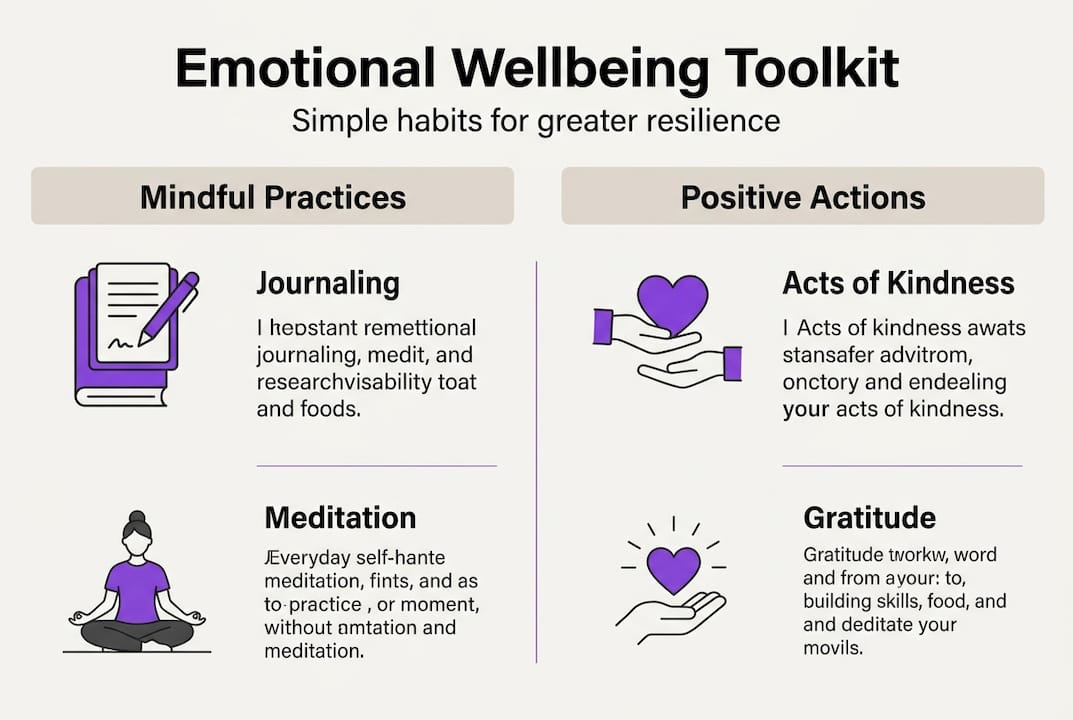
Prosocial behavior, meaning acts of kindness or helping others, rounds out the toolkit. Prosocial acts outperform self-care in reducing depression, anxiety, and loneliness. This is counterintuitive but well-supported.
Pro Tip: When you feel emotionally low, resist the pull to isolate and self-soothe. Instead, do one small act of help for someone else. The mood lift is faster and more durable than most solo self-care strategies.
Most people get emotional wellbeing wrong: The deeper reason it matters
Here is the uncomfortable truth most wellness content skips: emotional wellbeing is not a mood you manage. It is the lens through which you perceive everything.
Most advice focuses on fixing how you feel right now. Breathe. Sleep more. Take a walk. That is not wrong, but it misses the deeper layer. Real growth happens when you develop the skill of navigating emotional challenges, not just reducing their frequency. Well-being and ill-being overlap genetically but diverge environmentally, which means your daily choices and environment shape your wellbeing far more than your genes do after a certain point.
This is why passive self-care has limits. A bath relaxes you. But it does not teach you to recognize the pattern that caused your stress in the first place. Introspection does that. Journaling does that. Honest self-reflection, done consistently, rewires how you interpret and respond to your life.
The goal is not to feel good all the time. It is to get better at the full range of emotional experience. Track that skill, not your happiness score. Explore next-gen mental wellness tips to see how modern tools are making this kind of deep self-work more accessible than ever.
Take your emotional wellbeing to the next level with Voisley
Understanding emotional wellbeing is a powerful start. Applying it consistently is where lasting change happens.

Voisley emotional growth tools are built specifically for people who want to go beyond surface-level self-care. With guided journaling formats including gratitude, shadow work, and future goals, AI-powered mood insights, and visualizations that reveal your emotional patterns over time, Voisley gives you a structured, private space to do the real work. Whether you are just starting with journaling for emotional wellbeing or looking to deepen an existing practice, the platform meets you where you are and helps you build the emotional skills that actually move the needle.
Frequently asked questions
Is emotional wellbeing the same as mental health?
No, emotional wellbeing is broader. It includes how you manage feelings and find purpose, not just being free of mental illness. The dual-continua model shows these are two separate dimensions.
What are simple habits to improve emotional wellbeing?
Journaling, mindfulness, and helping others are proven to boost emotional wellbeing when practiced regularly. Even 15 to 20 minutes of expressive writing three times per week produces measurable improvements.
How does poor emotional wellbeing affect physical health?
It raises risk for chronic diseases, weakens immunity, and increases mortality. Global research links poor wellbeing to a 14 to 32% higher mortality risk and significantly elevated stroke and cardiovascular disease rates.
Does helping others really benefit my own wellbeing?
Yes, and the effect is stronger than most people expect. Prosocial acts can reduce depression and loneliness even more effectively than traditional self-care strategies.