

TL;DR:
- Introspective writing is a structured self-examination that promotes emotional clarity and supports mental and physical health. Research demonstrates that just 15 to 20 minutes daily can significantly reduce doctor visits, anxiety, and accelerate healing by activating rational brain processes. Consistent, compassionate self-inquiry deepens self-awareness and enhances well-being, especially when combined with professional support.
Most people think journaling means filling pages with complaints about their day or replaying conversations they wish had gone differently. That picture is incomplete. Introspective writing is a structured, evidence-based practice that produces measurable changes in both mental and physical health. Research from Pennebaker's studies and subsequent meta-analyses shows that just 15 to 20 minutes of focused expressive writing per day can reduce doctor visits by 47%, lower anxiety by up to 45%, and even accelerate wound healing. This article will show you exactly what introspective writing is, how it compares to other journaling styles, what the science says, and how to build a practice that actually sticks.
Table of Contents
- What is introspective writing?
- Introspective writing vs. other journaling styles
- The science behind introspective writing
- How to start (and sustain) a meaningful introspective writing practice-a-meaningful-introspective-writing-practice)
- The uncomfortable truth: Introspective writing is powerful, but only if you move beyond self-judgment
- Ready to deepen your journey? Explore more tools for growth
- Frequently asked questions
Key Takeaways
| Point | Details |
|---|---|
| Introspective writing defined | Going beyond surface journaling, this practice uses guided reflection to foster clarity and self-growth. |
| Benefits backed by science | Expressive writing can boost immunity, speed healing, and significantly reduce anxiety and depression symptoms. |
| Approach matters | Consistency and using insight-focused frameworks are more important than writing length for building new mental patterns. |
| Start with curiosity | The key to progress is a nonjudgmental, compassionate approach—be curious, not critical, about your emotions. |
What is introspective writing?
Now that we've established introspective writing offers more than just recording your day, let's break down what actually sets it apart.
Introspective writing is guided self-examination using written reflection. Instead of simply narrating events ("I had a hard meeting today"), it asks you to explore the inner experience underneath those events ("Why did that comment trigger such a strong reaction in me, and what does that reveal about my values?"). The shift is small in word count but enormous in impact. You are essentially turning your attention inward with a specific purpose: to understand yourself better.
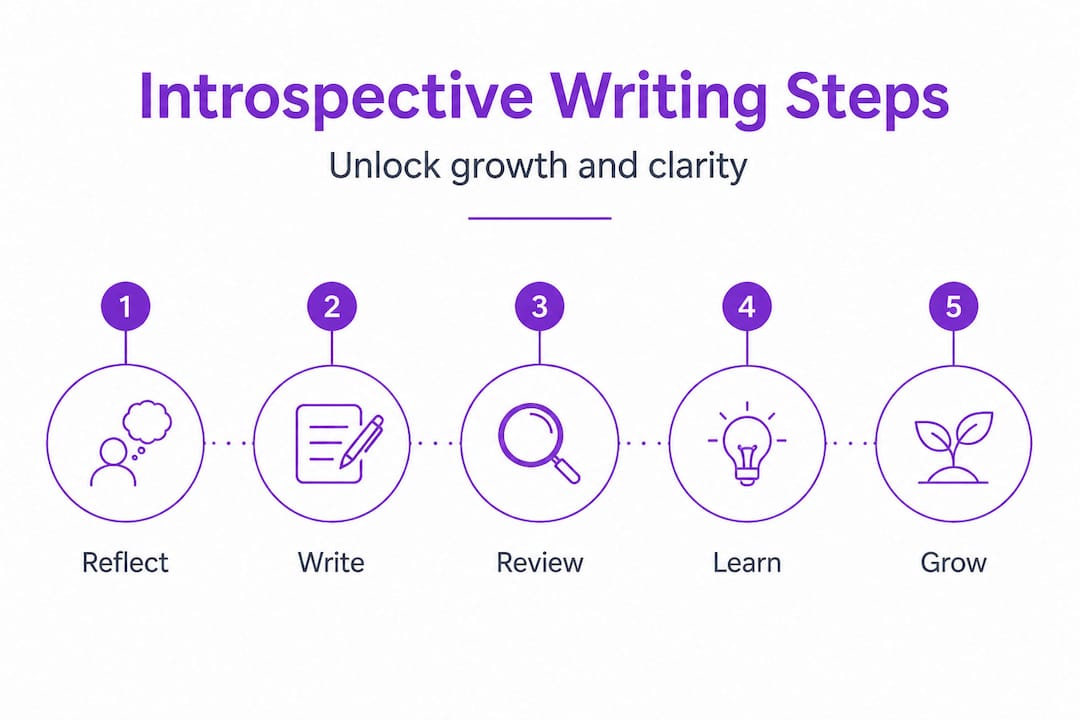
Introspection and mental health research shows that this kind of structured inner inquiry builds emotional clarity and supports pattern recognition, both of which are foundational skills for personal growth. When you can clearly name what you feel and trace why you feel it, you gain the ability to respond to your life rather than just react to it.
Here is a quick breakdown of what introspective writing is and what it is not:
- It is: Structured self-examination with intentional prompts or questions
- It is: Exploring feelings, motivations, values, and recurring patterns
- It is: A tool for cognitive processing and emotional regulation
- It is not: Unstructured venting without direction or purpose
- It is not: A simple record of daily events
- It is not: A replacement for therapy when clinical support is needed
- It is not: Something that requires perfect grammar or polished prose
"The goal of introspective writing is not to produce a flawless account of your feelings. It's to build emotional clarity and pattern recognition, the two core engines of lasting mental wellness."
Pro Tip: Approach every writing session with curiosity rather than self-judgment. Ask yourself "what is interesting about this feeling?" instead of "what is wrong with me?" That small reframe opens doors that self-criticism slams shut.
Introspective writing vs. other journaling styles
Having defined introspective writing, it's important to see how it fits into the broader landscape of journaling approaches.
Not all journaling is created equal, and reflective journal examples make it clear that different styles serve different purposes. The key is knowing which tool fits your current need. Using a diary-style approach when you are trying to process grief, for instance, is a bit like using a spoon to cut wood. It technically works, but not efficiently.
| Style | Focus | Depth | Best for |
|---|---|---|---|
| Diary/daily log | Surface events and facts | Low | Tracking schedules, recording memories |
| Reflective writing | Meaning and lessons learned | Medium | Academic growth, processing milestones |
| Introspective writing | Emotional patterns and self-discovery | High | Anxiety, identity work, personal growth |
| Expressive free writing | Emotional release without structure | Variable | Acute stress relief, creativity |
Context shapes which approach benefits you most, with structured introspective writing tending to outperform unstructured venting especially during periods of significant upheaval or stress. Simply put, when life feels chaotic, more structure in your writing produces more clarity in your mind.
Ready to shift from surface-level entries to insight-focused writing? Follow these steps:
- Start with an anchoring question. Instead of opening with "today I felt," open with "what was the most emotionally charged moment today, and why?"
- Follow the feeling, not the story. Once you identify the feeling, stop describing the event and describe the feeling itself: where it lives in your body, what memories it echoes, what it makes you want to do.
- Look for patterns across entries. After three or four sessions, read back and circle words or themes that repeat.
- Add a "so what" statement at the end. One sentence that captures what you are learning about yourself from this session.
- Gradually reduce description and increase analysis. Over time, aim for 30% event description and 70% emotional exploration.
This graduated approach helps you develop the internal language needed for genuine self-awareness without feeling overwhelmed on day one.

The science behind introspective writing
To understand why introspective writing gets such praise, let's examine the science and statistics that drive its reputation.
The psychological researcher James Pennebaker pioneered much of the foundational work in this field, and his findings along with later meta-analyses are striking. Writing about emotionally meaningful experiences for as few as 15 to 20 minutes per day produces changes that reach well beyond mood.
| Benefit | Finding |
|---|---|
| Immune function | Significant increase in T-lymphocyte (CD4+) response |
| Doctor visits | Reduced by up to 47% |
| Wound healing | 76% of writers healed faster vs. 42% of control group |
| Depression and anxiety | Symptoms reduced by 20 to 45% |
| Working memory | Measurable improvements after consistent writing |
| Stress processing | Faster cognitive integration of stressful events |
76% vs. 42%. That wound healing gap is one of the most surprising findings in the research. The idea that putting your emotional experiences into words can speed up physical recovery tells you something profound about the mind-body connection.
The mechanism works through what researchers call narrative processing. When you structure your experience into a coherent story with causes, consequences, and meanings, you activate the prefrontal cortex (the part of your brain responsible for executive reasoning) and reduce the hyperactivity of the amygdala (your brain's alarm system). In plain terms, writing helps your rational brain take back control from your emotional one.
Using specific types of language matters, too. Entries that contain "insight words" like realize, understand, and because, and "causal words" like since and therefore, are consistently linked to stronger mental health outcomes. The writing that builds journaling for emotional well-being is not just expressive. It is analytical. You are not just feeling. You are making sense of what you feel.
One additional finding worth noting: reflective journaling over a semester-long period significantly reduces what researchers call "interpretive anxiety," meaning the discomfort of not knowing what events mean. Over time, regular writers become more comfortable sitting with uncertainty and more skilled at finding meaning in difficult experiences. These are life skills that pay dividends far beyond the page.
For more life journaling techniques that put this research to work, there is a growing body of structured methods designed to maximize these specific benefits.
Pro Tip: Consistency matters far more than length. Three focused sessions of 10 to 15 minutes per week will outperform one exhausting 90-minute marathon. Think of it as exercise for your emotional brain. Short, regular workouts build more resilience than occasional all-nighters.
How to start (and sustain) a meaningful introspective writing practice
Knowing the science is one thing. The real change comes from practice. Here's how to get started, and why you'll want to keep going.
APA research on expressive writing confirms that success is tied directly to two factors: the use of causal and insight language in your entries, and the consistency of the practice rather than the length of each session. Aiming for 5 to 15 minutes three times a week is more effective than writing for hours once in a while.
Here is a straightforward framework for building your practice:
- Choose a consistent time. Morning writing processes lingering emotional residue from the previous day. Evening writing helps you decompress and identify what needs attention tomorrow. Neither is superior. Pick the one you will actually do.
- Create a low-friction environment. A dedicated notebook, a private digital app, or a quiet corner removes the activation energy that stops many people before they start.
- Use a starting prompt. Blank pages intimidate. Begin with a question like "What feeling am I carrying right now?" or "What am I avoiding thinking about?"
- Write toward insight, not output. Do not judge the session by how many words you wrote. Judge it by whether you learned something about yourself.
- Schedule a weekly review. Once a week, spend 10 minutes reading your recent entries. Look for repeating themes, emotional triggers, and shifts in your language.
This emotional self-reflection guide approach gives structure to what can otherwise feel like wandering in the dark.
What makes a session genuinely meaningful goes beyond just showing up:
- Regularity: Three sessions a week beats seven scattered ones
- Honesty: Write what you actually feel, not what you think you should feel
- Insight language: Use words like "I realize," "I notice," and "because" to deepen analysis
- Emotional specificity: Name the feeling precisely. "Frustrated" is different from "ashamed," and the distinction matters
- Non-judgment: Treat your entries like a curious scientist reviewing data, not a judge reading a confession
Guided journaling for clarity is especially helpful in the early stages when you are still learning to ask yourself the right questions.
When introspective writing serves as a self-coaching tool, approaching entries with compassion rather than self-criticism produces more durable growth. Think of yourself as your own wise mentor, asking gentle but honest questions. This is not about letting yourself off the hook. It is about creating the psychological safety needed for real honesty.
For people dealing with persistent rumination, trauma responses, or clinical depression, combining writing with professional therapy multiplies the benefit of both. Your journal becomes a source of material for therapy, and therapy gives you new frameworks to bring back into your writing.
Journaling prompts for growth can serve as a helpful bridge if you are not yet working with a therapist but want to deepen your self-inquiry in a structured way.
Pro Tip: At the end of each entry, write one sentence that begins with "I am learning that I..." This single habit accelerates pattern recognition faster than any other technique we have seen.
The uncomfortable truth: Introspective writing is powerful, but only if you move beyond self-judgment
Even with the best methods, many writers run into unseen hurdles. Here is a frank, experience-based perspective on the biggest one.
Most people who start introspective writing expect breakthroughs quickly. They dive in with genuine intention, and for a few sessions, it works beautifully. Then something shifts. They start writing and the pen fills with self-criticism. "Why do I always do this?" "I should be over this by now." "I am so bad at relationships." The session that was supposed to be growth-focused becomes a loop of self-blame.
This is the most common reason people quietly abandon their practice. Not because writing failed them. Because they confused self-examination with self-prosecution.
"The paradox of introspective growth is that nonjudgment accelerates insight far more effectively than criticism. You cannot think clearly about yourself when you are also attacking yourself."
Harsh self-criticism activates the same stress response that introspective writing is designed to calm. When you write from a place of shame or blame, the prefrontal cortex goes offline and the amygdala takes over. You end up generating emotional noise instead of genuine self-knowledge.
Sustainable progress comes from what researchers and practitioners call "compassionate witnessing." You observe your patterns without immediately judging them. You notice "I tend to withdraw when I feel criticized" instead of "I am a coward." The first is information you can work with. The second is just a closed door.
Pro Tip: Replace "why did I do that?" with "what can I learn from this?" The first question looks for a guilty party. The second looks for a lesson. Same event, completely different inner experience.
This shift does not mean avoiding hard truths. It means approaching them with enough steadiness to actually absorb them. Think of it as the difference between a surgeon who is steady and precise versus one who is frantic and frustrated. Both are dealing with the same wound. Only one is going to help it heal.
When you notice your writing turning toward repetitive self-blame rather than genuine inquiry, that is also data. It often signals a deeper belief worth exploring with professional support rather than alone on the page.
Ready to deepen your journey? Explore more tools for growth
Apply these lessons with the right support. Here's where to go next for hands-on tools and deeper insights.
Introspective writing is one of the most accessible, evidence-backed practices available for personal growth. But the tools you use matter just as much as the intention you bring.

Voisley was built specifically for people who want to take their inner work seriously. The platform combines AI-powered prompts, mood tracking, pattern visualization, and structured journal types like shadow work, gratitude, and future goals into one private, guided space. Instead of staring at a blank page, you get the right question at the right time, and your entries are analyzed to surface emotional trends you might miss on your own. Explore proven journaling strategies and start building the clarity you have been looking for.
Frequently asked questions
How long should I practice introspective writing for results?
Research suggests 15 to 20 minutes per session, or 5 to 15 minutes three times a week consistently, can produce measurable mental and physical health benefits without requiring marathon sessions.
Does introspective writing help with anxiety and depression?
Studies find expressive journaling reduces symptoms of depression and anxiety by 20 to 45%, especially when the writing focuses on processing stressful experiences rather than simply describing them.
What's the difference between introspective and reflective writing?
Reflective writing examines meaning and lessons from events, while introspective writing goes deeper to uncover emotional patterns and self-growth through structured inner inquiry focused on identity and values.
Can I use introspective writing along with therapy?
Yes, combining writing with therapy deepens self-discovery, especially for persistent rumination or complex emotional issues, because your journal entries become rich material to explore with professional guidance.