

TL;DR:
- Personal data, like mood logs and behavioral tracking, provides an objective mirror that reveals true emotional patterns over time. Tracking and reflecting on this data improve emotional differentiation, regulation, and self-awareness beyond simple intuition. However, excessive focus or unconstructive interpretation can lead to self-criticism, so intentional, balanced use of data is essential for genuine growth.
Most people assume that sitting quietly with their thoughts is the most powerful path to knowing themselves. That belief feels intuitive, but it leaves out something critical: the human mind is a notoriously unreliable narrator of its own story. We misremember how we felt last Tuesday, we rationalize our reactions, and we overlook patterns that repeat month after month. Personal data, collected intentionally through mood logs, journaling, and behavioral tracking, cuts through that fog. It hands you an objective mirror, one that reflects not who you think you are, but how you actually feel, move, and respond over time.
Table of Contents
-
How tracking and journaling reveal hidden emotional patterns
-
From information to transformation: Using data for emotional regulation
-
Potential pitfalls and edge cases: Are there downsides to all this data?
-
Our take: The surprising difference between knowing and growing
-
Ready to harness the power of data for your self-awareness journey?
Key Takeaways
| Point | Details |
|---|---|
| Data sharpens self-awareness | Tracking moods and habits helps you see patterns that are easy to miss with reflection alone. |
| Actionable insights drive growth | Real transformation happens when you apply data to adjust behaviors and emotional regulation. |
| Reflection prevents bias | Pausing to review your data helps you avoid misinterpreting numbers and leads to clearer insights. |
| Balance is key | Using data as a helpful guide, not a strict rule, prevents overwhelm and supports healthy progress. |
What is data-driven self-awareness?
Self-awareness is generally described as the ability to observe your own thoughts, emotions, and behaviors clearly. It sits at the core of emotional intelligence and guides everything from how you handle stress to how you relate to people around you. Traditional self-reflection, journaling in a freeform diary or simply thinking things over, is valuable. But it carries a significant limitation: it captures only the moments you choose to examine, filtered through whatever mood you happen to be in right now.
Data-driven self-awareness adds a layer of objectivity. Instead of asking “how do I generally feel about Mondays?”, you log your mood every Monday for three months and let the numbers answer. Personal data includes mood ratings, sleep duration, step counts, journaling entries, and habit completion. Together, these data points reveal patterns your narrative mind would miss entirely.
A foundational method for this kind of self-monitoring is the Experience Sampling Method (ESM). ESM involves prompting people to log their emotions multiple times per day, often through an app or scheduled reminders, rather than doing one big recap at night. Research confirms that self-monitoring via ESM not only records emotional states but actively improves your ability to tell emotions apart, a skill called emotion differentiation. A related ESM study in Nature found that this benefit extends even to clinical populations: people with depression who used ESM for six weeks showed measurable improvement in emotion differentiation, which directly supports better emotional regulation.
Here are some common misconceptions that hold people back from leveraging data for growth:
-
“I already know how I feel, so tracking is redundant.”
-
“Data turns emotions into cold numbers and removes meaning.”
-
“I only need to reflect when something big happens.”
-
“Journaling is enough; I don’t need an app.”
-
“Tracking mood is only for people with mental health diagnoses.”
Each of these misses the point. Data doesn’t replace meaning; it creates a foundation for finding it. You can explore more about the steps to improve self-awareness and the science and tools behind self-awareness if you want to go deeper on these foundations.
| ESM benefit | What it means for you |
|---|---|
| Higher emotion differentiation | You can tell anxiety from sadness, frustration from fatigue |
| Real-time logging accuracy | Fewer memory distortions than end-of-day reflection |
| Pattern detection over weeks | Reveals triggers invisible in single-session reflection |
| Improved regulation | Clearer emotions are easier to manage effectively |
How tracking and journaling reveal hidden emotional patterns
Once you understand the basics of self-monitoring, it’s time to see the practical impact of tracking and reflective journaling on emotional awareness.
Your gut feeling about your emotional life is often wrong in small but consequential ways. You might believe work stress peaks on Fridays, but your mood logs show Tuesday afternoons are the real trouble spot. You might think you feel best after socializing, but your data reveals that solo evenings with a book consistently produce your highest mood ratings. Tracking exposes these surprises.

Mood tracking tools, whether dedicated apps or consistent journaling, work because they create a time-stamped record. That record becomes searchable and visual. Therapists are increasingly recommending tools with real-time data to support therapy, emotional regulation, and personal growth, precisely because clients arrive at sessions with actual evidence rather than impressions.
Here’s a straightforward process to start building that evidence base for yourself:
-
Choose a consistent logging method, whether an app or a brief written entry.
-
Set two or three daily reminders to log your mood on a 1 to 10 scale.
-
Add a single sentence of context: “Had a difficult meeting” or “Went for a walk at noon.”
-
Review your entries once a week and look for repeating situations or scores.
-
After four weeks, identify your top three emotional triggers, both positive and negative.
-
Use that information to adjust one specific behavior or routine.
The contrast between gut-feeling awareness and data-backed awareness is stark:
| Gut-feeling awareness | Data-backed awareness |
|---|---|
| “I think I feel worse in winter.” | Logs show mood dips every November and February consistently. |
| “I feel fine most days.” | Data reveals low-grade anxiety every Sunday evening. |
| “Exercise helps sometimes.” | Step counts correlate with mood improvements the following morning. |
| “I snap at people when tired.” | Logs show sleep under six hours predicts irritability within 24 hours. |
Pro Tip: When you hit a low-mood period, pull up your mood visualizations from the previous month. Seeing that your mood has cycled before and recovered can interrupt the thought spiral that says “it’s always been like this.” Visualization turns abstract data into emotional evidence that you have navigated difficulty before.
For a structured introduction to how digital journaling tools support this process, the digital mental wellness tools overview is a solid resource. And for practical strategies to weave journaling into daily routines, explore wellness journaling strategies.
From information to transformation: Using data for emotional regulation
Now that you’ve identified patterns in your emotional landscape, discover how data translates into better regulation and well-being.
Knowing your patterns is the first move. Acting on them is where transformation actually happens. The research here is encouraging: physical activity data shows that step counts, standing time, and exercise are positively associated with mood, while sedentary time consistently pulls mood downward. The same research links emotion regulation strategies like cognitive reappraisal, the practice of reframing how you interpret a situation, to higher self-esteem and less emotional variability over time.
Even small amounts of movement count. Just ten minutes of moderate exercise produces a measurable boost in mood within the hour. When your tracking data confirms this connection in your own life, it stops being abstract health advice and becomes personal evidence you can act on.
Here are the key behaviors worth tracking if emotional growth is your goal:
-
Daily mood ratings (morning and evening to capture shifts)
-
Sleep duration and quality (even a rough estimate matters)
-
Physical activity (steps, workouts, or simply time spent moving)
-
Social interactions (who you spent time with and how you felt afterward)
-
Cognitive reappraisal attempts (did you consciously reframe a difficult moment?)
-
Gratitude or positive highlights (what went well, however small)
“Combining physical activity data with cognitive strategies like reappraisal creates a feedback loop where clients can see in real numbers that their coping efforts are working. That visibility is motivating in a way that general advice never is.” — Observation shared consistently by mental health practitioners working with tracking-based interventions.
Pro Tip: Not all data matters equally. If you track ten variables but only two actually correlate with your mood outcomes, tracking the other eight is just noise. After your first month, identify which data points move with your emotional state and focus your energy there. For a science-backed framework on how to apply these insights, the guide on science-backed emotional regulation breaks it down clearly. If you prefer a journaling-specific approach, the journaling techniques for mood resource offers seven practical methods.
The importance of reflection: Making sense of your data
With a foundation in practical tracking and emotional regulation, the next challenge is extracting meaning from your growing pool of personal data.
Data without interpretation is just numbers. This is where a concept from organizational learning, the Ladder of Inference, becomes genuinely useful for personal growth. The Ladder of Inference describes how we move from raw data at the bottom of the ladder to beliefs and actions at the top. The problem is that each rung involves filtering, and our existing biases quietly shape which data we notice, what meaning we assign to it, and what conclusions we reach.
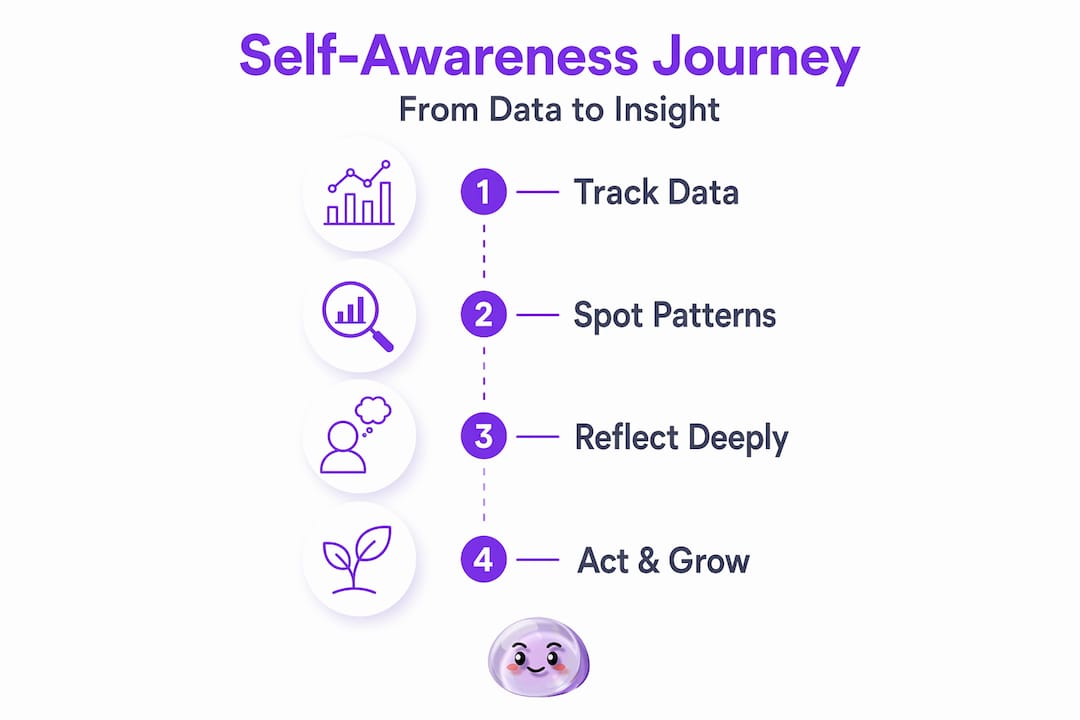
For example, you might track your mood for six weeks and notice several low scores during a particular project at work. Your brain might quickly climb the ladder: “I’m bad at this type of work. I should avoid leadership roles.” But the raw data might also show that those low scores clustered during a week when you slept poorly and skipped exercise. The numbers don’t tell the story on their own. Your reflective questions do.
Useful questions to ask yourself when reviewing your data:
-
What data am I not paying attention to, and why?
-
Am I interpreting this pattern based on evidence or on what I expected to find?
-
What alternative explanations could account for this trend?
-
What does my narrative about this data say about my current beliefs?
-
What is one small action this pattern suggests I could test?
“Without reflection, data collection risks becoming another form of avoidance, a way to feel productive about self-improvement without actually changing anything.”
The combination of quantitative tracking (your numbers) and qualitative reflection (your written interpretation) is what produces real insight. Numbers tell you what happened. Your reflective writing helps you understand why and decide what to do next. For more on why consistent monitoring supports growth, see tracking mental wellness for self-awareness.
Potential pitfalls and edge cases: Are there downsides to all this data?
While the transformative potential of data is clear, it’s honest to ask: what could go wrong or become counterproductive in this pursuit?
Self-discrepancy theory offers a useful caution here. When people become highly focused on the gap between who they are and who they want to be, that awareness can tip into self-criticism rather than growth. High self-awareness can amplify doubt, increase emotional sensitivity, and lead to over-analysis if the tracking is done without a constructive frame. Knowing you felt anxious fourteen times last month is only helpful if that knowledge points toward action, not toward a new layer of worry about why you feel anxious so often.
Watch for these warning signs that your tracking has shifted from a tool into a burden:
-
You feel stressed or anxious when you miss a logging session.
-
You spend more time analyzing your data than acting on it.
-
Your mood scores become a source of judgment rather than information.
-
You compare your emotional data to an ideal standard instead of your actual baseline.
-
You feel worse after reviewing your data, not more informed or motivated.
If any of these sound familiar, a simple reset helps: reduce logging frequency for two weeks and focus only on your single most meaningful metric.
Pro Tip: Use your tracking data as a compass, not a report card. It is there to help you navigate, not to grade you. When you notice a pattern you don’t like, the question is “what can I learn from this?” not “what does this say about my worth?” That mindset shift changes the entire relationship with your data.
Our take: The surprising difference between knowing and growing
Having examined the science and common pitfalls, here is a nuanced take that rarely gets said plainly: more data does not automatically mean more growth. We’ve seen this clearly through the patterns of people deeply engaged in self-tracking practices. The individuals who grow the most are not the ones collecting the most data points. They’re the ones who track a few things with intention, reflect on them honestly, and then act.
There’s a seductive quality to accumulating self-knowledge. You feel productive. You feel insightful. But insight sitting in a log is just archive. Growth requires that the insight change something, a decision, a habit, a conversation you finally have. Data is the beginning of that chain, not the end.
One observation worth taking seriously: sometimes stepping back from active tracking for a week or two produces more clarity than another month of data collection. When you’re immersed in daily logging, it’s easy to lose sight of the broader season of your life. A pause lets you sense the bigger picture rather than the daily fluctuations. Then when you return to tracking, you bring fresh context that makes the data more meaningful.
Explore improving emotional clarity for a practical look at how selective focus, rather than total coverage, builds lasting self-understanding.
Ready to harness the power of data for your self-awareness journey?
You now have both the science and the practical framework to make data work for your growth. The next step is putting these ideas into a structured, supported practice rather than attempting to build it from scratch on your own.

Voisley brings together guided journaling, mood tracking, AI-powered insights, and emotional regulation tools in one private space designed specifically for this kind of self-discovery. Whether you want to start with daily mood logs, try a shadow work journal, or explore gratitude prompts that surface emotional patterns, Voisley’s self-awareness tools give you the structure and the reflection frameworks to move from raw data to real, lasting change. Your patterns are already there. The right tools just help you finally see them.
Frequently asked questions
What is Experience Sampling Method (ESM) and how does it improve self-awareness?
ESM involves logging emotions multiple times daily, which reduces memory distortion and helps you notice subtle emotional patterns that single end-of-day reflection consistently misses.
How can mood tracking apps help with emotional regulation?
Mood tracking apps provide real-time data that shows emotional trends over time. Therapist-recommended tools use this data to help clients identify triggers and measure whether their coping strategies are actually working.
Are there risks to tracking too much personal data for self-awareness?
Yes. High self-awareness without direction can increase self-criticism and over-analysis, so it’s important to track selectively and use data as a guide rather than a judgment of your character.
Which data points are most useful for tracking emotional growth?
Step counts, activity levels, and reappraisal habits show the strongest links to mood and self-esteem, making them the highest-priority metrics for anyone focused on emotional well-being.