

TL;DR:
- Most people believe they know themselves well, but only 10 to 15% are genuinely self-aware, according to research. Developing true self-awareness requires deliberate attention to internal feelings and external perceptions, along with discomfort tolerance and consistent reflection practices. Using structured journaling, mindfulness, and specific feedback tools can effectively enhance self-understanding and emotional regulation.
Most people believe they know themselves well. The research says otherwise. Only 10 to 15% of people are genuinely self-aware, according to organizational psychologist Tasha Eurich, even though the vast majority of us are confident we fall into that small group. That gap between perceived and actual self-knowledge is where poor decisions, strained relationships, and emotional suffering quietly take root. This article breaks down exactly what self-awareness is, how psychology explains it, and which practical journaling and reflection tools give you the best chance of genuinely developing it.
Table of Contents
- What is self-awareness?
- Core theories of self-awareness: How science explains it
- Internal vs. external self-awareness: Why both matter
- Practical tools for building self-awareness
- Why most people miss true self-awareness: A perspective
- Ready to start your journey? Where to go next
- Frequently asked questions
Key Takeaways
| Point | Details |
|---|---|
| Self-awareness is rare | Only a small percentage of people are truly self-aware, defying common assumptions. |
| Two main types | Both internal and external self-awareness are essential for balanced emotional health. |
| Journaling works | Structured journaling is one of the most effective tools for building self-awareness. |
| Science supports reflection | Psychological theories show why reflecting on ourselves, even when uncomfortable, leads to growth. |
| Application is key | Putting reflective tools into daily practice is what transforms insight into lasting self-improvement. |
What is self-awareness?
Self-awareness sounds like a simple concept until you try to define it precisely. At its core, self-awareness is the capacity to focus attention inward and recognize your own personality, thoughts, feelings, motives, and behaviors. Notice the word "recognize," not "assume." Real self-awareness is active, not passive. It requires deliberate attention, not just a general sense that you know who you are.
Psychologists divide self-awareness into two distinct types:
- Internal self-awareness: Knowing your values, emotions, patterns, and what motivates or drains you.
- External self-awareness: Understanding how other people perceive you, your impact on those around you, and the gap between intention and effect.
Most people develop one more than the other. Someone might be deeply in touch with their inner emotional world yet completely blind to how their communication style frustrates colleagues. Someone else might be highly attuned to social feedback but barely connected to their own values or needs. True emotional intelligence requires both.
"Knowing yourself is the beginning of all wisdom." That quote, often attributed to Aristotle, has held up for millennia because it points to something fundamental: you cannot regulate what you cannot see.
The transformative role of self-awareness in personal growth is well documented. It shapes how we handle stress, conflict, and change. And it starts with honest, consistent attention to what is actually happening inside you rather than what you wish were true. If you are already tracking mental wellness in some form, you are already practicing one of its essential building blocks.
Core theories of self-awareness: How science explains it
Understanding the science helps you use self-awareness tools more intelligently. Here is what the major psychological frameworks actually say.
Objective Self-Awareness Theory (Duval and Wicklund, 1972) is one of the most foundational models. According to this theory, self-focused attention leads to comparing your current self against internal standards. When you notice a gap, you feel negative affect (discomfort, shame, or anxiety), which motivates either self-regulation (trying to close the gap) or avoidance (escaping the self-focused state entirely). This explains a familiar pattern: you start journaling honestly, hit an uncomfortable truth, and suddenly find yourself doing anything else.
Carver and Scheier's Cybernetic Control Model offers a different view. In their framework, comparison alone suffices to motivate self-regulation. Negative emotion is not the required driver. The process is more neutral and continuous, like a thermostat constantly adjusting toward a set point. This model explains why some people find self-reflection energizing rather than threatening.
Hull and Levy's Priming Model takes yet another angle: becoming self-aware activates relevant self-knowledge, making it easier to access and act on. Thinking about your patience, for example, primes your whole behavioral network around patience, making related memories and tendencies more accessible.
Here is how the three models compare:
| Theory | Core mechanism | Emotional component | Practical implication |
|---|---|---|---|
| Duval and Wicklund | Self vs. standard comparison | Negative affect drives change | Discomfort signals a growth opportunity |
| Carver and Scheier | Cybernetic feedback loop | Neutral, process-driven | Regular check-ins work without crisis |
| Hull and Levy | Self as knowledge prime | Activates relevant behaviors | Reflecting on a trait strengthens it |
What these theories collectively show is that self-awareness is not a fixed personality trait. It is a dynamic process that you can deliberately engage, and the effects of introspection on mental health are significant when done well. The challenge is that most people engage self-awareness reactively, only when something goes wrong, rather than building it as a regular practice.
Key insight: The theories also explain why avoidance is so common. If self-focused attention triggers discomfort (as Duval and Wicklund found), the human mind will naturally try to escape it. Building a consistent practice means learning to sit with that discomfort long enough to extract its value.
Internal vs. external self-awareness: Why both matter
The difference between internal and external self-awareness is more than academic. They operate differently, develop differently, and affect different areas of your life.
Internal self-awareness correlates more strongly with personal satisfaction, emotional regulation, and a clear sense of identity. When you know your values and can name what you are feeling in real time, you make choices that align with who you actually are rather than who you think you should be.
External self-awareness is harder to develop because it requires accurate information about how others perceive you, and that information is often filtered, softened, or simply never shared. Yet without it, blind spots accumulate. You might think you are being direct while others experience you as harsh. You might believe you are collaborative while colleagues feel overruled.
Here is a practical breakdown of the impacts:
| Type | What it includes | Life area most affected | Common blind spot |
|---|---|---|---|
| Internal | Values, emotions, drives, patterns | Personal wellbeing, decision-making | Confusing feelings with facts |
| External | Others' perceptions, social impact | Relationships, leadership, teamwork | Assuming impact matches intention |
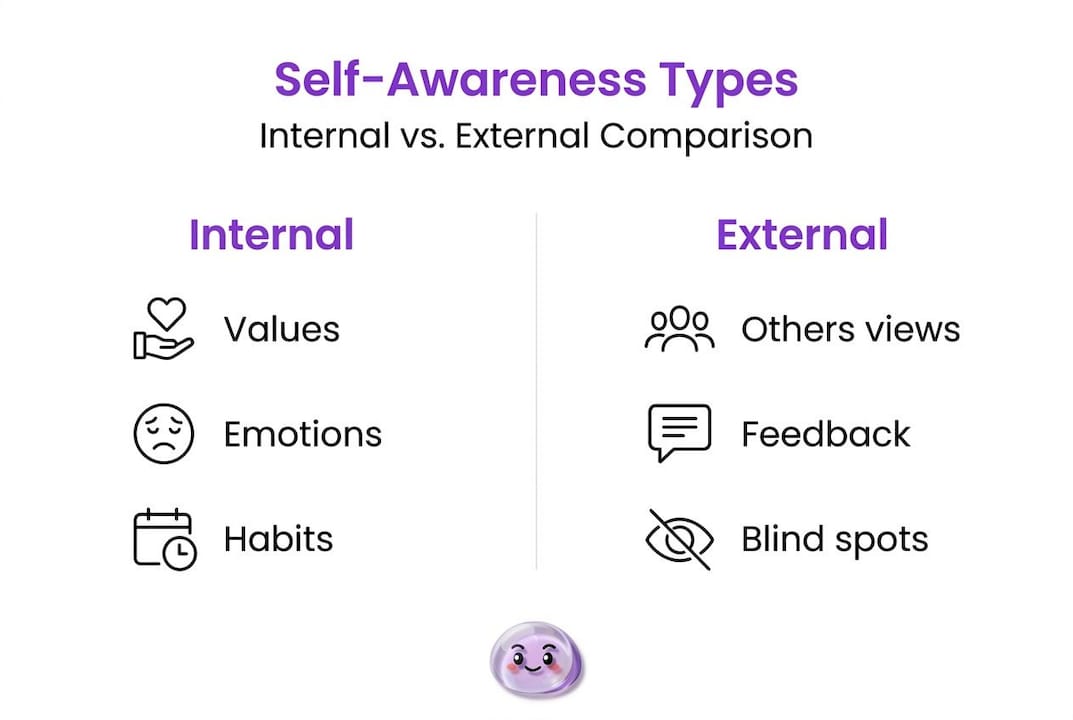
The healthiest approach treats both types as complementary, not competing. Knowing your benefits of self-reflection on inner clarity is important, but pairing it with regular feedback about external impact creates a fuller picture.
Here is how to start developing both simultaneously:
- Set a daily check-in time. A five-minute end-of-day pause to name your dominant emotion is internal self-awareness in its simplest form.
- Ask one trusted person for honest feedback monthly. Keep the question specific: "How did I come across in that meeting?" not "Am I a good communicator?"
- Track patterns over time. Single moments are noisy. Patterns are signal.
- Notice your triggers. The situations or people that consistently activate strong reactions tell you a great deal about your internal landscape.
- Compare intention with outcome. After important interactions, ask yourself whether the impact matched what you intended.
Pro Tip: When seeking external feedback, ask "what" questions rather than "why" questions. "What did you notice about how I handled that?" gets cleaner information than "Why do you think I reacted that way?" which can put people on the defensive.
You can find a curated list of ways to improve self-awareness that covers both internal and external development in more depth.
Practical tools for building self-awareness
Knowing what self-awareness is matters far less than actually building it. Here are the tools and routines with the strongest evidence behind them.
Journaling is the most accessible and well-researched method. Journaling works through a cognitive-affective-behavioral mechanism, meaning it simultaneously engages your thinking, your emotions, and your behavioral patterns. Writing forces you to externalize and examine internal experience rather than just cycling through it. A daily emotion log (simply noting what you felt, when, and what triggered it) begins to reveal patterns within two to three weeks.

Effective journaling for self-awareness is not freewriting. It is structured. Start with prompts like "What triggered my strongest emotional reaction today?" or "Where did my behavior match my values today, and where did it not?" These "what" questions surface information without spiraling into unproductive self-criticism. Research from Developing Self-Awareness specifically recommends using "what" prompts over "why" prompts to avoid rumination, the trap of asking "why am I like this?" without ever arriving at a useful answer.
Mindfulness and body scan meditation develop present-moment internal awareness. The goal is not to eliminate thought but to notice it without immediately reacting. Even five minutes of intentional breathing while scanning for physical sensations builds the muscle of noticing your internal state in real time. This is the foundation of emotional regulation.
360-degree feedback is the structured version of asking for external perspective. In professional settings, this involves collecting anonymous ratings from peers, managers, and direct reports across specific behavioral dimensions. In personal life, it looks like building a small circle of honest people you ask for regular, specific feedback. The key word is specific. "Be honest with me" is too vague. "I want to get better at listening. What do you notice when I am in a conversation?" is actionable.
Mindfulness pauses throughout the day are brief but powerful. Setting a reminder to stop and notice your emotional state three times per day builds the habit of checking in with yourself rather than running on autopilot.
Here is a simple daily routine to bring these tools together:
- Morning (two minutes): Set an intention based on one value you want to live today.
- Midday (one minute): Note your current emotional state and energy level.
- Evening (five to ten minutes): Journal using a structured prompt. Identify one moment you were proud of and one where you could have responded differently.
- Weekly: Review your journal entries for patterns. What emotions appeared most often? What situations kept triggering the same response?
Pro Tip: Link your journaling habit to something you already do, like your morning coffee or your evening wind-down. Habit stacking makes consistency far easier than relying on motivation alone.
The journaling for emotional well-being approach pairs especially well with mindfulness and journaling techniques for a layered daily practice. For a structured roadmap, the step-by-step guide to self-awareness walks you through building the habit progressively.
Why most people miss true self-awareness: A perspective
Here is the uncomfortable truth: the tools are widely available. Journaling apps, mindfulness courses, feedback models. None of them are hard to find. Yet only 10 to 15% of people are genuinely self-aware. That gap exists not because people lack information. It exists because true self-awareness requires something that information alone cannot provide: the willingness to be wrong about yourself.
Most self-reflection stops at the comfortable layer. People journal about their day without questioning whether their interpretation of events is accurate. They seek feedback but hear what they expected. They practice mindfulness but use it to feel calm rather than to notice difficult truths. This is not laziness. It is a deeply human protective response.
The real barrier is not a missing tool. It is avoidance, dressed up as practice. Someone who journals every day but never revisits uncomfortable entries is using journaling as release, not as inquiry. Both have value, but only one builds genuine self-awareness.
What separates the 10 to 15% from the rest is a tolerance for being surprised by themselves. They ask "what am I missing about this?" as a genuine question, not a rhetorical one. They understand that why self-exploration matters is not about feeling better in the moment but about building an accurate map of who they actually are.
The counterintuitive advice: stop trying to understand yourself and start trying to observe yourself. Understanding implies explanation and narrative. Observation is simpler. It just notices. "I got defensive when my partner gave feedback" is an observation. "I got defensive because I had a difficult childhood" might be an explanation that stops the inquiry rather than deepening it. Stay curious longer than feels comfortable. That is where the real insight lives.
Ready to start your journey? Where to go next
If this article has sparked something in you, the next step is not to think more about self-awareness. It is to start practicing it with structure and support.

Voisley is built specifically for this kind of intentional inner work. With guided journaling prompts, mood tracking visualizations, and AI-powered pattern recognition, it gives you a structured, private space to do the reflection work that most people attempt alone and abandon within a week. Whether you are starting with a gratitude journal, shadow work, or future goals mapping, the platform meets you where you are. Explore the tools for structured self-reflection and start building the self-awareness habit today, one entry at a time.
Frequently asked questions
What are quick daily activities to improve self-awareness?
Journaling emotions, mindfulness pauses, and asking yourself "what did I feel today?" are the fastest ways to build the habit. Consistency matters more than duration.
Is internal self-awareness more important than external?
Both types are essential for emotional intelligence, but internal self-awareness correlates more strongly with personal satisfaction and wellbeing. Neglecting external awareness, however, creates blind spots in relationships.
Why do most people overestimate their self-awareness?
Self-assessment biases, confirmation bias, and the discomfort of honest introspection cause most people to misjudge their own self-knowledge. Research shows only 10 to 15% of people meet the actual benchmark for self-awareness.
How does feedback help build self-awareness?
Seeking structured feedback exposes the gap between your intentions and your actual impact on others. Specific, behavioral 360-degree feedback improves external self-awareness faster than self-reflection alone.