

TL;DR:
- Most people overestimate their self-awareness, which can hinder personal growth.
- Building self-awareness involves practicing reflection, seeking feedback, and managing emotional responses.
- Consistent use of journaling, mindfulness, and honest feedback enhances self-understanding and emotional regulation.
Most people are confident they know themselves well. That confidence, it turns out, is part of the problem. Only 10-15% of people are truly self-aware, even though roughly 95% believe they are. That gap is not a small rounding error. It is the space where missed opportunities, repeated mistakes, and stalled growth quietly live. Real self-awareness is not about navel-gazing or journaling for the sake of it. It is the engine behind emotional intelligence, better decisions, and genuine personal development. This article walks you from confusion to clarity, with evidence-backed insights and practical tools you can use starting today.
Table of Contents
- What is self-awareness and why does it matter?
- How self-awareness accelerates personal and emotional growth
- Tools and techniques for building self-awareness
- Self-awareness in action: Overcoming common challenges
- A practical perspective: What most self-improvement advice misses
- Take the next step with guided self-awareness tools
- Frequently asked questions
Key Takeaways
| Point | Details |
|---|---|
| Self-awareness is rare | Most people believe they're self-aware, but research shows true self-insight is uncommon. |
| Drives personal growth | Understanding yourself boosts emotional intelligence and leads to smarter decisions and growth. |
| Practical tools work | Structured journaling, mindfulness, and feedback-seeking are proven methods to build self-awareness. |
| Iterative practice matters | Continuous reflection and adjustment are better paths to growth than seeking perfect self-knowledge. |
What is self-awareness and why does it matter?
Self-awareness is your ability to observe yourself clearly, understanding your emotions, motivations, strengths, and blind spots, and recognizing how your behavior affects others. It sounds simple. It rarely is.
Researchers break self-awareness into two distinct types: internal and external. Internal self-awareness is about understanding your own inner world. External self-awareness is about understanding how other people perceive you. Most people are stronger in one than the other, and that imbalance creates friction in relationships, careers, and personal growth.
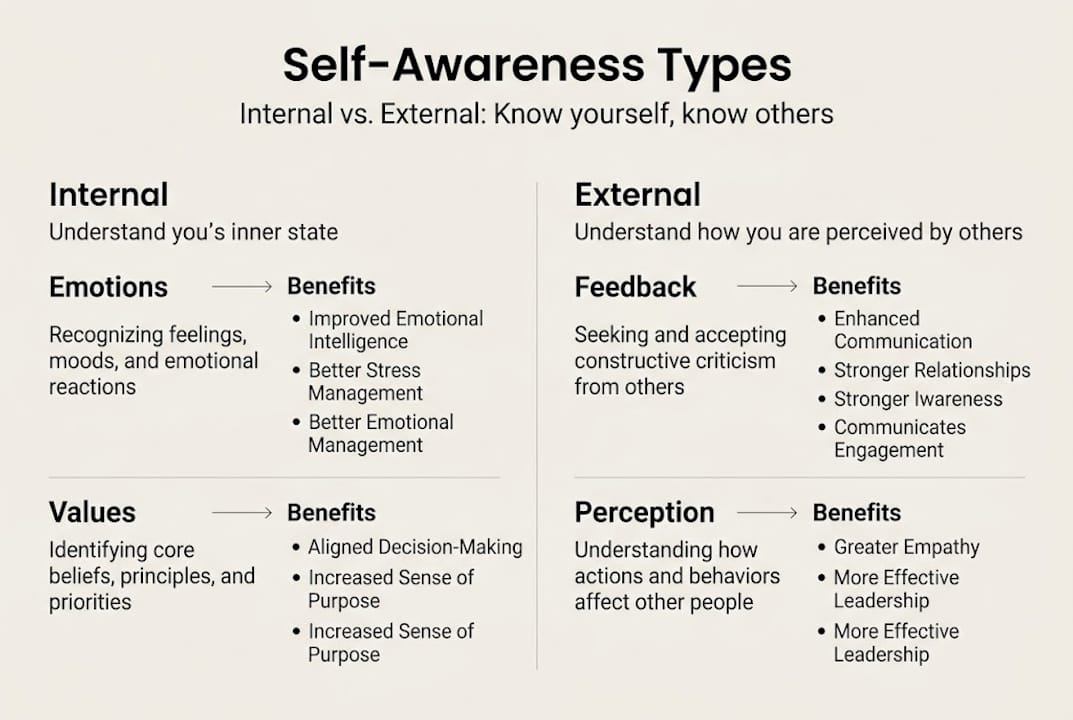
| Type | Focus | Example |
|---|---|---|
| Internal self-awareness | Your emotions, values, and drives | Noticing you feel anxious before conflict |
| External self-awareness | How others see your behavior | Realizing colleagues find you hard to read |
| Combined | Full picture of self and impact | Adjusting communication style after feedback |
Why does this matter so much? Because self-awareness is the foundational component of emotional intelligence, enabling recognition and understanding of your emotions, strengths, weaknesses, and their impact on behavior. Without it, emotional intelligence has no base to build on. You cannot regulate what you cannot name, and you cannot change what you refuse to see.
There are also some common self-awareness misconceptions worth clearing up early, because many people confuse self-awareness with self-criticism or overthinking. They are not the same thing.
Here are the core benefits self-awareness delivers for personal growth:
- Clearer decision-making: You spot your emotional triggers before they hijack your choices.
- Stronger relationships: You understand how your tone, habits, and reactions land with others.
- Faster learning: You recognize your patterns and adjust instead of repeating the same errors.
- Greater resilience: You can separate your identity from a bad day or a setback.
- Authentic confidence: Your self-image aligns with reality, so you stop second-guessing yourself.
Self-awareness is not a personality trait you either have or lack. It is a skill, and like any skill, it responds to deliberate practice.
How self-awareness accelerates personal and emotional growth
Understanding what self-awareness is opens the door. Knowing how it fuels growth is what gets you through it.
Self-awareness enhances personal growth through self-reflection, feedback-seeking, emotional regulation, and mindfulness practices. A growth mindset also positively correlates with self-regulated learning, meaning the more you believe you can grow, the more effectively you use self-awareness as a lever.
The data backs this up in concrete ways:
| Area | Impact of high self-awareness |
|---|---|
| Confidence | Stronger, more grounded sense of self |
| Workplace performance | Higher likelihood of promotions and pay increases |
| Relationship satisfaction | More empathy, less reactive conflict |
| Emotional wellbeing | Lower anxiety, greater sense of meaning |
The mechanism is a cycle, not a single step. Here is how it works in practice:
- Observe: Notice an emotional reaction or behavioral pattern without judging it.
- Reflect: Use reflection for growth to ask what triggered it and what it reveals about your values or fears.
- Seek feedback: Check your internal read against how others experienced the same situation.
- Adjust: Make one specific behavioral shift based on what you learned.
- Repeat: Each cycle builds a more accurate self-model over time.
Emotional regulation sits at the heart of this process. When you can name an emotion accurately, your nervous system responds differently than when you just feel overwhelmed. This is where mindfulness for emotional regulation becomes a practical tool, not just a wellness buzzword.

Pro Tip: Balance your internal and external perspectives deliberately. Spend one week journaling about your inner experience, then spend the next week asking two trusted people for honest feedback. The contrast will reveal more than either approach alone.
Tools and techniques for building self-awareness
Theory without practice stays theoretical. The good news is that the most effective tools for building self-awareness are accessible, low-cost, and backed by solid research.
Journaling, mindfulness, and feedback loops enhance emotional regulation and self-awareness, with 77% of people reporting that journaling reduces anxiety and clarifies their emotions. That is not a small effect. It means a structured writing habit is doing real psychological work.
Here are high-impact journaling prompts to try:
- What emotion showed up most strongly today, and what triggered it?
- Where did I act in line with my values, and where did I drift from them?
- What feedback have I been avoiding, and why?
- What pattern keeps repeating in my relationships or work?
- What would I do differently if I were not afraid of judgment?
For journaling for well-being to actually work, consistency matters more than length. Ten focused minutes beats an hour of scattered venting.
Building effective feedback-seeking habits takes a bit more structure:
- Identify two or three people whose observations you trust and who will be honest, not just kind.
- Ask specific questions rather than broad ones. "How did I come across in that meeting?" beats "Am I a good communicator?"
- Listen without defending. Your job in that moment is to collect data, not to explain yourself.
- Write down what you heard immediately after, before your brain starts editing the memory.
- Revisit it in a week to see what still rings true once the initial sting or flattery fades.
Pairing these techniques with journaling techniques for emotional regulation creates a feedback loop that is genuinely self-reinforcing. You notice more, you write more clearly, and your emotional self-reflection deepens with each cycle.
Pro Tip: Combine a five-minute mindfulness body scan with your journaling session. Checking in physically before writing helps you access emotions that are stored in tension, not just in thought.
Self-awareness in action: Overcoming common challenges
Even with the right tools, self-awareness work runs into real obstacles. Knowing what they are ahead of time makes them far less derailing.
Complete self-knowledge is unattainable due to cognitive biases, but iterative mindsets and self-efficacy predict wellbeing, and a growth mindset offers overall positive effects even when results are mixed. In other words, you do not need perfect insight. You need a practice that keeps improving your accuracy over time.
Here are the most common challenges and how to address each:
- Confirmation bias: You notice evidence that confirms your existing self-image and ignore the rest. Fix: Actively seek out disconfirming feedback.
- Emotional avoidance: You sidestep uncomfortable feelings instead of examining them. Fix: Use structured prompts that name the emotion first.
- Over-identification: You confuse your thoughts and feelings with your identity. Fix: Practice labeling emotions as events, not definitions. "I feel angry" not "I am an angry person."
- Inconsistency: You reflect deeply once and then drop the habit. Fix: Anchor journaling to an existing daily routine, like morning coffee or before bed.
- Harsh self-judgment: Reflection turns into self-attack, which shuts down honest inquiry. Fix: Write as if you are advising a close friend, not criticizing yourself.
The benefits of self-reflection are well-documented, but they only materialize when the practice feels safe enough to be honest. Creating that psychological safety for yourself is part of the work.
"Growth through self-awareness is not a destination you arrive at. It is a direction you keep choosing, one honest reflection at a time."
For practical self-reflection steps that make this sustainable, the key is building in small checkpoints rather than waiting for a major life review. Weekly is better than monthly. Daily is better than weekly.
A practical perspective: What most self-improvement advice misses
Here is something most guides on self-awareness quietly skip over: waiting until you fully understand yourself before taking action is itself a form of avoidance.
Real growth does not come from achieving perfect self-knowledge. It comes from treating your life as an ongoing experiment. You try something, you notice what happens, you adjust. The journal is not a record of who you are. It is a lab notebook for who you are becoming.
The people who grow fastest are not the ones with the deepest self-insight at the start. They are the ones who stay curious about their patterns instead of defensive about them. When you use tools like journaling to spot recurring themes, like the situations that always drain you or the moments when you consistently overreact, you are doing something more valuable than self-analysis. You are building a map.
Focus on discovering emotional patterns rather than chasing a complete self-portrait. Patterns are actionable. Perfection is not.
Take the next step with guided self-awareness tools
Building self-awareness is not a one-time exercise. It is a daily practice that deepens with structure, consistency, and the right support.

Voisley is designed exactly for this kind of intentional growth. With guided journaling prompts, mood tracking, and AI-powered insights, it gives you a structured space to explore your emotional patterns and build real self-knowledge over time. Whether you are working through shadow work, tracking gratitude, or setting future goals, Voisley's self-awareness resources meet you where you are. Explore journaling techniques for growth and start turning daily reflection into lasting change. Your next insight is closer than you think.
Frequently asked questions
Can self-awareness really improve my mental health?
Yes. Journaling reduces anxiety in 77% of people who practice it regularly, and combining it with mindfulness significantly strengthens emotional regulation over time.
What is the difference between internal and external self-awareness?
Internal self-awareness means understanding your own emotions and drives, while external self-awareness is knowing how others perceive you. Both are essential for balanced personal growth.
Which tools are best for increasing self-awareness?
Structured journaling, honest feedback from trusted people, and mindfulness exercises are the most evidence-backed methods for building self-awareness consistently.
Why is perfect self-knowledge impossible?
Cognitive biases and blind spots mean no one sees themselves completely clearly, but iterative self-reflection steadily improves accuracy and supports long-term wellbeing.