

TL;DR:
- Visualization is a structured mental practice that enhances self-confidence, reduces stress, and improves focus.
- Effective visualization involves intentional imagery, sensory engagement, and process rehearsal aligned with personal values.
- Combining visualization with journaling, mindfulness, and action enhances lasting self-growth.
Visualization gets a bad reputation. Most people hear the word and picture athletes closing their eyes before a big race, or self-help gurus telling you to "manifest" your dream life. Neither image captures what visualization actually is or what it can do for you. When practiced deliberately and grounded in real technique, visualization is a proven strategy that boosts self-confidence, reduces stress, sharpens focus, and builds emotional resilience. It's not daydreaming. It's a structured mental practice that reshapes how you think, feel, and respond to your own life.
Table of Contents
- What is visualization? Practical definitions and how it works
- Evidence for visualization in self-growth: What science tells us
- Pitfalls, limits, and common misconceptions of visualization
- How to practice effective visualization for self-growth
- Why visualization in self-growth is more nuanced than it seems
- Take your self-growth practice further with expert tools
- Frequently asked questions
Key Takeaways
| Point | Details |
|---|---|
| Evidence-backed benefits | Visualization enhances self-confidence, motivation, and emotional well-being when used strategically. |
| Integrate with action | Combining visualization with journaling and mindfulness maximizes its impact and avoids pitfalls like demotivation. |
| Know the limits | Visualization isn't a one-size-fits-all solution; adapt your practice and avoid over-relying on positive fantasizing. |
| Personalized approaches matter | Tailoring visualization techniques to your preferences, senses, and goals leads to the most reliable growth. |
What is visualization? Practical definitions and how it works
With the core benefits outlined, let's clarify what visualization truly means.
Visualization is the intentional practice of creating mental images, sensations, or narratives to simulate an experience, emotion, or outcome in your mind. Notice that word: intentional. Daydreaming happens by accident. Visualization happens by choice, with a specific purpose and structure.
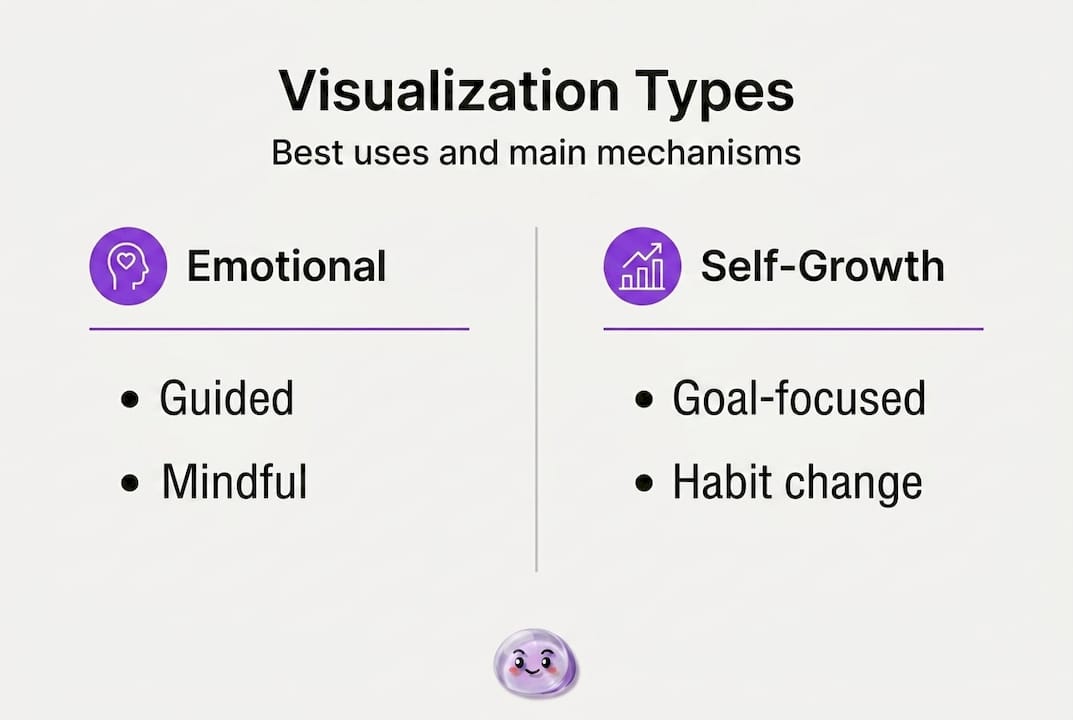
There are four main types worth knowing:
- Guided visualization: A narrated experience, often led by a recording or facilitator, that walks you through imagery step by step. This is ideal for beginners and for emotional regulation work.
- Mindfulness-based visualization: Anchored in present-moment awareness, this type blends sensory attention with imagined scenes to increase body awareness and reduce reactivity.
- Outcome visualization: Picturing the end result you want, such as feeling calm during a stressful conversation or reaching a personal milestone.
- Process visualization: Mentally rehearsing each step of a behavior or action, not just the finish line. Research in performance psychology shows this type is often more effective than outcome-only approaches.
The typical practice involves three layers: imagery (what you see in your mind), narrative (the story or sequence you follow), and sensory engagement (sounds, textures, emotions, and physical sensations you consciously bring in). The richer these layers, the more your brain responds.
Here's why that matters neurologically. Mental rehearsal activates similar motor and emotional brain regions as real experience, making it genuinely useful for emotional regulation, not just athletic performance. When you vividly imagine feeling calm while confronting a fear, your brain begins building pathways that support that calm response in real life. That's not metaphor. That's measurable neural activity.
Understanding your emotional health principles can help you appreciate why this mechanism is so significant. The brain prioritizes survival and pattern recognition, so any mental practice that creates new emotional patterns has real functional value.
| Type | Best for | Core mechanism |
|---|---|---|
| Guided visualization | Emotional regulation, beginners | Narrated imagery, external structure |
| Mindfulness-based | Self-awareness, stress reduction | Sensory attention, present-moment focus |
| Outcome visualization | Motivation, goal-setting | Future-state simulation |
| Process visualization | Habit building, skill rehearsal | Step-by-step mental rehearsal |
The crucial distinction between helpful visualization and harmful fantasizing is action orientation. Fantasizing is passive: you enjoy the image without any plan or engagement. Visualization is active: you use the image to prepare, regulate, or reinforce real behavior.
Pro Tip: Before each visualization session, write one sentence stating your intention. "I am practicing this to feel more grounded when anxiety rises" is far more effective than simply closing your eyes and hoping something good happens.
Evidence for visualization in self-growth: What science tells us
Now that you know what visualization is, let's explore what the research actually says about its impact on self-growth.
The evidence base for visualization has grown considerably over the past two decades, especially in sports psychology, clinical therapy, and mindfulness research. The findings are genuinely exciting, though they come with important nuances.
The strongest documented benefits include boosts in self-confidence, reduced stress and anxiety, improved focus and motivation, greater emotional resilience, and better decision-making under pressure. These aren't soft claims. They come from controlled studies across a range of populations, from athletes to patients managing chronic illness.
One particularly compelling area is interoception, which is your brain's ability to sense and interpret what's happening inside your body. Strong interoception is directly tied to emotional intelligence and self-regulation. Mindfulness-based visualization significantly improves interoceptive awareness and self-awareness, and this improvement correlates with reduced psychological distress. In plain terms: when you get better at sensing your own emotional states through visualization practice, you become more resilient and less reactive.
Here's how the evidence ranks by benefit magnitude and certainty:
| Benefit | Evidence strength | Context |
|---|---|---|
| Anxiety reduction | Very strong | Sports, clinical, mindfulness settings |
| Self-confidence | Strong | Performance and clinical research |
| Stress reduction | Strong | Mindfulness-based programs |
| Emotional resilience | Moderate | Mindfulness and guided imagery |
| Decision-making clarity | Moderate | Performance psychology |
| Long-term habit change | Emerging | Best when paired with action |
"The greatest value of visualization is not that it replaces effort, but that it organizes your emotional and mental resources so effort becomes more effective." This captures what the research repeatedly demonstrates: visualization amplifies the results of real action.
The numbered priorities for applying evidence-based visualization to self-growth are:
- Prioritize anxiety and stress reduction first, since this is where effects are most consistent and fastest to appear.
- Use visualization to reinforce self-confidence before challenging situations, not as a substitute for preparation.
- Combine with science-backed emotional regulation strategies for compounding effects.
- Practice mindfulness practices alongside visualization to sharpen interoceptive awareness.
- Track changes over time. Subjective improvement is real, but written records make patterns visible and keep motivation high.
Visualization works best when you treat it as a skill, not a shortcut. Like any skill, early sessions may feel awkward. Staying consistent for at least four to six weeks is where most of the research-backed benefits start to stabilize and compound.

Pitfalls, limits, and common misconceptions of visualization
Understanding the strengths is crucial, but knowing visualization's limits prevents disappointment and misuse.
Not everyone experiences visualization the same way. In fact, only about 3% of people can form truly vivid mental images, and a small percentage experience aphantasia, a condition where voluntary mental imagery is nearly absent. If you've ever tried a guided visualization and felt like the images just wouldn't come, you're not doing it wrong. Your brain may simply process mental simulation differently, which is completely workable with the right adaptations.
The more widespread problem isn't aphantasia. It's positive fantasizing without action. Research clearly shows that imagining a desired outcome in vivid, pleasurable detail, without connecting it to a real plan, can actually decrease motivation. Your brain partially registers the fantasy as achievement and reduces the drive to pursue the real thing. This is one of the most counterintuitive and important findings in the entire visualization literature.
Here's what that looks like in practice:
- Imagining yourself as calm and confident in social situations without also practicing the specific behaviors that produce calm
- Visualizing your future self as healthy without mapping out the actual steps to get there
- Using visualization as an escape from difficult emotions rather than a tool to process them
Perspective matters too. Third-person visualization can actually backfire for goals that aren't central to your identity. If you imagine yourself from the outside, like watching yourself in a movie, exercising more or eating differently, and that behavior isn't something you see as core to who you are, you may end up feeling less committed, not more. First-person visualization is generally safer for motivation when the goal feels personal and identity-linked.
Key risks to watch for:
- Using visualization as avoidance rather than preparation
- Practicing outcome-only visualization without process rehearsal
- Assuming more vivid imagery always equals better results (it doesn't)
- Applying the same technique to every goal regardless of fit
- Skipping any reflection or journaling after sessions, which limits learning
Understanding self-exploration for clarity becomes especially important here. If you don't know what your core values and identity actually are, you can't align your visualization practice with them effectively.
Pro Tip: After each session, write two sentences: one describing what felt true or resonant, and one describing what felt forced or hollow. Over time, this reveals which techniques actually fit you versus which ones you've borrowed from someone else's practice.
Statistic callout: Up to 3% of people experience aphantasia, meaning a complete or near-complete absence of voluntary mental imagery. Yet many of them report benefiting from other forms of visualization, including verbal, auditory, and written approaches, proving that vivid visual imagery is not a prerequisite for the benefits.
How to practice effective visualization for self-growth
Having confronted the pitfalls, you can apply visualization safely and effectively with the right practices.
Effective visualization isn't one-size-fits-all. The practice you choose should match your goal type, your natural cognitive style, and your current emotional needs. Here's a structured approach that works across a wide range of contexts.
Step-by-step guide to a structured visualization routine:
- Set a clear intention. Before you begin, write down what you want from this session. Emotional regulation? Confidence for an upcoming event? Processing a difficult memory? Clarity of intention changes the quality of the session entirely.
- Create a physical anchor. Sit comfortably, close your eyes if that helps, and take five slow, deliberate breaths. This signals to your nervous system that you're shifting into a different mode of attention.
- Choose your perspective. For identity-linked goals, use first-person. For skill rehearsal or emotional distance (such as processing a conflict), third-person can be useful but should be used carefully.
- Engage multiple senses. Don't just see the scene. What do you hear? What physical sensations are present? What emotions arise as the scenario unfolds? Richer sensory detail increases neural engagement.
- Rehearse the process, not just the outcome. Walk through the specific steps, the moments of difficulty, and how you navigate them. This is where process visualization earns its research credentials.
- Close with a grounding statement. Bring your attention back to your body and the present moment. Name one concrete action you will take today that connects to what you just visualized.
Journaling is one of the most underused tools for deepening visualization. Using journaling for emotional regulation as a feedback loop after each session creates a record of your emotional patterns over time. You begin to notice which types of visualization leave you energized versus drained, which mental images recur, and how your emotional reactions shift week to week.
Mental wellness journaling strategies pair naturally with visualization because both practices orient you toward honest self-observation, not performance or perfection. Together, they form a feedback cycle: visualize, notice, write, reflect, adjust.
For those with aphantasia or low visual imagery, the workarounds are practical. Focus on auditory cues rather than images. Write your visualization as a detailed paragraph before or after practice. Use guided audio recordings that describe scenes with rich language, even if the "pictures" don't form clearly.
Building this into your well-being workflow steps as a consistent habit matters more than the length of any single session. Ten focused minutes four times a week outperforms a single hour-long session done irregularly.
Pro Tip: Match your visualization type to your goal. If you want to feel more emotionally regulated day-to-day, use mindfulness-based visualization. If you're preparing for a specific challenge, use process visualization. If you're clarifying long-term values and direction, guided visualization with journaling integration gives you the most traction.
Why visualization in self-growth is more nuanced than it seems
Most self-help content treats visualization as a standalone tool: do the practice, get the result. That's not what the evidence shows, and it's not what we've observed works for the people who come to Voisley looking for real change.
What actually moves the needle is alignment. Visualization is most powerful when the image you're holding reflects a value or identity that genuinely matters to you, not a borrowed goal or a social comparison. When the mental scene you rehearse is rooted in who you are becoming rather than who you think you should be, the motivational effect compounds over time instead of fading.
The second underappreciated factor is tracking. Visualization without written reflection is like exercising without ever checking whether your fitness is improving. Emotional wellbeing for growth requires feedback loops, not just intention. Journaling after sessions turns vague subjective impressions into actionable data about your own emotional patterns.
Finally, no single method beats a combination. The people who see the most durable change combine guided visualization with mindfulness, journaling, and regular self-reflection. Not because each piece is weak, but because they reinforce each other in ways that no individual technique can replicate alone.
Take your self-growth practice further with expert tools
Ready to amplify your self-growth journey? Here's how you can continue evolving.
If this article has shifted how you think about visualization, the next step is building a practice that's structured, consistent, and tailored to how you actually process emotions.

Voisley was built for exactly this kind of work. The platform combines guided journaling prompts, mood tracking, and AI-powered insights to give you a private, structured space to practice self-reflection and emotional regulation every day. Whether you're working through anxiety, building self-confidence, or simply trying to understand your own emotional patterns more clearly, Voisley's tools meet you where you are. Explore the full range of journal types, visualization-supporting prompts, and pattern visualizations at voisley.com and take your practice from intention to real, measurable growth.
Frequently asked questions
What type of visualization is best for emotional regulation?
Mindfulness-based and guided visualization show the strongest evidence for improving emotional regulation, particularly because they improve interoceptive awareness and reduce psychological distress when practiced consistently.
Can visualization really change my habits or just my mindset?
Visualization can support habit change by increasing motivation and clarity, but durable results require pairing mental practice with concrete action steps and consistent tracking over time.
How can I practice visualization if I can't form vivid mental images?
Focus on auditory or kinesthetic cues, write out your visualizations in detail, or use guided audio formats. Research confirms only 3% form vivid images, yet many non-visual practitioners still gain meaningful benefits through alternative approaches.
Are there risks to using visualization for self-growth?
Yes. Pure positive fantasizing without grounded action steps can reduce real-world motivation, making consistent journaling and reflection essential safeguards for any visualization practice.
Should I use a first-person or third-person perspective in visualization?
First-person works best for identity-linked goals, while third-person perspective can reduce commitment for goals not central to your sense of self, so match your perspective to how personally meaningful the goal actually feels.