

TL;DR:
- Real self-growth involves gradual, consistent improvement through science-backed practices like self-awareness and emotional regulation. Expect modest, nonlinear progress over months, emphasizing patience and process-centered habits rather than quick fixes. Building self-awareness and reflection routines fosters lasting well-being and meaningful change.
Self-growth gets a bad reputation thanks to the wellness industry's obsession with radical reinvention. But empirical evidence shows that genuine progress looks more like effect sizes of 0.2 to 0.3 on well-being scales rather than dramatic overnight transformations. That gap between expectation and reality is exactly where most people lose momentum. This article cuts through the noise by offering you a grounded, science-backed look at what self-growth actually is, the frameworks that support it, the traps that derail it, and the everyday strategies you can start using right now.
Table of Contents
- Defining self-growth: Beyond the buzzwords
- How self-growth works: Frameworks and practical tools
- Common barriers and pitfalls: What gets in the way
- Applying self-growth: Everyday strategies for mindful development
- The uncomfortable truth most experts won't tell you about self-growth
- Explore resources for your self-growth journey
- Frequently asked questions
Key Takeaways
| Point | Details |
|---|---|
| Self-growth is gradual | Meaningful change emerges from consistent, iterative effort, not quick fixes. |
| Science supports mindful methods | Empirical research shows practices like mindfulness and self-affirmation boost wellbeing modestly. |
| Barriers affect progress | Rumination, emotional avoidance, and growth neuroticism can undermine self-growth if unaddressed. |
| Everyday strategies matter | Simple routines like journaling and mindful breathing make self-growth accessible and sustainable. |
| Personal wins over perfection | Focusing on individual progress and emotional regulation delivers authentic self-growth. |
Defining self-growth: Beyond the buzzwords
Self-growth is not a destination you arrive at after finishing a 30-day challenge or reading the right book. It is an ongoing, iterative process of expanding your self-awareness, managing your emotions more skillfully, and gradually closing the gap between who you are today and who you want to become. The key word here is gradual. Real growth compounds quietly, the way interest builds in a savings account you almost forget about.
The science backs this up in meaningful ways. Research links iterative growth mindsets to self-efficacy at a correlation of r=0.64 and to overall well-being at r=0.68. That is a robust relationship. It tells us that how you think about your ability to change is as powerful as the specific tool you use to change. Self-affirmation practices, for example, produce well-being effect sizes of 0.29 generally and 0.32 for self-perception, with even stronger delayed effects for people facing real barriers (g=0.36). These are not flashy numbers, but they are consistent and replicable, which matters far more.
Emotional wellbeing for growth sits at the center of the whole model. You cannot meaningfully develop yourself while ignoring how you feel, and self-awareness for growth is the lens that lets you see your patterns clearly before trying to change them.
Here are the four core pillars that genuinely drive self-growth:
- Mindset: Believing that your traits and abilities can evolve with effort, even modestly
- Self-awareness: Observing your thoughts, emotions, and behaviors without judgment
- Emotional regulation: Responding to difficult feelings rather than reacting impulsively
- Self-affirmation: Reconnecting with your core values to buffer against stress and threat
"Most people treat self-growth as something that happens to them during peak moments. The research suggests it happens through them during ordinary, repetitive practice."
Research snapshot: What the evidence says
| Outcome | Finding | Effect size / correlation |
|---|---|---|
| Self-efficacy and growth mindset | Strong positive link | r = 0.64 |
| Well-being and growth mindset | Strong positive link | r = 0.68 |
| Self-affirmation on general well-being | Moderate improvement | ES = 0.29 |
| Self-affirmation on self-perception | Moderate improvement | ES = 0.32 |
| RMERT training on emotional regulation | Significant gains in nursing students | Clinically meaningful |
The table above is not meant to intimidate you with numbers. It is meant to reassure you: the practices that help are known, tested, and accessible to anyone willing to be consistent.
How self-growth works: Frameworks and practical tools
Now that we have defined self-growth, let's look at the actionable frameworks and practical tools that can help you start applying it every single day.
The most important shift you can make is from a milestone mindset to an iterative mindset. Instead of waiting to "complete" your self-growth journey, you make small, regular adjustments the way a sailor corrects course every few minutes rather than steering once and hoping for the best. This approach is less glamorous but far more effective.
RMERT training, which stands for Reflective Mindfulness and Emotional Regulation Training, was developed in healthcare education contexts and has demonstrated significant improvements in self-awareness and emotional regulation among nursing students. The mechanism is straightforward: structured, repeated reflection builds neural pathways that make emotional awareness feel automatic over time rather than effortful. You do not need a formal training program to apply this principle. You just need consistency.
Here is a comparison of the main self-growth frameworks so you can find the right fit for your current season of life:
| Framework | Core mechanism | Best for | Time investment |
|---|---|---|---|
| Mindfulness practice | Present-moment awareness | Anxiety, stress, reactivity | 10 to 20 min/day |
| Reflective journaling | Structured written self-inquiry | Clarity, pattern recognition | 10 to 15 min/day |
| RMERT | Guided mindful reflection with emotional focus | Deep emotional regulation | Weekly sessions |
| Self-affirmation | Values-based positive self-statements | Confidence, resilience | 5 min/day |
When it comes to emotional regulation strategies, journaling stands out as one of the most versatile entry points. It costs nothing, requires no special skill, and creates a tangible record of your emotional patterns over time. Pair that with self-reflection techniques and you have a two-part system that covers both the noticing and the processing stages of growth.
How to start mindful journaling for self-growth (step by step):
- Choose a consistent time. Morning or evening works equally well. The point is regularity, not timing.
- Start with a prompt. Try: "What emotion showed up most strongly today, and where did I feel it in my body?"
- Write without editing. Let thoughts appear unfiltered for 5 to 10 minutes. Editing comes later, if at all.
- Identify one pattern. After writing, underline or circle one recurring theme or feeling.
- Name a small next step. Ask yourself: "What is one tiny thing I can do differently tomorrow?" Write it down.
- Review weekly. Once a week, read back through your entries and notice what has shifted, no matter how small.
If you want a simple checklist to track these habits over time, the growth habits checklist is a great starting point for building your routine.
Pro Tip: Shorter, daily sessions of 5 to 15 minutes outperform occasional marathon journaling sessions. Consistency trains your brain to enter a reflective state more quickly each time, making the practice progressively easier and more rewarding.
Common barriers and pitfalls: What gets in the way
With practical frameworks in hand, it is crucial to navigate the common obstacles and misconceptions that can stall progress, sometimes for years without you even realizing it.

One of the most counterintuitive findings in self-growth research is that asking yourself why you behave a certain way can actually make things worse. "Why" questions tend to spiral into rumination, pulling you into loops of self-blame and hypothetical reasoning rather than productive insight. "What" questions work far better. "What was I feeling?" and "What did I want in that moment?" tend to generate self-compassion and actionable clarity instead.
Another major barrier is emotional avoidance. When people encounter discomfort during self-reflection, the natural response is to step back from the process entirely. This creates a frustrating paradox: the moments that feel most uncomfortable to examine are usually the ones most worth exploring. Building the capacity to sit with difficult emotions, even briefly, is itself one of the most valuable self-growth skills you can develop.
Perhaps the most sobering finding concerns the limits of self-help products themselves. Studies tracking over 2,391 participants found no significant personality trait change after two years of using popular self-help tools. This does not mean self-growth is impossible. It means that passive consumption of self-help content (books, podcasts, courses) without active, reflective practice rarely moves the needle on deep change.
Most common self-growth pitfalls and how to avoid them:
- Seeking rapid transformation: Expect gradual, cumulative progress instead of sudden breakthroughs
- "Why" questioning spirals: Replace "Why am I like this?" with "What was I feeling when this happened?"
- Growth neuroticism: Pursuing self-improvement to prove your worth rather than to genuinely thrive; this pattern correlates with anxiety and depression
- Passive consumption: Reading about growth is not the same as practicing it; always link content to a specific action
- Skipping emotional check-ins: Tracking your mental wellness over time reveals patterns that one-off reflections miss entirely
- Perfectionism: Waiting for the "right moment" to start, or abandoning a practice after one missed day, destroys momentum faster than almost anything else
The self-reflection benefits you are after become accessible only when you have removed the landmines of rumination and unrealistic expectation from your path.
Pro Tip: If you notice that your self-growth efforts feel urgent, driven by shame, or connected to proving something to others, pause. Shift your internal framing from "I need to fix myself" to "I am curious about myself." That single shift from judgment to curiosity defuses growth neuroticism before it takes root.
Applying self-growth: Everyday strategies for mindful development
Armed with awareness of common pitfalls, let's explore practical ways to embed self-growth into your daily life for lasting well-being.
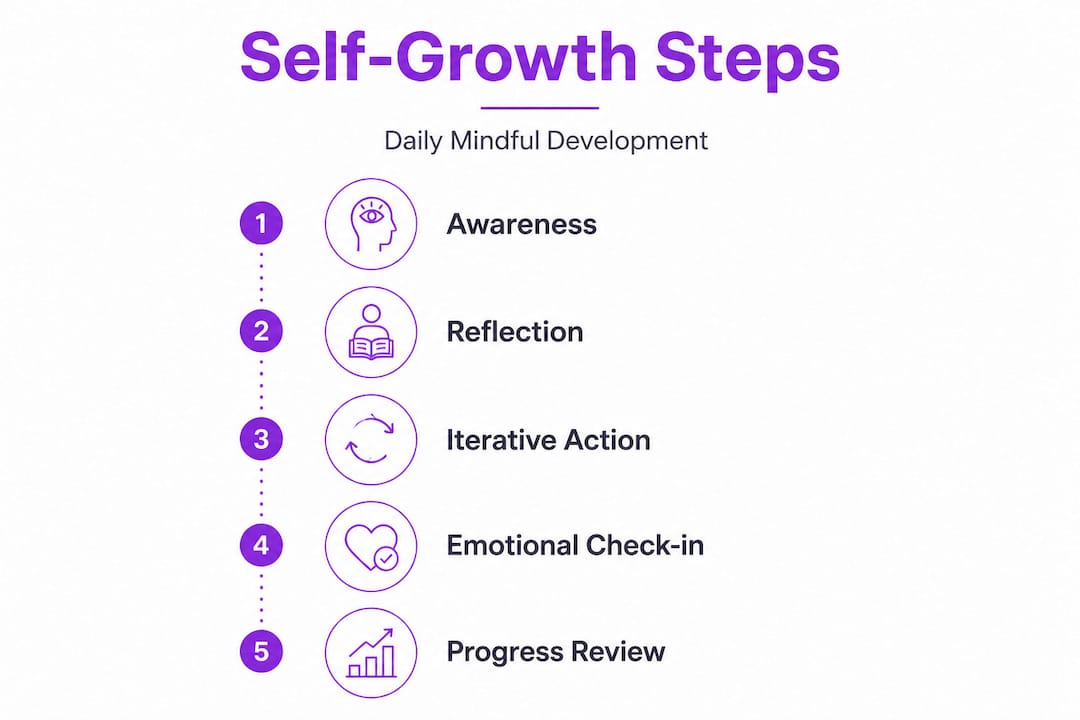
The research is clear that measurable well-being gains with effect sizes in the 0.2 to 0.3 range are achievable through consistent, science-based practice. Those numbers might sound small, but they translate into real-life differences: better emotional resilience, more stable relationships, clearer decision-making, and a quieter inner critic. Small shifts accumulate.
Everyday actions to anchor your self-growth practice:
- Spend 3 to 5 minutes on mindful breathing before checking your phone in the morning
- Write one sentence in a journal each evening about what emotion was most present that day
- Practice a brief body scan at midday to notice physical tension linked to emotional stress
- Celebrate one small win per day, no matter how minor it seems
- Schedule a 10-minute weekly reflection to review emotional patterns and note progress
- Use mindfulness for emotional well-being exercises during routine activities like walking or washing dishes
A simple daily self-growth routine (step by step):
- Morning anchor (5 minutes): Set a brief intention. What quality do you want to bring to the day? Patience, curiosity, openness? Write one word.
- Midday check-in (2 minutes): Notice your emotional state. Rate it from 1 to 10 and name the emotion. No analysis needed, just observation.
- Evening journal (10 minutes): Reflect using a structured prompt. What went well? What felt hard? What did you notice about your reactions?
- Weekly review (15 minutes): Read your entries and identify one recurring pattern. Write one small commitment for the coming week.
- Monthly audit (30 minutes): Compare your emotional trend data over the month. Are you more regulated? More self-aware? Celebrate the delta, not the ideal.
Emotional awareness for growth is not about becoming an emotionless observer. It is about knowing your emotional landscape well enough to navigate it with intention. The self-awareness steps that work best are the ones baked into your existing routine rather than bolted on as extra obligations. Make the practice fit your life, not the other way around.
Measuring progress is often overlooked, but it is essential for staying motivated through the slow, messy stretches of genuine growth. Track mood trends, note moments of emotional regulation you are proud of, and build a record of small wins that you can look back on when progress feels invisible.
The uncomfortable truth most experts won't tell you about self-growth
Here is what the self-growth industry quietly skips over: most of the people selling you transformation have a financial incentive to make growth sound dramatic and achievable in 30 days. The actual science tells a quieter, less marketable story.
Authentic self-growth looks like a 0.29 shift in well-being scores over months of consistent practice. It looks like noticing, for the first time, that you paused before snapping at someone you love. It looks like a journal entry where you finally name the emotion you have been avoiding for years. These moments are not Instagram-worthy. They are also the only kind of change that actually lasts.
"Modest, measurable benefits, not magical overnight changes, are what define authentic self-growth."
The other truth that rarely gets airtime is that growth is deeply nonlinear. You will have weeks where you feel clearer and more grounded than ever, followed by weeks where old patterns resurface as if you had never done any work at all. This is not failure. This is the normal rhythm of psychological development. The people who make the most meaningful progress over time are not the ones who never regress. They are the ones who keep returning to the practice after they do.
We also tend to underestimate just how much emotional wellbeing underpins every other dimension of growth. You cannot think your way to better behavior while neglecting how you feel. Cognition and emotion are inseparable in the brain, and any growth model that prioritizes one while ignoring the other is working with half a map.
The most radical thing you can do in a culture obsessed with rapid self-optimization is commit to slow, patient, process-centered growth. Not because it is humble or virtuous, but because it is the only kind that actually works.
Pro Tip: Focus on the process, not perfection. Measure your success by how consistently you show up to the practice, not by how dramatically you have changed. Consistency is the compound interest of self-growth.
Explore resources for your self-growth journey
Ready to put these frameworks into daily practice? Guided tools and structured resources make the difference between sporadic reflection and a genuine habit that builds over time.

Voisley offers a private, AI-powered journaling platform designed exactly for the kind of slow, intentional self-growth this article describes. From mood tracking and personalized prompts to shadow work journals and emotional trend visualizations, every feature is built to support the iterative, science-backed approach outlined here. Whether you are just starting out or looking to deepen an existing practice, you will find structured guidance, community support, and insights that meet you exactly where you are. Explore everything available at Voisley and take one small, consistent step forward today.
Frequently asked questions
How long does it take to see results from self-growth practices?
Measurable well-being gains with effect sizes of 0.2 to 0.3 tend to emerge over weeks to months of consistent practice, not days. Patience with the timeline is itself part of the process.
Can self-growth actually change your personality?
Research tracking over 2,391 people found that self-help products rarely produce significant personality trait changes within two years. Deep behavioral change requires active, sustained practice rather than passive content consumption.
What is the risk of focusing too much on self-growth?
Overemphasis on growth can tip into growth neuroticism, a pattern of self-improvement driven by shame or the need to prove worth, which correlates with increased anxiety and depression. Balance reflection with self-compassion.
Are there practices that work best for beginners?
Mindful journaling, brief daily self-reflection prompts, and simple breathing exercises are the most accessible entry points for newcomers, requiring minimal time and no prior experience with formal mindfulness training.