

TL;DR:
Complex emotions are layered and often contradictory, making them difficult to process effectively.
Research-backed frameworks like DBT and ACT provide structured techniques to understand and accept these emotions.
Complex emotions can stop you cold. One moment you’re grieving something you also feel relieved about, or longing for a past you know wasn’t actually good for you. These emotional contradictions don’t respond to simple logic, and most advice barely scratches the surface of what it takes to move through them. The good news is that research-backed frameworks like Dialectical Behavior Therapy (DBT) and Acceptance and Commitment Therapy (ACT) offer practical, structured methods for understanding and processing the emotions that feel most confusing. This guide walks you through every stage of that process.
Table of Contents
-
Understanding complex emotions: What are they and why they matter
-
Preparing to process emotions: Tools, frameworks, and prerequisites
-
Step-by-step methods: Guided journaling, mindfulness, and emotional regulation
-
Evaluating progress: Tracking, reflection, and troubleshooting
-
What most guides miss: The uncomfortable truth about processing emotions
Key Takeaways
| Point | Details |
|---|---|
| Naming emotions | Identifying and labeling your emotions is the first step to processing them effectively. |
| Frameworks matter | Using DBT and ACT skills offers structure and measurable results in emotional regulation. |
| Journaling benefits | Guided journaling can improve well-being even in high-stress environments. |
| Track progress | Daily tracking and reflection help verify and reinforce emotional growth. |
| Embrace discomfort | Growth comes from accepting and working through uncomfortable emotions rather than avoiding them. |
Understanding complex emotions: What are they and why they matter
Not all emotions are equal. Simple emotions like happiness, fear, or anger are relatively straightforward. Complex emotions are layered, often contradictory, and can involve multiple feelings happening at the same time. Grief is a classic example: it frequently blends sadness, love, anger, guilt, and even relief into one overwhelming experience. Nostalgia mixes warmth with longing and sometimes regret. Ambivalence means holding two opposing feelings simultaneously, like loving someone and also resenting them.
What makes complex emotions particularly difficult is that most people lack the vocabulary to describe them precisely. When you can’t name what you’re feeling, you can’t work with it. That’s why DBT places naming emotions at the center of its approach. The DBT emotion regulation module includes skills like identifying and naming emotions, checking the facts, and accessing Wise Mind, which integrates emotional and rational thinking. Naming is not just semantics. It’s the first functional step toward regulation.
Here’s a quick overview of common complex emotions and how they tend to show up:
| Emotion | What it blends | Common triggers |
|---|---|---|
| Grief | Sadness, love, relief, anger | Loss of a person, relationship, or identity |
| Nostalgia | Warmth, longing, mild regret | Revisiting memories, music, old places |
| Ambivalence | Two opposing emotions at once | Major life decisions, complex relationships |
| Shame | Fear, disgust, sadness | Perceived failure, social judgment |
| Awe | Wonder, fear, smallness | Nature, art, significant life events |
| Moral distress | Anger, helplessness, guilt | Witnessing injustice without being able to act |
The foundational step in processing any of these emotions is acceptance. Acceptance doesn’t mean you approve of how you feel or that you stop trying to improve. It means you stop fighting the reality of what’s already present. Acceptance of emotions without control, as practiced in ACT, reduces stress, anxiety, and depression by allowing the natural flow of emotional experience rather than forcing resistance. Resistance creates a second layer of suffering on top of the original feeling.
Understanding your emotional health principles gives you a map for why these emotions arise in the first place. Once you see them as signals rather than threats, you can start working with them. Building your emotional wellbeing for growth requires this foundational shift in perspective before any technique can take hold.
Preparing to process emotions: Tools, frameworks, and prerequisites
Jumping into emotional processing without preparation is like starting a long run without warming up. The tools and mental readiness you bring into the work dramatically affect the results. At minimum, you need a dedicated journal, a quiet and private space, and some form of mindfulness support, whether that’s a breathing exercise, a guided meditation, or a structured app.

DBT’s PLEASE skill is designed specifically to reduce emotional vulnerability before you even start processing. PLEASE stands for treating PhysicaL illness, balanced Eating, Avoiding mood-altering drugs, balanced Sleep, and Exercise. When your body is run down, your emotional brain is more reactive. Research shows that the PLEASE skill in DBT reduces emotional vulnerability with a 20 to 30% reduction in emotional intensity after just 4 to 6 weeks of daily tracking. That’s a meaningful shift, and it comes from physical habits, not just mental techniques.
Here’s a comparison of the two major frameworks you’ll use in this process:
| Feature | DBT (Dialectical Behavior Therapy) | ACT (Acceptance and Commitment Therapy) |
|---|---|---|
| Core goal | Build emotional regulation skills | Increase psychological flexibility |
| Key technique | Opposite action, PLEASE, Wise Mind | Defusion, acceptance, values-based action |
| Journaling role | Structured tracking and skill use | Exploratory and values clarification |
| Best for | Intense, dysregulating emotions | Avoidance patterns and chronic emotional suppression |
| Approach to discomfort | Learn to tolerate and regulate | Accept and move alongside discomfort |
Both frameworks complement each other well. DBT gives you structure and skills. ACT gives you philosophical grounding and flexibility. Using them together is more effective than relying on one alone.
Key tools to gather before you begin:
-
A physical or digital journal dedicated to emotional processing
-
A quiet space you can return to consistently
-
A timer for mindfulness exercises (even 5 minutes counts)
-
An app or notebook for daily mood and emotion tracking
-
Basic knowledge of at least two or three DBT or ACT techniques
Pro Tip: Consistency beats intensity every time. Doing 10 minutes of emotional processing daily for a month outperforms a single two-hour session. Your nervous system learns through repetition, not duration.
Explore emotional regulation strategies to go deeper on the skills involved, and check out how mindfulness for emotional wellness can serve as a daily foundation. If you’re building habits from the ground up, journaling for wellness offers a practical starting framework.
Step-by-step methods: Guided journaling, mindfulness, and emotional regulation
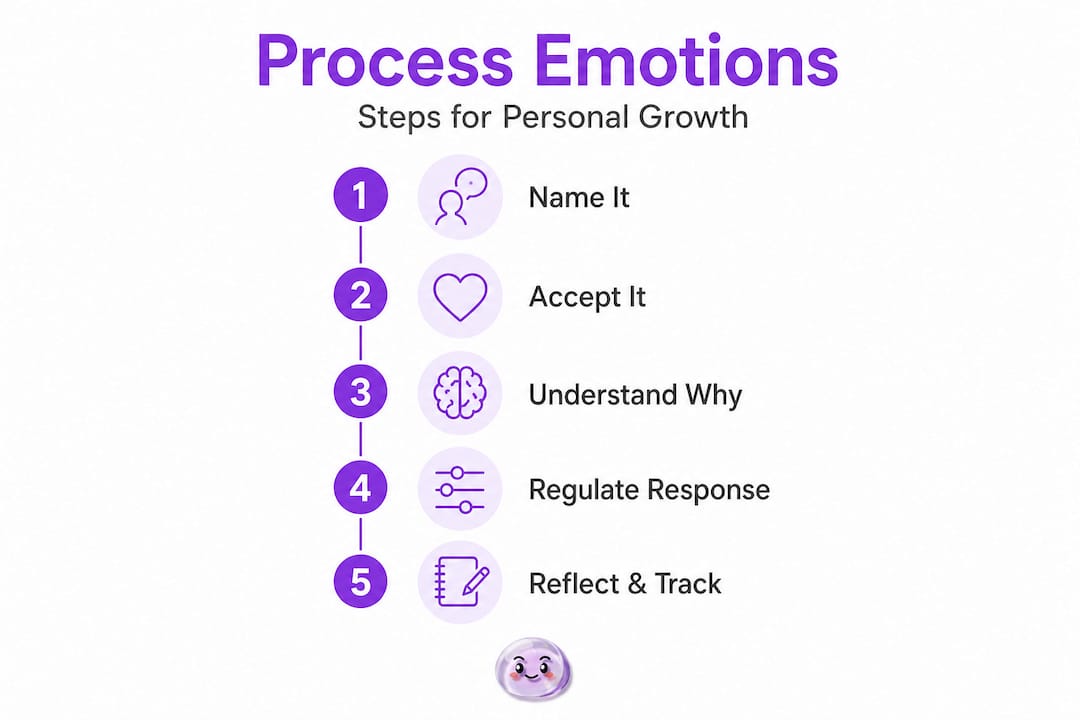
Now comes the actual work. The following steps combine guided journaling, mindfulness, and DBT-based regulation into a sequence that builds on itself.
-
Name the emotion. Open your journal and write exactly what you’re feeling. Be specific. Not just “sad” but “a heavy, hollow sadness mixed with some guilt.” The more precise your label, the more effectively your brain can process it. This is the core of emotional labeling.
-
Check the facts. Ask yourself what triggered this feeling. Is the emotion proportional to what actually happened, or is it amplified by a past memory or belief? DBT’s “check the facts” skill helps you separate the story from the event.
-
Body scan. Close your journal and sit quietly for 5 minutes. Starting from your head and moving to your feet, notice where you feel the emotion physically. Tight chest, heavy shoulders, clenched jaw. This grounds the emotion in your body, which prevents it from spiraling into abstract rumination.
-
Apply opposite action. If your emotion is urging you to withdraw, take one small social action. If it’s pushing you toward anger, practice a moment of deliberate calm. Opposite action works by interrupting the reinforcing cycle between emotion and behavior.
-
Access Wise Mind. After the body scan and opposite action, write for 5 minutes from what DBT calls Wise Mind, the integrated space between pure emotion and pure logic. Ask: “What does the wise part of me know about this situation?”
-
Use acceptance phrases. Borrow from ACT here. Write or say out loud: “I notice I am feeling [emotion]. I am making room for this feeling.” This isn’t suppression. It’s creating space for the emotion without letting it control your next action.
-
Reappraise. Write a one-paragraph reappraisal: what might this emotion be telling you? What value does it point to? Reappraisal is not toxic positivity. It’s finding meaning without dismissing the pain.
Research from high-stress environments supports how powerful these steps can be. Positive self-talk journaling in juvenile detention facilities shows that combining emotional labeling with reappraisal improves well-being even in severe circumstances. If these techniques work there, they will work in your daily life. And acceptance-based approaches consistently reduce stress, anxiety, and depression by removing the resistance that turns difficult emotions into chronic suffering.
Daily practice of the PLEASE skill and structured journaling produces a 20 to 30% reduction in emotional intensity within 4 to 6 weeks, according to DBT research.
Pro Tip: Use an emotion-tracking app to log your mood before and after each journaling session. Seeing even a small shift on a graph gives your brain tangible evidence that the work is paying off, which builds motivation.
For specific journaling techniques that pair well with these steps, that resource breaks down seven approaches in practical detail. Learning to track emotional trends also helps you identify patterns you can’t see in a single session. And staying current on emotional health trends keeps you informed about what the latest research recommends.
Evaluating progress: Tracking, reflection, and troubleshooting
Doing the work is step one. Knowing whether the work is actually helping is equally important. Many people continue the same emotional processing routines for weeks without checking whether those routines are producing change. That’s a missed opportunity.
Daily emotion tracking is the most direct feedback tool available. After each session, rate your emotional intensity on a scale from 1 to 10, note the dominant emotion, and write one sentence about what shifted. Over two to four weeks, patterns become visible. You might notice that your intensity scores drop after journaling but spike on days you skip the body scan. That’s actionable information.
Signs your techniques are working:
-
Emotional intensity after triggering events decreases over time
-
You recover from difficult emotions more quickly than before
-
You can name emotions more precisely and with less effort
-
You notice urges to avoid or suppress emotions but choose processing instead
-
Journaling feels easier and more revealing than it did at the start
Common mistakes that stall progress:
-
Skipping the naming step. Processing emotion without labeling it is like trying to navigate without a map. You stay lost.
-
Inconsistent practice. The PLEASE skill research shows results appear after 4 to 6 weeks of daily tracking. Sporadic effort produces sporadic results.
-
Treating journaling as venting. Pure venting without reflection can actually reinforce negative patterns. The goal is processing, not just releasing.
-
Avoiding difficult emotions entirely. If every session focuses on easier feelings, the complex ones never get touched.
| Symptom | What it usually means | How to recalibrate |
|---|---|---|
| Sessions feel repetitive | Stuck in venting mode | Add a structured prompt like Wise Mind writing |
| Emotional intensity not dropping | Skipping physical preparation | Return to PLEASE skills for one week |
| Avoidance increasing | Overwhelm or inadequate pacing | Reduce session length; prioritize acceptance phrases |
| No pattern visible in tracking | Irregular practice | Commit to same time daily for two weeks |
Pro Tip: Set a weekly reflection appointment with yourself. Spend 15 minutes reviewing your tracking data and asking what you learned. Reflection accelerates self-awareness faster than daily sessions alone, because it creates a bird’s-eye view of your emotional patterns.
Learning to track mental wellness systematically transforms emotional processing from a vague practice into a measurable growth strategy.
What most guides miss: The uncomfortable truth about processing emotions
Most step-by-step guides on emotion processing are secretly promising you a way to feel less. Less pain, less discomfort, less intensity. That framing is understandable but ultimately misleading. The real goal of processing complex emotions isn’t to eliminate discomfort. It’s to build a relationship with discomfort that doesn’t paralyze you.
Here’s what we’ve seen consistently: people who treat emotional discomfort as evidence of personal failure tend to bounce between techniques without staying long enough to benefit from any of them. They try journaling for a week, switch to meditation, pivot to breathwork, and wonder why nothing sticks. The problem isn’t the technique. It’s the expectation underneath it.
The research on positive self-talk journaling in extreme settings like juvenile detention makes this point powerfully. Those individuals didn’t have the luxury of optimized conditions, personalized apps, or low-stress environments. What worked for them was consistent emotional labeling and reappraisal under pressure. The most effective emotional processing happens not when conditions are perfect but when practice is stubborn.
Step-by-step guides, including this one, also have a real limitation: they can’t fully account for your specific emotional history, your nervous system’s particular patterns, or the relationships that shape your emotional landscape. That’s not a flaw in the guide. It’s an invitation to personalize. Use the frameworks as starting points, then adapt. If opposite action feels counterproductive for a specific emotion, pause and examine why. That examination is itself a form of processing.
The long game looks like this: after several months of consistent practice, you stop needing to follow steps consciously. Naming emotions, accepting their presence, and responding with intention become reflexes. That’s the real outcome, and it’s worth far more than a temporary reduction in discomfort. Understanding your emotional health explained at a deeper level is what makes that kind of lasting change possible.
Continue your growth journey with Voisley
Processing complex emotions takes structure, consistency, and the right tools. Voisley brings all three together in a single platform designed specifically for emotional growth.

Voisley’s guided journaling, mood tracking, and AI-powered insights give you a private, structured space to practice exactly the techniques covered in this guide, from emotion labeling and reappraisal to Wise Mind writing and daily mood visualization. You can explore emotional regulation strategies through personalized prompts and track your emotional trends over time with visual data that makes patterns visible. If you’re ready to turn journaling for wellness into a consistent, rewarding habit, Voisley gives you the framework and support to make it last. Visit Voisley to start your guided emotional growth journey today.
Frequently asked questions
How long does it take to see results from emotion regulation techniques?
Most people see a 20 to 30% reduction in emotional intensity after 4 to 6 weeks of daily tracking using DBT’s PLEASE skills, provided practice is consistent rather than occasional.
Can I process emotions without journaling?
Yes, mindfulness and acceptance-based practices like ACT can effectively process emotions on their own; journaling simply adds structure, clarity, and a record of your progress over time.
What is the easiest first step if I feel overwhelmed by complex emotions?
Start by naming what you feel as specifically as possible, then allow its presence without judgment. This simple act of accepting emotions immediately reduces resistance and lowers distress without requiring any prior training.
Are these strategies suitable for high-stress situations?
Yes, research confirms that journaling and emotional labeling improve well-being even in high-stress settings like juvenile detention facilities, making these techniques applicable in nearly any environment where you have a few quiet minutes.