

TL;DR:
- Emotional intelligence includes self-awareness, self-regulation, motivation, empathy, and social skills.
- Journaling helps identify emotional patterns and promotes lasting growth in emotional intelligence.
- Consistent, forward-looking reflection fosters behavior change and deeper self-understanding.
You snap at someone you care about, then spend the rest of the day wondering why you reacted so strongly. Sound familiar? That cycle of reacting first and understanding later is one of the most common emotional struggles people face. The good news is that emotional intelligence (EI) is a skill you can actually build. Research consistently shows that structured journaling and self-reflection are among the most effective tools for growing it. This guide walks you through each step, from understanding what EI really means to building a daily practice that creates lasting change.
Table of Contents
- Understand emotional intelligence and why it matters
- What you need: Tools, mindset, and preparation
- Step-by-step: Emotional journaling and self-reflection process
- Common pitfalls and troubleshooting your progress
- Our perspective: How emotional intelligence work really pays off
- Take the next step in your emotional growth journey
- Frequently asked questions
Key Takeaways
| Point | Details |
|---|---|
| Start with self-awareness | Building emotional intelligence begins with accurately recognizing and naming your emotions. |
| Use consistent journaling | Regular reflective writing transforms emotional patterns and improves self-regulation over time. |
| Balance reflection with action | Apply insights from journaling to real-life choices, avoiding the trap of endless analysis. |
| Watch for rumination | Self-reflection can support growth, but too much may increase anxiety or negative thinking. |
Understand emotional intelligence and why it matters
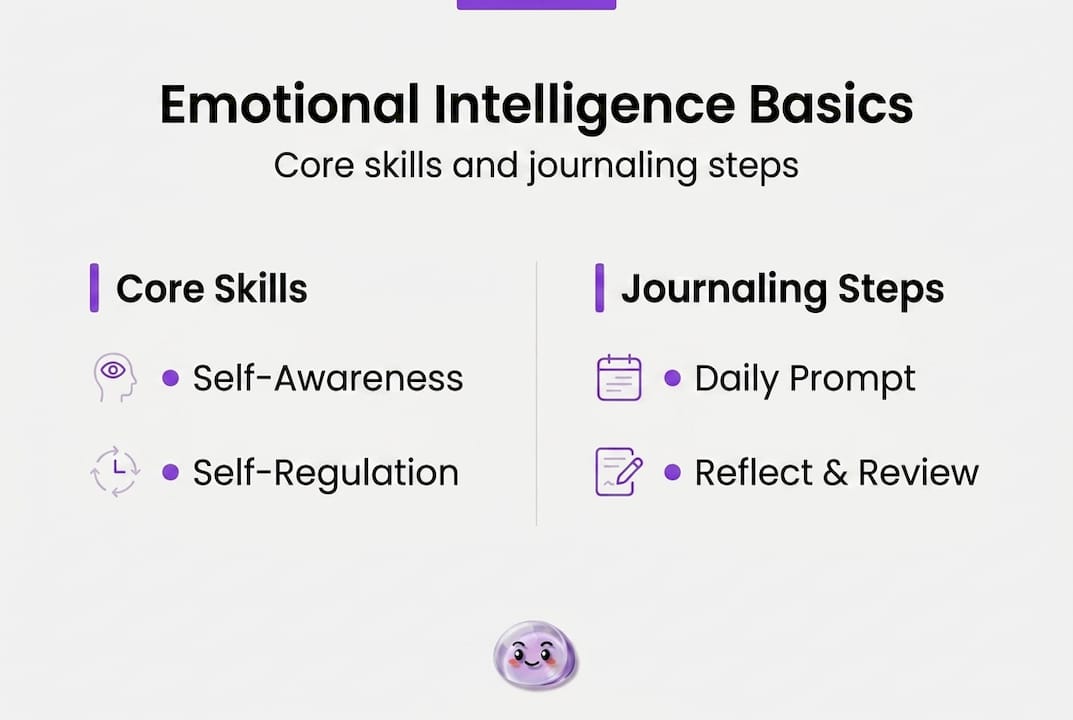
Emotional intelligence is your ability to recognize, understand, manage, and use emotions effectively, both your own and those of the people around you. According to Harvard's framework, EI breaks down into five core components: self-awareness, self-regulation, motivation, empathy, and social skills. Self-awareness is foundational. You can't regulate what you can't name.
Here's a quick breakdown of each component:
| EI Component | Core Skills and Attributes |
|---|---|
| Self-awareness | Recognizing emotions as they arise, understanding triggers |
| Self-regulation | Managing impulses, staying calm under pressure |
| Motivation | Staying driven by internal goals, not just rewards |
| Empathy | Reading others' emotional states, listening without judgment |
| Social skills | Communicating clearly, resolving conflict constructively |
Higher emotional intelligence pays off in concrete ways. People with stronger EI tend to experience:
- Better relationships built on genuine understanding and reduced reactivity
- Clearer decision-making because feelings inform choices without overwhelming them
- Stronger emotional regulation, meaning fewer emotional outbursts and faster recovery
- Greater empathy, which deepens both personal and professional connections
- Increased resilience when navigating stress or setbacks
The self-awareness importance piece often gets underestimated. Most people assume they know themselves well, but research suggests that only about 10 to 15 percent of people are truly self-aware. That gap between how we think we show up and how we actually show up is exactly where journaling does its most important work. When you write down what you felt and why, you start to see patterns that are invisible in the moment. And once you can see a pattern, you have real power to change it. Exploring emotional health principles alongside your journaling practice gives you an even stronger foundation for that kind of growth.
What you need: Tools, mindset, and preparation
Before you start writing a single word, getting the right setup in place makes a real difference. The tools and mindset you bring to journaling directly affect how useful it becomes.
Essential tools to have ready:
- A notebook and pen, or a digital journaling app
- An emotion wheel to help you move beyond vague labels like "bad" or "stressed"
- A quiet, consistent space where you won't be interrupted
- Five to fifteen minutes of uninterrupted time
One critical insight from emotional awareness basics: naming emotions precisely reduces their intensity. Using an emotion wheel to go deeper than "angry" into words like "humiliated" or "betrayed" is far more useful for journaling for well-being because it targets the root, not the surface.

Analog vs. digital journaling: A quick comparison
| Format | Pros | Cons |
|---|---|---|
| Notebook/pen | Tactile, no distractions, private | Hard to search, slower, no prompts |
| Digital app | Prompts, mood tracking, easy search | Screen fatigue, less tactile feel |
| Guided app (like Voisley) | AI insights, structured formats | Requires consistent logins |
Beyond tools, your mindset going in shapes everything. Check these off before you begin:
- Set a clear intention ("I'm here to understand, not judge")
- Put your phone on silent
- Take three slow breaths to shift out of autopilot
- Remind yourself: curiosity, not criticism
Pro Tip: Pick one consistent time and place each day for your journaling session. Morning works well for intention-setting; evening works well for reflection. Consistency builds the habit faster than duration does. Even five minutes done daily beats thirty minutes done once a week.
The mindset piece also means bringing self-compassion to whatever you find. You will discover things about yourself that are uncomfortable. That discomfort is the work. Stay curious instead of defensive, and the insights will keep coming.
Step-by-step: Emotional journaling and self-reflection process
With the right tools and mindset, you're ready to build emotional intelligence step by step. Here's a process grounded in both research and practice.
- Choose a specific moment. Pick one emotional event from the day, not a general mood. Something concrete: "I felt tense during my morning meeting" is more useful than "I was stressed today."
- Name the emotion precisely. Use your emotion wheel to find the most accurate word. Emotion wheels help you move from vague to precise, which reduces emotional intensity and builds regulation.
- Trace the trigger. Write down what happened right before the feeling showed up. What was said, done, or implied? This is where you start connecting external events to internal responses.
- Explore your reaction. Ask yourself: did I respond in a way I'm proud of? What did I say or do, and what drove that choice? No judgment here, just honest observation.
- Look for the pattern. Does this type of situation trigger you regularly? Naming a pattern is the moment reflection becomes journaling techniques for regulation in action.
- Write one forward-looking sentence. What would you do differently next time? This small shift turns reflection into a practical plan.
Consistency matters more than duration. Ten minutes of focused daily reflection builds more self-awareness than an occasional hour-long session ever will.
Pro Tip: If you're staring at a blank page, start with a journaling prompt like "Today I noticed I felt ___ when ___. I think it happened because ___."
The research behind this approach is compelling. Reflective diaries show an effect size of d=1.24 on learning engagement and a measurable positive shift in emotional states. A separate study found that structured reflection boosted EI and self-regulation significantly (η2 = 0.59 to 0.68, p < 0.001). These aren't small effects. They confirm that the structure you bring to reflection determines how much you gain from it. For a deeper walkthrough of this process, the self-reflection journaling guide on the Voisley blog is worth bookmarking.
Common pitfalls and troubleshooting your progress
As with any self-development practice, some challenges are common. Here's how to sidestep them.
The most frequent pitfalls people run into include:
- Overanalyzing: Spending so much time picking apart every feeling that no insight emerges. If you've written more than a page and still feel confused, step back.
- Rumination: Replaying painful events without asking "what can I learn here?" Rumination recycles pain; reflection transforms it.
- Negative self-talk: Using your journal as a place to criticize yourself rather than understand yourself. Phrases like "I'm so stupid" aren't reflection, they're self-punishment.
- Inconsistency: Writing intensely for a week after a hard experience, then stopping when things feel fine. EI grows in the quiet moments too.
Reflection should bring clarity, not deepen self-criticism. If your journal entries leave you feeling worse, adjust the lens from "what's wrong with me" to "what can I learn from this."
If journaling starts to feel triggering or unhelpful, try shortening your sessions, switching to gratitude-focused writing, or using structured prompts instead of open-ended pages. The goal is insight, not emotional overload.
A meta-analysis on self-reflection found that self-reflection positively correlates with negative mental health outcomes (r=0.155) when it slips into rumination. That finding doesn't mean reflection is harmful. It means direction matters. Purposeful, forward-looking reflection builds EI. Circular, shame-based replay does the opposite.
If you notice your sessions drifting toward the circular kind, explore these resources on the benefits of self-reflection and introspection mental health insights to recalibrate your approach.
Our perspective: How emotional intelligence work really pays off
Here's something most EI guides won't tell you: monitoring your emotions is the easy part. The harder, more valuable work is integrating what you notice into actual behavior change.
Most conventional advice says to track your feelings, name them, and repeat. That's a fine start. But we've seen that real growth happens when you use what you write to identify emotional patterns and then ask, "given this pattern, what do I want to do differently next week?" That forward-looking question is what turns journaling from a record of past reactions into a guide for future choices.
Another uncomfortable truth: emotional intelligence isn't about policing yourself into perfect reactions. It's about understanding why you respond the way you do and forgiving yourself when you don't live up to your own standards. The people who grow the fastest aren't the ones who never slip. They're the ones who reflect on the slip without catastrophizing it, learn something concrete, and move forward. That cycle, when repeated honestly, is where real emotional growth lives.
Take the next step in your emotional growth journey
You've got the framework. Now it's about putting it into practice consistently and with the right support behind you.

Voisley is built specifically for this kind of work. With personalized prompts, mood tracking, AI-powered insights, and structured journal formats like shadow work and gratitude journals, it gives you everything you need to move from occasional reflection to a real EI-building habit. Whether you're just getting started or looking to go deeper, exploring life journaling techniques and understanding how empathy and recovery connect can help you get the most out of every session. Your emotional growth journey doesn't have to be a solo one.
Frequently asked questions
What are the main components of emotional intelligence?
The five main components are self-awareness, self-regulation, motivation, empathy, and social skills. Each one builds on the others, with self-awareness as the essential starting point.
How can journaling help me regulate my emotions?
Journaling makes your feelings visible and actionable, turning vague emotional noise into clear patterns you can work with. EI training with journaling has been shown to improve both self-regulation and empathy, especially in consistent practice.
Is there a risk to too much self-reflection?
Yes. When self-reflection slides into rumination, it can increase anxiety or depression rather than reduce them. Keep sessions forward-looking and solution-oriented to stay on the productive side.
What is the first step to improving emotional intelligence?
The first step is building self-awareness by noticing and naming your emotions accurately. Self-awareness is foundational for every other component of emotional intelligence to develop.
Are there prompts or tools to make journaling easier?
Absolutely. Using emotion wheels for precision and guided journal templates can make the process much simpler and significantly more effective from day one.
Recommended
- Step-by-step guide to emotional self-reflection journaling
- Unlock emotional patterns for well-being with journaling
- Process for self-discovery: guided journaling for clarity
- Emotional regulation tips: 7 journaling techniques to master your mood
- Why Naming Your Feelings Helps — The Caia Journal
- 10 Transformative Mental health journaling prompts to Try in 2026