

TL;DR:
- Transition from traditional balance to value-based integration for sustainable well-being.
- Use structured journaling and self-assessment to identify misalignments and prioritize energy and values.
- Incorporate brief, consistent practices like gratitude and mindfulness, paired with reflection, to enhance emotional health.
You know that feeling when you've crossed off every item on your to-do list but still feel completely empty? Or when you take a "rest day" but spend it guilt-scrolling through emails? Traditional work-life balance was supposed to fix all of that. Instead, it gave us a new thing to fail at. The good news is that research increasingly points toward a smarter, more human approach: integrating your life around energy, values, and self-reflection rather than obsessing over equal hours. This guide walks you through honest self-assessment, practical journaling tools, and a values-based framework that actually holds up in real life.
Table of Contents
- Assessing your current balance: Where are you starting from?
- Building your toolkit: Journaling, gratitude, and reflection
- Integrating and aligning: Moving beyond balance to value-based living
- Troubleshooting and verifying progress: Common barriers and what works
- A fresh perspective: Why the pursuit of balance is often backwards
- Next steps for your balanced life
- Frequently asked questions
Key Takeaways
| Point | Details |
|---|---|
| Balance is integration | Real balance comes from aligning actions with your values and energy, not from splitting hours equally. |
| Journaling boosts engagement | Gratitude and reflective journaling improve emotional well-being and awareness, proven by research. |
| Barriers are manageable | Workload, stigma, and unrealistic expectations can be overcome with practical strategies and peer support. |
| Measure energy, not time | Prioritize your satisfaction and energy levels instead of tracking time splits between work and life. |
| Brief actions work | Small, structured interventions like mindfulness and gratitude journaling make a measurable difference. |
Assessing your current balance: Where are you starting from?
After understanding the limits of old balance concepts, let's lay the groundwork for genuine self-assessment.
Most people assume balance means a perfectly split schedule: eight hours work, eight hours personal, eight hours sleep. That mental model is not just unrealistic. It actively creates shame when life inevitably tilts. A better starting point is asking two simpler questions. Where is your energy going? And does that match what you actually value?
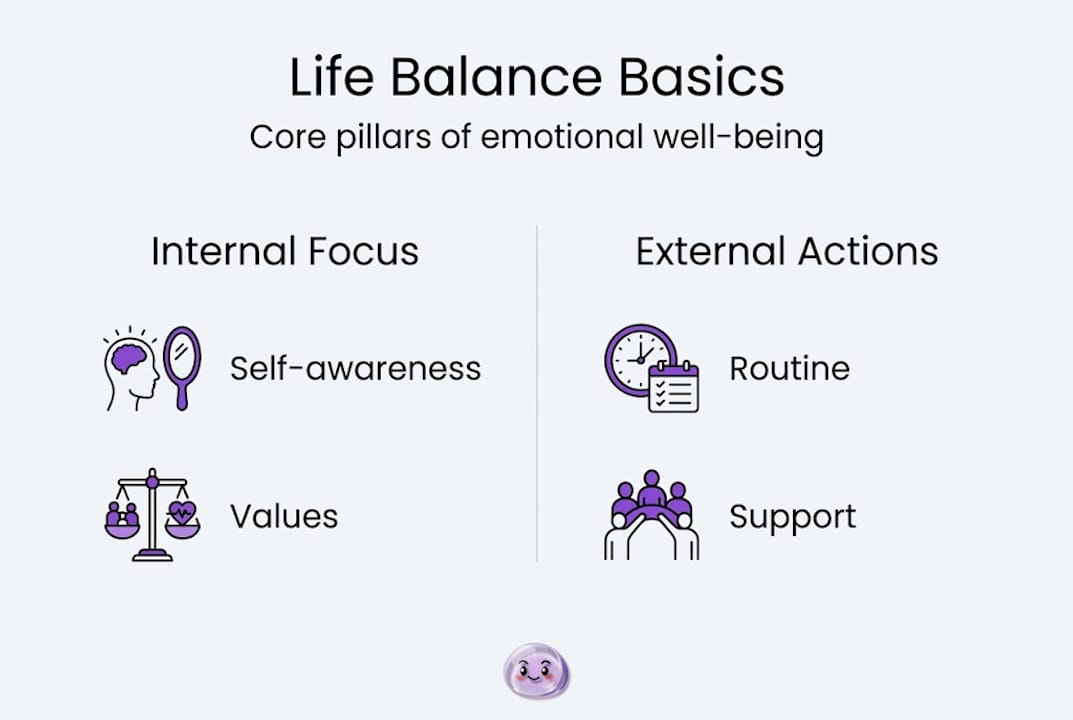
Work-life balance is a myth; what actually matters is pursuing integration, alignment with values, quality over quantity of time, and energy management. The moment you stop measuring your life in hours and start measuring it in satisfaction and energy, the entire picture changes. You might work long hours on a project you love and feel energized. You might leave work at 5 p.m. every day but feel chronically drained. Hours alone tell you almost nothing.
To get a real snapshot of where you stand, use a simple self-assessment across four dimensions. Understanding your mental wellness overview can add crucial context to this process.
| Dimension | What to measure | Healthy signal | Warning sign |
|---|---|---|---|
| Energy | How you feel after main activities | Energized or neutral | Consistently depleted |
| Satisfaction | Enjoyment and meaning in work and personal time | Frequent positive moments | Persistent emptiness |
| Time allocation | Where hours actually go vs. where you want them | Close to your priorities | Severe mismatch |
| Values alignment | Whether actions reflect what matters most | Regular alignment | Chronic conflict |
Once you can see those four dimensions honestly, you can pinpoint exactly where the friction lives. Most people discover that their biggest pain point is not time at all. It is a mismatch between daily actions and personal values.
Here is a numbered process to get your baseline right now:
- Track your time for three days. Use a simple notes app or paper. Log each activity in 30-minute blocks without judgment.
- Rate your energy after each block. Use a simple scale: 1 (drained), 3 (neutral), 5 (energized). Notice patterns.
- List your top five personal values. Examples include creativity, family, learning, health, and contribution. Be honest, not aspirational.
- Compare your time log to your values list. Circle any activity that directly serves a top value. Count uncircled hours.
- Identify your three biggest misalignment areas. These are the specific spots your integration work will target first.
This exercise usually takes under 30 minutes, but the clarity it produces can reshape months of effort. Most people are surprised to find that a single chronic time drain, like unstructured social media scrolling or meetings without agendas, is responsible for most of their dissatisfaction.
Building your toolkit: Journaling, gratitude, and reflection
With self-awareness from the assessment, it's time to assemble practical tools for change.
Self-awareness is only useful if it leads to action. The most accessible and research-supported tool for translating inner awareness into real behavioral change is journaling. Not journaling as a vague "write what you feel" practice, but structured, intentional journaling with a clear purpose for each session.
The evidence here is compelling. Gratitude journaling over 12 days significantly increases work engagement and awareness of job resources. That is not a long commitment for a meaningful return. Meanwhile, reflective diary writing over 12 weeks significantly enhances learning engagement and improves positive emotions. Both studies point to the same conclusion: structured reflection creates measurable emotional gains.
Choosing the right format for your journaling practice matters more than most people realize. Here is a quick comparison:
| Format | Best for | Limitations | Time investment |
|---|---|---|---|
| Pen and paper | Deep processing, no distractions | Hard to search or track trends | 10 to 20 minutes daily |
| Digital app (guided) | Pattern tracking, AI insights, consistency | Requires screen time | 5 to 15 minutes daily |
| Voice journaling | Busy schedules, emotional release | Less structured, hard to review | 5 to 10 minutes daily |
| Prompted journals | Beginners, focus and direction | Less flexibility for free-form | 10 minutes daily |
Whichever format you choose, the key is structure. Aimless journaling can spiral into rumination, which research links to worse outcomes rather than better ones. A clear prompt keeps you anchored to growth rather than cycling through the same worries.
Effective journaling for balance typically covers three areas in each session:
- What went well today and why (builds awareness of positive patterns)
- What drained your energy and what triggered it (maps friction points for future planning)
- One small action you can take tomorrow to better align with a core value (bridges reflection to behavior change)
Incorporating a gratitude practice into your morning routine, specifically before you check any device or social media, can prime your brain to notice resources and opportunities throughout the day. Even smiling intentionally has measurable positive effects on mood and perceived well-being, reinforcing how small physical cues can shift your emotional baseline. Pair that with a two-minute gratitude entry and you have a simple but powerful morning anchor.
Resources for journaling for wellness and specific journaling techniques can help you go deeper once the habit is established.
Pro Tip: Write your gratitude entry before 9 a.m. and keep it specific. "I'm grateful for my health" is too vague. "I'm grateful that my walk this morning cleared my head before the difficult meeting" gives your brain a concrete memory to anchor positive emotion to.
Integrating and aligning: Moving beyond balance to value-based living
Now that the toolkit is ready, here's how to use it as you reshape balance into a value-driven integration.
The word "balance" implies a scale, and scales tip. The moment you accept that your life is not supposed to be static, the pressure to maintain perfect equilibrium disappears. Integration is a more honest word for what sustainable well-being actually looks like. It means weaving your values, energy needs, and responsibilities into a life that feels coherent rather than compartmentalized.
Traditional balance, based on equal time splits, leads to chronic guilt and an endless sense of falling short. Integration via value-aligned actions feels sustainable because it flexes with reality rather than fighting it. When an important project demands extra hours for two weeks, integration allows that without shame, because you know it is temporary and you have planned for recovery time.
"The goal is not to divide your life into equal parts but to make each part feel purposeful. When your actions reflect your values, even the busiest seasons can feel balanced from the inside."
Here are practical steps for shifting from balance to integration:
- Schedule energy recovery, not just tasks. Block time in your calendar for activities that refill you, treating them as non-negotiable as meetings.
- Audit your commitments quarterly. Review every recurring obligation and ask whether it still serves a core value. Drop what does not.
- Practice the "good enough" standard selectively. Reserve perfectionism for the work that truly matters to you. Apply efficiency to everything else.
- Name your guilt triggers. Write them down. Often, guilt comes from internalized social expectations rather than your own values. Seeing them on paper reduces their power.
- Create transition rituals. A five-minute walk, a brief breathing exercise, or even changing your physical space can signal your brain to shift modes from work to personal life.
Handling societal expectations is one of the trickiest parts of this work. Culture often rewards busyness as a badge of honor. Stepping back from that narrative requires deliberate practice. Mindfulness and emotional self-care practices, especially when paired with journaling, help you recognize when you are operating from external pressure versus internal values. You can also find holistic emotional support through community resources if the transition feels overwhelming.
The integration approach also redefines success. Instead of asking "Did I work fewer hours this week?" ask "Did I feel energized by what I did?" and "Did I spend meaningful time on what matters most?" Those two questions are far harder to fake and far more useful as a compass.
Troubleshooting and verifying progress: Common barriers and what works
Now that you've set up integration, let's tackle common challenges and make sure your efforts deliver real progress.
Even with the best intentions and solid tools, real-life obstacles get in the way. The most common barriers are heavy workload, social stigma around prioritizing personal well-being, and unrealistic expectations about how quickly change happens. Recognizing these as predictable rather than personal failures is the first step.
Structured interventions work when they are brief and grounded. Mindfulness-based practices, yoga, and peer support networks improve well-being when applied in structured, theoretically grounded ways, with peer networks and flexibility serving as key facilitators. This means you do not need an hour-long meditation practice to see results. A 10-minute guided reflection, done consistently three times a week, outperforms a sporadic 45-minute session you force during a stressful week.
Here is a troubleshooting sequence for common sticking points:
- If journaling feels forced: Shorten the session to five minutes and use a single prompt. Consistency at a low effort level beats perfection at a high one.
- If guilt keeps returning: Write about the specific expectation triggering it. Trace it to its source. Is it yours, or someone else's standard you have absorbed?
- If progress plateaus: Switch journal types. If you have been doing gratitude journaling, try emotional pattern journaling to identify underlying cycles you may have missed.
- If workload feels unmanageable: Use a two-column exercise. List everything on your plate in one column. In the second, write the actual consequence of not doing each item this week. Most lists get shorter fast.
- If social stigma holds you back: Start your practice privately. You do not need to announce that you journal or meditate. Results over time become their own argument.
One critical nuance: self-reflection is powerful, but it has a shadow side. Self-reflection is significantly associated with negative mental health outcomes including depression and anxiety, though not with positive mental health, and cultural background and measurement tools both moderate these effects. This means that reflection without structure or guidance can spiral into self-criticism. Pairing reflection with a positive anchor like gratitude or a forward-looking prompt is what keeps the practice healthy.
Tracking your well-being workflow over time gives you data to spot stagnation early and adjust before frustration sets in.
Pro Tip: Set a recurring 15-minute calendar block every Sunday evening to review your week using the four-dimension table from the assessment section. This regular check-in prevents small drift from becoming a full reset.
A fresh perspective: Why the pursuit of balance is often backwards
Most advice about balance starts with time management and ends with a color-coded calendar. We think that framing is backwards, and not just slightly. It is fundamentally misdirecting your energy.
Chasing balance by hours assumes all hours are equal. They are not. One hour of high-energy, deeply meaningful work can leave you more fulfilled than an entire day of low-stake tasks. One hour of real connection with someone you love does more for your emotional health than three hours of distracted together-time on a couch with phones out.
The real question is never "Am I spending enough time on X?" It is always "Am I bringing my full self to what matters?" That reframe shifts your attention from the clock to your internal state, which is where change actually happens. Tools like journaling for self-awareness make that internal landscape visible and, more importantly, navigable.
The uncomfortable lesson from real experience is this: people who feel balanced almost never achieved it by negotiating hours. They achieved it by getting brutally honest about what they value, cutting what they do not, and building the daily habits that reinforce that clarity. Integration is not a softer goal. It is a harder, more honest one.
Next steps for your balanced life
With actionable wisdom and troubleshooting behind you, here is how to continue your journey toward balance and well-being.
Taking the first step is almost always the hardest part. You now have a framework for honest self-assessment, a toolkit of evidence-backed journaling and reflection practices, a values-based integration model, and a troubleshooting guide for the moments when progress stalls. That is a strong foundation.

The next step is putting it into practice with support that keeps you consistent. Voisley brings together guided journaling, mood tracking, personalized prompts, and AI-powered insights in one private space, so your reflection has structure and your progress becomes visible over time. Whether you are just starting or deepening an existing practice, support for emotional balance is available exactly when and how you need it. Your well-being is worth the commitment.
Frequently asked questions
Is work-life balance really achievable?
Work-life balance is a myth in the traditional sense; practical integration and value alignment are far more sustainable and realistic long-term approaches.
How can journaling help me find balance?
Gratitude journaling over 12 days significantly boosts work engagement and awareness of available resources, both of which directly support emotional balance.
What are the biggest barriers to emotional balance?
Heavy workload, stigma, and unrealistic expectations are the most common barriers; peer networks and flexible, brief interventions are among the most effective ways to address them.
Can self-reflection have negative effects on mental health?
Yes. Self-reflection links to depression and anxiety rather than positive mental health, which is why structured prompts and positive anchors are essential to keep the practice healthy.
What quick interventions can help improve emotional well-being?
Brief, structured practices like mindfulness and gratitude journaling show consistent well-being improvements; combining them with peer support and scheduling flexibility amplifies the results.