

TL;DR:
- Emotional processing involves staying with feelings long enough to transform and integrate them, unlike regulation or suppression. It requires awareness, acceptance, differentiation, and extracting meaning, leading to genuine emotional growth. Separating processing from regulation ensures lasting change, with tools like journaling and therapy facilitating this deeper engagement.
Most people assume that working through difficult emotions means calming down or thinking things through until they feel better. It’s a reasonable assumption, but it misses the actual mechanism behind lasting emotional change. Genuine emotional growth doesn’t come from managing feelings into silence or analyzing them from a distance. It comes from something more specific and more demanding: processing emotions, not just regulating them. This article breaks down what emotional processing actually means, how it differs from regulation, and what tools you can use to do it well.
Table of Contents
-
Structured tools for emotional processing: Journaling, CBT, and self-reflection
-
Why emotional processing is misunderstood—and why it matters for real change
Key Takeaways
| Point | Details |
|---|---|
| Processing is transformation | Emotional processing is about experiential change, not just feeling or thinking about emotions. |
| Regulation supports processing | Regulating arousal helps create the conditions needed for effective emotional engagement. |
| Structured tools matter | Journaling and self-reflection provide pathways to process and integrate emotions meaningfully. |
| Avoid rumination pitfalls | True processing shifts emotion, while rumination keeps you stuck in repetitive analysis. |
| Therapy applies the framework | Emotion-focused approaches use processing to foster lasting change and resilience. |
What is emotional processing?
Emotional processing is one of those phrases that sounds intuitive until you try to define it. People use it to mean everything from “talking about your feelings” to “getting over something.” But in psychological terms, it means something precise.
Peer-reviewed research describes emotional processing as generating, accepting, or rejecting emotional responses, including awareness, acceptance, and regulation. In plain terms: emotional processing is the psychological work of staying with an emotion long enough for it to shift, integrate, and inform you, rather than suppressing it, escaping it, or endlessly thinking about it without moving forward. The emotion changes you, and you change through the emotion.
This is distinct from related concepts that often get confused with it:
| Concept | What it does | What it does NOT do |
|---|---|---|
| Emotional processing | Transforms emotion, creates new meaning | Simply reduce distress |
| Emotion regulation | Controls or modulates intensity | Lead to integration or change |
| Emotional suppression | Temporarily reduces expression | Resolve or process emotion |
| Rumination | Repeatedly revisits emotion | Create experiential change |
The core components of real emotional processing include:
-
Awareness: Recognizing that an emotion is present and naming it accurately
-
Attention: Directing your focus toward the emotional experience rather than away from it
-
Acceptance: Allowing the emotion to exist without judgment or urgency to eliminate it
-
Regulation: Using just enough calming or grounding tools to stay functional while engaging the emotion
-
Differentiation: Identifying the specific emotion rather than a vague sense of “feeling bad”
-
Integration: Incorporating the emotional experience into your broader self-understanding and sense of meaning
“Emotional processing generally refers to the psychological work of engaging with an emotion so it can change and integrate, rather than only avoiding, suppressing, or intellectually reflecting on it.”
Understanding these components connects directly to emotional health principles that support well-being over time. Without awareness, you cannot find the emotion. Without acceptance, you cannot stay with it. Without integration, the experience does not translate into growth.
One of the most common misunderstandings is that overthinking counts as processing. Replaying an argument in your head, analyzing why someone said something, or imagining alternative outcomes can feel productive. But unless that reflection creates a genuine experiential shift, it is more likely to keep you stuck than move you forward.
Emotional processing versus emotion regulation
With a clear definition in mind, let’s contrast emotional processing with emotion regulation. These two concepts are frequently used interchangeably, but they serve fundamentally different functions.

Regulation is about reducing intensity or keeping emotion within a tolerable range, while processing involves staying with the emotion long enough for new meaning, learning, or movement to emerge. Think of regulation as the scaffolding and processing as the actual building work.
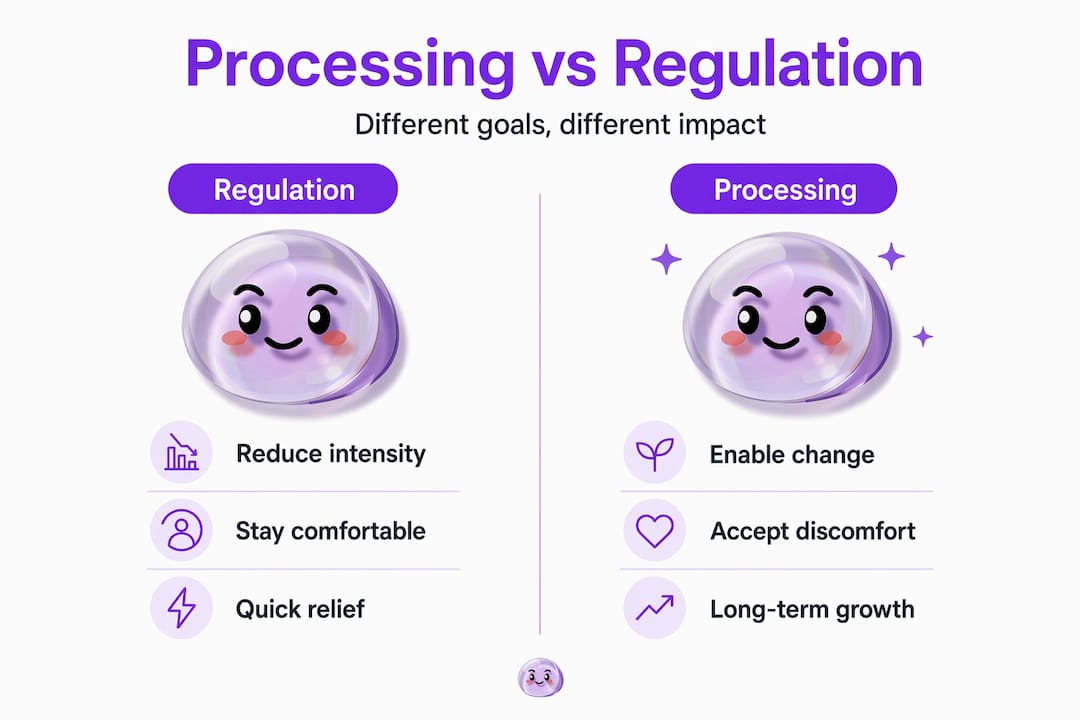
Here is how the two compare across key dimensions:
| Dimension | Emotion regulation | Emotional processing |
|---|---|---|
| Primary goal | Reduce intensity | Enable change and integration |
| Timeframe | Immediate or short-term | Sustained engagement |
| Outcome | Restored stability | New meaning, growth, insight |
| Example tool | Box breathing, grounding | Journaling, expressive therapy |
| Works alone? | Yes, but limited | Often needs regulation first |
Regulation is not a lesser skill. It is essential, especially when you are in a state of high distress. Without some ability to manage your nervous system, you cannot access the kind of focused, present attention that real processing requires. Someone in acute anxiety or grief needs regulation strategies first before they can engage productively with what they are feeling.
Here is a practical way to think about the sequence:
-
Notice the emotion and assess your current arousal level
-
Regulate to a workable range using breathing, movement, or grounding
-
Turn attention toward the emotion with curiosity rather than judgment
-
Stay present with the experience and allow it to shift organically
-
Reflect on what emerged and what new understanding or meaning was generated
This sequence shows up in therapy, in structured journaling, and in mindfulness practice. Someone writing in a journal about a difficult relationship, for example, might start by doing a few minutes of slow breathing before they begin. That regulation step makes room for the processing that follows. Both are required to develop emotional resilience that actually holds up under pressure.
A critical insight: Many people stop after regulation. They feel calmer and assume the work is done. But calmer is not the same as changed. Regulation without processing can become a long-term avoidance strategy, keeping emotional experiences in a kind of permanent pause rather than letting them move through to completion.
Therapeutic models: Emotional processing in practice
Understanding the distinction is useful, but let’s see how emotional processing actually shows up in structured therapeutic and reflective practices.
Emotion-focused therapy frames effective emotional work as helping people experience, accept, understand, and transform emotion, using emotion as an adaptive guide for enduring change. This is one of the most well-researched therapeutic approaches that centers emotional processing as its core mechanism. The therapist does not help you think differently about an emotion or suppress it. Instead, they help you move through it fully.
The key steps in emotion-focused work look like this:
-
Experiencing: Letting yourself feel the emotion as a present, bodily experience, not just a thought
-
Accepting: Treating the emotion as valid information rather than a problem to eliminate
-
Understanding: Asking what the emotion is signaling about your needs, values, or history
-
Transforming: Allowing a new emotional experience to emerge and update your internal sense of self
Structured self-reflection tools like journaling serve a parallel function outside of therapy. When you write about an emotional experience with the goal of exploring and integrating it, rather than just venting, you are engaging in the same fundamental process. You experience, accept, articulate, and move toward understanding. You can unlock emotional patterns that would otherwise stay invisible through this kind of intentional reflection.
Pro Tip: Journaling for emotional processing works best when you write toward the discomfort rather than away from it. Instead of describing what happened, try writing about what you felt in your body, what the emotion seemed to want, and what it might be telling you about your needs.
Nuances, challenges, and common pitfalls
Even with strong methods and clear intentions, emotional processing can be derailed in predictable ways. Let’s address the most common challenges and how to navigate them.
The biggest physiological barrier is arousal level. Regulation is necessary when emotional arousal is too high (hyperarousal) or too low (shutdown), because in either state, productive processing is disrupted. When you are hyperaroused, the emotion is too intense to engage with clearly. When you are shut down, you cannot access the emotion at all. Real processing requires a middle zone, sometimes called the “window of tolerance,” where you can feel enough to engage but not so much that you are overwhelmed.
Common pitfalls that block emotional processing include:
-
Hyperarousal: Panic, intense anger, or flooding that makes it impossible to think or reflect
-
Emotional shutdown: Numbness, dissociation, or feeling “nothing” when you know something should be there
-
Premature closure: Moving to problem-solving before the emotion has actually been engaged
-
Toxic positivity: Reframing the experience too quickly with optimistic thinking before allowing the emotion to be felt
-
Mistaking rumination for processing: Replaying events without moving toward meaning or insight
That last pitfall deserves particular attention. Rumination is not productive processing; productive processing is better conceptualized as experiential change, such as generating new meaning or integration, rather than stuck repetitive analysis. If you notice you are thinking about the same event in the same way for the fifth time this week, that is a signal that you are ruminating, not processing.
Mindfulness practices are particularly useful here because they train you to notice when your attention has drifted into repetitive, analytical loops. Once you can see that pattern, you can redirect toward embodied, present-moment awareness of the emotion itself.
Pro Tip: If your journaling starts to feel like circular thinking or you are writing the same sentences in different orders, stop writing. Shift to a body-based practice: close your eyes, locate the emotion as a physical sensation, and simply describe where it lives in your body and how it feels. This mindfulness and journaling combination moves you out of cognitive loops and back into experiential engagement.
Using journaling regulation tips alongside your reflective practice gives you concrete tools for managing the moments when emotions spike during writing, so you can stay in the productive zone rather than getting flooded.
Structured tools for emotional processing: Journaling, CBT, and self-reflection
Having addressed the hurdles, let’s look at specific, actionable tools for building emotional processing into daily life.
CBT approaches that aim to change how people perceive, remember, or respond to emotional stimuli are directly linked to emotion-processing mechanisms. This means cognitive behavioral tools are not just about changing thoughts; at their best, they are designed to shift emotional experience from the inside.
Practical tools you can apply right now:
-
Emotion labeling: Research consistently shows that naming an emotion with specificity (“I feel ashamed” vs. “I feel bad”) reduces its intensity and creates psychological distance that enables reflection
-
Somatic journaling: Writing about where you feel an emotion in your body before analyzing it mentally grounds you in the experiential layer
-
Values-based prompts: Asking “what does this emotion tell me about what I care about?” links the feeling to your deeper self-knowledge
-
Facial expression recognition exercises: A CBT-adjacent technique that helps you accurately read emotional cues in yourself and others, reducing the cognitive distortions that block processing
-
Letter writing: Writing unsent letters to people or situations lets you externalize emotion in a structured way that supports integration
A step-by-step journaling sequence for emotional processing:
-
Spend two minutes regulating with slow, deliberate breathing before you begin writing
-
Name the emotion as specifically as you can; avoid vague labels like “stressed” or “off”
-
Describe the physical experience of the emotion: location, texture, temperature, movement
-
Write about what the emotion might be responding to, without judgment
-
Explore what this emotion tells you about your needs or values in this situation
-
Close by writing one sentence about what you want to carry forward from this reflection
You can boost emotional intelligence significantly by practicing this sequence consistently, even for five minutes per day. The compounding effect of regular emotional processing through structured journaling is one of the most well-supported pathways to lasting self-awareness and emotional growth.
Why emotional processing is misunderstood—and why it matters for real change
Here is the uncomfortable truth: most emotional wellness advice is really just regulation advice in disguise. Breathe deeply. Reframe your thoughts. Cultivate gratitude. These are genuinely useful tools, but they are often presented as the full picture when they are really just the entry point.
The deeper work, staying present with difficult emotions long enough for experiential change to happen, is harder to package. It does not feel productive in the moment. You are not solving anything or reaching a conclusion. You are simply present with something uncomfortable, trusting that the engagement itself is the mechanism of change.
Conventional wisdom often treats emotional discomfort as a problem to be solved as quickly as possible. That framing makes regulation feel like success. But if you consistently regulate without processing, you are essentially managing a chronic condition rather than resolving it. The emotion returns because it has not been integrated; it has only been quieted.
Tracking emotional health trends shows increasing awareness in the mental wellness space about this distinction, but it still does not reach most people in their daily practice. Real change happens at the integration layer, when an emotional experience is not just endured but understood, accepted, and woven into your larger sense of self. That is when behavior shifts. That is when patterns break. That is when growth becomes durable.
The most powerful thing you can do is build structured tools into your daily life that are specifically designed for processing, not just regulation. The difference in outcome over months and years is significant.
Explore actionable tools for your emotional journey
Understanding emotional processing intellectually is just the beginning. Turning that understanding into consistent practice is where the real work happens, and that is exactly where structured tools make the difference.

Voisley is built for exactly this kind of work. With guided journaling prompts designed to move you through awareness, acceptance, and integration, mood tracking that reveals your emotional patterns over time, and AI-powered insights that help you spot what your feelings are actually telling you, Voisley’s emotional tools give you a structured space to do real emotional processing, not just emotional management. Whether you are working through something specific or building long-term self-awareness, Voisley supports the whole arc of emotional growth with tools that meet you where you are.
Frequently asked questions
Does emotional processing mean just feeling emotions?
No, emotional processing involves generating, accepting, or rejecting emotional responses and includes awareness, acceptance, and regulation so that emotions can change, integrate, and provide new meaning rather than simply being felt.
How is emotional processing different from rumination?
Productive processing leads to experiential change and meaning, while rumination is repetitive thinking that revisits the same material without generating new insight or integration.
Can emotional processing happen during journaling?
Yes, structured journaling supports emotional processing by enabling awareness, acceptance, and integration, particularly when it uses emotion-focused approaches that move beyond recapping events toward exploring and transforming emotional experience.
Do I need emotion regulation before processing?
If emotions feel overwhelming or too muted, regulation helps you stay in the window of tolerance where real processing is possible, making it a necessary foundation rather than an optional step.