
TL;DR:
- Mindfulness rewires how you relate to your emotions and thoughts, promoting genuine emotional growth. Scientific evidence shows consistent practice improves mental health, attentional control, and brain structure for all age groups. Deep emotional transformation involves not only mindfulness but also journaling to foster clarity and self-awareness over time.
Most people assume mindfulness is about feeling calm. That's the version sold on wellness apps and magazine covers: breathe slowly, clear your head, relax. But why mindfulness matters runs much deeper than stress relief. At its core, mindfulness is a practice that rewires how you relate to your emotions, your thoughts, and yourself. It builds the kind of self-awareness that makes emotional growth possible, not just momentary peace. If you've ever wanted to understand your emotional patterns, respond instead of react, or simply feel less at the mercy of your inner world, this guide is where that work begins.
Table of Contents
- The science behind mindfulness and emotional well-being
- How mindfulness changes your brain and emotional regulation
- Common misconceptions and the deeper role of mindfulness
- Practicing mindfulness effectively: duration, techniques, and journaling synergy
- Mindfulness across life stages: evidence from adolescents to adults
- Why many mindfulness guides miss the emotional self-awareness factor
- How Voisley supports your mindfulness and emotional growth journey
- Frequently asked questions
Key Takeaways
| Point | Details |
|---|---|
| Mindfulness reduces anxiety and depression | Scientific studies show mindfulness programs provide moderate improvements comparable to antidepressants for mild to moderate symptoms. |
| Brain changes support emotional control | Regular mindfulness practice increases brain areas responsible for attention and emotion regulation, aiding psychological resilience. |
| Acceptance over control | Mindfulness benefits come from accepting thoughts and emotions, not stopping them, shifting the relationship to mental experiences. |
| Consistent practice is essential | Daily mindfulness practice for months is needed to form lasting habits and unlock full emotional well-being benefits. |
| Journaling enhances self-awareness | Combining mindfulness with journaling deepens emotional clarity by reflecting and reframing thoughts and feelings effectively. |
The science behind mindfulness and emotional well-being
The research on mindfulness isn't soft. It's clinical, replicated, and growing. Mindfulness programs show moderate improvements in anxiety, depression, and pain with effect sizes comparable to antidepressants. That's not a metaphor. That's a measurable shift in symptoms.
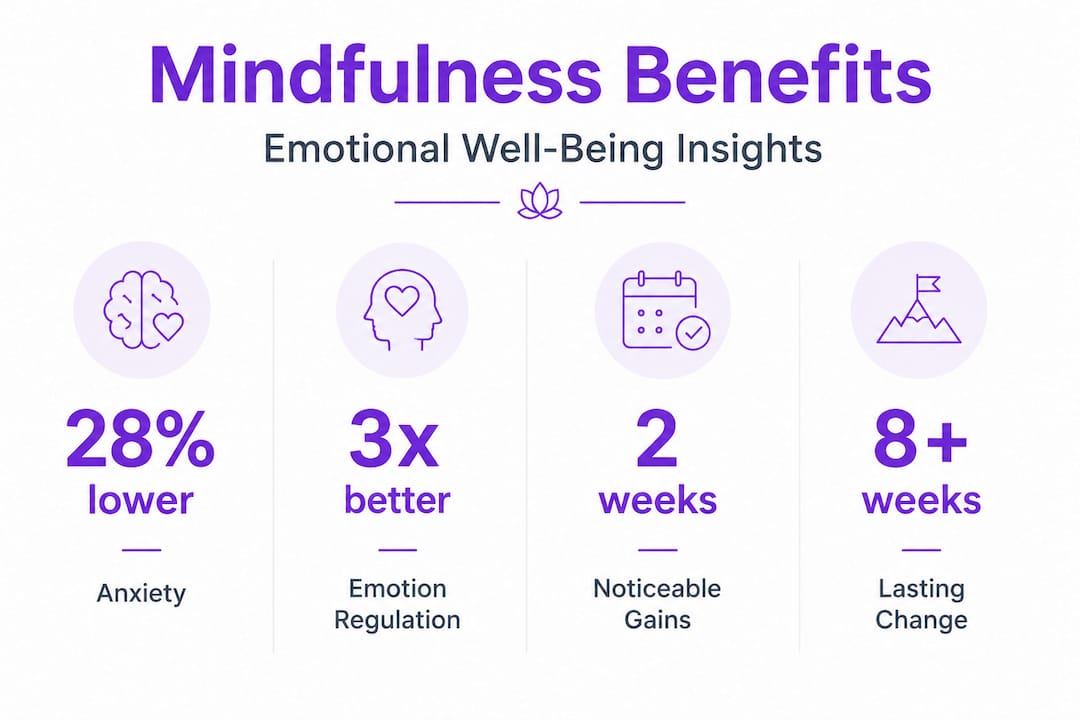
What makes the science even more compelling is the dose-response relationship. A meta-analysis of 30 studies found that mindfulness programs lasting 8 to 12 weeks produce a moderate effect size of g = -0.45 for anxiety, depression, and stress. Short, scattered sessions don't deliver the same return. Consistency over weeks is what produces change you can actually feel.
The importance of mindfulness also shows up at the neurobiological level. Regular practice strengthens attentional control, which means you get better at choosing where your focus goes. It also regulates the stress response, reducing cortisol reactivity and dampening the fight-or-flight spiral that anxiety feeds on.
Key documented benefits of consistent mindfulness practice include:
- Reduced symptoms of anxiety and depression within 8 to 12 weeks
- Improved attentional control and ability to stay present under pressure
- Lower cortisol reactivity and more regulated physiological stress responses
- Greater emotional clarity and reduced emotional numbing
- Stronger self-awareness that supports more intentional decision-making
Pro Tip: If you're new to mindfulness, commit to a structured 8-week program rather than practicing randomly. The research is clear that structure accelerates results far more than occasional sessions.
How mindfulness changes your brain and emotional regulation
Beyond symptom reduction, mindfulness physically reshapes the brain. Mindfulness-based interventions are associated with increased gray matter density, volume, and cortical thickness in regions tied to attention and emotional regulation. The prefrontal cortex, which governs rational thinking and impulse control, becomes more active. The amygdala, the brain's alarm system, becomes less reactive.
This matters because emotional regulation is not just a soft skill. It's a neurological capacity that you can build deliberately. One of the most valuable ways mindfulness builds it is through a process called cognitive reappraisal. In plain terms, this is your ability to reinterpret a situation so it carries less emotional charge. Instead of thinking "this is a disaster," you learn to pause and ask what else might be true. Mindfulness increases reappraisal use, which predicts lower depression and anxiety, and reduces reliance on expressive suppression, the habit of pushing feelings down that tends to make things worse.
| Emotion regulation strategy | What it looks like | Mindfulness influence |
|---|---|---|
| Cognitive reappraisal | Reframing a stressful situation | Increases use of this strategy |
| Expressive suppression | Hiding or pushing down feelings | Decreases reliance on this strategy |
| Attentional control | Choosing what to focus on | Strengthens through practice |
| Acceptance | Allowing emotions without fighting them | Core mechanism of mindfulness |
The science of emotional regulation confirms that suppression has real costs: higher physiological arousal, worse memory consolidation, and strained relationships. Mindfulness offers a healthier alternative, not suppression but non-reactive awareness. You notice the emotion, you let it exist, and you choose how to respond.
Pro Tip: When you notice a difficult emotion, try naming it out loud or in writing before reacting. This simple act of labeling activates the prefrontal cortex and reduces amygdala reactivity, a mechanism research calls "affect labeling."
The benefits of self-reflection compound over time. The more you practice noticing your inner states without judgment, the more your brain builds new default pathways that favor regulation over reaction.
Common misconceptions and the deeper role of mindfulness
Here's the misconception that causes most people to quit: they believe mindfulness means stopping their thoughts. It doesn't. You're not trying to empty your mind. You're learning to change your relationship with what's in it.
Mindfulness helps by allowing thoughts and emotions to be present without resistance or judgment, shifting attention to the present moment. The goal isn't silence. It's a different quality of attention: curious, non-reactive, and open.
Buddhist psychology has a useful concept called the "second arrow." When something painful happens, that's the first arrow. The second arrow is the suffering you add by fighting against the pain, judging yourself for feeling it, or wishing it away. Mindfulness practice is largely about learning to drop the second arrow. And that accepting attitude is where the real benefits come from, not from suppressing unpleasant feelings but from meeting them with less resistance.
There are a few misconceptions worth clearing up directly:
- "I'm doing it wrong if I have a lot of thoughts." More thoughts during early practice usually means you're becoming more aware, not failing.
- "Mindfulness should feel relaxing right away." Sometimes it surfaces discomfort first. That's not a problem. It's information.
- "I need to meditate for 30 minutes a day." Even 5 to 10 focused minutes beats sporadic hour-long sessions.
- "Mindfulness is passive." It requires active attention and practice. It's closer to exercise than to napping.
- "Benefits appear quickly." Meaningful changes in emotional regulation develop over months of consistent practice.
"The goal of mindfulness is not to get rid of thoughts or feelings, but to observe them with less reactivity and more curiosity."
The mindfulness and journaling guide at Voisley covers this distinction in depth, particularly for people who feel stuck in the "clearing thoughts" trap.
Practicing mindfulness effectively: duration, techniques, and journaling synergy
Knowing why mindfulness matters is one thing. Building a practice that actually sticks is another. The research on this is direct: practicing mindfulness daily for about six months is what allows it to become a natural habit, not a chore you have to remind yourself to do.
You don't need a meditation cushion or a silent retreat. The most accessible techniques include:
- Mindful breathing: Focus entirely on each inhale and exhale for 5 minutes. When your mind wanders, return without criticism.
- Body scan: Move your attention slowly through your body, noticing sensation without trying to change anything.
- Informal practice: Bring full attention to a routine activity, like eating, walking, or washing dishes, without checking your phone.
- Mindful journaling: Write about your emotional state before and after a stressful moment, tracking what you notice.
The last one deserves more attention than it typically gets. A two-step practice of mindfulness followed by journaling shifts both cognition and emotional state, enhancing self-awareness in ways that mindfulness alone doesn't fully deliver. Mindfulness opens the door to noticing your inner experience. Journaling helps you make sense of what you find.
| Practice type | Time required | Best for |
|---|---|---|
| Formal meditation | 10 to 20 minutes daily | Building foundational focus |
| Informal mindfulness | Woven into daily activities | Habit integration |
| Mindful journaling | 10 to 15 minutes after practice | Emotional processing and insight |
| Body scan | 10 to 15 minutes | Physical awareness and stress release |
Journaling for emotional well-being doesn't require perfect writing. It requires honesty and a willingness to notice what's actually there.

Pro Tip: Pair your mindfulness session with a specific journaling prompt. "What emotion was hardest to sit with today, and where did I feel it in my body?" bridges the gap between awareness and understanding faster than freewriting.
If you want to track your emotional progress over time, structured journaling with consistent prompts gives you a real map of your growth, not just a feeling that things are better.
Mindfulness across life stages: evidence from adolescents to adults
The impact of mindfulness on health isn't age-specific. But the timing of adoption matters. Adolescence is when many emotional patterns set in, and that's exactly where some of the most compelling large-scale research now points.
A study of 3,519 adolescents found that a 9-week universal mindfulness program increased life satisfaction and positive affect significantly at both 9 and 26 weeks, with home practice moderating positive outcomes. The teens who practiced independently between sessions showed stronger benefits, which reinforces the consistent practice principle across every age group.
What this tells us:
- Emotional habits are malleable and mindfulness reaches them at every developmental stage
- Independent practice outside formal sessions strengthens outcomes more than attendance alone
- Life satisfaction and positive emotional tone are measurable outcomes, not just vague improvements
- Early adoption supports long-term emotional and mental health trajectories
- Adults who start later still benefit significantly but may need longer to see comparable depth of change
| Age group | Key benefit area | Evidence strength |
|---|---|---|
| Adolescents (13 to 18) | Life satisfaction, positive affect, resilience | Large-scale RCT, 3,519 participants |
| Young adults (18 to 35) | Anxiety, stress, academic or work performance | Multiple meta-analyses |
| Adults (35 to 60) | Depression, emotional regulation, chronic pain | Clinical trial evidence |
| Older adults (60+) | Cognitive function, loneliness, physical health | Growing evidence base |
A guide to emotional clarity is a useful starting point regardless of where you are in life. The mental wellness checklist can also help you assess where mindfulness might have the greatest immediate impact for your current emotional landscape.
Why many mindfulness guides miss the emotional self-awareness factor
Most articles about mindfulness stop at stress reduction. Breathe more, worry less, feel calmer. That framing isn't wrong, but it leaves out the most powerful thing mindfulness actually does, and why so many people plateau after initial relief.
The real engine of mindfulness is what it does to your relationship with your own emotions. Mindfulness affects emotional well-being mostly through changing relationships with thoughts and improving cognitive reappraisal, not just by reducing unpleasant feelings. That distinction matters enormously in practice. If you're using mindfulness only to feel calmer, you may miss the deeper transformation: learning to meet your emotional experience with clarity instead of fear.
There's also a risk that popular guides gloss over. Mindfulness can temporarily increase distress when emotion regulation skills are still developing. You become more aware of difficult feelings before you've built the capacity to work with them skillfully. This isn't a flaw in the practice. It's a signal that awareness needs to be paired with the right tools.
That's why journaling is not optional for serious practitioners. It's the partner practice that turns raw awareness into emotional insight. After a mindfulness session surfaces difficult material, mindful journaling gives you a structured way to process it rather than simply sit with discomfort. And self-reflection for emotional clarity accelerates the development of the cognitive reappraisal skills that mindfulness primes but doesn't fully install on its own.
The guides that focus only on calmness are selling you the smallest version of what mindfulness can deliver. The fuller version involves real emotional work, and it pays off in the kind of self-awareness that actually changes how you live.
How Voisley supports your mindfulness and emotional growth journey
You now understand why mindfulness matters and how to practice it in a way that builds genuine emotional awareness, not just temporary calm. The next step is finding a structure that makes it sustainable.

Voisley is built for exactly this. The platform combines guided mindfulness practices, personalized journaling prompts, and mood tracking into one coherent space for emotional growth. Instead of managing a meditation app, a journal, and a mood tracker separately, Voisley brings them together with AI-powered insights that reveal your emotional patterns over time. Whether you're working through anxiety, building self-awareness, or exploring deeper emotional patterns through shadow work, Voisley gives you the structure that research says makes the difference between scattered practice and lasting change.
Frequently asked questions
How long do I need to practice mindfulness to see benefits?
Consistent daily practice for about six months is what allows mindfulness to become a natural habit with lasting benefits for emotional well-being, though many people notice meaningful shifts within 8 to 12 weeks.
Can mindfulness replace medication for anxiety or depression?
Mindfulness programs produce improvements comparable to antidepressants for mild to moderate symptoms, but they work best alongside professional medical treatment rather than as a direct replacement.
What is cognitive reappraisal in mindfulness practice?
Cognitive reappraisal is the ability to reinterpret a situation to change its emotional weight. Mindfulness increases its use, which research links directly to lower depression and anxiety.
Why is journaling recommended alongside mindfulness?
Mindfulness surfaces your emotional experience; journaling helps you make meaning of it. A mindfulness-plus-journaling habit produces measurable shifts in both cognition and emotional state, deepening self-awareness beyond what either practice delivers alone.
Does mindfulness work the same for all age groups?
Mindfulness benefits all ages, but a 9-week program in adolescents showed that independent home practice significantly amplified gains in life satisfaction and positive affect, confirming that self-directed consistency is the key variable at every stage of life.