

TL;DR:
- Reflection involves a structured process that transforms raw experiences into valuable insights, unlike rumination that worsens feelings. Consistent, honest reflective practice improves self-awareness, emotional regulation, problem-solving, and personal growth by analyzing thoughts and feelings with clear frameworks like Gibbs’ Cycle. Using structured journaling and embracing honesty enhances emotional well-being, with tools like Voisley offering guided support for meaningful self-reflection.
Most people think reflection means sitting quietly and replaying what went wrong. That’s not reflection. That’s rumination, and it often makes things worse. True reflective practice is something entirely different: a structured, intentional process that turns raw experience into genuine insight. When you approach reflection with a clear framework, it stops being passive and starts being one of the most powerful tools you have for emotional well-being and personal growth. This article breaks down exactly how that works, and how you can start doing it today.
Table of Contents
-
How reflective practice boosts self-awareness and emotional well-being
-
Reflective journaling: Turning experience into personal growth
-
Common challenges and nuanced perspectives on reflective practice
-
Our perspective: Beyond definitions, the real power of reflective practice
Key Takeaways
| Point | Details |
|---|---|
| Structured reflection unlocks growth | Using proven models like Gibbs’ Cycle turns experience into actionable self-awareness. |
| Journaling deepens emotional clarity | Reflective journaling helps process your emotions and builds clarity for personal development. |
| Evidence supports real-world impact | Studies show reflective practice improves emotional regulation and professional skills. |
| Consistency matters more than frequency | The quality and depth of reflection drive lasting personal change, not just how often you do it. |
| Tailored resources boost progress | Guides and prompts can help you overcome common pitfalls and maximize reflective practice. |
What is reflective practice?
Reflective practice is the deliberate process of examining your experiences, thoughts, and emotions to extract meaning and guide future behavior. It goes far beyond journaling your day or venting about a frustrating conversation. At its core, it asks you to step back, analyze what happened, understand why it happened, and decide what you want to do differently.
There are two foundational modes of reflection worth knowing:
-
Reflection-in-action: This happens in real time. You notice something isn’t working and you adjust on the fly. A teacher who senses a student is confused and changes their explanation mid-lesson is doing this.
-
Reflection-on-action: This happens after the fact. You revisit an experience with some distance and ask what it meant, what you could learn, and what you’d change. Most journaling falls into this category.
Key methodologies include Schon’s reflection-in-action (real-time adjustment during experiences) and reflection-on-action (post-event analysis), and Gibbs’ Reflective Cycle with six stages: Description, Feelings, Evaluation, Analysis, Conclusion, Action Plan.
Gibbs’ Reflective Cycle is especially useful for personal development because it gives you a clear roadmap. Here’s a quick summary of each stage:
| Stage | Core question | Purpose |
|---|---|---|
| Description | What happened? | Establish the facts without judgment |
| Feelings | What were you thinking and feeling? | Surface emotional responses |
| Evaluation | What was good or bad about the experience? | Weigh the positives and negatives |
| Analysis | Why did things happen this way? | Dig into causes and patterns |
| Conclusion | What else could you have done? | Generate alternatives |
| Action Plan | What will you do next time? | Commit to change |
Working through these stages systematically is what separates reflective practice from casual self-talk. You’re not just expressing feelings. You’re building a case study from your own life. Exploring reflection methods for personal growth can help you figure out which framework fits your style best.
How reflective practice boosts self-awareness and emotional well-being
Understanding reflective practice is just the start. Next, let’s explore how it can transform your emotional health and self-awareness.

When you practice reflection consistently, something shifts. You start noticing your emotional patterns before they control you. You recognize the triggers that lead to certain reactions. You begin to understand the gap between your values and your actual behavior, and that gap is where real growth lives.
The benefits of self-reflection extend well beyond personal insight. Research across professional fields shows that reflection improves competency, decision-making, and emotional processing. Teachers who reflect on their classroom strategies become more effective educators. Doctors who keep reflective portfolios make measurable changes to their clinical practice.
Empirical evidence shows reflective practice improves professional competencies, teaching practices, and emotional processing. Studies indicate positive effects on EFL teachers’ instructional strategies, and doctors’ portfolios reveal concrete changes in practice.
What does this mean for you personally? It means that the same structured thinking that helps professionals perform better can help you navigate difficult emotions, improve your relationships, and make decisions that align with who you actually want to be.
Here are some specific outcomes people experience through consistent reflective practice:
-
Greater emotional vocabulary: You stop saying “I feel bad” and start identifying whether you feel disappointed, overlooked, anxious, or something more specific. Precision matters because vague emotions are harder to address.
-
Reduced emotional reactivity: When you understand why certain situations trigger you, you gain a moment of choice before you react.
-
Improved problem-solving: Reflection forces you to look at situations from multiple angles, which naturally improves how you approach challenges.
-
Stronger sense of identity: Over time, you build a clearer picture of your values, your patterns, and what genuinely matters to you.
Using journaling for mood regulation is one of the most accessible ways to start experiencing these benefits, especially if formal frameworks feel intimidating at first.
Pro Tip: After a difficult emotional event, don’t write about it immediately. Wait 20 to 30 minutes for the initial intensity to settle, then write. You’ll access deeper insight rather than just replaying the raw emotion.
Reflective journaling: Turning experience into personal growth
With the benefits of reflective practice in mind, let’s see how journaling can help you apply these concepts in your daily life.
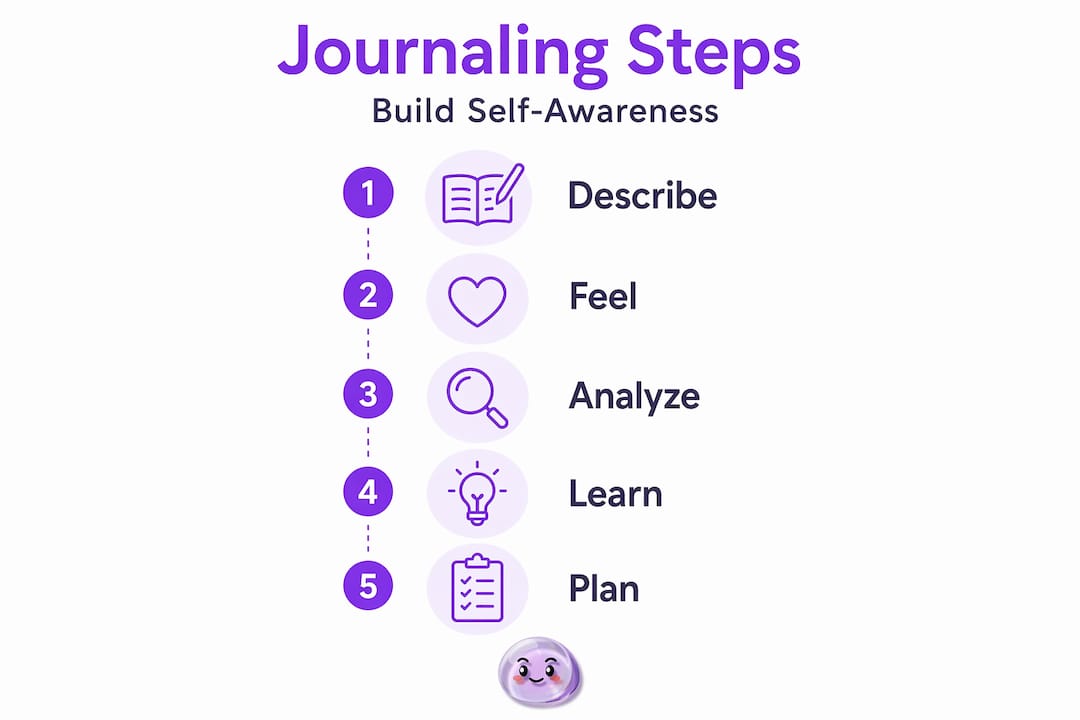
Reflective journaling for personal development involves structured writing using prompts to analyze daily events, emotions, and patterns, fostering emotional well-being by processing feelings and building self-awareness. The key word is structured. Without structure, journaling tends to stay at the surface level. You describe what happened, maybe express how you felt, and close the notebook. That’s useful, but it’s not transformative.
Here’s how to build a reflective journaling practice that actually goes deep:
-
Choose a consistent time and space. Morning works well for setting intentions. Evening works well for processing the day. What matters most is consistency, not timing.
-
Start with a grounding ritual. Take two or three slow breaths before you write. This signals to your nervous system that you’re shifting into a reflective state rather than a reactive one.
-
Pick a structured prompt or framework. Don’t just write “how was my day.” Use a model like Gibbs’ Cycle or a specific prompt set that pushes you toward analysis.
-
Write without editing yourself. First drafts of reflection are messy. Let them be. You can revisit and refine later.
-
End with a forward-looking statement. Close every entry with one concrete intention, something you’ll try differently or pay attention to tomorrow.
-
Review past entries regularly. Patterns only become visible over time. Set a monthly reminder to read back through recent entries and look for recurring themes.
For a deeper look at this process, the emotional self-reflection journaling guide walks through each step with practical examples.
Here’s how you can apply Gibbs’ Cycle directly in a journaling session:
| Gibbs stage | Example journal prompt | What you’re building |
|---|---|---|
| Description | “What exactly happened today?” | Factual clarity |
| Feelings | “What emotions came up, and when?” | Emotional awareness |
| Evaluation | “What went well? What didn’t?” | Honest assessment |
| Analysis | “Why did I react that way?” | Pattern recognition |
| Conclusion | “What could I have done instead?” | Creative thinking |
| Action Plan | “What will I do differently next time?” | Behavioral commitment |
Pro Tip: If you find yourself writing the same description over and over without moving to analysis, try asking “Why?” three times in a row. Each “why” peels back another layer and moves you from description to genuine insight. You can find more approaches in journaling examples for growth that show what this looks like in practice.
Common challenges and nuanced perspectives on reflective practice
As you develop your reflective practice, it’s important to navigate common difficulties and understand the broader research landscape.
Reflective practice is not a perfect science, and it’s worth being honest about that. The research base, while promising, has real limitations. Most studies rely on self-reports, meaning participants assess their own growth, which introduces obvious bias. People tend to report what they believe they should have learned rather than what they actually changed.
Contrasting viewpoints highlight that while reflection is foundational, research often lacks large-scale empirical rigor, relying heavily on self-reports. Some professionals also resist written reflection, preferring verbal discussions as their primary mode of processing.
This is worth taking seriously. Written reflection is not the only valid form. Some people process better through conversation, whether with a therapist, a trusted friend, or even out loud to themselves. If you’ve tried journaling and it feels forced or hollow, that doesn’t mean reflective practice isn’t for you. It may just mean you need a different format.
That said, written reflection has unique advantages. It creates a record you can return to. It slows your thinking down in ways that conversation often doesn’t. And it gives you something concrete to analyze over time.
Common pitfalls to watch out for as you build your practice:
-
Staying in description mode: Writing only about what happened without moving into analysis. This feels productive but rarely generates growth.
-
Reflection as self-criticism: Using your journal as a place to beat yourself up rather than understand yourself. Harsh self-judgment shuts down learning.
-
Inconsistency: Reflecting intensely for a week and then abandoning it for a month. Sporadic reflection rarely builds the pattern recognition that makes it valuable.
-
Avoiding difficult topics: Unconsciously steering away from the experiences that would yield the most insight. Growth lives in the uncomfortable material.
-
Treating reflection as a task: Rushing through prompts to check a box rather than genuinely engaging with the questions.
For those who want to go deeper into the writing side of things, introspective writing for clarity offers practical techniques for moving past surface-level description into real self-understanding.
Our perspective: Beyond definitions, the real power of reflective practice
Now that we’ve explored both foundational and nuanced angles, here’s a candid take on what really unlocks the value of reflective practice.
Most guides on reflective practice focus on frequency. Journal every day. Reflect consistently. Build the habit. That advice isn’t wrong, but it misses something important. Frequency without depth is just busy work. We’ve seen people who journal daily for years without meaningfully changing anything about themselves, because they never push past comfortable observations.
The real variable is honesty. Specifically, the willingness to write what you actually think and feel rather than what sounds reasonable or self-aware. There’s a version of reflective journaling that becomes a performance, even when no one else is reading. You craft insights that sound good. You frame your behavior charitably. You avoid the questions that make you uncomfortable. That kind of reflection has a ceiling, and it’s a low one.
What actually creates transformation is the moment you write something that surprises you. The moment you realize you were more jealous than you admitted, or more afraid than you acknowledged, or that a pattern you’ve been blaming on external circumstances is actually something you keep choosing. That’s where the growth is.
Rituals matter too, but not for the reasons most people think. A consistent journaling ritual isn’t valuable because it forces you to reflect. It’s valuable because it lowers the resistance to being honest. When reflection is a familiar, low-stakes activity, you’re more likely to go to the uncomfortable places. When it’s a special occasion, you tend to perform.
The proven journaling strategies that consistently produce results share one thing in common: they create conditions for honesty rather than just compliance. Set aside distraction-free time, revisit old entries without judgment, and treat your journal as a space where nothing you write is wrong. That shift in relationship to the practice is what makes the difference.
Enhance your reflective journey with Voisley
If this article has sparked a genuine interest in building a reflective practice, the next step is finding the right structure to support it.

Voisley is built specifically for people who want to go deeper than casual journaling. With guided prompts, mood tracking, and AI-powered insights, it gives you a structured space to apply the frameworks we’ve covered here in a way that’s personal to you. Whether you’re working through a specific emotional challenge or building long-term self-awareness, the platform adapts to where you are. Explore guided journaling for clarity to see how structure transforms the journaling experience, or browse mental wellness journaling strategies for practical approaches you can start using right away.
Frequently asked questions
How is reflective practice different from regular journaling?
Reflective practice uses structured prompts and models to critically analyze experiences, whereas regular journaling often records events and feelings without deeper analysis. As structured reflective writing shows, the difference lies in intentionally moving from description to evaluation and action planning.
Can reflective practice help with emotional regulation?
Yes, evidence shows reflective practice supports emotional processing and can meaningfully improve emotional regulation over time. Empirical research confirms positive effects on emotional processing across professional and personal contexts.
What are the best prompts for reflective journaling beginners?
Effective starting prompts include: What happened? How did I feel in that moment? What did I learn? And what would I do differently? Following structured journaling guidance helps beginners move past surface description toward genuine analytical depth.
Is there scientific evidence that reflective practice works?
Yes, multiple studies demonstrate that reflective practice has positive effects on professional competencies and emotional well-being, though large-scale controlled studies remain limited. The available evidence is consistent enough to support reflective practice as a meaningful tool for personal growth.