

TL;DR:
- Emotional pattern recognition involves identifying recurring emotional responses triggered by specific situations or thoughts. Journaling helps develop this skill over weeks by capturing triggers, bodily signals, and urges, fostering greater self-awareness. Combining personal reflection with AI insights enables deeper understanding and healthier emotional regulation.
You probably know the feeling: a colleague's offhand comment sends you spiraling into self-doubt, or a familiar situation triggers a surge of anxiety you can't quite explain. These aren't random reactions. They're patterns, and most people live inside them for years without ever recognizing what's happening. Learning to explain emotional pattern recognition, and more importantly to practice it, is one of the most practical investments you can make in your own well-being. This article breaks down what it actually means, why it matters, and how journaling combined with AI tools can help you decode the emotional loops running quietly in the background of your daily life.
Table of Contents
- What is emotional pattern recognition?
- How journaling develops emotional pattern recognition
- AI and emotional pattern recognition: new frontiers
- How emotional pattern awareness transforms your experience
- Applying emotional pattern recognition for personal growth
- A fresh take on emotional pattern recognition: more than control
- Start your emotional pattern recognition journey with Voisley
- Frequently asked questions
Key Takeaways
| Point | Details |
|---|---|
| Pattern recognition basics | Recognizing recurring emotional signals in body, thoughts, and urges is key to emotional self-awareness. |
| Journaling effectiveness | Consistent journaling over weeks builds insight into emotional patterns and supports behavior change. |
| AI complements journaling | AI identifies hidden emotional patterns quickly to enhance self-understanding. |
| Awareness shifts experience | Naming and observing emotional patterns creates a space that reduces overwhelm and improves resilience. |
| Strategy matching matters | Using emotion regulation techniques tailored to emotional intensity improves effectiveness. |
What is emotional pattern recognition?
Emotional pattern recognition is the practice of identifying recurring emotional responses that get triggered by specific situations, thoughts, or relationships. It starts well before you label something as "anxiety" or "anger." Emotional pattern recognition begins with noticing signals in your body, your thoughts, and your behavioral impulses. A tightening in your chest before a difficult conversation. A familiar urge to cancel plans when you feel unappreciated. These are data points, not just feelings.
Emotions aren't random noise. They signal underlying needs: safety, connection, recognition, autonomy. The body speaks first, often as physical tension or a shift in energy. Thoughts arrive next, interpreting the situation. Then come urges, the pull toward a specific action like withdrawing, defending, or seeking reassurance. Recognizing this three-part sequence is the foundation of emotional journaling for well-being and intentional self-regulation.
What makes pattern recognition different from simply "noticing your feelings" is the repetition factor. You're not just catching one emotional moment. You're connecting multiple moments across time to see that the same emotional sequence appears again and again in similar contexts. That's the insight that changes behavior.
Here's what emotional signals typically look like across three channels:
- Body: chest tightness, shallow breathing, stomach tension, restlessness, fatigue
- Thoughts: catastrophizing, self-critical loops, assumptions about others' motives, replaying past events
- Urges: withdrawing, people-pleasing, overexplaining, lashing out, numbing with distraction
One more thing worth understanding: no single regulation strategy works at every emotional intensity level. Trying to reframe your thoughts cognitively when you're in a full-blown panic rarely works, because your nervous system isn't ready to process language that way. Matching your response strategy to your current arousal level is itself a form of emotional intelligence patterns in action.
How journaling develops emotional pattern recognition
Journaling is not about venting. That's a common misuse of the practice, and it tends to reinforce rather than resolve emotional patterns. The more powerful version is structured, specific, and designed to build a personal emotional dataset over time.
Here's a practical sequence to follow in your entries:
- Name the situation in one sentence. Not how you felt about it, just the facts of what happened.
- Describe your body first, before any interpretation. Where did you feel something? How intense was it?
- Identify the emotion as precisely as you can. "Frustrated" and "humiliated" are not the same feeling, even though they both feel bad.
- Ask "what" questions, not "why" questions. "What did I need in that moment?" opens insight. "Why do I always react this way?" opens rumination.
- Note the urge you felt, even if you didn't act on it. The urge is often more revealing than the behavior.
Emotional journaling shows benefits after just 3 to 5 sessions, with pattern awareness typically emerging within 2 to 3 weeks and behavioral changes occurring in 6 to 8 weeks for 70% of practitioners. That timeline matters because it tells you this isn't a quick fix. It's a practice that compounds.
Reviewing your entries is where the real pattern work happens. After two or three weeks, you may notice that conflict with authority figures almost always triggers a specific shame response. Or that Sunday evenings bring a reliable dip in mood connected to unmet expectations for the week. These are not personality flaws. They're maps.
Pro Tip: If you find yourself stuck in "why" questions during journaling, swap every "why" for "what." Instead of "Why am I so sensitive to criticism?", try "What does criticism feel like in my body, and what does it make me want to do?" The answers will be more specific and far more actionable. Explore emotional self-reflection journaling steps to build this habit in a structured way.
You can also combine different journaling techniques for mood regulation to address different emotional intensities, and use journaling prompts for emotional safety when exploring especially raw or vulnerable territory.
AI and emotional pattern recognition: new frontiers
Manual journaling has real limits. You can only see what you're consciously aware of, and your interpretations are shaped by the same cognitive biases that created the patterns in the first place. This is where AI tools are genuinely useful, not as a replacement for reflection, but as a pattern recognition engine that works on a scale you can't match alone.
AI can analyze months of conversational and written data to surface emotional themes you haven't consciously connected. It might notice that your language shifts in specific ways when discussing work compared to relationships, or that certain words cluster together in entries written during low-mood periods. Renée AI recognizes multiple emotional patterns including fear of abandonment, and offers these pattern insights without waitlists or fees, making the technology broadly accessible.
What users typically report is a sense of recognition when AI surfaces a pattern: not surprise, but a "yes, that's exactly it" response. That moment is valuable because it provides the conceptual label needed to work with a pattern consciously rather than just living inside it.
A few principles for using AI responsibly in this context:
- Treat AI insights as hypotheses, not diagnoses. They're starting points for your own reflection, not conclusions.
- Cross-reference with your journal. When AI names a pattern, go back through your entries and test whether the evidence holds up.
- Avoid over-reliance. If you find yourself checking AI feedback before trusting your own emotional read, the tool is working against you.
- Combine modalities. AI analysis plus manual journaling plus body-awareness practices creates a richer picture than any single approach.
For deeper context on how these tools fit into a broader mental wellness journaling strategies practice, the integration of digital insight with personal reflection is where the most durable growth happens.
How emotional pattern awareness transforms your experience
Without awareness, emotional patterns run like background programs. Something happens, the pattern fires, you react, and afterward you might feel confused or regretful without quite understanding what drove the response. This is the default for most people, and it's not a character flaw. It's simply what happens when patterns go unnamed.

Pattern awareness creates a cognitive gap that allows you to observe emotions rather than be consumed by them, building resilience and what researchers call emotional mastery. That gap is small at first, maybe a few seconds of noticing before reacting. But over time, it widens. You stop being inside the pattern and start being able to see it.
Naming matters more than people realize. When you label a recurring pattern, like "there's that old not-good-enough loop," you're creating a new conceptual category that your brain can work with. The emotion doesn't disappear. But your relationship to it changes fundamentally.
Awareness doesn't eliminate the storm. It teaches you that you are not the weather.
Here's how life looks before and after developing pattern awareness:
| Experience | Without awareness | With pattern awareness |
|---|---|---|
| Receiving criticism | Immediate shame spiral, defensive reaction | Notice the sting, identify the pattern, choose a response |
| Conflict with a close friend | Withdraw or escalate automatically | Recognize the trigger, name the need underneath it |
| Sunday evening anxiety | Absorbed by it, unsure of cause | Identify as recurring pattern, apply a grounding practice |
| Positive feedback | Dismissed or minimized without noticing | Catch the dismissal reflex, sit with the positive feeling |
Pairing this awareness work with mindfulness and journaling for emotional care accelerates the shift considerably, because mindfulness trains the noticing muscle that pattern awareness depends on.
Applying emotional pattern recognition for personal growth
Knowing the theory isn't enough. Here's how to build the actual practice:
- Track five things in every journal entry: the situation, the trigger, the emotion name, the intensity (1 to 10), and the underlying need.
- Use grounding first when intensity is above 7. Box breathing, cold water, or a walk before attempting any cognitive work.
- Review your entries weekly, not just to record but to look for repetition. What triggered you three times this week? That's a pattern worth naming.
- Use mood visualizations to spot emotional trends that individual entries might obscure. A week of 6/10 entries might hide a pattern better revealed in a 30-day view.
- Adjust your strategy to match intensity. Effective emotion regulation means matching strategies to intensity, with grounding essential for high arousal before cognitive reframing even becomes possible.
| Emotional intensity | Recommended strategy | Why it works |
|---|---|---|
| Low (1 to 4) | Cognitive reframing, journaling | Prefrontal cortex is fully accessible |
| Medium (5 to 7) | Breathing exercises, body scan | Reduces activation before reflection |
| High (8 to 10) | Grounding, movement, sensory focus | Regulates nervous system first |
Pro Tip: Start your weekly review by asking one question: "What situation came up more than once this week, and what emotion did it reliably produce?" That single question surfaces more pattern data than an hour of general journaling.
Unlock emotional patterns with journaling and combine that with mood visualizations for emotional clarity to see both the micro and macro picture of your emotional life.
A fresh take on emotional pattern recognition: more than control
Most people come to emotional pattern recognition hoping to finally get their emotions under control. That framing is understandable, but it leads in the wrong direction. Control implies suppression, and suppressed emotional patterns don't dissolve. They resurface, usually with more force.
The more useful frame is understanding. When you can explain emotional pattern recognition to yourself, you're not building a wall against your feelings. You're building a relationship with them that's grounded in curiosity rather than fear. That shift is subtle, but it changes everything about how resilience actually develops.
Here's what most articles on this topic miss: pattern awareness is also an act of self-compassion. When you recognize that your defensive reaction isn't a personality flaw but a learned pattern developed for very good reasons at an earlier point in your life, the shame around that reaction tends to dissolve. You stop fighting yourself and start working with yourself.
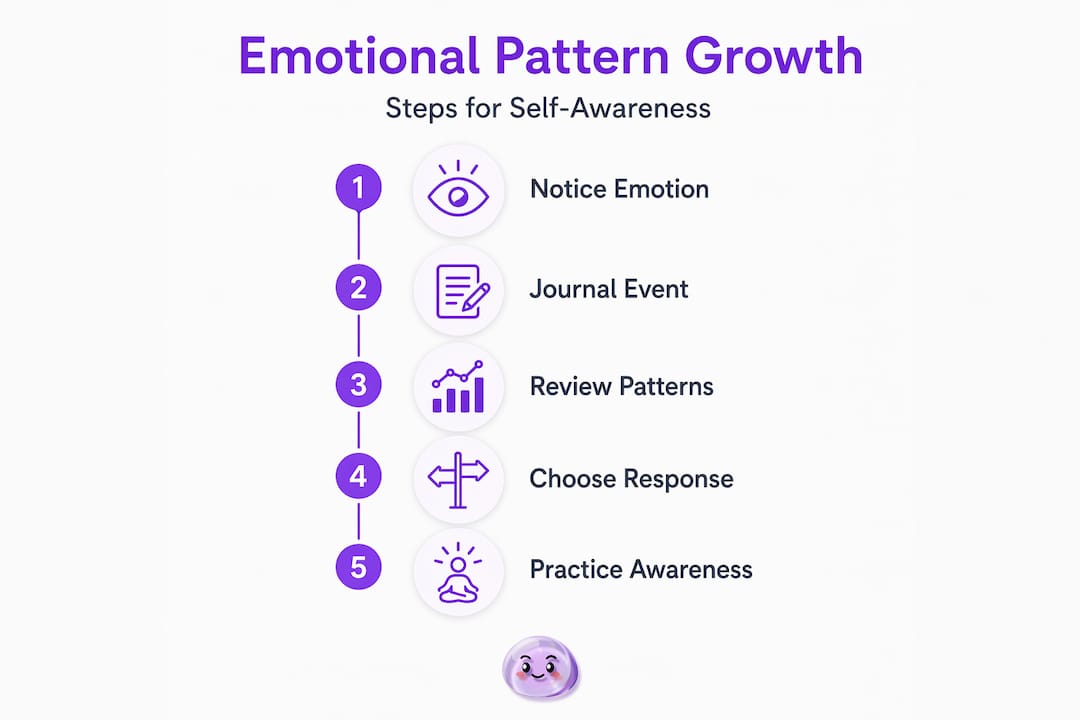
The combination of science-backed mental wellness journaling strategies with AI-powered insight and consistent personal reflection creates something more powerful than any single approach. It creates a feedback loop. Journal, notice, name, reflect, adjust, repeat. Over months, the patterns that once ran silently start to feel legible. And legible patterns are ones you can actually work with.
Emotional mastery, real mastery, isn't the absence of difficult emotions. It's knowing what you're dealing with when they arrive, having tools ready, and being able to choose your response instead of defaulting to a script written years ago. That's what developing emotional patterns for well-being is actually about.
Start your emotional pattern recognition journey with Voisley
Building emotional self-awareness takes a consistent practice and the right structure to make it sustainable. Starting strong matters as much as starting at all.

Voisley gives you a guided journaling environment built specifically for this work. With mood tracking, structured prompts across journal types including gratitude, shadow work, and future goals, and AI-powered pattern visualizations, you get both the daily practice tools and the broader view of your emotional trends over time. Whether you're just beginning to notice recurring patterns or you're ready to go deeper into emotional intelligence work, Voisley provides the structure that turns good intentions into lasting growth.
Frequently asked questions
What is emotional pattern recognition?
Emotional pattern recognition is the process of identifying recurring emotional responses triggered by specific situations or thoughts, starting with emotional signals in your body, thoughts, and urges, so you can better understand and regulate your emotions over time.
How does journaling help with emotional pattern recognition?
Journaling builds a detailed personal record of emotions, triggers, and contexts, and pattern awareness emerges within 2 to 3 weeks for most practitioners, with behavioral changes following in 6 to 8 weeks.
What role can AI play in emotional pattern recognition?
AI can process large volumes of emotional and conversational data to surface patterns that manual reflection misses, and tools like Renée AI identify complex relational patterns such as fear of abandonment and deliver those insights immediately.
Can emotional pattern awareness eliminate emotional reactions?
No. Awareness doesn't erase emotions, but it creates a cognitive gap between feeling and reacting, giving you space to observe what's happening and choose a more intentional response rather than defaulting to an automatic one.