

TL;DR:
- Personal growth involves ongoing development in thinking, emotional processing, and finding genuine meaning, beyond just feeling happy. It is best understood through frameworks like Ryff’s model, which emphasizes change, openness, and measurable outcomes; combining growth and iterative mindsets enhances lasting change. Structured journaling and regular self-assessment are practical tools that facilitate behavioral shifts, self-awareness, and sustainable personal evolution.
Most people assume personal growth means becoming happier, more confident, or simply “better.” That framing sells a lot of books, but it misses the point. Personal growth in psychology is about development, not just feeling good. It’s a measurable, ongoing process involving how you think, adapt, process emotion, and move toward a life that feels genuinely meaningful. This guide unpacks what personal growth actually is, which frameworks support it, and how tools like structured journaling can make it real and trackable, not just aspirational.
Table of Contents
-
Key frameworks: Growth mindset, iterative mindset, and outcomes
-
Personal growth in context: Challenges, nuances, and what actually works
Key Takeaways
| Point | Details |
|---|---|
| Growth is measurable | Personal growth can be tracked through well-being dimensions and self-reflection. |
| Mindset needs structure | A growth mindset works best when paired with practical tools and feedback loops. |
| Journaling accelerates change | Structured journaling facilitates deeper self-awareness and supports lasting growth. |
| Personal growth is ongoing | Sustainable development is a continuous practice, not a one-time insight. |
What is personal growth? Understanding the core dimensions
With that foundation, let’s clarify how psychology defines personal growth.
The term “personal growth” gets used loosely. But in research, it has a precise meaning. Psychologist Carol Ryff developed one of the most respected models of psychological well-being, and personal growth sits at the center of it as one of six core dimensions. In Ryff’s model, growth is defined as continued development, staying open to new experience, and recognizing that you are evolving rather than fixed.
This is fundamentally different from just “feeling good.” Ryff’s model distinguishes between hedonic well-being (pleasure, positive emotion, life satisfaction) and eudaimonic well-being (meaning, growth, purpose, and engagement). Personal growth belongs firmly in the eudaimonic camp. You can feel great but be stagnant. You can also feel uncomfortable while growing rapidly. These are not the same thing.
Here’s a breakdown of all six dimensions in Ryff’s model, so you can see where growth fits:
| Dimension | What it means | How it shows up |
|---|---|---|
| Self-acceptance | Positive view of who you are | Acknowledging strengths and flaws |
| Personal growth | Openness to change and learning | Seeking challenge, embracing feedback |
| Purpose in life | Sense of direction and meaning | Clear goals, values-driven decisions |
| Environmental mastery | Shaping your surroundings | Effective use of resources and time |
| Autonomy | Acting from internal values | Resisting unhelpful social pressure |
| Positive relations | Deep, trusting relationships | Empathy, connection, reciprocity |
Personal growth, then, isn’t a vague aspiration. It’s an operational concept with three layers: a stance (openness and curiosity), behaviors (learning, practicing, seeking feedback), and measurable outcomes (new competencies, changed responses, expanded perspective).
“Growth is not measured by how good you feel today, but by how differently you engage with tomorrow compared to a year ago.” This shift in definition changes everything about how you approach your own development.
The key takeaway: personal growth is not a destination. It’s a direction. And directions require tracking, not just intention.
Key frameworks: Growth mindset, iterative mindset, and outcomes
To turn understanding into action, it’s helpful to look at established frameworks.
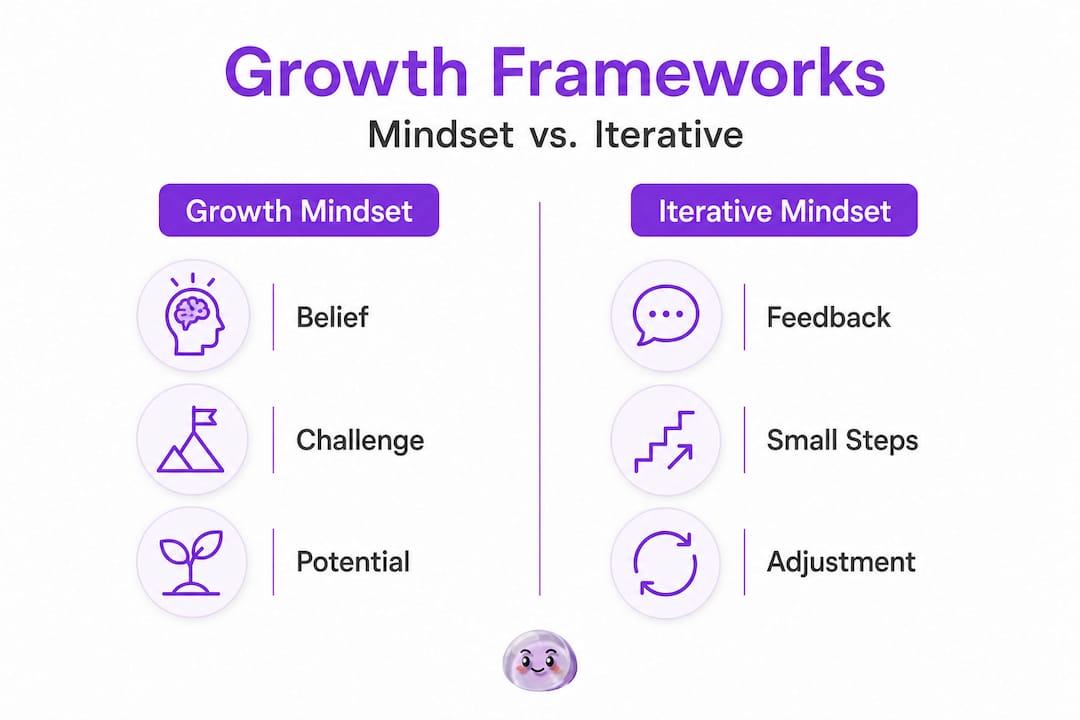
The most popular framework in personal development circles is Carol Dweck’s growth mindset, developed at Stanford. At its core, growth mindset means reframing setbacks as opportunities for learning rather than evidence of fixed limitations. If you fail an exam, a growth mindset says: “I haven’t learned this yet.” A fixed mindset says: “I’m just not good at this.”
This framing is genuinely useful. It shifts how you interpret struggle, which affects whether you keep going or give up. But here’s what gets left out of most growth mindset conversations: the effect sizes are modest. Mindset alone does not transform outcomes in a reliable, linear way. Context matters enormously. A growth mindset without a corresponding skill set, feedback system, or practice structure leaves a lot of potential on the table.
That’s where the iterative mindset framework offers something more robust. Research published in the journal Behavioral Sciences outlines an iterative mindset as a three-stage process involving adaptation, deliberate practice, and self-assessment. This isn’t just “believe you can improve.” It’s a repeating loop:
-
Adapt: Identify what isn’t working and adjust your approach
-
Practice: Deliberately repeat behaviors that target the skill or pattern you want to shift
-
Assess: Measure what changed, what didn’t, and why, then begin again
This loop is powerful because it builds feedback into the process. Growth becomes a system, not a hope. You stop waiting to “feel changed” and start looking for evidence of change.
Pro Tip: Don’t wait for a major epiphany to mark your progress. Instead, track small behavioral shifts weekly. Did you respond to a stressful email differently than last month? Did you notice an automatic thought pattern before reacting? Those micro-shifts are real growth.
Here’s a side-by-side comparison of both frameworks so you can see how they complement each other:
| Framework | Core belief | Strength | Limitation |
|---|---|---|---|
| Growth mindset | Abilities are developed, not fixed | Shifts interpretation of failure | Modest effect size alone |
| Iterative mindset | Growth comes through repeated cycles of practice and feedback | Builds measurable skill | Requires consistent effort and tracking |
The most effective approach uses both. Start with the growth mindset to stay emotionally open to challenge, then use the iterative cycle to make change concrete and trackable. One handles the attitude, the other handles the method.
Journaling as a tool for real personal growth
Once you have a clear framework, tools like journaling can make growth actionable and visible.

Here’s a critical distinction that doesn’t get made often enough: venting in a journal is not the same as growing through one. Writing out frustration without structure can actually reinforce rumination, which is the tendency to replay problems without resolution. What research consistently shows is that structured journaling changes the outcome completely.
Journaling for mental health boosts mood, eases stress, and becomes significantly more powerful when paired with prompts and intentional structure. The key variable isn’t the writing itself. It’s the quality of reflection the writing produces.
Structured journaling supports personal growth in several distinct ways:
-
Emotional regulation: Writing about emotional experiences with a focus on meaning (not just venting) helps you process them rather than stay stuck in them
-
Pattern recognition: Over time, journaling surfaces recurring thoughts, triggers, and responses that would otherwise remain invisible
-
Values clarification: Prompt-based writing helps you identify what you actually care about versus what you think you should care about
-
Behavioral tracking: Noting specific actions and outcomes creates the feedback loop the iterative mindset requires
-
Accountability: A written record creates a reference point. You can compare today’s self to last month’s self, not based on feeling, but on evidence
If you want to integrate journaling into your growth practice, exploring strategies for wellness journaling gives you a strong practical starting point. For those who want to understand what patterns their entries are already revealing, unlocking emotional patterns through guided journaling offers a deeper layer of self-awareness. And for those newer to the practice, building a mindful journaling habit from scratch is covered in detail there.
The prompts you use matter more than the time you spend writing. Instead of “How was my day?” try:
-
“What did I resist today, and why?”
-
“Where did I act in line with my values? Where didn’t I?”
-
“What would my future self say about how I handled that?”
-
“What’s one belief I held this week that I want to examine?”
These prompts are designed to generate reflection, not recollection. That’s the difference between journaling that changes you and journaling that just records you.
Pro Tip: Set a weekly “review” entry specifically to assess patterns across the week’s writing. This creates the “assess” step of the iterative mindset right inside your journaling practice.
Personal growth in context: Challenges, nuances, and what actually works
Still, it’s important to recognize not everything labeled as growth delivers on its promise.
Personal growth has a real plateau problem. You start with enthusiasm, make early gains, and then stall. This isn’t a character flaw. It’s a structural feature of how learning works. Gains are often front-loaded, and sustained progress requires deliberate effort that most approaches don’t actually teach.
“Most people overestimate what they can change in a week and underestimate what they can change in a year, if they have a consistent practice loop.”
Research on growth mindset interventions shows that effects can be small, non-linear, and highly context-specific. Simply believing you can grow doesn’t produce growth. Lasting change requires pairing mindset work with concrete skill practice and active feedback. Similarly, recent evidence from learning research suggests that combining mindset shifts with deliberate practice and structured reflection yields significantly better outcomes than either approach alone.
Here’s what that means practically. Avoid these common traps:
-
Passive journaling: Writing about your feelings without any structured prompt or follow-up action rarely translates into behavioral change
-
Mindset-only focus: Believing you can grow without building the skills or seeking feedback that growth requires leads to a sense of effort without progress
-
Insight without iteration: Having a breakthrough realization is only meaningful if you act on it repeatedly until it becomes a new pattern
-
Avoiding discomfort: Real growth typically involves sitting with uncertainty, failure, or difficult emotion. Optimizing purely for comfort keeps you comfortable and stuck
What actually works? Pairing self-reflection with structured feedback, repeating new behaviors in realistic contexts, and tracking progress over weeks and months rather than days. Using journaling techniques for well-being that build in review cycles is one practical way to do this. Another is using journaling prompts designed for emotional safety, which allow you to explore difficult material without becoming overwhelmed by it.
Sustainable growth is neither fast nor always obvious. It shows up in subtle behavioral shifts, changed automatic responses, and a gradual expansion of what you’re willing to face. Track that, not just your mood.
Rethinking personal growth: What most guides miss
Now, let’s tie all these concepts together with an honest look at how true growth actually plays out.
Most personal growth content focuses on mindset and motivation. Read the right book, adopt the right belief, attend the right retreat, and transformation follows. That model is seductive but incomplete. What it consistently overlooks is the role of measurement and iteration. You cannot grow what you don’t track, and you can’t track what you don’t operationally define.
Here’s the uncomfortable reality: people who report the most meaningful personal growth aren’t the ones who had the biggest insights. They’re the ones who built the most consistent practice loops. Daily or weekly reflection combined with behavioral feedback, small adjustments, and honest self-assessment over months produces more lasting change than any single epiphany.
Another thing most guides skip: emotional processing is not a soft skill. It’s the mechanism through which growth happens. If you can’t sit with the discomfort that comes from recognizing an outdated pattern or a real limitation, you won’t change it. You’ll explain it away. This is why structured self-reflection tools, including a self-reflection journaling guide, are more than “nice to have.” They’re the actual engine of change.
What we’d suggest designing for yourself is a simple practice loop: reflect weekly, identify one specific pattern or behavior to work on, practice deliberately for two to four weeks, then assess what shifted. Rinse and repeat. It’s unsexy. It’s also what actually works. Growth that lasts isn’t dramatic. It’s consistent, measured, and cumulative.
Take your personal growth journey further
If you’ve made it this far, you already understand something most people don’t: real growth requires structure, not just intention. That’s exactly what a tool like Voisley is built around.

Voisley brings together guided journaling, mood tracking, AI-powered insights, and personalized prompts to create a structured space where self-reflection becomes a genuine practice. Whether you’re working through emotional patterns, building self-awareness, or trying to turn insight into lasting behavioral change, the platform gives you the frameworks and feedback that make growth measurable. Explore the different journal types, from gratitude and shadow work to future goals, and discover how consistent, structured reflection can become your most powerful personal growth tool.
Frequently asked questions
How is personal growth measured?
Personal growth can be assessed using models like Ryff’s, which track development across dimensions like openness to experience, self-acceptance, and sense of purpose. Behavioral tracking through journaling and iterative self-assessment also provides concrete evidence of change over time.
What is an example of a practical personal growth exercise?
Journaling with structured prompts focused on values, challenges, or behavioral patterns is one of the most accessible and evidence-supported growth exercises. Reviewing those entries weekly for recurring themes turns single reflections into a long-term feedback system.
Does a growth mindset guarantee change?
A growth mindset supports openness to change, but mindset alone produces modest effects when not paired with skill-building, deliberate practice, and structured feedback. Think of it as a necessary starting condition, not a sufficient one.
How often should I reflect for real growth?
Iterative mindset research supports weekly self-assessment cycles as the minimum effective frequency for longitudinal growth. Daily brief check-ins combined with a more thorough weekly review tend to produce the most consistent gains in self-awareness and behavioral change.