

TL;DR:
- Real-time mood tracking closes the gap between perceived experiences and actual emotions, revealing useful patterns. The most effective methods include EMA, the Yale Mood Meter, and digital journaling, each suited to different lifestyles and goals. Consistently logging during natural daily transitions and reviewing trends fosters self-awareness and emotional regulation for long-term growth.
You remember last Tuesday as a decent day, maybe even a good one. But your journal tells a different story: two separate moments of frustration, a midday energy crash, and one genuine burst of joy right after lunch. That gap between what you feel you experienced and what actually happened is called hindsight memory bias, and it quietly distorts your self-awareness every single day. Real-time mood tracking closes that gap. By capturing emotional data as it unfolds, you build an honest record of your inner life, one that reveals the patterns, triggers, and recovery cycles that no amount of end-of-day reflection can uncover on its own.
Table of Contents
Key Takeaways
| Point | Details |
|---|---|
| Track moods in real time | Capturing mood at daily transitions unlocks more accurate patterns and personal insights. |
| Digital tools aid consistency | Apps and journaling platforms offer reminders and searchable logs for sustainable self-awareness. |
| Mindful reflection deepens insights | Weekly review and emotion labeling help you recognize triggers and energy cycles. |
| Personalization is key | Adapting your tracking style to your habits enhances adherence and makes emotional growth more effective. |
| Immediate action leads to growth | Acting on mood pattern findings improves emotional intelligence and regulation. |
What you need: mood tracking tools and methods
Having identified the need for real-time mood tracking, let’s explore the most effective tools and frameworks to begin.
The foundation of any good mood pattern analysis is choosing a method that matches your lifestyle and goals. Three frameworks dominate this space, and each has distinct strengths.
Ecological Momentary Assessment (EMA) is the most research-backed option. It works by prompting you multiple times per day through an app to rate how you feel right now. EMA achieves 72.8% compliance in research settings, which is impressive for a self-report tool. The tradeoff is that non-symptomatic users sometimes find frequent prompts tedious, so the design of those reminders matters a lot.
The Yale Mood Meter takes a different approach. Developed by the Yale Center for Emotional Intelligence, it uses a 2D grid that maps emotions by energy level on the vertical axis and pleasantness on the horizontal axis. Instead of just saying “I feel bad,” you locate your precise emotional state, such as “low energy, slightly unpleasant,” which is far more informative for pattern analysis. This nuanced labeling helps you move from vague awareness to specific emotional intelligence.
Digital journaling platforms combine the best of both worlds. They offer structured prompts, AI-powered pattern detection, and searchable archives that make spotting trends over weeks and months surprisingly easy. Exploring journaling and AI strategies can accelerate how quickly you understand your emotional baseline.
Here is a quick comparison to help you choose:
| Method | Frequency | Best for | Key limitation |
|---|---|---|---|
| EMA | 3 to 8 times daily | Research-grade accuracy | Can feel intrusive |
| Yale Mood Meter | 1 to 4 times daily | Emotion vocabulary growth | Requires learning the grid |
| Digital journaling | 1 to 3 times daily | Long-term pattern analysis | Slower feedback loop |
| AI-enhanced apps | Adaptive | Personalized insights | Requires data over time |
When evaluating the best AI wellness tools for this purpose, look for apps that let you customize prompt timing, export your data, and visualize trends rather than just logging raw entries.
Key features to prioritize when selecting your tool:
-
Customizable reminders that align with your natural daily rhythm
-
Emotion labeling options beyond simple 1 to 10 scales (wheels, grids, or descriptive tags)
-
Visual trend displays so you can see weekly and monthly patterns at a glance
-
Search and filter functions to locate specific emotional events quickly
-
Privacy controls because emotional data is deeply personal
Pro Tip: Start with just one or two mood entries per day for the first two weeks. Trying to log six times daily from day one is a fast route to quitting. Consistency over frequency is the rule that actually builds long-term insight.
How to track moods: practical steps and routines
With the right tools in place, it’s time to build a sustainable habit and master the process of mood tracking.
The single biggest factor in mood tracking success is when you log, not how thoroughly. Research shows that real-time tracking outperforms retrospective logging because memory actively rewrites emotional experiences, smoothing out the uncomfortable peaks and valleys. The solution is to anchor your logs to natural daily transitions.
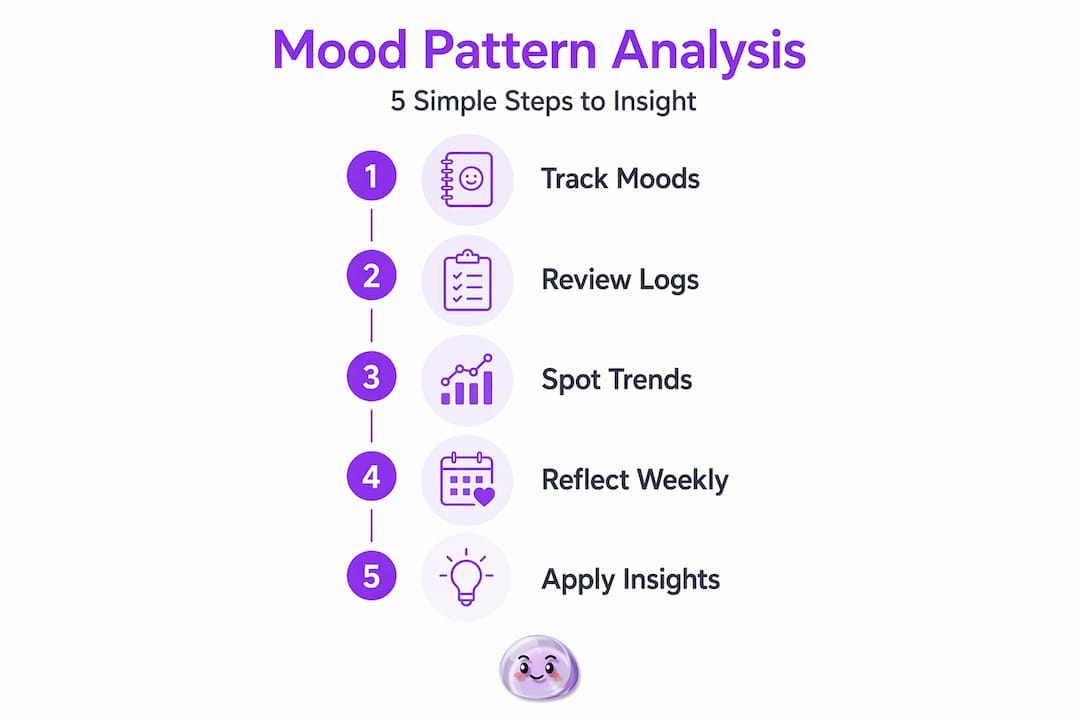
Here is a practical step-by-step routine to follow:
-
Morning log (within 20 minutes of waking): Record your baseline mood before the day’s demands take over. Note your energy level, any lingering emotions from sleep, and your immediate physical state.
-
Midday check-in (around lunch): This is often where the first significant emotional shift occurs. A two-minute pause to label what you feel and briefly note a cause is enough.
-
Afternoon transition (between work and personal time): This boundary moment captures stress spillover or the relief of switching contexts, both are highly informative.
-
Evening reflection (30 minutes before bed): Review the day’s emotional arc rather than trying to reconstruct it. Use your earlier logs as anchors so you are analyzing patterns, not fabricating memories.
-
Weekly pattern review (Sunday or Monday): Spend 15 minutes scanning your seven-day record. Look for repeat themes, energy dips on specific days, or emotions tied to particular activities.
Applying journaling techniques during your evening reflection, such as affect labeling (naming the precise emotion rather than just “bad” or “good”), measurably reduces the intensity of the feeling itself. That is not just a mindfulness bonus; it is a neurological process that calms the brain’s threat response.
Digital journaling with AI excels for personal use because of its searchability and ability to surface patterns that human eyes miss in raw text. Reviewing mood visualization tips is a great way to understand how to read those AI-generated charts meaningfully.

Here is a breakdown of what to log at each transition:
| Time of day | What to record | Time required |
|---|---|---|
| Morning | Energy level, emotional baseline, sleep quality | 2 to 3 minutes |
| Midday | Current mood, primary activity, stress level | 1 to 2 minutes |
| Afternoon | Mood shift, social context, physical sensations | 2 minutes |
| Evening | Emotional arc, notable events, gratitude note | 3 to 5 minutes |
A mindfulness journaling guide can help you build the non-judgmental awareness that turns routine logging into genuine self-discovery. The goal is to observe your emotions with curiosity, not to evaluate whether you felt the “right” things.
Pro Tip: Set your app reminders to fire five minutes after a natural transition, like five minutes after you sit down to eat lunch, so the prompt arrives when you are already pausing rather than interrupting focused work.
Common mistakes, troubleshooting, and edge cases
Even with an established mood tracking routine, obstacles and exceptions can arise that affect your progress.
The most common reason people abandon mood tracking is simple: it stops feeling relevant. The prompts become background noise, the logs feel repetitive, and the insights seem to plateau. Understanding why this happens gives you a clear path to fix it.
Adherence drops usually signal one of three problems: the prompt frequency is too high, the logging format is too complex, or the feedback loop is too long. EMA response rates vary significantly based on prompt design and the cognitive burden each entry requires. One study found that a streamlined EMA format achieved completion times under 45 seconds with full emotion scale usage, which is the sweet spot for sustained compliance.
Specific barriers and how to address them:
-
Generic reminders: Replace “How are you feeling?” with a contextual prompt like “What’s your energy level right now?” Personalized questions trigger more honest responses.
-
Memory bias in delayed logging: If you miss a real-time entry, do not try to reconstruct it from memory. Log “missed entry” and move on rather than filling in guesses that corrupt your dataset.
-
Emotional numbness or flatness: Some days you genuinely cannot identify what you feel. Use a body-scan approach, noting physical sensations (tight chest, relaxed shoulders) as proxy data until clarity returns.
-
Inconsistent baseline days: Illness, poor sleep, and unusual events create outliers. Flag them with a tag rather than excluding them. These outliers often reveal important patterns about your resilience.
-
Plateaus in insight: After four to six weeks, many users feel they have “figured out” their patterns. This is the time to deepen your analysis, not stop. Shift from daily mood to exploring specific emotion categories like frustration or curiosity.
Low adherence in non-symptomatic groups, such as healthy adults without active mental health concerns, is a documented challenge in EMA research. This matters because it means even motivated users can struggle with consistency if the system feels irrelevant to their current emotional state.
“Memory unreliability favors real-time tracking.” This is not a suggestion for perfectionists. It is a structural fact about how human memory works, and building your system around it is the single most important design decision you will make.
Reading about journaling for emotional wellness can help you reconnect with your why when motivation dips. Pairing that with science-backed emotional regulation techniques gives you practical tools to reactivate the habit quickly.
Pro Tip: When your motivation drops, shrink the system down to one entry per day for two weeks. This “maintenance mode” preserves your data continuity and makes it much easier to ramp back up than starting fresh.
Interpreting your mood patterns and applying insights
Once your mood tracking process is consistent and pitfalls are addressed, it’s time to transform your logs into meaningful self-awareness and practical improvements.
Raw mood data is only useful when you know how to read it. The goal of pattern analysis is not to catalog emotions but to identify the structure of your emotional life: when you are most vulnerable, when you thrive, and what reliably moves you from one state to another.
Tracking at transitions and conducting weekly reflection consistently reveals actionable insights like peak energy times, stress accumulation points, and emotional recovery patterns that are invisible in day-to-day experience.
Here is what to look for in your mood logs:
-
Energy peaks: Which days and times show consistently high energy and positive affect? These are your optimal windows for creative work, difficult conversations, or important decisions.
-
Recurring dips: Does your mood reliably drop on Sunday evenings, or mid-Wednesday afternoons? Naming a pattern removes its power to catch you off guard.
-
Emotional triggers: What activities, people, or environments consistently precede negative mood states? Equally important: what reliably lifts you?
-
Recovery cycles: After a stressful day or emotional low, how many hours or days does it take you to return to baseline? This is your personal resilience metric.
-
Contrast patterns: Are your highs and lows getting closer together over time? That convergence usually signals growing emotional regulation capacity.
| Pattern type | What it reveals | How to act on it |
|---|---|---|
| Morning low energy | Sleep quality or cortisol rhythms | Adjust sleep schedule or morning routine |
| Post-social fatigue | Introversion signals or boundary issues | Build in recovery time after social events |
| Midweek emotional peak | Work engagement patterns | Schedule high-stakes tasks on these days |
| Evening frustration spike | Stress carryover from work | Create a transition ritual to decompress |
Applying insights from your logs to emotional health practices turns passive self-awareness into active self-regulation. Combining this with consistent mindfulness practices deepens the effect because mindfulness trains the observational capacity that makes pattern recognition more accurate over time.
Your weekly reflection checklist should include: reviewing your three most intense emotional moments, identifying one recurring trigger you can address, noting any change in your baseline mood compared to the prior week, and writing one concrete behavioral adjustment to test in the coming week.
Why most mood analysis advice falls short—and what actually works
Most articles about mood tracking tell you to download an app, log daily, and look for patterns. That advice is not wrong. It is just dangerously incomplete.
The problem with generic mood tracking advice is that it treats all users as the same. It suggests uniform prompt schedules, standardized emotion scales, and fixed weekly review templates. But individual variability in emotion reporting means that the best system for one person can be actively counterproductive for another. A highly extroverted person might find midday social context logs enormously revealing. An introvert might find that solitary evening reflection captures far more signal. One size does not fit all.
The second gap in standard advice is underestimating the value of searchable, digital records. A paper journal can show you patterns, but only the ones you can manually scan for. An AI-enhanced digital record can surface correlations you would never notice on your own, like the fact that your mood reliably dips two days after high-sugar intake, or that creative work entries cluster on mornings after seven or more hours of sleep. These are the insights that actually change behavior.
The third failure is treating reflection as optional. Logging without reviewing is like collecting data and never running the analysis. The emotional health trends in digital wellness consistently point toward one conclusion: sustainable self-awareness requires a reflection ritual, not just a logging habit.
“Affect labeling reduces amygdala intensity.” This single finding reframes everything. Naming your emotion is not just journaling. It is a real-time intervention that physically calms your nervous system. That is why mood tracking is not merely self-monitoring. It is an active practice of emotional regulation.
The combination that actually works is real-time logging plus personalized prompts plus weekly AI-assisted reflection plus a mindful, non-judgmental attitude toward your own data. Remove any one of those elements and you get a system that works for a few weeks and then fades.
Next steps: enhance your emotional growth journey
If this guide has shown you anything, it is that mood pattern analysis is not about perfection. It is about building a personal system that actually reflects how you feel and evolves as you grow.

Voisley is built precisely for this kind of intentional, deeply personal emotional work. With AI-powered journaling, mental wellness tips grounded in research, and mood visualizations that make your patterns impossible to ignore, the platform gives you everything you need to move from scattered emotional awareness to genuine self-knowledge. Whether you are just starting out or ready to go deeper with advanced AI wellness tools, Voisley meets you exactly where you are. Start your first structured mood log today and let the data tell your story.
Frequently asked questions
What is the most effective way to track mood patterns for self-improvement?
EMA via digital apps provides real-time, high-frequency mood data that reveals accurate emotional patterns far better than end-of-day recall. Pairing this with weekly reflection turns raw data into actionable personal growth insights.
How do mood tracking apps differ from traditional journaling?
Digital AI-powered tools enable instant updates, custom reminders, emotion grids, and automated pattern detection that paper journals simply cannot match. The searchability alone makes identifying emotional trends dramatically faster.
When should I log my mood to capture meaningful data?
Log during natural daily transitions such as waking, mealtimes, and bedtime, as these moments yield the most actionable insights including peak energy windows and emotional recovery cycles.
How can I improve consistency in mood tracking?
Keep your logging format simple and use contextual reminders because prompt design directly affects response rates and the quality of data you collect over time. Shrinking to one entry per day during low-motivation periods preserves your data streak without burning out.
What insights should I expect from analyzing mood patterns?
Weekly review of your mood logs reliably uncovers peak energy times, recovery patterns, and emotional triggers that you can directly translate into better daily routines and stronger self-regulation habits.