

TL;DR:
- AI journaling helps users process unspoken feelings and enhances emotional well-being through structured reflection. It lowers barriers to daily self-awareness, identifying triggers, patterns, and building honesty without social judgment. However, users should remember it's a supportive tool, not a substitute for professional therapy, and must combine judgment with AI insights for safe emotional growth.
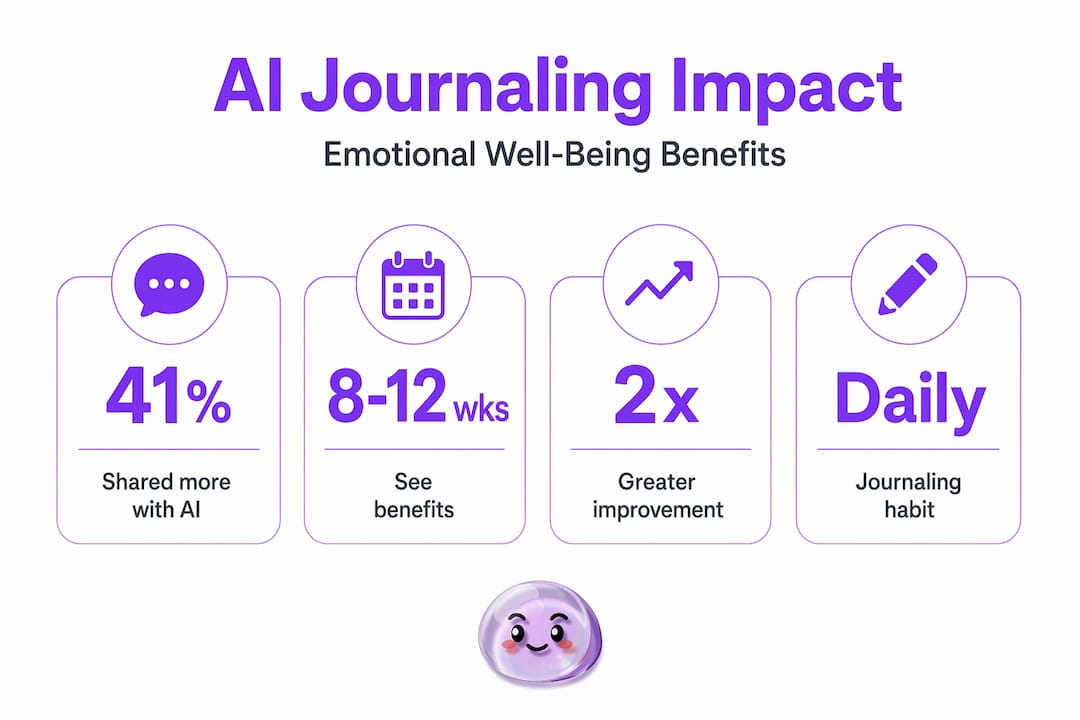
A striking 41% of people using AI journaling apps have disclosed things to the AI they had never told another human. That number reframes the question of why AI journaling insights matter. This isn't a productivity trend or a tech gimmick. For millions of people quietly struggling with anxiety, emotional confusion, or the daily weight of unprocessed feelings, AI journaling has become a genuine form of self-care. This guide breaks down exactly how it works, why the research supports it, and how to use it without losing sight of your own judgment.
Table of Contents
- How AI journaling enhances emotional well-being
- The role of mindfulness and structured reflection in AI journaling
- Balancing AI insight support with thoughtful user reflection
- Practical steps to integrate AI journaling into your emotional well-being routine
- Why AI journaling is less about answers and more about ongoing conversations
- Explore Voisley: your AI journaling companion for emotional well-being
- Frequently asked questions
How AI journaling enhances emotional well-being
The benefits of AI journaling go well beyond having a digital notebook. The real shift is structural. Traditional journaling is open-ended and often stalls when you hit emotional resistance. AI journaling keeps you moving by offering prompts, follow-up questions, and pattern recognition that surface connections you wouldn't find on your own.
The evidence is getting hard to ignore. A 2025 randomized trial found that AI journaling produced greater improvements in anxiety and depression than group therapy or a control group. That same research showed that the degree to which users felt a therapeutic connection with the AI correlated directly with greater engagement and symptom improvement. People who trusted the process got more out of it. That's not magic; that's consistency in action.
What makes AI particularly effective here is that it lowers the barrier to daily reflective practice. Scheduling a therapy appointment, showing up, and processing something vulnerable in front of another person takes energy many people don't have on difficult days. AI journaling meets you where you are, at midnight, in three sentences, when that's all you've got.
Key reasons AI journaling supports emotional health:
- Reduces avoidance. Guided prompts prevent the blank-page freeze that stops most people from journaling consistently.
- Builds self-awareness over time. Pattern recognition across entries reveals mood trends you'd never notice session to session.
- Encourages honesty. No social judgment means people often write more truthfully than they would in a human conversation.
- Accessible daily practice. Unlike mental wellness tips with AI journaling that require scheduled effort, AI apps integrate into existing routines.
Pro Tip: Start with one emotion per session rather than summarizing your whole day. Depth beats breadth in self-reflection. Ask yourself: what did I feel most strongly today, and when exactly did it start?
The journaling strategies for emotional well-being that work consistently share one trait: they create a repeating structure that makes reflection feel automatic rather than effortful. AI builds that structure around you.
The role of mindfulness and structured reflection in AI journaling
Journaling with AI technology works best when it's rooted in structure, not just free expression. The most effective protocols combine mindfulness principles with repeated attention to emotions, triggers, and behavioral patterns over time. That combination is what produces lasting change.

Mindfulness-based interventions conducted over 8 to 12 weeks show moderate improvements in anxiety and depression, with effect sizes around g = −0.45. That's clinically meaningful, and it's the timeframe most people need to build the habit before it becomes self-sustaining.
Here's how a structured AI journaling routine typically unfolds:
- Start with a grounding check-in. Before writing, spend 60 seconds noting your current physical sensations. Tension in your chest, shallow breathing, restlessness. This primes your nervous system for honest reflection rather than performance.
- Respond to a targeted AI prompt. Prompts focused on specific emotions or situations produce more useful insights than open-ended "how was your day" questions.
- Identify the trigger, not just the feeling. AI tools are particularly useful here because they can ask follow-up questions that push you past surface-level descriptions.
- Add a gratitude element. Even one genuine statement of gratitude shifts the emotional register of the entry and mindfulness and journaling practices consistently show this reduces emotional reactivity.
- Close with an intention. One small, concrete behavioral intention for tomorrow makes the session actionable, not just cathartic.
The importance of AI in journaling becomes clearest at step three. Most people can name their feelings. Very few can identify what triggers them without external prompting. AI provides that prompting without judgment or fatigue.
Additional elements that amplify the benefits:
- Weekly pattern reviews comparing mood entries across the week
- Shadow work prompts exploring reactions you'd rather not examine
- Future-goals journaling that connects current emotional states to longer-term identity
Pro Tip: Use the emotional self-reflection journaling guide as a reference when you feel stuck. Sometimes the structure itself is what's missing, not motivation.
Balancing AI insight support with thoughtful user reflection
Here's the part most AI journaling content skips: AI gets things wrong. Not dramatically, not dangerously often, but enough that you should never treat an AI reflection as a diagnosis or a verdict on your emotional state.
A 2026 JMIR Mental Health study found that large language models used in psychiatric documentation can generate critical errors, and clinician oversight is essential for safe use. The same logic applies to personal journaling. If the AI labels a pattern as "avoidant attachment" or suggests your anxiety stems from childhood experiences, treat that as a hypothesis worth exploring, not a conclusion worth acting on.
This doesn't undermine the value of AI journaling. It just frames it correctly. Here's how to use it responsibly:
- Treat AI reflections as questions, not answers. "It sounds like you might be avoiding conflict" is a useful prompt. It's not a clinical finding.
- Don't use AI journaling to make medication or treatment decisions. If you're experiencing serious symptoms, those conversations belong with a licensed professional.
- Combine AI prompts with your own judgment. The AI sees your words. You know your full context. Your interpretation matters more.
- Notice when you're leaning on it too heavily. If you feel anxious when the app is unavailable, that's worth reflecting on independently.
- Use AI alongside journaling techniques for emotional regulation that don't require technology, so your self-reflection practice isn't entirely dependent on any single tool.
The best outcomes from life journaling techniques come from people who see AI as a thinking partner, not an authority. That framing keeps you in the driver's seat of your own emotional growth.
Practical steps to integrate AI journaling into your emotional well-being routine
Knowing the benefits is one thing. Building the actual habit is another. AI journaling for personal growth works when it's treated like any other practice: scheduled, specific, and reviewed over time.
A 2026 JMIR Mental Health feasibility pilot demonstrated practical success with general populations using guided prompts and reminders, confirming that structure and consistency are the real drivers of progress, not the sophistication of the AI itself.
Follow these steps to build a practice that sticks:
- Choose a consistent time. Morning journaling sets emotional intention for the day. Evening journaling processes what happened. Pick one and protect it. Even 10 minutes counts.
- Use AI prompts to explore, not just describe. "I felt frustrated" is a description. "What does that frustration tell me about what I value?" is exploration. Ask the AI to go deeper with you.
- Review entries weekly. This is where the real insight lives. AI-assisted pattern recognition across a week of entries can show you things no single session reveals. Look for recurring emotions, repeated triggers, and language shifts.
- Combine with mindfulness and gratitude. The data consistently supports pairing these practices. Use your journaling session to close with both a mindful observation and something specific you're grateful for.
- Know your limits. If you're processing trauma, grief, or persistent clinical symptoms, boost emotional intelligence with journaling as a complement to therapy, not a substitute for it.
Once you've built consistency, you can expand into more specialized formats. Guided journaling for emotional patterns helps you surface deeper behavioral cycles, while shadow work and future-goals journals push the practice into new territory.
Pro Tip: When evaluating platforms, check best AI mental wellness tools to find apps that align with your specific goals. Not all AI journaling tools are built the same. Some focus on mood tracking, others on narrative depth. Match the tool to what you actually need.
Why AI journaling is less about answers and more about ongoing conversations
Most people approach AI journaling expecting insights. What they find, if they stick with it, is something more valuable: a conversation that knows their story.
Users report that AI journaling apps learn their values and patterns over time, prompting deeper and more personal reflections as the relationship develops. That's not a feature you experience on day one. It's earned through consistency, and it changes how you think.
Here's the uncomfortable truth most AI wellness content avoids: the intimacy you feel with an AI journaling app is, at its core, a simulation. The AI doesn't care about you. It reflects you back to yourself using language patterns. But here's the thing: that reflection still works. The honesty it enables, the patterns it surfaces, and the questions it asks are functionally valuable regardless of what's generating them.
What changes over months of use isn't the AI. It's you. Regular engagement trains you to notice contradictions in your own thinking, to catch emotional avoidance earlier, and to articulate feelings you used to leave vague. The app becomes a mirror that gets cleaner the more you use it.
This is why the AI journaling insights that matter most aren't the ones the AI generates. They're the ones you generate because the AI asked. The technology creates the conditions. The insight is yours.
Think of it less like consulting an expert and more like having a writing partner who reads everything you've ever written and asks the one question you've been avoiding. That's the actual value proposition. And it compounds over time in a way no single session can show you.
Explore Voisley: your AI journaling companion for emotional well-being
If you're ready to move from understanding the value of AI journaling to actually experiencing it, the right platform makes all the difference.

Voisley is built specifically for people who want emotional well-being support that's grounded in science, not just inspiration. The platform combines mood tracking, personalized AI-driven prompts, and multiple journal types including gratitude, shadow work, and future goals into a single private space designed for real self-reflection. You get pattern visualizations that show your emotional trends over time, habit-building reminders that keep your practice consistent, and a structure that grows with you. Voisley also makes it clear when professional support might be worth considering, keeping your emotional safety at the center of the experience. Getting started takes minutes. The results build over weeks.
Frequently asked questions
How does AI journaling help with anxiety and depression?
AI journaling provides guided prompts and personalized reflections that encourage daily emotional exploration, which has been shown to reduce anxiety and depression symptoms more effectively than group therapy in a 2025 clinical trial.
Is AI journaling a replacement for therapy?
No, AI journaling is a supportive tool that enhances self-reflection and mental clarity, but clinician oversight remains essential in mental health contexts and AI cannot replace professional diagnosis or clinical treatment.
How long does it take to see benefits from AI journaling?
Most people notice meaningful changes after 8 to 12 weeks of consistent practice, which aligns with 8 to 12 week mindfulness-based interventions that produce moderate symptom improvements.
Can AI journaling apps remember my past entries?
Yes, many AI journaling apps maintain an ongoing narrative across entries. AI journaling apps now connect past reflections to your current emotional state, which is what makes their prompts increasingly personal over time.
Is it safe to share private thoughts with AI journaling apps?
Most platforms treat your entries as private, but 41% of users disclosed things to AI apps they had never shared with another person. That reflects genuine trust, but it's worth reading your platform's privacy policy and avoiding sharing sensitive clinical details you'd normally discuss only with a licensed professional.