

TL;DR:
- Journaling creates a safe space for honest emotional reflection, helping to set grounded, achievable wellness goals. This gentle, pattern-recognition approach fosters self-awareness, compassion, and meaningful growth over time. Consistent, low-pressure practice unlocks lasting emotional well-being without the stress of rigid goal-setting.
Setting emotional wellness goals sounds meaningful until you actually sit down to do it. The goals either feel too vague (“be happier”), too rigid (“meditate every day at 6 a.m.”), or too emotionally loaded to approach without anxiety. A goal-journaling method combines emotion tracking, reflection, and future-focused exploration without pressure, making it one of the most accessible and effective approaches available. In this guide, you’ll get a step-by-step system that helps you set real, emotionally grounded goals through a journaling practice that feels supportive rather than demanding.
Table of Contents
-
Why journaling is a powerful tool for emotional goal setting
-
The five-step journaling method for setting future emotional wellness goals
-
The hidden benefit of gentle goal-setting through journaling
Key Takeaways
| Point | Details |
|---|---|
| Journaling builds self-awareness | Writing about emotions regularly helps you recognize patterns and triggers over time. |
| Small, consistent steps work best | Short and gentle sessions create sustainable emotional goal-setting habits. |
| Low-pressure goals yield growth | When journaling focuses on exploration, it reduces stress and supports long-term change. |
| Celebrating progress matters | Noticing and acknowledging small achievements keeps motivation high. |
Why journaling is a powerful tool for emotional goal setting
Emotional goal setting is fundamentally different from career or fitness goals. You can’t simply decide to “feel less anxious” and then track it like reps in a gym. Emotions are subtle, layered, and often contradictory. Journaling creates the kind of slow, intentional space where you can actually get honest with yourself about what you’re experiencing and where you genuinely want to go.
What makes journaling particularly effective is that it builds compassionate self-awareness. Unlike mentally rehearsing your feelings or talking about them in passing, writing forces you to articulate what’s actually going on inside. That articulation is the first step toward meaningful change. When you write, you externalize internal experience, which makes it easier to observe patterns without judgment.
Here’s what journaling specifically helps you do when it comes to emotional goal setting:
-
Identify emotional triggers you might overlook in everyday life
-
Recognize recurring thought patterns that either support or undermine your well-being
-
Clarify what “better” actually looks like for you personally, not a generic ideal
-
Track shifts in mood and resilience over time, giving you real evidence of progress
-
Process difficult feelings before they build into something harder to manage
Journaling prompts that support emotional processing align best with goal-setting because they guide you to name feelings first, then gently explore what you want more or less of. This sequence matters. Goal-setting that skips emotional processing tends to produce goals that don’t stick because they aren’t rooted in what you actually feel.
A good self-reflection journaling guide will also help you understand that the goal isn’t to produce polished writing. It’s to show up honestly, even if what comes out is messy and incomplete. The messiness is actually valuable data.
“Journaling is not about crafting perfect prose. It’s about creating a private, honest conversation with yourself that you can return to, learn from, and build on.”
The emotional clarity journaling creates is what transforms vague wishes into grounded, achievable intentions. That’s a big deal if you’ve ever felt like your wellness goals evaporated within two weeks of setting them.
What you need to begin: Materials and mindset
Understanding the power of journaling, it’s time to gather what you’ll need and set the stage for your practice. The good news is that the barrier to entry is extremely low. You do not need a perfect setup to start.

Here’s a simple comparison of setups so you can find what works for you:
| Setup level | What you need | Best for |
|---|---|---|
| Minimal | Notebook, pen, 5 minutes | Complete beginners |
| Comfortable | Dedicated journal, quiet space, timer | Building a consistent habit |
| Enhanced | Digital app with prompts, mood tracker | Those wanting guided structure |
| Advanced | AI-powered journaling platform | Deep pattern recognition and insights |
Any of these setups can work. The key is choosing one you’ll actually use. A beautiful leather-bound journal sitting on a shelf does less for you than a crumpled notepad you write in every Tuesday night.
Beyond materials, your mindset is the most important preparation. Three qualities make all the difference:
-
Openness: Let whatever comes up be valid, even if it surprises you.
-
Self-compassion: Treat yourself the way you’d treat a close friend working through hard feelings.
-
Curiosity: Approach your inner world like an explorer, not a critic.
Goal-journaling sessions can be just 5 to 10 minutes and do not require elaborate setups. This is important to internalize. If you’ve been putting off a journaling practice because you imagined needing an hour of uninterrupted silence, let that go. Even a few lines written during a lunch break can move the needle.
For practical journal examples for growth and a look at how others structure their entries, you’ll find that simplicity almost always wins over complexity.
You can also explore different life journaling techniques to figure out which style resonates with you before you commit to a routine.
Pro Tip: Try your journaling session at the same time each day for two weeks, even if it’s only five minutes. Morning sessions tend to surface aspirations and intentions, while evening sessions are better for reflection and processing. Experiment and see which time gives you more to work with.
The five-step journaling method for setting future emotional wellness goals
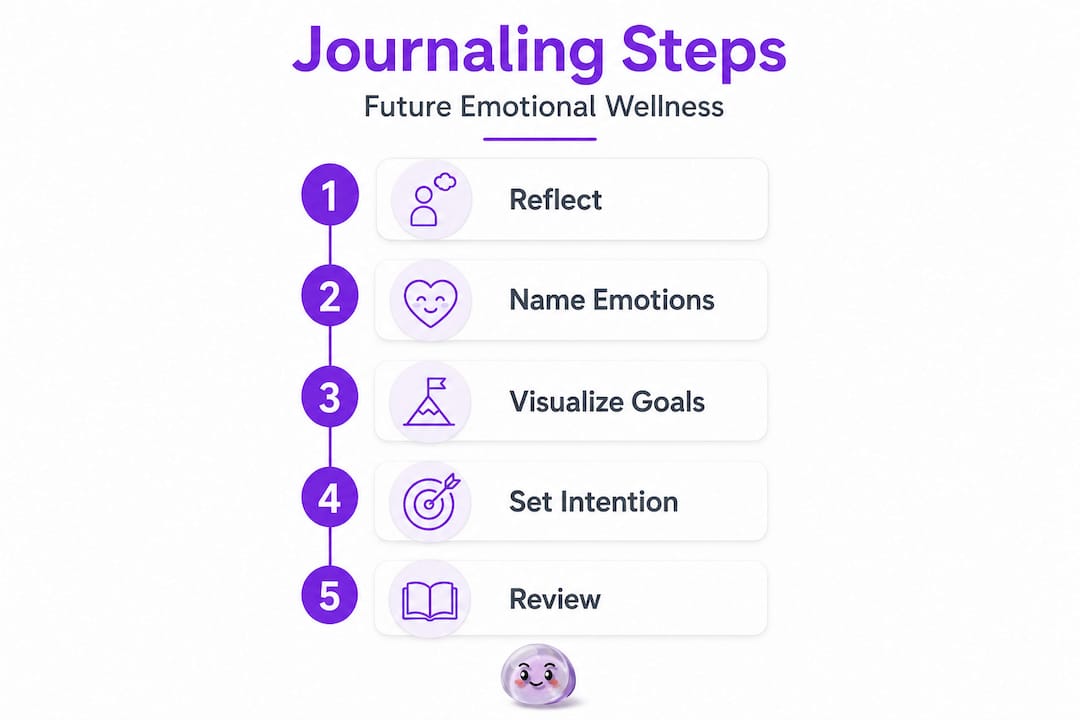
With your materials and mindset ready, you’re set to try the five-step method backed by research and experts. A goal-journaling method can combine emotion tracking, reflection on recent experiences, and gentle future exploration in a way that feels manageable rather than overwhelming.
Here are the five steps:
-
Track your current emotional state. Start every session by naming what you feel right now. Not what you think you should feel, what you actually feel. Use specific words: “low-grade dread,” “quiet contentment,” “restless irritation.” Precision matters because vague labels like “fine” or “stressed” give you nothing useful to work with.
-
Reflect on a recent experience. Write about one thing that happened in the past few days that had an emotional charge, positive or negative. Describe what happened, what you felt, and what the experience revealed about what matters to you. This step builds the raw material for pattern recognition later.
-
Explore your emotional patterns. Look back at two or three recent entries (once you have them) and ask: What keeps showing up? What situations consistently drain me? Where do I feel most alive or at ease? You don’t need to analyze deeply at first. Just notice and name what you see.
-
Envision your emotional future. Write a short paragraph about how you want to feel three to six months from now in a specific area of your life, relationships, work, or daily routine. Avoid prescriptive language like “I will never feel anxious.” Instead, try “I want to feel more settled when uncertainty comes up.” This keeps the vision realistic and emotionally grounded.
-
Set one gentle intention. Prompts that end with one next-step intention you can attempt at a low-capacity level are most effective. Your intention should be small enough to do on a bad day. “I’ll take one slow breath before I respond when I feel triggered” is more sustainable than “I’ll practice mindfulness for 30 minutes daily.”
Here’s how this method compares to rigid goal-setting:
| Rigid goal-setting | Flexible journaling method |
|---|---|
| Fixed outcomes with deadlines | Open-ended intentions with room to evolve |
| Pass/fail measurement | Progress measured by patterns and shifts |
| Ignores emotional context | Rooted in emotional self-awareness |
| Creates pressure and shame | Encourages curiosity and self-compassion |
| Goals set once, rarely revisited | Goals revisited and refined regularly |
To make your sessions feel emotionally safe, use emotional safety prompts that help you ease into vulnerability without overwhelm. And as you build a longer journal history, you’ll be able to unlock emotional patterns you never would have noticed in the moment.
Pro Tip: Don’t skip Step 5, even when you feel like you have nothing to say. A tiny intention written down is a commitment made to yourself. Over time, those small commitments compound into real emotional shifts.
Common mistakes and how to overcome them
Knowing how to journal is great, but avoiding common mistakes will ensure your practice is sustainable and rewarding. Most people who abandon journaling don’t quit because it isn’t working. They quit because they accidentally made it harder than it needed to be.
Here are the most common pitfalls and how to sidestep them:
-
Overcommitting to long sessions. Starting with 30-minute journal marathons almost always leads to burnout. Start with five minutes. Expand only when the practice feels genuinely inviting, not obligatory.
-
Setting unrealistic emotional standards. If you expect to feel radically transformed after a week, you’ll feel like you’re failing when you don’t. Emotional growth is slow and nonlinear. That’s not a flaw in the process.
-
Journaling only when you’re in crisis. Using journaling as a crisis tool rather than a maintenance practice means you associate it with distress. Regular, low-stakes entries build the emotional data you need for meaningful goal-setting.
-
Treating every session as a performance. Some days your entry will be three rambling sentences. That’s fine. Inconsistent quality is part of a consistent practice.
-
Skipping sessions and then giving up entirely. Missing a day doesn’t break a habit. Missing two weeks and deciding you’re “not a journaling person” does. If you skip, just return without making it a big deal.
Too much pressure in journaling can backfire; keeping it low-pressure is what produces the best results over time. This principle sounds counterintuitive in a culture obsessed with pushing harder, but emotional wellness genuinely responds better to gentleness.
“The sessions where you feel like you have nothing to say are often the ones that reveal the most. Showing up anyway is the practice.”
If you find yourself stuck in comparison or self-criticism during journaling, explore journaling prompts to overcome comparison and rebuild momentum from a grounded place. For a broader view of how to sustain this as part of your daily life, the emotional well-being workflow approach offers useful structure without rigidity.
How to notice progress and stay motivated
You’ve learned the method and how to troubleshoot, but how do you know when it’s working and keep your enthusiasm alive? Progress in emotional wellness is often invisible in the moment. It shows up in retrospect: the argument you handled better than you used to, the anxious thought you noticed without spiraling, the boundary you set without guilt.
Goal journaling is intended for compassionate self-awareness and pattern recognition, not dramatic milestone achievement. That reframe matters. You’re not chasing a finish line. You’re building a clearer, kinder relationship with your inner life.
Here’s how to actively notice your progress:
-
Reread entries from four to six weeks ago. The emotional distance often makes growth visible in ways day-to-day living doesn’t.
-
Look for language shifts. Do your entries sound less self-critical over time? Are you naming emotions with more precision? That’s growth.
-
Notice behavioral changes. Journal breakthroughs often show up in real life as behavioral shifts before you even consciously register them.
-
Track your intentions. Go back to the intentions you set in Step 5 and ask honestly: Did I try? Even partial follow-through is worth acknowledging.
-
Celebrate consistency, not content. Showing up to write three times this week is a win, regardless of what you wrote.
A powerful motivator: Research consistently shows that people who track their emotional states over time report greater self-understanding and emotional regulation compared to those who don’t. This isn’t about collecting data for its own sake. It’s about giving yourself concrete evidence that your inner world is changing.
Support your practice with an emotional self-care mindfulness journaling guide to layer in additional techniques as you grow. You can also deepen your practice by focusing on boosting emotional intelligence through targeted self-reflection exercises that build on what you’ve already written.
The hidden benefit of gentle goal-setting through journaling
Most advice about emotional wellness goals sounds like productivity advice in disguise. Set SMART goals. Track your metrics. Hold yourself accountable. But emotional wellness doesn’t respond well to the same frameworks you’d use to hit a quarterly sales target. It’s not a productivity problem.
Here’s what most guides miss: the real transformation in journaling doesn’t happen in any single session. It happens in the accumulation of honest moments you return to over and over. The pattern you notice on week six? That’s built from every imperfect, five-minute session you showed up for. No single entry created it. All of them together did.
Slow, reflective methods unlock deeper emotional change than checklist thinking because they work with the actual texture of your inner life rather than against it. When you approach your emotional wellness as something to be “optimized,” you create a subtle but persistent layer of self-judgment. That judgment is often exactly what gets in the way of the change you’re trying to create.
The journaling for sustained wellness approach treats emotional growth as a practice rather than a project. There’s no deadline, no finish line, and no grade. Just you, returning regularly to an honest conversation with yourself. That consistency, more than any specific technique, is what creates lasting emotional well-being.
Most goal-setting advice also ignores the emotional roots of behavior. You don’t procrastinate because you’re lazy. You don’t avoid hard conversations because you’re weak. These patterns almost always trace back to emotional experiences that journaling is uniquely positioned to surface. When you address those roots through compassionate exploration, behavior changes follow naturally, often without effort.
Ready to start your emotional wellness journey?
If this guide has lit something up for you, the next step doesn’t have to be complicated. Voisley is designed exactly for this kind of intentional, emotionally grounded journaling practice.

Voisley brings together mood tracking, personalized prompts, and AI-powered insights in one private, structured space. Whether you’re just starting out or you’re ready to go deeper with future goals journaling, gratitude practice, or shadow work, Voisley gives you the tools to explore your emotional world at your own pace. The platform’s visualizations make it easy to see patterns and progress over time, turning your journal entries into real self-knowledge. Visit Voisley and take your first step toward emotional clarity today.
Frequently asked questions
How often should I journal to set effective emotional goals?
Consistency matters more than frequency. Even 5 to 10 minute sessions several times a week are enough to build meaningful emotional awareness and make progress toward your goals.
What if I feel stuck or don’t know what to write about?
Start with a prompt that helps you name what you’re feeling right now. Journaling prompts that support emotional processing are most effective when they guide you from naming your current feeling to identifying a small, gentle next-step intention.
Is digital journaling as effective as pen-and-paper?
Both formats work well for emotional goal-setting. What matters most is that you’re intentional and present during the session, not distracted or rushing through it to check a box.
How do I know if my journaling is helping my emotional wellness?
Reread entries from several weeks ago and look for shifts in how you describe your emotional experiences. Because goal journaling builds compassionate self-awareness, progress shows up gradually as clearer language, calmer responses, and a stronger sense of your own patterns.