

TL;DR:
- Most of our daily actions occur on autopilot, making reflection essential for conscious self-awareness.
- A structured daily reflection practice helps break this pattern, fostering emotional insight and personal growth.
Most of us spend our days reacting rather than choosing. Around 50% of daily actions happen on autopilot, which means half your life is running without your conscious input. A structured daily reflection process interrupts that pattern. It gives you a moment to actually look at your day, your emotions, and your choices before they pile up into a blur you can't make sense of. This guide walks you through exactly how to build that practice, from the right setup and execution to tracking real progress over time.
Table of Contents
- Key takeaways
- What you need before starting your daily reflection process
- How to conduct your daily reflection session step by step
- Common challenges and how to move past them
- How to know your reflection practice is actually working
- My honest take on why reflection is harder than it looks
- Deepen your practice with Voisley
- FAQ
Key takeaways
| Point | Details |
|---|---|
| Start small and consistent | Ten to fifteen minutes of daily self-reflection is enough to create meaningful emotional and behavioral change. |
| Structure beats willpower | Using prompts and a timed session prevents aimless rumination and keeps your reflection focused. |
| Evening timing works best | Reflecting at night captures raw, fresh emotional data and primes your subconscious mind during sleep. |
| End every session with action | Identifying one small next step after each session prevents reflection from becoming passive mental review. |
| Track patterns over time | Reviewing your journal weekly or monthly reveals emotional trends that single sessions cannot show. |
What you need before starting your daily reflection process
Before you sit down and expect insight to arrive, there are a few things worth getting right. The setup matters more than most people expect.
Time and space
Experts recommend 10 to 15 minutes of dedicated reflection daily. That is not a lot, but it requires protection. Block it into your schedule the same way you would a meeting. Choose a location that is genuinely quiet, somewhere you will not be interrupted by notifications, other people, or ambient noise. Trying to reflect in a chaotic environment is like trying to read with someone shouting next to you. Your thoughts need room.
Your writing tool
Whether you prefer a physical notebook or a notes app, have it ready before you sit down. The act of writing is not optional. It transforms vague emotional impressions into concrete language, which is where the real clarity comes from. A reflection journal differs from a diary in a specific way: it analyzes experience for insight rather than just recording what happened. That distinction is worth keeping in mind from day one.
The right mindset
This is the part people most often skip. You need to approach reflection without judgment. That does not mean being soft on yourself. It means being curious instead of critical. When you review your day looking for what went wrong, you tend to spiral. When you look for what you can learn, you move forward. Structured reflection is a learned skill that grows with patience and self-compassion, not one you master on the first try.
Here is a quick checklist before your first session:
- A quiet, distraction-free space ready
- Your journal or writing tool open
- A timer set for 10 to 15 minutes
- A nonjudgmental, curious attitude
- At least one prompt prepared in advance
Pro Tip: Use journaling prompts to guide your reflection. Open-ended questions like "What emotion showed up most today and why?" give your mind a direction, which prevents blank-page paralysis and keeps the session productive.
How to conduct your daily reflection session step by step
Once you are set up, the actual process follows a clear sequence. Treat it less like a ritual and more like a short, purposeful meeting with yourself.
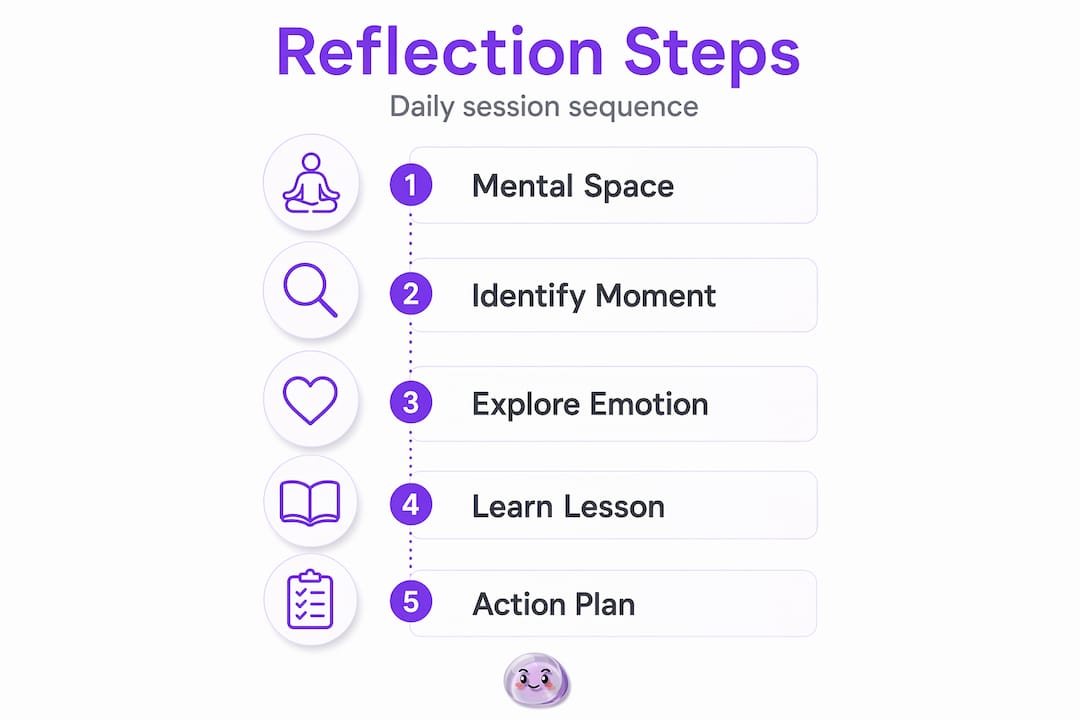
Step 1: Create mental space
Start by taking three slow breaths before writing a single word. This is not about meditation for its own sake. It is about signaling to your nervous system that this moment is different from the rest of your day. That transition matters.

Step 2: Identify one specific moment
Do not try to review your entire day at once. Pick one moment, one emotion, or one interaction that stood out. It might be the meeting that left you tense, the conversation that felt surprisingly easy, or the task you kept avoiding. Specificity is what makes reflection useful. Broad reviews of "how the day went" tend to stay surface level.
Step 3: Ask targeted questions
This is the core of daily self-reflection. Good questions move you from description to understanding. Use questions like:
- What happened, and what did I feel in that moment?
- What does my reaction tell me about what I value or fear?
- What would I do differently if I had that moment again?
- What did I do well that I want to repeat?
The distinction between reflection and rumination lives here. Healthy reflection asks "what can I learn," while rumination loops the same negative thought with no forward motion. Keep your questions oriented toward learning, not verdict.
Step 4: Write it down
Spend most of your session writing. Do not edit as you go. Let the thoughts move from your mind to the page without judging them. A sample structure might look like this:
- Moment of focus: What situation am I reflecting on?
- Emotional response: What did I feel, and how strong was it?
- Underlying reason: Why did I react that way?
- Lesson or pattern: What does this tell me about myself?
- Next step: What is one small thing I can do differently tomorrow?
Step 5: End with one action
Reflection without action leads to ineffective routines. Every session should close with one small, specific thing you will do differently or carry forward. Not a goal list. One thing. That is enough.
Here is a comparison of effective versus ineffective reflection habits:
| Effective reflection | Ineffective reflection |
|---|---|
| Focuses on one specific moment | Tries to review the whole day vaguely |
| Asks learning-oriented questions | Repeats the same negative thought |
| Ends with one concrete next step | Ends without any forward direction |
| Timed session of 10 to 20 minutes | Open-ended, drifts into rumination |
| Written output for clarity | Mental-only, easily forgotten |
Pro Tip: Evening reflection tends to outperform morning reflection because your experiences are still fresh, emotionally raw, and your brain will process them during sleep. If you reflect in the morning, you are working with yesterday's data from a distance.
Common challenges and how to move past them
Even with the right setup and steps, the daily reflection process hits predictable walls. Knowing them in advance makes you far less likely to quit.
The rumination trap
The biggest mistake people make is confusing reflection with self-criticism. You sit down to review your day and end up cataloguing everything you did wrong. That is not reflection. Avoiding the complaint trap requires actively shifting your prompts from "what went wrong" to "what can I learn from this." If you notice you are cycling through the same negative thought for more than two minutes, that is a signal to redirect, not push harder.
Strategies that actually help when you feel stuck:
- Take a short walk before continuing
- Shift to a gratitude prompt as a reset
- Use a breathing exercise to break the mental loop
- Switch your writing hand to change your neural state momentarily
Time and consistency challenges
Most people start a daily mindfulness practice with enthusiasm and lose it within two weeks. The solution is not more motivation. It is making the habit smaller. Even small daily adjustments identified through reflection compound into major life changes over time. If 15 minutes feels like too much, start with five. Progress beats perfection here, without exception.
Depth versus overwhelm
Some people go too deep too fast, turning every session into an excavation of childhood patterns. That is exhausting and unsustainable. Timed, purposeful reflection of 10 to 20 minutes is measurably more effective than open-ended journaling because the timer gives your brain a container. When the timer goes off, the session is done.
"Self-reflection should lead to wiser choices, not endless mental loops." The moment reflection stops producing forward motion, something in the process needs adjusting.
Pro Tip: Rotate your prompts every week to keep sessions fresh. Alternate between emotional prompts (How did I feel today?), behavioral prompts (What did I avoid and why?), and gratitude prompts (What went better than expected?). You can find curated prompt sets designed for this kind of emotional self-reflection journaling.
How to know your reflection practice is actually working
Knowing how to reflect daily is one thing. Knowing whether it is working is another. Here is how to track real progress over time.
Look for pattern recognition
After two to three weeks of consistent journaling, you will start noticing recurring themes. Maybe you feel drained after every meeting with a certain person. Maybe you are consistently most anxious on Sunday evenings. These patterns are invisible in the moment but obvious in the log. Daily reflection helps you recognize emotional patterns and make better decisions because you have actual data about yourself, not just impressions.
Signs your practice is producing real results:
- You catch emotional reactions faster than before
- You feel less reactive in situations that used to trigger you
- Your journal entries shift from vague to specific over time
- You notice yourself applying the "one small action" from previous sessions
- Decision-making feels less clouded and more grounded
Track your emotional changes week by week
| Week | What to look for | What it signals |
|---|---|---|
| Week 1 to 2 | Increased emotional vocabulary | You are naming feelings more precisely |
| Week 3 to 4 | Recurring themes and triggers | Pattern recognition is developing |
| Week 5 to 6 | Behavior shifts in real time | Reflection is influencing your choices |
| Week 7 and beyond | Sustained emotional regulation | The habit is creating durable self-awareness |
The importance of self-compassion
Self-reflection helps reduce cognitive dissonance by aligning your behavior with your core values. But that process is uncomfortable, and it takes time. Celebrate the small wins. A journal entry where you recognized a pattern for the first time is worth acknowledging. Progress in self-awareness is rarely dramatic. It shows up quietly, in the choices you make differently without even thinking about it.
Pro Tip: Schedule a 30-minute "meta reflection" session once a month. Read back through your journal entries and ask yourself: What has changed? What keeps coming up? This longer-view session often produces insights that daily sessions miss entirely.
My honest take on why reflection is harder than it looks
I have worked with people committed to daily self-reflection for years, and the pattern I see most consistently is this: the problem is rarely a lack of desire. It is a lack of self-compassion.
People sit down, write honestly, see something uncomfortable, and then they judge themselves for it. They expect the process to feel clarifying and peaceful, and when it surfaces tension or confusion, they decide they are doing it wrong. In my experience, that tension is actually the signal that it is working. The discomfort is information.
What I have found actually works is treating each session as a data collection exercise, not a performance review. You are not trying to catch yourself failing. You are trying to understand yourself more clearly. That framing changes everything.
I also want to push back on the idea that more depth always equals more benefit. Some of the most effective reflection sessions I have seen are five minutes long and brutally specific. One moment, one emotion, one action. The people who try to process their entire psychological history every evening burn out within a month. The people who keep it focused and repeatable build something that lasts.
If you are exploring self-reflection techniques that actually fit into real life, start simpler than you think you need to. You can always go deeper later.
— Joan
Deepen your practice with Voisley

If you are ready to move from occasional journaling to a genuinely structured daily reflection process, Voisley was built for exactly this. The platform gives you personalized prompts based on your emotional patterns, mood tracking visualizations that reveal trends you would never catch on your own, and multiple journal types including gratitude, shadow work, and future goals. Instead of staring at a blank page each evening, you get a guided structure that meets you where you are. Explore everything Voisley offers at voisley.com and start turning your daily reflection habit into a tool for lasting personal growth.
FAQ
How long should a daily reflection session be?
Ten to fifteen minutes is the recommended length for most people. Consistency matters more than duration, so a focused 10-minute session every day outperforms an occasional hour-long session.
What is the difference between reflection and rumination?
Reflection focuses on learning and forward movement, while rumination loops negative thoughts without resolution. If your session is producing insight and one next step, it is reflection. If it is producing guilt or repeated criticism with no direction, it is rumination.
When is the best time to practice daily self-reflection?
Evening reflection tends to be most effective because your experiences are still fresh and your brain will process them during sleep. Morning reflection works as a review of the previous day but lacks the immediacy of end-of-day emotion.
How do I know if my reflection practice is working?
Look for changes in how quickly you recognize your emotional reactions, how specifically you can describe your feelings, and whether the "one small action" from your sessions is showing up in your actual behavior. Consistent reflection leads to emotional clarity and better decision-making over weeks, not days.
Do I need a physical journal, or can I use an app?
Either works, as long as you write rather than just think. The act of converting emotions into written language is what drives clarity. Apps like Voisley add the advantage of prompts, mood tracking, and pattern visualization that a blank notebook cannot offer.