

TL;DR:
- Journaling helps reduce anxiety by externalizing thoughts and strengthening emotional regulation. Structured and consistent practice, especially with specific formats, prevents rumination and builds resilience over time. It serves as a supportive tool alongside therapy, not a complete cure.
Journaling for anxiety is defined as the structured practice of writing thoughts and feelings to reduce emotional distress and improve cognitive control. A 2022 systematic review found that journaling reduced anxiety symptom scores by 9%, a statistically significant result that places writing alongside other evidence-based self-care strategies. That number matters because it comes from real clinical populations, not wellness blogs. The underlying mechanism is well established: putting feelings into words, a technique called affect labeling, quiets the brain's threat center and activates the regions responsible for rational thinking. If you experience anxiety and want a practical tool that works between therapy sessions, understanding why use journaling for anxiety is the right place to start.
Why use journaling for anxiety: the neuroscience behind it
Journaling works on anxiety through three distinct brain processes: affect labeling, cognitive offloading, and narrative construction. Each one targets a different part of the anxiety cycle, which is why writing consistently outperforms passive coping strategies like distraction or avoidance.

Affect labeling is the act of naming an emotion in words. Research shows that affect labeling reduces amygdala activation, the brain's alarm system, while simultaneously engaging the prefrontal cortex, the region that handles reasoning and emotional regulation. Anxiety thrives when the amygdala runs unchecked. Writing the words "I feel terrified about this meeting" literally changes your brain's response to that fear.
Cognitive offloading is the second mechanism. An anxiety journal acts as an external storage system for your working memory. When worries loop silently in your head, they consume mental bandwidth that you need for problem-solving. Writing them down frees that bandwidth. Students who wrote for 10 minutes about anxiety before exams performed significantly better than those who did not. The act of writing transferred the worry from an internal loop to an external page, making room for focused thinking.
"Journaling shifts anxious thoughts from internal loops to external pages, creating psychological distance and improving cognitive control. That distance is not avoidance. It is the first step toward resolution."
Narrative construction is the third process. Anxiety often feels chaotic because anxious thoughts arrive in fragments, not in logical order. Writing forces you to arrange those fragments into a sequence with a beginning, middle, and end. That structure alone reduces the sense of being overwhelmed. The mental clarity benefits of this process are well documented and build over time as the brain develops stronger pathways for emotional regulation.
Key mechanisms at a glance:
- Affect labeling: Names emotions to reduce amygdala reactivity
- Cognitive offloading: Moves worries from working memory to the page
- Narrative construction: Organizes fragmented anxious thoughts into structured form
- Neural pathway building: Repeated practice strengthens emotional regulation circuits
What journaling techniques work best for anxiety?
Not all journaling formats produce the same results. The four formats with the strongest research support each target a different anxiety pattern.
| Format | Best for | How it works |
|---|---|---|
| Expressive writing | Processing acute emotional distress | Write freely about feelings for 15–20 minutes with a clear time limit |
| CBT thought records | Challenging distorted thinking | Identify the anxious thought, examine evidence for and against it, then reframe |
| Scheduled worry time | Repetitive, intrusive worries | Contain worry to one 15-minute window per day; redirect outside that window |
| Gratitude journaling | Low mood and negativity bias | Record 3 specific things you appreciate daily to shift attentional focus |
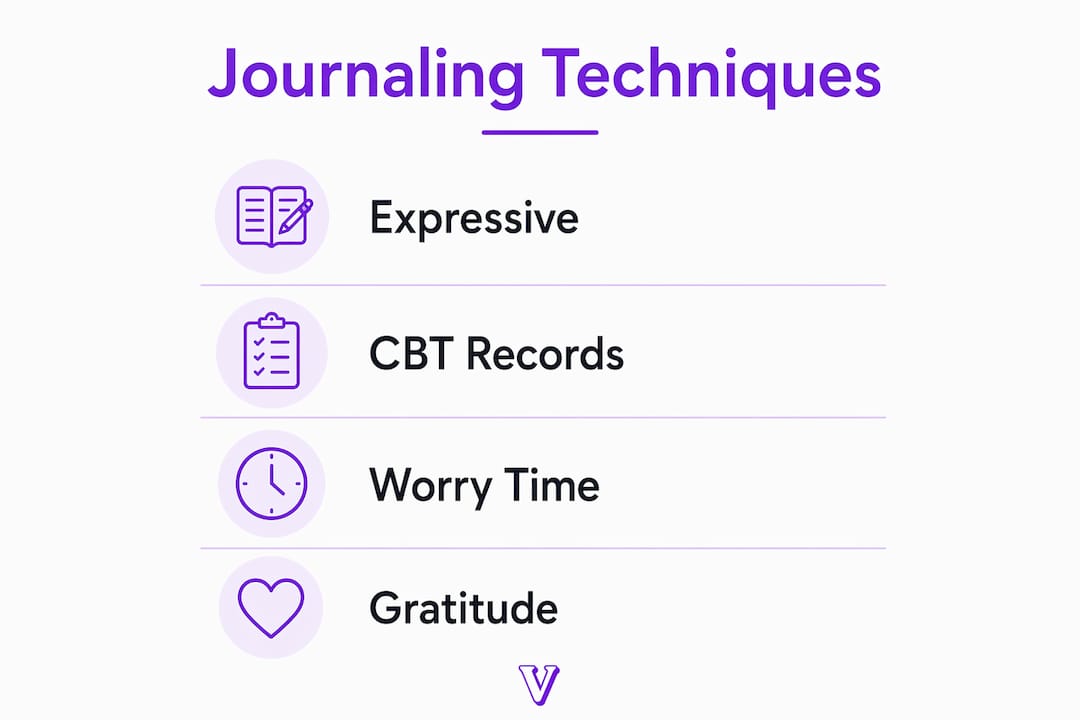
Expressive writing reduces anxiety symptoms, improves immune function, and enhances mood across numerous studies. The key word is "expressive." Writing a grocery list does not count. You need to engage with the emotional content of what is bothering you, not just describe events.
CBT thought records are the most structured format. You write the anxious thought, rate how strongly you believe it, list evidence for and against it, and then write a more balanced version. This format mirrors what a cognitive behavioral therapist would guide you through in a session. A detailed explanation of this method is available in Voisley's guide to CBT journaling techniques.
Scheduled worry time is counterintuitive but effective. Instead of fighting intrusive thoughts throughout the day, you give them a designated 15-minute slot. When a worry appears outside that window, you write it down and defer it. This trains your brain to stop treating every anxious thought as an emergency.
Gratitude journaling works by redirecting attention. Anxiety narrows focus onto threats. Writing three specific, concrete things you are grateful for each day widens that focus. The specificity matters: "I am grateful for the coffee my partner made me this morning" works better than "I am grateful for my family."
Pro Tip: Set a timer for every journaling session. Time limits prevent emotional spillover from turning into rumination, and they make the habit feel manageable even on difficult days.
What are the common pitfalls of journaling for anxiety?
Journaling can backfire when done without structure. Unstructured venting without direction can worsen anxiety by increasing rumination rather than resolving it. Writing "I am so anxious and everything is terrible" repeatedly for 30 minutes does not produce insight. It reinforces the negative thought loop.
The most common pitfalls to watch for:
- Venting without a goal: Writing about feelings without moving toward insight or a next step keeps you stuck in the emotion rather than processing it.
- Journaling at peak intensity: Writing during a panic attack or acute anxiety spike can amplify distress. Regulate first with slow breathing, then write.
- No time boundaries: Open-ended sessions drift into rumination. A 15-minute timer is not optional; it is protective.
- Skipping prompts: Blank pages invite circular thinking. A specific prompt like "What is the worst realistic outcome, and how would I handle it?" gives anxious thoughts somewhere productive to go.
- Expecting immediate results: Journaling builds emotional regulation capacity over weeks, not sessions. One entry rarely produces a breakthrough.
When journaling consistently increases anxiety after multiple sessions, the method needs to change, not the habit. Shift from expressive writing to gratitude journaling or CBT thought records. Both formats create more cognitive distance from the emotion, which is what anxious minds need most.
Pro Tip: If you notice your anxiety rising during a session, stop writing and write one sentence only: "What is one small thing I can do right now?" That single question redirects the brain from threat detection to problem-solving.
How to start and maintain a journaling practice for anxiety
Starting a journaling practice requires less time than most people assume. The barrier is not time. It is friction. The lower the friction, the more likely the habit sticks.
- Choose your format first. Paper journals, guided journal apps, and plain text documents all work. The best format is the one you will actually use. Voisley offers guided journaling prompts with mood tracking built in, which removes the blank-page problem entirely.
- Start with five minutes. Five minutes of focused writing beats 30 minutes of avoidance every time. Once the habit is established, you can extend the session naturally.
- Anchor it to an existing routine. Journaling after morning coffee, before bed, or immediately after lunch uses an existing behavior as a trigger. This is the most reliable way to build a new habit without relying on motivation alone.
- Use a prompt every session. Good starting prompts include: "What is making me anxious right now?", "What would I tell a friend in this situation?", and "What is one thing I can control today?" Prompts prevent circular thinking and keep sessions productive.
- End each entry with a next step. Effective journaling moves from emotional description to cognitive insight to a concrete action. Even a small next step, like "I will send that email tomorrow morning," closes the loop and reduces residual anxiety.
- Keep your journal private. Knowing that no one will read your entries removes self-censorship. Honest writing produces better results than polished writing. Privacy is not a luxury; it is a functional requirement for the practice to work.
- Treat journaling as a complement to therapy, not a replacement. Journaling as a mental health tool works best alongside professional care. It extends the work of therapy into daily life, reinforcing insights and tracking patterns between sessions.
Maintaining a consistent, low-friction habit anchored to daily routines improves both adherence and effectiveness. The research supports short, daily sessions over long, infrequent ones. Consistency builds the neural pathways that make emotional regulation easier over time.
Key Takeaways
Journaling reduces anxiety by externalizing thoughts, freeing working memory, and building emotional regulation skills through consistent, structured practice.
| Point | Details |
|---|---|
| Proven symptom reduction | A 2022 meta-analysis found journaling reduces anxiety symptom scores by 9% on average. |
| Neuroscience supports it | Affect labeling reduces amygdala activity and engages the prefrontal cortex for better regulation. |
| Structure prevents rumination | Time limits and specific prompts keep sessions productive and prevent emotional spillover. |
| Four formats, four use cases | Expressive writing, CBT thought records, worry time, and gratitude journaling each target different anxiety patterns. |
| Habit beats intensity | Five minutes daily outperforms occasional long sessions for building lasting emotional regulation. |
Journaling is a tool, not a cure. Here is what that distinction actually means.
At Voisley, we work with people who come to journaling expecting it to fix their anxiety. That expectation sets them up for disappointment, and disappointment makes them quit. The honest framing is this: journaling is a skill that improves your relationship with anxious thoughts. It does not eliminate anxiety. It changes how much power those thoughts have over you.
The people who get the most from a journaling practice are not the ones who write the most. They are the ones who write with intention. A five-minute CBT thought record done consistently beats an hour of unstructured venting every time. Structure is not a constraint. It is what makes the practice therapeutic rather than just cathartic.
One pattern we see repeatedly: people stop journaling the moment anxiety spikes, which is exactly when the practice is most needed. The solution is not to push through discomfort blindly. It is to have a backup format ready. When expressive writing feels like too much, switch to gratitude journaling or write a single sentence about what you can control. The habit matters more than the format on any given day.
Journaling also amplifies the benefits of professional care in ways that are hard to overstate. Clients who journal between therapy sessions arrive with clearer language for their experiences, better pattern recognition, and more specific questions. That clarity accelerates progress. If you are in therapy, your journal is not a diary. It is a working document.
— Voisley
Voisley supports your mental wellness practice
Anxiety does not follow a schedule, and neither should your support tools. Voisley is a guided journaling platform built around the science of emotional well-being, offering personalized prompts, mood tracking, and AI-powered insights that help you spot patterns in your emotional life before they become problems.

Whether you are new to keeping an anxiety journal or looking to make your existing practice more effective, Voisley gives you the structure that makes journaling work. The platform includes gratitude journals, CBT-style reflection tools, and mindfulness-based prompts, all in one private space. Visit Voisley to build a journaling habit that actually supports your mental health, not just on good days, but on the ones that matter most.
FAQ
Can journaling help with anxiety symptoms?
Yes. A 2022 meta-analysis found journaling reduces anxiety symptom scores by an average of 9%, making it a clinically supported complement to professional care.
How long should I journal each day for anxiety?
Five to fifteen minutes of focused, structured writing is enough. Consistency matters more than session length, and short daily entries outperform long, infrequent ones.
What should I write in an anxiety journal?
Use a specific prompt rather than writing freely. Effective starting points include identifying the anxious thought, examining the evidence for it, and writing one thing you can control today.
What if journaling makes my anxiety worse?
Switch formats immediately. Shift from expressive writing to gratitude journaling or CBT thought records, both of which create more cognitive distance from the emotion and reduce the risk of rumination.
Is journaling a replacement for therapy?
No. Journaling works best as a complement to professional care, extending therapeutic insights into daily life and helping you track emotional patterns between sessions.