

TL;DR:
- Most people quit journaling within two weeks because they treat it as a confession booth rather than a cognitive tool.
- Journaling rewires your brain by transforming chaotic emotional data into structured narratives, enhancing emotional regulation.
- Using focused prompts consistently improves mental clarity, mood, and self-awareness, making journaling a powerful discipline.
Most people who try journaling quit within two weeks because they treat it like a confession booth rather than a cognitive tool. If you've ever asked yourself why journal for mental clarity and wondered whether you're doing it right, the answer probably isn't what you expect. Journaling doesn't work by getting feelings "out of your system." It works by forcing your brain to reorganize chaotic emotional data into structured, manageable narratives. That's a meaningful distinction, and understanding it changes how you write, how often, and what you actually gain from the practice.
Table of Contents
- Key takeaways
- Why journaling for mental clarity actually works
- Journaling techniques and their benefits for clarity
- How to journal effectively for mental clarity
- Emotional regulation and self-awareness beyond mental clarity
- My take: journaling is cognitive infrastructure, not self-expression
- Start your journaling practice with Voisley
- FAQ
Key takeaways
| Point | Details |
|---|---|
| Journaling rewires your brain | Writing named emotions engages the prefrontal cortex and calms amygdala reactivity, reducing emotional overwhelm. |
| Structure matters more than volume | Focused, prompt-driven sessions outperform free venting for producing real mental clarity. |
| Frequency beats duration | Writing 15 to 20 minutes three to four times weekly yields stronger benefits than occasional marathon sessions. |
| Technique selection is personal | Matching the right journaling style to your emotional need maximizes results across mood, focus, and self-awareness. |
| Consistency builds lasting change | Regular journaling builds new neural pathways that improve emotional flexibility over the long term. |
Why journaling for mental clarity actually works
The brain under stress doesn't think clearly. It reacts. The amygdala, your brain's threat-detection center, processes emotional signals faster than your rational mind can catch up. What most people don't realize is that writing about your emotions physically changes that dynamic.
Affect labeling through journaling activates the ventrolateral prefrontal cortex, which inhibits the amygdala and measurably reduces emotional reactivity. You're not just describing a feeling. You're interrupting its grip on your nervous system. That's why people often feel calmer after writing, not because they vented, but because naming an emotion out loud on paper engages the regulatory part of the brain.
There's a second mechanism at work too. Expressive writing converts fragmented emotional memories into coherent narratives, shifting processing from the amygdala to the hippocampus for better memory organization. Think of it like defragmenting a hard drive. The raw data was always there. Journaling reorganizes it so your brain can actually access and use it.
The third piece is cognitive offloading. When you have twelve unresolved concerns cycling through your mind at once, your working memory gets saturated. Writing externalizes intrusive thoughts, freeing up mental bandwidth and producing that distinctive feeling of lightness after a good journaling session. You're not solving problems when you write them down. You're releasing your brain from the job of holding them.
Here's what the research shows across the board:
- Emotional journaling interventions produce a 5% greater reduction in mental health symptoms compared to control groups, with benefits increasing after 30 days
- Improved mood, reduced anxiety, and better memory consolidation are all documented outcomes of consistent journaling practice
- Writing before stressful tasks improves performance by freeing mental capacity that would otherwise be tied up in worry
- Effects on anxiety reduction can last up to 6 months after a writing intervention ends
"Journaling is not simply catharsis. It is a structured act of meaning-making that trains the brain to process and regulate emotion more efficiently over time."
Journaling techniques and their benefits for clarity
Not all journaling produces the same result. The technique you choose determines which brain processes you engage, which means choosing deliberately matters. Here's how the four main approaches compare.

| Technique | Core purpose | Brain mechanism | Best use case |
|---|---|---|---|
| Expressive writing | Process difficult emotions | Amygdala to hippocampus shift | After conflict, loss, or overwhelm |
| Gratitude journaling | Build positive emotional baseline | Dopamine and reward circuits | Daily mood regulation, resilience |
| Brain dump | Clear cognitive overload | Cognitive offloading | Before high-stakes tasks or decisions |
| Future-self writing | Build goal clarity and motivation | Prefrontal cortex activation | Long-term planning, identity shifts |
Gratitude exercises and "best possible self" writing yield the strongest benefits for psychological well-being among all journaling styles. That doesn't mean gratitude journaling is the only approach worth using. It means that positive expressive writing carries a particular potency that purely problem-focused writing often lacks.
Brain dumps serve a completely different function. They're not therapeutic in the traditional sense. They're operational. When your mind is full before a presentation, a difficult conversation, or a major decision, spending five minutes writing every concern on the page literally clears the queue. Focus improves immediately because your working memory isn't multitasking between the task at hand and the background noise of unresolved thoughts.
Combining different journaling types based on your emotional needs maximizes benefits across mood, cognition, and self-awareness. You don't have to pick one and stick with it forever.
Pro Tip: Keep two short prompts ready at all times: one for heavy emotional days ("What am I feeling right now, and what triggered it?") and one for clear-headed days ("What do I want to think and feel differently about in six months?"). Rotating between these two alone covers most of the core mechanisms.
You can explore a full breakdown of 7 journaling techniques matched to specific emotional states if you want to go deeper on this.
How to journal effectively for mental clarity
Knowing why journaling works and knowing how to do it well are two different things. Most people fall into the same traps, and those traps explain why journaling can feel pointless after a few weeks.
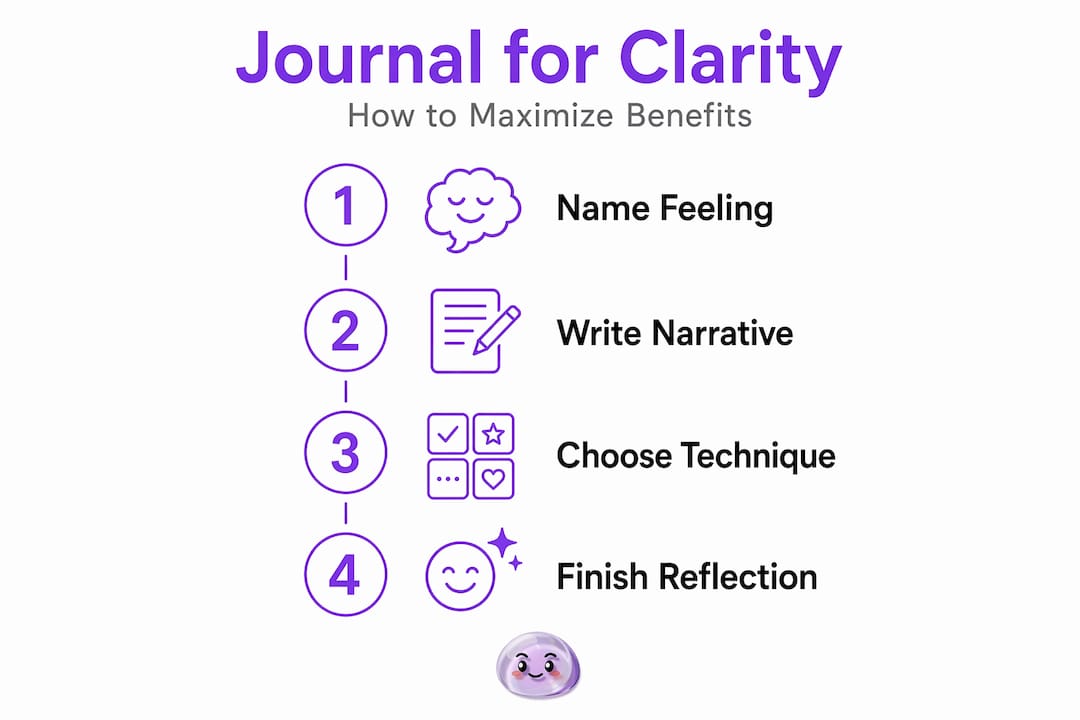
Here's a research-backed framework for making it work:
-
Set a consistent duration and frequency. Writing 15 to 20 minutes, three to four times per week, produces the strongest long-term benefits. Daily writing isn't required. Consistency over time matters far more than daily perfection.
-
Name emotions with specificity. Vague words like "stressed" or "bad" don't activate the same regulatory circuits as precise language. "Resentful," "overstimulated," or "ashamed" do. The specificity forces your brain to engage more deeply with the emotion rather than gloss over it.
-
Use structured prompts, not open-ended venting. Focused journaling about triggers, patterns, and protective responses produces better outcomes than generic emotion dumping. Start with a prompt. Let it anchor the session.
-
Write by hand when you can. Handwriting journaling offers cognitive pauses that aid deeper reflection compared to typing. The slower motor pace forces your brain to feel what it's expressing rather than just process it. If typing is what allows you to write at all, type. But if you have the choice, hand-writing has a real edge.
-
Don't edit while you write. The internal critic that wants to fix sentences and soften truths is the enemy of real cognitive processing. Write messy, write honestly, and let the reflection come after.
Common pitfalls to watch for: venting the same story session after session without evolving the narrative, using surface-level emotion words that don't require any real introspection, and skipping the reflection phase where the real insight actually happens. The first draft of your feeling is rarely the whole truth. The second or third pass is where clarity lives.
Pro Tip: End every session with one sentence that starts with "What this means for me is..." This single habit forces you out of description and into insight, which is where mental clarity actually forms.
Emotional regulation and self-awareness beyond mental clarity
Mental clarity is what most people are looking for when they start journaling, but it's not the only thing they find. The benefits of journaling extend into emotional regulation, self-awareness, and long-term personal growth in ways that compound over time.
Here's what consistent journaling builds when practiced with structure:
- Reduced rumination. Externalizing a worry on paper interrupts the loop. You stop replaying it mentally because it's already been captured somewhere outside your head.
- Pattern recognition. Over weeks of journaling, you start to notice that certain situations, people, or times of day reliably trigger the same emotional responses. That awareness alone changes how you respond.
- Increased resilience. Expressive writing reduces anxiety symptoms and improves immune function. The physical body benefits from the emotional processing that journaling facilitates.
- Better decision-making. When emotions are named and organized rather than suppressed or scattered, they stop hijacking your judgment. You make cleaner, less reactive decisions.
- Stronger self-concept. Future-self writing, in particular, builds a clearer internal picture of who you are becoming, which shapes how you behave in the present.
Targeted prompts accelerate all of these benefits. If you want to develop this skill deliberately, a guide on how prompts guide self-reflection is worth reading alongside your practice.
My take: journaling is cognitive infrastructure, not self-expression
Here's what I've learned after watching people pick up and abandon journaling dozens of times: the ones who quit almost always treat it as a mood release valve rather than a skill they're building.
I've seen the research, talked to practitioners, and tested this myself. Journaling done casually, without structure or intention, feels good in the moment but produces almost nothing durable. It's like going to the gym and only ever stretching. You feel like you did something. You didn't really.
What actually works is treating journaling the way you'd treat any cognitive training. You show up consistently. You use prompts that challenge you. You push past the surface description into what the feeling actually says about your patterns, your values, and your reactions. Over time, the brain's emotional regulation circuits genuinely strengthen. That's not a metaphor. Regular journaling builds new neural pathways linking emotion and regulation centers, producing measurable improvements in emotional flexibility.
My uncomfortable opinion: most journaling advice focuses too much on getting started and not enough on getting better. The habit matters, but the quality of what you do in the habit matters more. A structured 15 minutes three times a week beats an hour of undirected venting every single day.
Start structured. Stay curious. Don't confuse writing with reflecting. They aren't the same thing, and the distinction is where all the real value lives.
— Joan
Start your journaling practice with Voisley
If you know journaling works but haven't been able to make it stick, the missing piece is often structure.

Voisley is built specifically for this. The platform gives you personalized prompts tailored to your emotional state, multiple journal types including gratitude, shadow work, and future-self writing, plus mood tracking that reveals emotional patterns you'd never spot on your own. Instead of staring at a blank page wondering what to write, you get a guided session that moves you from emotional reaction to genuine insight. Whether you're working through anxiety, building self-awareness, or simply trying to think more clearly, Voisley's AI-powered tools meet you where you are. Visit Voisley to start building the kind of journaling practice that actually produces results.
FAQ
Why does journaling improve mental clarity?
Journaling engages the prefrontal cortex and reduces amygdala reactivity through affect labeling, which converts scattered emotional data into organized narratives. This cognitive offloading frees working memory, making it easier to think clearly and focus.
How often should you journal for mental clarity?
Research supports writing 15 to 20 minutes, three to four times per week. Benefits increase beyond the one-month mark, so consistency over time matters more than daily frequency.
Is gratitude journaling or expressive writing better?
Both serve different purposes. Gratitude and "best possible self" writing yield stronger psychological well-being outcomes, while expressive writing is more effective for processing difficult emotions and reducing anxiety.
Why keep a journal if you already talk to others about your feelings?
Talking engages different brain processes than writing. Journaling forces linear, structured articulation that builds narrative coherence and emotional regulation in ways that conversation alone does not replicate.
Can journaling help with anxiety specifically?
Yes. Expressive writing reduces anxiety symptoms with effects documented to last up to six months after the writing intervention ends, and it also supports immune function through the emotional processing it facilitates.