

TL;DR:
- Cognitive behavioral journaling applies structured techniques to reframe automatic negative thoughts and reduce mental health symptoms. It involves evidence evaluation, thought labeling, and reflection, leading to measurable improvements in emotional regulation. This practice is more effective than unstructured journaling and benefits those with anxiety and depression when done consistently.
Cognitive behavioral journaling is defined as a structured psychological practice that applies Cognitive Behavioral Therapy (CBT) principles to identify, test, and reframe automatic negative thoughts. Unlike a traditional diary, it uses specific tools like thought records, cognitive distortion labeling, and evidence evaluation to produce measurable changes in thinking patterns. Clinical research confirms it reduces anxiety and depression symptoms. The practice sits at the intersection of self-reflection and psychological technique, making it one of the most evidence-backed forms of journaling for mental health available outside a therapist's office.
What is cognitive behavioral journaling and how does it work?
CBT journaling is a structured psychological practice applying CBT principles to identify, test, and reform automatic negative thoughts, significantly reducing anxiety and depression symptoms. The core mechanism is cognitive restructuring: you write down a thought, examine the evidence for and against it, and replace it with a more balanced perspective. This process interrupts the automatic loop between a triggering situation and a distorted emotional response.

The neuroscience behind this is concrete. Journaling reduces activity in the amygdala, the brain's threat-detection center, and increases activation in the prefrontal cortex, which governs reasoning and decision-making. That shift is why writing about a stressful event often feels calming within minutes. You are literally moving processing from the reactive part of your brain to the analytical part.
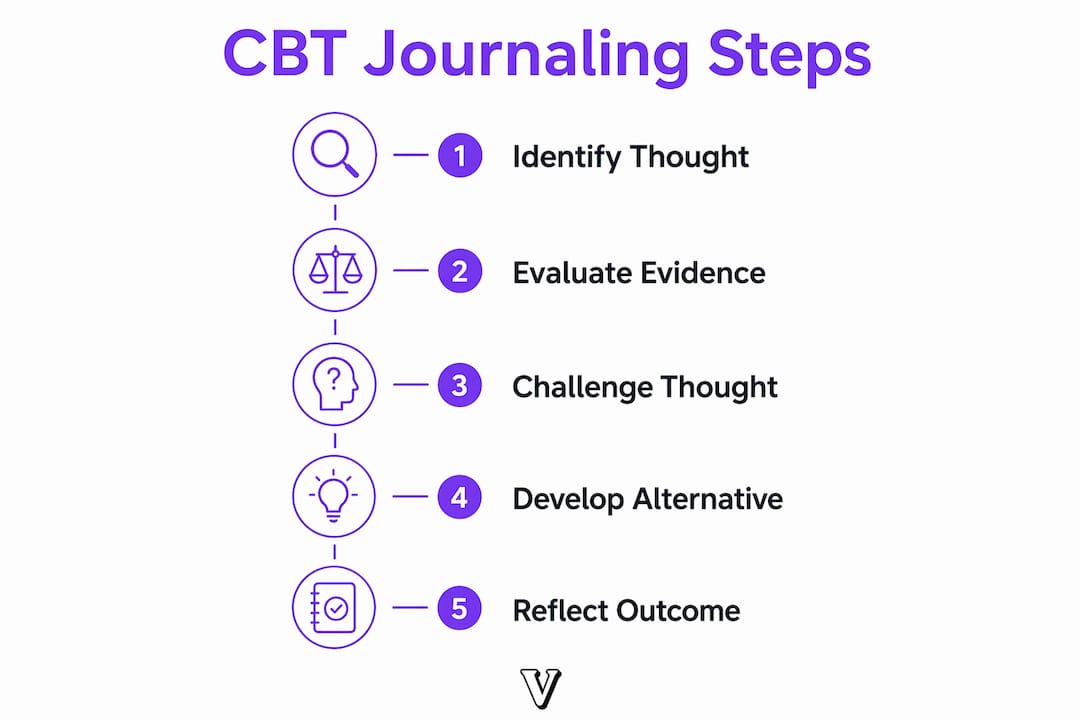
A standard CBT journaling session follows five steps:
- Identify the situation. Write one sentence describing what happened, without interpretation.
- Rate your emotional intensity. Assign a number from 1–10 to how strongly you feel the emotion.
- Name the automatic thought. Write the exact thought that appeared, word for word.
- Label the cognitive distortion. Common distortions include catastrophizing, all-or-nothing thinking, and mind reading.
- Write a balanced thought. Replace the distortion with a statement supported by actual evidence.
The recommended protocol is 15–20 minutes of focused writing over 3–4 consecutive days for optimal brain benefits. Consistency matters more than duration. A short, structured session three times a week outperforms an occasional hour-long venting session every time.
Pro Tip: Set a timer for 15 minutes and commit to finishing all five steps before it goes off. Stopping at step three, which is naming the thought without challenging it, is where most people accidentally reinforce the distortion instead of resolving it.
How does CBT journaling differ from traditional journaling?
The distinction matters because confusing the two can produce opposite results. Traditional journaling is freeform emotional expression. CBT journaling is a structured analytical exercise with a defined goal: cognitive restructuring. One releases feelings; the other changes the thinking patterns that generate those feelings.
Traditional journaling is freeform emotional expression, while CBT journaling uses structured prompts for cognitive restructuring and measurable thinking pattern changes. That difference in structure is what separates a helpful habit from one that can accidentally deepen distress.
Unstructured journaling carries a real risk called the rumination trap. When you write about a painful experience without any analytical framework, you can loop through the same negative thoughts repeatedly, reinforcing them rather than resolving them. CBT journaling prevents this by requiring you to move through evidence evaluation and balanced thought formation before closing the entry.
| Feature | Traditional journaling | CBT journaling |
|---|---|---|
| Primary purpose | Emotional expression and release | Cognitive restructuring |
| Structure | Freeform, no fixed format | Structured prompts and thought records |
| Focus | Feelings and events | Thoughts, distortions, and evidence |
| Risk | Rumination and emotional looping | Requires consistent practice to see results |
| Outcome | Temporary relief | Lasting change in thought patterns |
The table above shows why CBT journaling is the stronger tool for people dealing with persistent anxiety, low mood, or recurring negative self-talk. Traditional journaling still has value for creative expression and processing day-to-day stress. The two are not mutually exclusive, but they serve different functions.
What techniques and prompts work best in cognitive journaling?
Practical technique is where CBT journaling becomes genuinely useful. The most widely used framework is the ABC model, drawn directly from CBT theory. "A" is the Activating event, "B" is the Belief or automatic thought triggered by it, and "C" is the Consequence, meaning the emotional or behavioral response. Writing through all three components forces you to see the thought as the link between event and emotion, not the event itself.
Effective CBT journal prompts include:
- Thought identification: "What was the first thought I had when this happened?"
- Evidence gathering: "What facts support this thought? What facts contradict it?"
- Distortion labeling: "Am I catastrophizing, mind reading, or overgeneralizing here?"
- Reframing: "What would I tell a close friend who had this exact thought?"
- Identity-based reflection: "Does this thought reflect who I actually am, or who I fear I am?"
Identity-based journaling, which involves reflecting on life stages and personal motivation, showed reduced depression and feelings of disconnection in emerging adults in a controlled study. That finding suggests the reframing prompts that connect to personal identity produce the deepest results.
Another technique worth building into your practice is the "compassionate observer" prompt. Write about your situation in the third person, as if you are a trusted advisor watching the scene unfold. Analytical writing from a distanced perspective reliably improves adaptive thinking and reduces rumination compared to purely emotional venting. The shift from "I am failing" to "She is struggling but has handled harder things before" changes the emotional charge of the thought immediately.
Pro Tip: When you notice your writing getting more emotional and less analytical, switch to third-person narration for the rest of the entry. Refer to yourself by name. This single shift engages your brain's reasoning centers and breaks the reactive spiral before it takes hold.
What challenges come with CBT journaling, and how do you avoid them?
The most common obstacle is the rumination trap. Emotionally stuck writers should shift to third-person writing to engage reasoning over reactive emotional processing. If you find yourself writing the same painful thought in five different ways without reaching a balanced conclusion, you are ruminating, not restructuring.
Practical strategies to build a sustainable CBT journaling habit include:
- Anchor it to an existing routine. Write directly after your morning coffee or before bed. Habit stacking reduces the friction of starting.
- Keep entries short and structured. Five focused minutes beats thirty minutes of unguided venting.
- Track your emotional ratings over time. Watching a 9/10 anxiety score drop to a 5/10 over two weeks is motivating evidence that the practice works.
- Transition from venting to analysis. Give yourself two sentences to express the emotion, then move immediately to the five-step process.
- Treat journaling as a supplement, not a replacement, for therapy. Journaling aids emotional processing and mindfulness, strengthening self-understanding and coping with trauma when combined with professional support.
Progress tracking is underrated. Reviewing entries from four weeks ago and noticing that a thought you once rated as 9/10 believable now feels like a 4/10 is concrete proof of cognitive change. That kind of evidence keeps the habit alive when motivation dips.
What does research say about the benefits of CBT journaling?
The research base for structured journaling is stronger than most people realize. Recording three positive experiences daily for 14 days led to depressive symptom reductions similar to antidepressants in one study. That is a striking finding for a practice that costs nothing and takes under 20 minutes a day.
The neurological benefits are equally well-documented. Reduced amygdala activation means lower baseline anxiety and fewer stress-triggered emotional reactions. Increased prefrontal cortex engagement means better decision-making and impulse control. These are not abstract benefits. They show up as calmer responses to conflict, clearer thinking under pressure, and a reduced tendency to catastrophize.
"Journaling is most effective as a tool to aid emotional processing, self-understanding, and mindfulness, not just to vent emotions. Regular journaling helps with stress relief, goal follow-through, and immune function improvement." — Dr. Jeffrey Leichter, licensed clinical psychologist, via Sanford Health
The benefits of journaling extend beyond mood. Structured protocols with consistent short-duration sessions outperform sporadic freeform writing for sustained mental health benefits. That means the format of your journaling practice matters as much as the act of doing it.
| Research finding | Outcome |
|---|---|
| 14-day positive experience logging | Depressive symptom reduction comparable to antidepressants |
| Identity-based journaling over months | Reduced depression and disconnection in emerging adults |
| 15–20 min focused writing, 3–4 days | Decreased amygdala activity, increased prefrontal cortex activation |
| Third-person analytical writing | Reduced rumination, improved adaptive thinking |
Key Takeaways
Cognitive behavioral journaling works because it combines the accessibility of writing with the clinical structure of CBT, producing measurable changes in thought patterns and emotional regulation.
| Point | Details |
|---|---|
| Core definition | CBT journaling applies structured thought records to identify and reframe automatic negative thoughts. |
| Neuroscience backing | Focused writing reduces amygdala activity and increases prefrontal cortex engagement within sessions. |
| Structure over freeform | Unstructured journaling risks rumination; the five-step CBT format prevents emotional looping. |
| Research-supported outcomes | Short-term structured journaling can produce antidepressant-level reductions in mild to moderate depression. |
| Sustainable practice | Consistent short sessions anchored to daily routines outperform occasional long venting sessions. |
What I've learned from watching people actually use this practice
The biggest misconception I encounter is that cognitive behavioral journaling is just "writing about your feelings with extra steps." It is not. It is an analytical exercise that requires you to treat your own thoughts as hypotheses, not facts. That mental shift is the entire point, and it is harder than it sounds.
Most people who try CBT journaling and quit do so at step three. They name the automatic thought, feel the discomfort of seeing it written down, and close the notebook. They never reach the evidence evaluation or the balanced thought. That incomplete loop actually reinforces the distortion. The practice only works when you finish it.
What I find genuinely surprising is how quickly the emotional self-reflection process changes a person's relationship with their own thinking. After two to three weeks of consistent practice, people start catching distortions in real time, before they write anything down. The journal trains the mind to do the work automatically. That is the real payoff, and no one talks about it enough.
CBT journaling will not replace therapy for serious mental health conditions. But as a daily self-care tool for emotional regulation and self-awareness, it is one of the most evidence-backed options available to anyone with a notebook and 15 minutes.
— Voisley
Structured journaling tools at Voisley
Voisley is built for exactly this kind of practice. The platform provides guided journaling prompts structured around science-backed frameworks, including mood tracking, personalized reflection prompts, and visualizations that show your emotional patterns over time.

Whether you are new to CBT journaling or looking to make your existing practice more consistent, Voisley gives you the structure to move beyond venting and into genuine cognitive work. The AI-powered insights surface patterns you might miss on your own, and the private, organized format keeps your entries focused and purposeful. Visit Voisley to build a journaling habit that actually changes how you think.
FAQ
What is cognitive behavioral journaling in simple terms?
Cognitive behavioral journaling is a structured writing practice that uses CBT techniques to identify negative automatic thoughts, examine the evidence for them, and replace them with more balanced perspectives. It differs from regular journaling by following a defined format rather than freeform expression.
How long should a CBT journaling session be?
Research recommends 15–20 minutes of focused writing over 3–4 consecutive days for optimal mental health benefits. Consistency and structure matter more than session length.
Can cognitive journaling replace therapy?
CBT journaling is a supplement to therapy, not a replacement. It strengthens emotional processing and self-understanding, but serious mental health conditions require professional clinical support alongside any self-directed practice.
What is the rumination trap in journaling?
The rumination trap occurs when journaling loops through negative thoughts without reaching a balanced conclusion or evidence-testing step. Switching to third-person writing is the most reliable way to break the cycle and re-engage analytical thinking.
Who benefits most from cognitive behavioral therapy journaling?
Adults dealing with mild to moderate anxiety, depression, or persistent negative self-talk benefit most. Research also shows identity-based CBT journaling reduces depression and feelings of disconnection in emerging adults specifically.