

TL;DR:
- Emotional journaling is a mindful practice that helps build self-awareness by regularly expressing and examining feelings on the page. It involves choosing a suitable medium and approaching it with honesty and non-judgment, typically for 15 to 20 minutes, three to four times weekly. Structured prompts, reflection, and self-compassion are key to deepening emotional clarity and maintaining long-term consistency.
Emotional journaling is a mindful writing practice where you regularly express and process your feelings on the page to build self-awareness and emotional well-being. Unlike a diary that simply records events, this practice asks you to examine what those events mean to you and why they triggered specific reactions. Research shows that expressive writing engages the prefrontal cortex, translating raw emotions into structured language and reducing the brain's stress response. This how to guide on emotional journaling walks you through every step, from choosing your tools to running a session that produces genuine insight rather than just venting.
How to guide emotional journaling: where to start
Before you write a single word, two decisions shape everything: the medium you use and the mindset you bring. Get these right and the rest of the practice builds naturally.
Choosing your medium
Your options fall into three categories, each with real trade-offs.
- Physical notebooks (Leuchtturm1917, Moleskine, or any blank-page journal) offer zero digital footprint and a tactile experience many writers find grounding. The act of handwriting also slows your thinking, which can deepen reflection.
- Digital apps like Voisley provide structured prompts, mood tracking, and pattern visualizations that a paper notebook cannot. If you want to spot emotional trends over weeks or months, a digital platform gives you data a notebook never will.
- Voice notes work well for people who process emotions verbally. Record a session, then transcribe and review it. The gap between speaking and reading often surfaces insights you missed in the moment.
Journaling privacy is essential to maximize therapeutic benefit. The subconscious fear of being read leads to sanitized entries that blunt the practice's effectiveness. Whether you use a locked notebook or a password-protected app, protect your space fiercely.
The mindset that makes it work
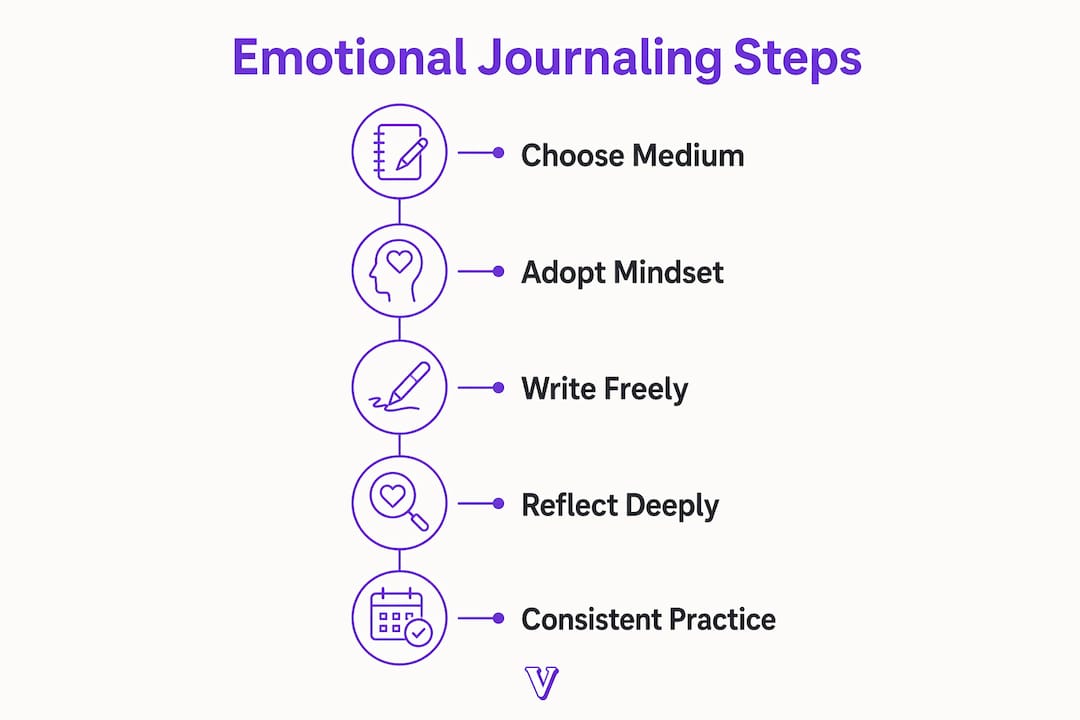
Approach each session as a non-judgmental observer of your own inner life. You are not writing for an audience, a therapist, or a future version of yourself who will judge your grammar. Spelling, structure, and coherence are irrelevant. What matters is honesty. Combining journaling with mindfulness strengthens emotional self-awareness and the capacity for non-judgmental acceptance, which means even two minutes of slow breathing before you open your journal can measurably improve what you get out of the session.

For frequency, effective sessions run 15 to 20 minutes, three to four times per week. That is enough to build the habit without making it feel like a second job.
Pro Tip: Attach your journaling session to an existing habit, such as morning coffee or the ten minutes after you brush your teeth at night. Habit stacking cuts the activation energy required to start.
What does an effective emotional journaling session look like?
Structure separates a productive session from an unfocused rant. Follow these steps and you will consistently leave the page feeling clearer than when you sat down.
- Set a timer for 15 to 20 minutes. A timer removes the mental overhead of watching the clock and signals your brain that this is a contained, safe space. Insights frequently emerge in the latter part of these timed sessions after surface thoughts are processed.
- Write without editing. Do not cross out words, reread sentences, or pause to find the "right" phrasing. Let the first draft of your feelings exist exactly as they are. This is the raw phase.
- Name the emotion specifically. Instead of "I feel bad," write "I feel ashamed because I snapped at my colleague and I don't know how to repair it." Specificity is where the processing actually happens.
- Alternate between difficult and positive material. Balancing expressive and gratitude writing provides complementary benefits for anxiety and mood regulation. After writing about a hard emotion, spend two to three minutes on what went well or what you are grateful for today.
- Close with one question. End every session by writing a single question you want to sit with, such as "What does this pattern tell me about what I need?" You are not required to answer it now.
- Return for reflection. The two-phase journaling approach involves raw writing in the first session, then a separate review days or weeks later to identify patterns and recurring themes. This second pass is where meaning-making happens.
The most common mistakes writers make
| Mistake | Why it backfires | What to do instead |
|---|---|---|
| Pure venting without reflection | Maintains or increases rumination rather than reducing it | Follow venting with one analytical question |
| Over-editing during writing | Blocks honest emotional expression | Set a rule: no deletions during the raw phase |
| Skipping sessions and quitting | Breaks the habit loop and increases guilt | Write one sentence on hard days rather than nothing |
| Treating every session as a crisis debrief | Creates a negative association with journaling | Include gratitude and strength-based entries regularly |
Pro Tip: If you sit down and genuinely cannot think of what to write, start with the sentence "Right now, my body feels..." Physical sensations are always accessible and they lead directly to emotional content.
Which prompts and techniques deepen emotional clarity?
Prompts are not training wheels. They are precision tools that access different emotional layers depending on what you need on a given day. Here are the most effective categories, drawn from structured prompt research:
- Gratitude prompts: "What three specific moments today made me feel supported?" Recording three positive daily events for 14 consecutive days significantly reduces depressive symptoms. The key word is specific. "My friend texted to check in at 2pm" works better than "I'm grateful for my friends."
- Third-person advising: "If a close friend described this exact situation to me, what would I tell them?" Writing from a third-person perspective reduces emotional reactivity by creating psychological distance from the problem.
- Worry containment: Set a timer for five minutes and write every worry you have. When the timer ends, close the journal. This technique tells your nervous system that the worries have been acknowledged and stored, which reduces intrusive thoughts during the rest of your day.
- Future self reflection: "What does the version of me who has already worked through this feel like? What did they do differently?" This prompt activates forward-thinking rather than rumination.
- Pattern tracking: After several weeks of entries, review them and write: "What emotion appears most often? What triggers it consistently?" Platforms like Voisley automate this with mood visualizations, but you can do it manually with a simple tally.
For a deeper look at evidence-based journaling prompts that build emotional safety, Voisley's resource library covers the research behind each approach.
Pro Tip: Rotate your prompts weekly rather than using the same one every session. Novelty keeps your responses honest and prevents you from writing what you expect to write rather than what you actually feel.
How do you handle the hard parts of emotional journaling?
Every consistent journaler hits the same walls. Knowing they are coming makes them easier to move through.
- Emotional overwhelm during a session. Some entries will surface grief, anger, or anxiety more intensely than expected. This is normal and is a sign the practice is working. Pause, breathe, and write "I notice I feel overwhelmed right now" before continuing. If the intensity does not settle, end the session and return tomorrow.
- Guilt over missed sessions. Psychologist Jeffrey Leichter recommends a flexible, self-compassionate approach to journaling, emphasizing consistency over perfection. Missing three days is not failure. Opening the journal on day four is success.
- Unproductive rumination. If you notice you are writing the same complaint in the same words for the fifth time without any new insight, that is a signal to shift technique. Move from venting to the third-person advising prompt or ask "What would need to be true for me to feel differently about this?"
- Privacy concerns. If you share a home and worry about others reading your journal, use a digital app with biometric lock or keep a physical journal in a genuinely private location. Strict privacy safeguards encourage the full emotional honesty that makes the practice therapeutic.
Journaling is a helpful supplement, not a substitute for therapy. Research confirms that professional support enhances processing depth when journaling surfaces significant trauma or persistent mental health symptoms. If entries consistently leave you feeling worse rather than better, that is a clear signal to speak with a licensed therapist.
For a broader look at emotional self-care through mindfulness and how it integrates with journaling, the connection between the two practices is well documented and worth exploring.
Pro Tip: Pair your journaling habit with two minutes of mindfulness breathing before you begin. This primes the prefrontal cortex for reflective thinking rather than reactive thinking, which directly improves the quality of what you write.
Key takeaways
Emotional journaling produces lasting clarity only when raw expression is paired with deliberate reflection and consistent, self-compassionate practice.
| Point | Details |
|---|---|
| Session structure matters | Run 15 to 20 minute sessions three to four times weekly, ending with one reflective question. |
| Two-phase approach | Write raw first, then return days later to review patterns and extract meaning. |
| Prompts unlock depth | Rotate gratitude, third-person, and worry-containment prompts to access different emotional layers. |
| Venting alone is not enough | Analytical meaning-making after emotional release produces better outcomes than pure venting. |
| Self-compassion sustains the habit | Missing sessions is normal. Returning without guilt is what keeps the practice alive long-term. |
What I have learned from watching people actually journal
The most common misconception about emotional journaling is that the writing itself is the therapeutic act. It is not. The writing is data collection. The reflection is where the therapy happens. I have seen users at Voisley fill pages every single day for months and report no meaningful change, because they were venting fluently without ever pausing to ask what the pattern meant.
The writers who report genuine breakthroughs share one habit: they read back. They treat their past entries the way a good analyst treats raw data. They look for repetition, contradiction, and surprise. "I wrote that I was angry at my manager six times this month, but reading it back, I think I was actually scared of being seen as incompetent." That sentence, written in a review session, is worth more than six pages of venting.
There is also a structural tension in journaling that nobody warns you about. Vulnerability and structure feel like opposites, but the practice needs both. Too much structure and you write what the prompt expects. Too little and you spiral. The sweet spot is a light container: a timer, a starting prompt, and permission to go wherever the writing leads from there. That combination produces the kind of emotional pattern recognition that changes how you move through your days.
Start where you are. Write badly. Come back tomorrow.
— Voisley
Start your emotional journaling practice with Voisley
Voisley is built specifically for the kind of reflective, structured journaling this article describes. The platform offers private, guided journaling with personalized prompts across multiple journal types, including gratitude, shadow work, and future goals. Its AI-powered mood tracking and emotional trend visualizations do the pattern recognition work automatically, so you can focus on writing honestly rather than analyzing manually.

If you are ready to move from occasional journaling to a consistent practice that actually builds self-awareness, start your journaling practice on Voisley today. The platform's structured prompts and mindfulness guidance give you the container that makes honest emotional writing possible, without requiring you to figure out the method on your own.
FAQ
What is emotional journaling?
Emotional journaling is a reflective writing practice where you express and examine your feelings to build self-awareness and emotional regulation. Unlike a standard diary, it focuses on processing the meaning behind experiences rather than simply recording them.
How long should an emotional journaling session be?
Sessions of 15 to 20 minutes, three to four times per week, are the evidence-backed standard for supporting emotional regulation and cognitive processing. Insights tend to surface in the latter half of the session once surface-level thoughts have been written through.
What should I write about when I don't know where to start?
Use a structured prompt such as "What am I feeling in my body right now?" or "If a friend were in my situation, what advice would I give them?" Structured prompts improve journaling accessibility and reduce the blank-page barrier significantly.
Can journaling replace therapy?
Journaling is a powerful supplement to therapy but not a replacement for it, particularly when processing significant trauma or persistent mental health symptoms. If your entries consistently leave you feeling worse, consult a licensed mental health professional.
How do I stay consistent with emotional journaling?
Attach journaling to an existing daily habit and prioritize consistency over session length or quality. Psychologist Jeffrey Leichter's research supports returning to the practice without guilt after missed sessions, treating flexibility as a feature rather than a failure.