

TL;DR:
- Daily journaling for ten minutes using techniques like gratitude, reflection, or stream-of-consciousness enhances mental clarity and emotional resilience. Using the right tools and a consistent environment helps sustain the practice and improve self-awareness over time. Journaling complements therapy and should focus on reflection rather than venting to avoid reinforcing negative thought patterns.
A journaling workflow for mental clarity is a structured, consistent practice of expressive and reflective writing that clears mental clutter, reduces stress, and strengthens emotional well-being. Clinical guidance from mid-2026 identifies just 10 minutes of daily journaling as the optimal amount for measurable therapeutic benefit. That is a remarkably low investment for a practice with real psychological returns. The key is not writing more. The key is writing with intention, using the right methods for your mental health goals.
What types of journaling best support mental clarity and emotional wellness?
The role of journaling in mental health depends heavily on the type of writing you choose. Not all journaling produces the same results. Three methods stand out for their evidence-backed impact on mental clarity and emotional regulation.
Stream-of-consciousness journaling is the practice of writing continuously without editing or filtering your thoughts. It works by externalizing mental noise onto the page, which reduces the cognitive load of holding competing thoughts in your head. Think of it as clearing your mental desktop before you start the day.
Gratitude journaling draws from positive psychology and produces measurable results quickly. Recording three positive experiences daily for just 14 days has been shown to lower depressive symptoms at a level comparable to antidepressants for mild to moderate depression. That finding, from a January 2026 study, reframes gratitude journaling from a feel-good habit into a clinically relevant tool.
Identity-focused reflective journaling is the newest addition to evidence-based practice. Cornell University research from 2026 found that a two-week identity-focused journaling program reduced depressive symptoms at a two-month follow-up. The critical factor was reflective self-evaluation rather than ruminative brooding. The distinction matters: writing to understand yourself is different from writing to replay your pain.
- Stream-of-consciousness: clears mental clutter and reduces cognitive overload
- Gratitude journaling: builds positive emotional patterns and reduces depressive symptoms
- Identity-focused journaling: supports self-awareness and long-term emotional resilience
- Expressive writing: processes difficult emotions safely and reduces stress
- Analytical journaling: converts emotional reactions into problem-solving insights
Pro Tip: Avoid purely venting in your journal. Venting without reflection can reinforce negative thought loops. After writing about a difficult emotion, add one sentence asking what you can learn from it or what you would tell a friend in the same situation.
What tools and environment optimize your journaling workflow?
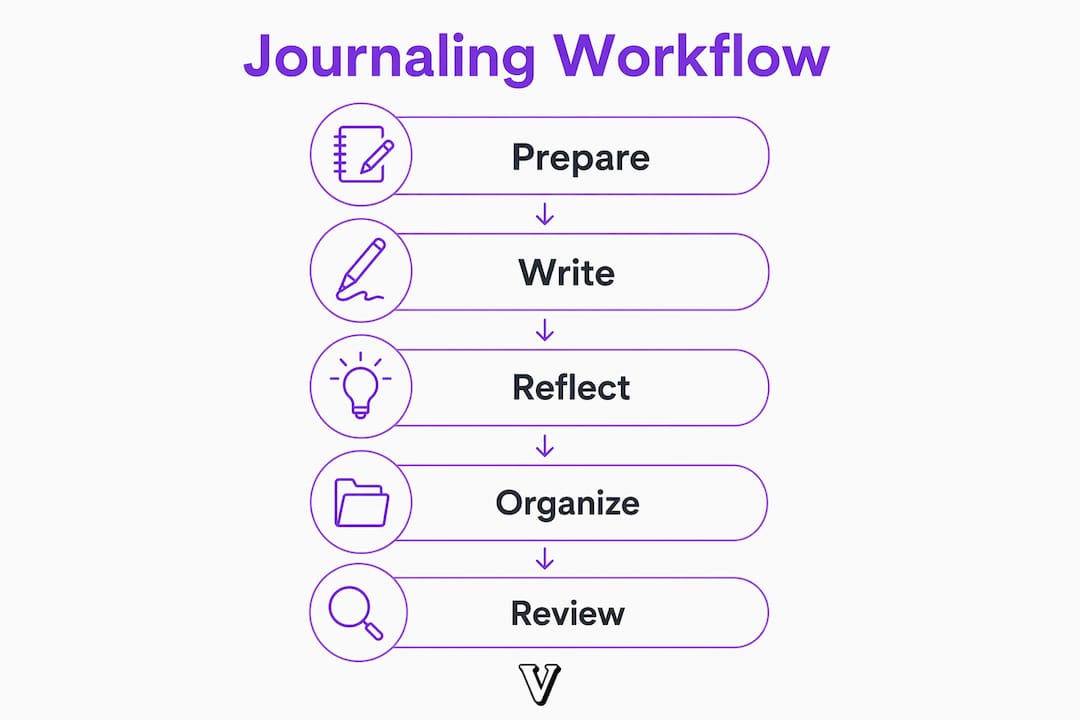
The right setup makes daily journaling easier to start and easier to sustain. Your tools do not need to be expensive. They need to fit your life.

Physical notebooks offer a distraction-free experience. Writing by hand slows your thinking, which can deepen reflection. Many people find that pen and paper feel more personal and private. The limitation is that handwritten entries are harder to search or track over time.
Digital journaling apps solve the search and tracking problem. Platforms like Voisley add structured prompts, mood tracking, and AI-powered pattern recognition to the writing experience. Mood visualizations in digital apps help you spot emotional trends you would miss by reading individual entries. That layer of insight is something a blank notebook cannot provide.
Voice-to-text journaling works well for people who think faster than they type or write. It removes the friction of the blank page entirely. The trade-off is that spoken entries can feel less structured and may require editing to be useful for reflection.
| Method | Strengths | Limitations |
|---|---|---|
| Paper notebook | Tactile, distraction-free, personal | Hard to search, no trend tracking |
| Digital app | Prompts, mood tracking, AI insights | Requires a device, potential distractions |
| Voice-to-text | Fast, low friction, natural flow | Less structured, may need editing |
Your environment matters as much as your tools. A quiet space, a consistent time of day, and a small ritual (a cup of tea, a few deep breaths) signal to your brain that it is time to reflect. Linking journaling to an existing habit, such as morning coffee or your evening wind-down, dramatically increases follow-through.
Pro Tip: Keep a small notebook or open a note app during your workday for interstitial journaling. Jotting a quick thought between tasks offloads mental clutter in real time and reduces the cognitive cost of switching between activities.
How to build a daily journaling routine for mental clarity
A daily journaling habit does not require a perfect system. It requires a repeatable one. The steps below work whether you are brand new to journaling or restarting after a long gap.
-
Set a 10-minute timer. Clinical guidance supports this as the minimum effective dose for mental clarity benefits. Starting small removes the pressure of filling pages and makes the habit sustainable.
-
Choose your moment. Morning journaling (often called morning pages) works well for clearing mental clutter before the day begins. Evening journaling works better for processing the day's events and preparing for rest. Pick one and stay consistent for at least two weeks before switching.
-
Start with a prompt. A blank page is the enemy of consistency. Use a simple starter: "What is taking up the most space in my mind right now?" or "What am I grateful for today and why?" Prompts bypass the hesitation of not knowing what to write.
-
Apply the distanced perspective technique. When writing about a stressful situation, write as if advising a friend facing the same problem. This shift reduces emotional reactivity and moves your writing from venting into problem-solving. It is one of the most effective techniques for converting emotional writing into mental clarity.
-
End with a brain dump. Before closing your journal, write down any unfinished tasks or worries for tomorrow. A nightly brain dump creates psychological closure by externalizing open loops that would otherwise disrupt sleep and mental rest.
-
Review weekly. Once a week, read back through your entries. Look for patterns in your mood, recurring worries, or repeated wins. This reflection step is where long-term self-awareness builds.
The science behind mental clarity confirms that consistency drives results more than length or eloquence. Five honest sentences written daily outperform a two-page entry written once a week.
Common pitfalls that block your journaling workflow
Most people who stop journaling do not quit because it stopped working. They quit because they hit a predictable obstacle and did not know how to move past it.
Rumination is the most common trap. Writing about a painful experience repeatedly without seeking perspective can deepen distress rather than relieve it. The fix is the distanced perspective technique described above. If you notice your entries circling the same wound without resolution, shift your prompt to "What would I tell a close friend in this situation?"
Perfectionism kills consistency. Many people stop writing because they feel their entries are not insightful or well-written enough. Journaling is not a performance. Messy, incomplete entries still produce mental clarity benefits because the act of writing itself processes emotion.
Irregular practice breaks the habit loop. Missing one day is normal. Missing a week means starting over psychologically. Keeping your journal visible and your sessions short (10 minutes) protects against long gaps.
- Avoid writing only when you feel bad. Journaling during neutral or positive moments builds emotional range.
- Do not skip the reflection step. Writing without reviewing your entries limits long-term growth.
- Avoid using journaling as a substitute for professional support when you need it.
Journaling is most effective as a complement to professional therapy, not a replacement. Pairing expressive writing with analytical reflection avoids negative thought loops and supports comprehensive mental health care.
Journaling works best alongside therapy for people managing significant anxiety, depression, or trauma. If your writing consistently triggers intense distress, that is a signal to bring a mental health professional into your process, not a reason to stop writing entirely.
Pro Tip: Use your journal to offload unfinished tasks before switching between major projects. This reduces context-switching costs and keeps your focus sharp throughout the day.
How to tailor your journaling practice for long-term personal growth
A journaling workflow that serves you at the start of your practice will need to evolve. Mental clarity is not a destination. It is a skill you build over time, and your writing should grow with you.
Identity-based journaling prompts are particularly effective for long-term growth. Questions like "Who am I becoming?" or "What values am I living by this week?" push writing beyond daily stress management into genuine self-exploration. Reflective self-evaluation through journaling has been shown to influence depressive symptoms and emotional regulation over months, not just days.
Integrating mindfulness into your sessions deepens the benefit. Before writing, take two minutes to breathe slowly and notice your physical state. This brief pause shifts your nervous system toward calm and makes your writing more honest. You are less likely to write from reactivity and more likely to write from awareness.
| Journaling goal | Recommended workflow | Example prompt |
|---|---|---|
| Stress relief | Evening brain dump + gratitude list | "What worried me today, and what is actually in my control?" |
| Personal growth | Identity-focused weekly reflection | "What did I learn about myself this week?" |
| Problem solving | Distanced perspective technique | "What would I tell a friend facing this exact situation?" |
| Emotional regulation | Morning stream-of-consciousness | "What am I feeling right now, and where do I feel it in my body?" |
The process of guided self-discovery through journaling rewards patience. Give each new method at least two weeks before evaluating whether it fits. Your emotional patterns take time to surface, and the most useful insights often appear in your third or fourth week of consistent practice.
Key Takeaways
A consistent journaling workflow for mental clarity, built on reflective writing and the right techniques, produces measurable benefits for stress, mood, and long-term emotional resilience.
| Point | Details |
|---|---|
| 10 minutes daily is enough | Clinical guidance confirms 10 minutes of daily journaling drives measurable mental clarity and stress reduction. |
| Method matters as much as frequency | Gratitude, identity-focused, and distanced-perspective journaling each target different mental health outcomes. |
| Environment supports consistency | Linking journaling to an existing habit and keeping sessions short protects against irregular practice. |
| Brain dumps prevent mental loops | Writing tomorrow's priorities at night creates psychological closure and improves sleep quality. |
| Journaling complements, not replaces, therapy | For complex emotions or clinical conditions, journaling works best alongside professional mental health support. |
What I have learned from building a journaling practice
The most common mistake people make with journaling is treating it as emotional release alone. Release without reflection is just venting on paper. The real shift happens when you start writing analytically, asking why you feel what you feel and what it tells you about your patterns.
At Voisley, we have seen this play out consistently. People who combine expressive writing with structured prompts and mood tracking report clarity faster than those who write freely without any framework. That is not because free writing is wrong. It is because structure gives your reflection somewhere to go.
Small daily habits build more resilience than occasional deep dives. Ten minutes every morning, done consistently for a month, changes how you relate to your own thoughts. You start to notice emotional triggers earlier. You respond to stress with more space between the feeling and the reaction. That space is mental clarity in practice.
The other thing worth saying plainly: be kind to yourself in your journal. Self-criticism disguised as self-reflection does not produce growth. Write to understand yourself, not to judge yourself. Patience with your own process is not weakness. It is the foundation of every lasting change.
— Voisley
Voisley supports your mental clarity through guided journaling
Voisley is a mental wellness platform built around the science of journaling and emotional self-awareness. It offers personalized prompts, mood tracking, and AI-powered insights that help you understand your emotional patterns over time.

Whether you are learning how to start a journal for mental health or deepening an existing practice, Voisley provides the structure and support to make daily journaling sustainable. Explore gratitude journals, identity-focused reflections, and shadow work prompts, all within a private, guided space designed for real emotional growth. Visit voisley.com to build a journaling habit that actually sticks.
FAQ
What is a journaling workflow for mental clarity?
A journaling workflow for mental clarity is a consistent, structured practice of expressive and reflective writing designed to reduce stress, process emotions, and improve self-awareness. Clinical guidance identifies 10 minutes of daily practice as the effective minimum.
How long should I journal each day for mental health benefits?
Ten minutes of daily journaling is the clinically supported target for measurable stress reduction and mental clarity. Consistency matters more than session length.
What are the best journaling types for mental health?
Gratitude journaling, identity-focused reflective journaling, and stream-of-consciousness writing each address different mental health needs. A 2026 study found that 14 days of gratitude journaling reduced depressive symptoms at a level comparable to antidepressants for mild to moderate depression.
Can journaling replace therapy?
Journaling is most effective as a complement to professional therapy, not a substitute. For complex emotions or clinical conditions, pairing journaling with professional support produces better outcomes than either approach alone.
What is the distanced perspective technique in journaling?
The distanced perspective technique involves writing about a stressful situation as if you were advising a close friend facing the same problem. This approach reduces emotional reactivity and shifts writing from rumination into analytical problem-solving.