

TL;DR:
- Structured journaling enhances emotional regulation, reduces anxiety, and increases self-awareness through evidence-based prompts. Daily practice of 15 to 20 minutes, tailored to specific needs like gratitude or trauma processing, yields measurable mental health improvements and extends therapy benefits. Using guided prompts and maintaining consistency are essential for transforming journaling from a habit into a powerful tool for emotional well-being.
A mental health journal is a purposeful writing practice designed to process emotions, build self-awareness, and support psychological well-being through structured reflection. Unlike a casual diary, it draws on evidence-based frameworks including expressive writing, gratitude journaling, and mindfulness journal prompts to produce measurable improvements in mood and emotional regulation. Research shows that structured journaling for just 15 to 20 minutes daily can reduce anxiety symptoms by up to 60% within seven days. That single finding reframes journaling from a soft self-care habit into a clinical-grade tool. This article breaks down which methods work, how to build a routine that sticks, and what outcomes you can realistically expect.
What types of mental health journaling are proven effective?
Not all journaling produces the same results. Different journaling methods serve distinct goals: expressive writing for trauma processing, gratitude journaling for mood elevation, worry journaling for anxiety containment, analytical journaling for cognitive reframing, and future-self journaling for motivation. Choosing the right type for your current need is the difference between genuine progress and spinning your wheels.

| Journaling type | Primary benefit | Best used for |
|---|---|---|
| Expressive writing | Processes trauma and suppressed emotion | Grief, past events, emotional overload |
| Gratitude journaling | Boosts positivity and resilience | Daily mood, low motivation |
| Worry journaling | Contains and externalizes anxiety | Chronic worry, racing thoughts |
| Analytical (third-person) | Reduces emotional reactivity | Conflict, rumination, perspective shifts |
| Mindfulness journaling | Lowers stress response | Present-moment awareness, daily calm |
Expressive writing, developed by psychologist James Pennebaker, asks you to write freely about emotionally significant events without editing or self-censoring. It works by moving suppressed material from implicit memory into conscious narrative, which reduces the cognitive load of carrying unprocessed experiences. One important caveat: expressive writing can temporarily increase distress before improving wellbeing weeks later, which is why professional support is recommended when processing acute trauma.
Gratitude journaling works differently. Writing three specific gratitude items daily for two weeks produces lasting improvements in wellbeing that extend beyond the journaling period itself. The key word is "specific." "I'm grateful for my health" produces far weaker results than "I'm grateful that my friend called to check on me this morning."
Analytical or third-person journaling is the most underused method. Writing about yourself as "he," "she," or "they" creates psychological distance from emotionally charged situations. Third-person perspective prompts reliably reduce rumination and improve adaptive thinking more than pure emotional venting. This technique is particularly effective for processing interpersonal conflict or making decisions under stress.
Mindfulness journaling targets the nervous system directly. Expressive writing lowers cortisol and reduces amygdala activity, which translates to measurably lower stress responses and less anxious thinking over time. A mindfulness journal prompt as simple as "What am I noticing in my body right now?" can interrupt a stress spiral before it escalates.
Pro Tip: Avoid unstructured venting as your default mode. Repeated negative writing without reframing reinforces anxiety feedback loops rather than resolving them. Always close a venting entry with one sentence that asks: "What is this teaching me?"
How to start a consistent mental health journaling routine
Building a sustainable journaling habit requires less time than most people assume and more intention than most people apply. The research is clear: daily shorter sessions outperform occasional longer ones for mood and wellbeing outcomes. Consistency is the active ingredient, not volume.
Here is a practical framework to get started and stay consistent:
-
Choose your medium deliberately. Paper journals reduce digital distraction and support deeper reflection for many people. Digital platforms like Voisley offer structured prompts, mood tracking, and AI-powered pattern recognition that paper cannot match. Neither is universally superior. Pick the one you will actually use every day.
-
Set a fixed time. Morning journaling primes your mindset and sets emotional intentions for the day. Evening journaling supports processing and closure. Both work. What does not work is journaling "whenever I feel like it," which typically means never.
-
Start with a prompt, not a blank page. Self-reflection journal prompts remove the friction of starting. Try: "What emotion am I carrying from yesterday?" or "What do I want to feel more of today?" Structured prompts from frameworks like Holstee's The Daily Flourish, designed by Dr. Emiliana Simon-Thomas, use pillars of Connection, Positivity, and Resilience to build measurable emotional progress through weekly check-ins.
-
Keep sessions to 15 to 20 minutes. This duration is optimal for mental health outcomes. Setting a timer removes the pressure of wondering when to stop and keeps the practice from feeling like a chore.
-
Track your mood alongside your entries. A daily mental health tracker adds a quantitative layer to your qualitative writing. Over time, patterns emerge: which topics correlate with low mood, which prompts produce the most clarity, which days you consistently skip and why.
-
Treat missed days as data, not failure. If you miss three consecutive days, that is information about your routine, not your character. Adjust the time, the medium, or the prompt style rather than abandoning the practice.
Pro Tip: Use the emotional self-care guide from Voisley's blog to match specific prompts to your current emotional state. Matching prompt type to need produces faster results than using the same prompt every day.
What mental health improvements can you expect from regular journaling?
The psychological outcomes from consistent journaling are well-documented and span multiple domains of mental health. These are not marginal improvements. They are clinically meaningful changes that researchers have replicated across diverse populations.
The core benefits include:
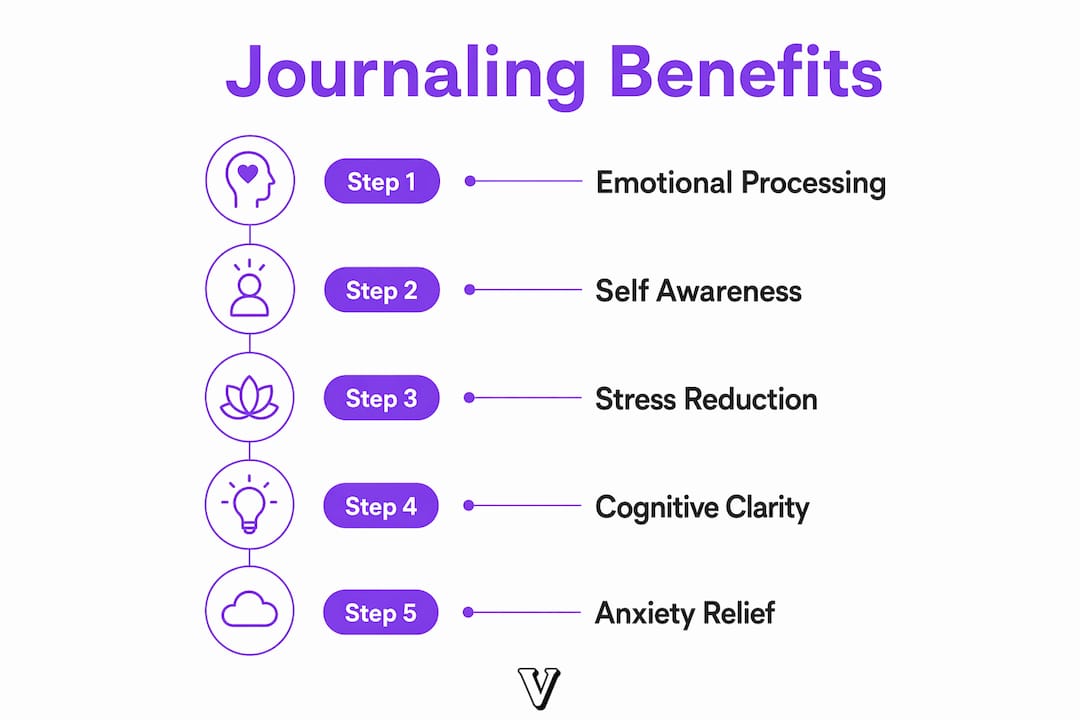
- Reduced anxiety and depressive symptoms. Structured journaling for 15 to 20 minutes daily produces up to a 60% reduction in anxiety within one week. For context, that is a faster response rate than many behavioral interventions.
- Improved emotional regulation. Writing about emotions activates the prefrontal cortex, the brain region responsible for rational thought and impulse control, which dampens the amygdala's threat response. This is the neurological basis for why journaling for stress relief works.
- Stronger self-awareness. Regular entries create a written record of your thought patterns, emotional triggers, and behavioral tendencies. Reviewing past entries reveals cycles you cannot see in real time.
- Enhanced resilience and motivation. Holistic journaling approaches built on Connection, Positivity, and Resilience produce stronger long-term wellbeing than single-focus techniques. Combining gratitude, future-self, and reflective prompts within a single routine compounds the benefits.
- Complementary support for therapy. Journaling does not replace professional mental health care, but it extends its reach. Bringing journal entries to therapy sessions gives your counselor richer material to work with and accelerates the therapeutic process. If you are preparing for your first appointment, a mental health care checklist can help you organize your thoughts and entries beforehand.
The mechanism behind these improvements is not mysterious. Successful journaling transitions from simply noticing and describing emotions to active reflection by asking "What is this teaching me?" That single shift breaks the feedback loop of anxiety and converts emotional experience into usable self-knowledge. For a deeper look at how journaling supports emotional well-being, the research consistently points to structured reflection as the key variable.
What do experts say about avoiding journaling pitfalls?
Psychology researchers and clinicians agree on one point that most journaling advice ignores: structure matters more than sincerity. You can write with complete emotional honesty and still make your mental health worse if you are doing it wrong.
The most common pitfalls and how to avoid them:
- Rumination disguised as reflection. If your entries repeatedly revisit the same painful event without reaching new understanding, you are ruminating, not reflecting. The fix is a structured prompt that forces forward movement, such as "What would I tell a close friend in this situation?"
- Unguided trauma processing. Unguided journaling during acute trauma can worsen symptoms rather than relieve them. If you are dealing with recent loss, abuse, or crisis, structured prompt-based journaling combined with professional support is the safer path.
- Perfectionism and performance. Many people abandon their emotional wellbeing journal because they feel their writing is not good enough. Journaling is not a writing exercise. Grammar, style, and coherence are irrelevant. The only standard is honesty.
- Single-method rigidity. Using only one journaling type limits your results. Rotating between gratitude, expressive, and analytical prompts across the week addresses different psychological needs and prevents the practice from going stale.
Expressive writing frameworks produce the best outcomes when they move beyond emotional venting to structured reflection. The question "What is this teaching me?" is not a cliché. It is the cognitive mechanism that converts raw emotion into insight.
Pro Tip: If you notice your entries becoming repetitive or increasingly negative over two weeks, switch journaling types entirely. Try five holistic journaling techniques that incorporate connection and resilience-based prompts to reset your practice.
Key takeaways
Consistent, structured journaling is the most accessible evidence-based tool for improving emotional regulation, reducing anxiety, and building self-awareness across all life stages.
| Point | Details |
|---|---|
| Structure beats sincerity | Structured prompts outperform free venting for reducing anxiety and breaking rumination cycles. |
| 15 to 20 minutes is optimal | Daily short sessions produce stronger mood outcomes than occasional long ones. |
| Match method to need | Use expressive writing for trauma, gratitude for mood, and analytical prompts for perspective shifts. |
| Avoid unguided trauma work | Acute trauma requires structured prompts and professional support to prevent symptom worsening. |
| Consistency is the active ingredient | Daily practice, even brief, compounds into measurable psychological improvements within weeks. |
What Voisley has learned about journaling that most guides miss
Most journaling advice treats the practice as inherently therapeutic, as if picking up a pen is enough. What we have seen at Voisley, working with thousands of users across different emotional starting points, is that the format of your journaling matters as much as the frequency.
Users who start with open-ended entries and no structure often report feeling worse after two weeks, not better. They are not doing anything wrong in the conventional sense. They are writing honestly and consistently. But without a framework that moves them from description to reflection, they are essentially rehearsing their pain rather than processing it.
The shift that changes everything is deceptively simple: replace "What happened?" with "What is this showing me about what I need?" That one reframe converts a mental health diary into a genuine self-discovery tool. It is the difference between a record and a practice.
We also notice that people underestimate how much medium matters. Paper journaling builds a different kind of intimacy with your thoughts. Digital journaling with mood tracking and pattern visualization gives you a meta-view of your emotional life that paper cannot provide. The most effective approach for most people is not choosing one but using both for different purposes. Use paper for raw emotional processing. Use a structured digital platform for pattern recognition and habit accountability.
The science supports personalization over prescription. There is no single correct way to keep a mental wellness journal. There is only the method that you will sustain and that moves you forward. Start there, and adjust as you learn what your mind actually needs.
— Voisley
Start your journaling practice with Voisley
Knowing the research is one thing. Having the tools to act on it is another.

Voisley is built specifically for people who want more than a blank page. The platform combines mood tracking, AI-powered insights, and structured prompts across journal types including gratitude, shadow work, and future-self writing, giving you a private space where your emotional patterns become visible and workable. Whether you are just starting out or looking to deepen an existing practice, Voisley's journaling platform provides the structure that turns good intentions into lasting emotional clarity. Explore the mindful journaling guide to find the right starting point for where you are right now.
FAQ
What is a mental health journal?
A mental health journal is a structured writing practice used to process emotions, build self-awareness, and support psychological well-being. It differs from a casual diary by using purposeful prompts and frameworks grounded in psychological research.
How long should I journal each day for mental health benefits?
Research shows that 15 to 20 minutes daily is the optimal duration for mental health outcomes, with consistency across days mattering more than the length of any single session.
Can journaling make anxiety worse?
Unstructured venting without reframing can reinforce anxiety feedback loops rather than resolve them. Expressive writing may also temporarily increase distress, which is why structured prompts and professional support are recommended for anyone processing acute trauma.
What are the best journal prompts for mental health?
Effective self-reflection journal prompts include "What emotion am I carrying right now and where do I feel it in my body?", "What is this situation teaching me?", and "What would I tell a close friend going through this?" These prompts move reflection forward rather than recycling the same emotional content.
Does journaling replace therapy?
Journaling complements therapy but does not replace it. Bringing journal entries to sessions gives your therapist richer material and can accelerate progress, but severe mental health conditions require professional clinical care alongside any self-directed practice.