

TL;DR:
- Mindful journaling involves observing your present thoughts and emotions without judgment or analysis to foster emotional awareness. It shifts focus from problem-solving to witnessing inner experiences, reducing stress and breaking rumination through cognitive defusion. Regular, short sessions with honest expression cultivate lasting emotional clarity and resilience.
Mindful journaling is defined as a contemplative writing practice in which you observe your present thoughts and emotions on paper without judgment, analysis, or the urge to fix anything. Unlike traditional journaling, which tends to focus on events, problem-solving, or tracking productivity, mindful journaling borrows directly from meditation. It asks you to witness your inner experience rather than narrate it. Researchers like Dr. James Pennebaker, whose expressive writing studies laid the groundwork for therapeutic journaling, and frameworks like Mindfulness-Based Cognitive Therapy (MBCT) both point to the same core mechanism: creating psychological distance from your thoughts produces measurable emotional relief.
What is mindful journaling and how does it differ from regular journaling?
Mindful journaling, also called mindfulness journaling, prioritizes witnessing thoughts and emotions without analysis or problem-solving. The goal is awareness, not documentation. You are not writing to remember your day or plan your next move. You are writing to notice what is happening inside you right now.
Richard French, whose work on contemplative writing is cited in recent mindfulness guides, describes this as a fundamental shift in stance. Traditional journaling approaches focus on productivity or venting. Mindful journaling changes the role of the writer from storyteller to observer. That single shift is what makes it a mindfulness practice rather than a diary habit.
The practical difference shows up in language. A traditional journal entry might read: "I had a terrible meeting and I need to figure out how to handle my boss." A mindful journal entry reads: "I notice tension in my chest. I notice a thought that says I failed." One entry tries to solve. The other simply sees. The journaling for mental health literature consistently shows that this observational stance is what produces emotional benefit, not the act of writing itself.
How does mindful journaling work to improve emotional well-being?
The psychological mechanism behind mindful journaling is called cognitive defusion. Shifting from narrating to observing creates psychological distance between you and your thoughts, which reduces the emotional charge those thoughts carry. When you write "I am anxious," you fuse with the anxiety. When you write "I notice a feeling of anxiety," you step outside it. That gap is where emotional clarity lives.
Neuroscience supports this. Mindfulness practices activate the prefrontal cortex, the brain region responsible for rational thought and emotional regulation, while calming the amygdala, which drives fear and stress responses. Writing during a mindful state compounds this effect by slowing the thought process and making the observation more deliberate.
"Emotional benefit arises from shifting perspective from inside anxiety to observing it, creating space and clarity." — Mindfulness Journaling research, Wholeosophy
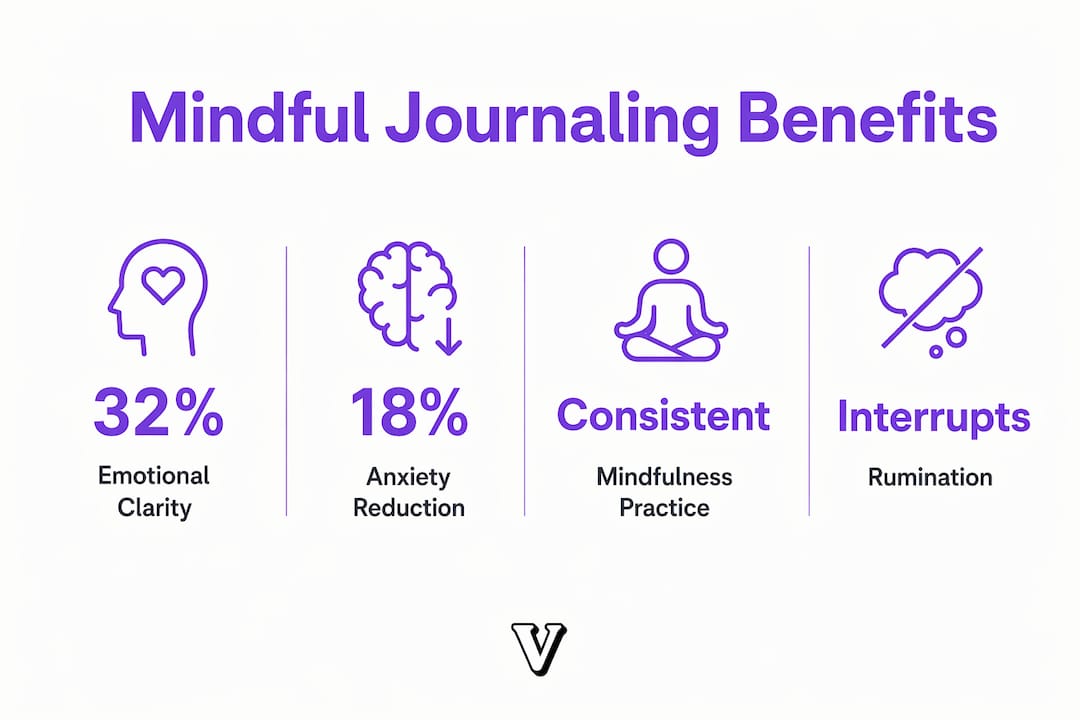
A 2026 pragmatic trial of internet-delivered MBCT that included mindful writing components reported 18 to 32% mediation effects for improvements in stress outcomes, with self-compassion and resilience identified as the key mediating factors. This means the practice does not just reduce stress directly. It builds the internal resources that make stress more manageable over time. A separate 2025 study confirmed that compassionate writing reduces stress with measurable effect sizes, even in brief ecological momentary interventions delivered via smartphone.
Mindful journaling also interrupts rumination. Rumination is the mental loop of replaying problems without resolution. By anchoring attention to the present moment through writing, you break the loop without suppressing the emotion. The result is not forced positivity. It is genuine emotional clarity, which is the foundation of self-awareness and personal growth.
What does a mindful journaling practice actually look like?
The structure of a mindful journaling session is simpler than most people expect. There is no required format, no minimum word count, and no correct answer. What matters is the quality of attention you bring to the page.
Here is a reliable starting framework for anyone learning how to start mindful journaling:
- Set a timer for 5 to 15 minutes. Short, consistent sessions maintain mindfulness focus and prevent the practice from drifting into analysis or anxiety spirals. A fixed endpoint signals to your brain that this is a contained, safe exercise.
- Begin with an observational prompt. Phrases like "I notice..." or "Right now, I am aware of..." anchor you in the present moment. If you feel stuck, writing "I'm stuck" is itself a valid and honest entry point.
- Write without editing. Do not cross out words, reread sentences, or correct grammar. The inner critic is the exact voice you are learning to observe, not obey.
- Allow difficult emotions on the page. Forcing positivity or rushing toward solutions undermines the practice. Emotional safety comes from letting what is true be written, not from making it prettier.
- Close with one sentence of self-compassion. Something as simple as "This was hard, and I showed up anyway" reinforces the non-judgmental tone that makes the practice sustainable.
Pro Tip: If your mind drifts mid-session, do not restart. Write "I notice my mind has wandered to X" and continue. The noticing is the practice.
The mindfulness journaling process works best when it is consistent rather than intense. Five minutes every morning outperforms a 45-minute session once a week. Ritual cues help: the same notebook, the same chair, the same time of day. These signals tell your nervous system that reflection, not performance, is what follows.

How does mindful journaling compare with other journaling styles?
Understanding where mindful journaling sits relative to other practices helps you choose the right tool for the right moment.
| Practice | Core focus | Emotional stance | Best for |
|---|---|---|---|
| Mindful journaling | Present-moment observation | Non-judgmental witnessing | Emotional clarity, stress reduction |
| Expressive writing | Processing past events | Cathartic release | Trauma processing, grief |
| Gratitude journaling | Positive reframing | Intentional appreciation | Mood uplift, perspective shift |
| Meditation | Breath and body awareness | Silent observation | Deep calm, concentration |
The key distinction is that mindful journaling combines the accessibility of writing with the observational stance of meditation. Many people find formal meditation difficult because the mind wanders with no anchor. Writing provides that anchor. The pen moving across the page keeps attention tethered to the present moment in a way that silent sitting does not always achieve.
Compared to gratitude journaling, mindful journaling does not require you to feel good or find silver linings. It accepts the full emotional spectrum. Compared to expressive writing in the Pennebaker tradition, it does not push you to process or make meaning. It simply asks you to see what is there. This makes it particularly accessible for people who are new to mindfulness practices or who find traditional meditation intimidating.
Mindful journaling also complements other self-care methods. Pairing it with breathwork before a session deepens the present-moment focus. Using emotional self-care strategies alongside it builds a fuller wellness practice. The practices reinforce each other rather than compete.
How to build a sustainable mindful journaling habit
Consistency is the variable that separates people who benefit from mindful journaling from those who try it once and abandon it. The following principles make the habit stick:
- Choose a fixed time. Morning sessions work well for setting an observational tone before the day's demands take over. Evening sessions help process the emotional residue of the day before sleep.
- Keep your materials simple. A dedicated notebook and pen reduce friction. Digital tools like Voisley, which offers structured prompts and mood tracking, work well for people who prefer a guided experience.
- Use third-person phrasing when emotions feel overwhelming. Writing "The mind is looping on this problem" rather than "I can't stop thinking about this" widens the gap between self and thought, making difficult emotions easier to observe without being consumed by them.
- Set a hard time limit. A 12-minute timer prevents sessions from becoming rumination marathons. When the timer ends, the session ends. This boundary protects the practice from turning into the very mental looping it is designed to interrupt.
- Accept imperfect sessions. Some days the writing will feel flat or forced. That is not failure. Writing "I don't know what to write and I notice resistance" is a perfectly valid mindful journaling entry.
Pro Tip: Try mindful journaling prompts designed for emotional safety when you feel too activated to write freely. Structured prompts reduce the cognitive load of starting and keep the session anchored in observation rather than analysis.
The most common reason people abandon the practice is over-analysis. They start writing observations and slide into problem-solving within two minutes. When that happens, the fix is not willpower. It is returning to the prompt: "I notice..." That phrase is a reset button available on every line of the page.
Key takeaways
Mindful journaling works because it shifts your relationship to thoughts from identification to observation, and that shift is what produces lasting emotional clarity.
| Point | Details |
|---|---|
| Core definition | Mindful journaling is observational writing that witnesses thoughts without judgment or analysis. |
| Psychological mechanism | Cognitive defusion creates distance from emotions, reducing stress and interrupting rumination. |
| Session structure | Use 5 to 15 minute timed sessions with "I notice..." prompts to maintain present-moment focus. |
| Research support | A 2026 iMBCT trial reported 18 to 32% mediation effects on stress outcomes via self-compassion. |
| Habit sustainability | Consistent short sessions, a fixed time, and self-compassionate language make the practice last. |
Why mindful journaling is worth taking seriously
From where Voisley sits, working with thousands of people navigating emotional complexity through guided journaling, the most common misconception about mindful journaling is that it requires you to be calm before you start. It does not. The practice is designed for the moments when you are not calm. The anxiety, the confusion, the low-grade dread at 7 a.m. — those are not obstacles to mindful journaling. They are the material.
The second misconception is that journaling and mindfulness are separate disciplines that need to be mastered independently before combining them. In practice, mindful journaling is often a more accessible entry point into mindfulness than formal meditation, especially for people who find silence activating rather than soothing. The act of writing slows the mind in a way that sitting still does not always achieve.
What Voisley has observed consistently is that the people who benefit most are not the ones who write the most. They are the ones who write with the most honesty. A single sentence that accurately names what you are feeling right now is worth more than three pages of polished reflection. The practice rewards precision and kindness, not volume or eloquence. Approach it with curiosity rather than expectation, and give it at least two weeks before you judge whether it is working.
— Voisley
Start your mindful journaling practice with Voisley
Voisley is built specifically for people who want the benefits of mindful journaling without having to figure out the structure alone.

The platform offers personalized prompts designed around present-moment observation, mood tracking that reveals emotional patterns over time, and journal types including gratitude, shadow work, and future goals. The AI-powered insights help you understand what your writing is telling you about your emotional state, going deeper than any paper journal can. Whether you are new to the mindfulness journaling process or looking to make an existing practice more consistent, Voisley provides the structure and support to make it sustainable. Visit Voisley to explore guided journaling tools built around your emotional well-being.
FAQ
What is mindful journaling in simple terms?
Mindful journaling is the practice of writing down your present thoughts and feelings without judging or trying to fix them. The goal is awareness, not problem-solving.
How long should a mindful journaling session be?
Sessions of 5 to 15 minutes are recommended, with a fixed timer to prevent the practice from drifting into rumination or unfinished mental problem-solving.
What are the best mindful journaling prompts to start with?
Prompts like "I notice..." or "Right now, I am aware of..." anchor attention in the present moment and work for any emotional state, including confusion or resistance.
How does mindful journaling differ from gratitude journaling?
Gratitude journaling focuses on positive reframing, while mindful journaling accepts the full emotional spectrum without requiring you to find silver linings or feel good.
Is mindful journaling backed by research?
Yes. A 2026 pragmatic trial of mindfulness-based cognitive therapy that included mindful writing reported significant reductions in stress, mediated by self-compassion and resilience, with 18 to 32% mediation effects on key outcomes.