
TL;DR:
- Strong community ties significantly reduce depression, anxiety, and mental distress by building resilience and belonging. Social participation, especially in rural areas, offers greater stress and depression reductions than urban settings. Trusted relationships and culturally grounded programs enhance mental health outcomes across diverse populations.
Community is defined as one of the most powerful determinants of mental health, with strong social ties directly reducing depression, anxiety, and psychological distress. The role of community in mental health goes far beyond casual connection. Research shows that social participation produces measurable reductions in stress and depression, with effects that are strongest in settings where people rely on each other most. Loneliness and isolation worsen nearly every mental health condition. Community does the opposite: it builds resilience, creates belonging, and gives people a reason to keep going.
How do social ties reduce mental distress?
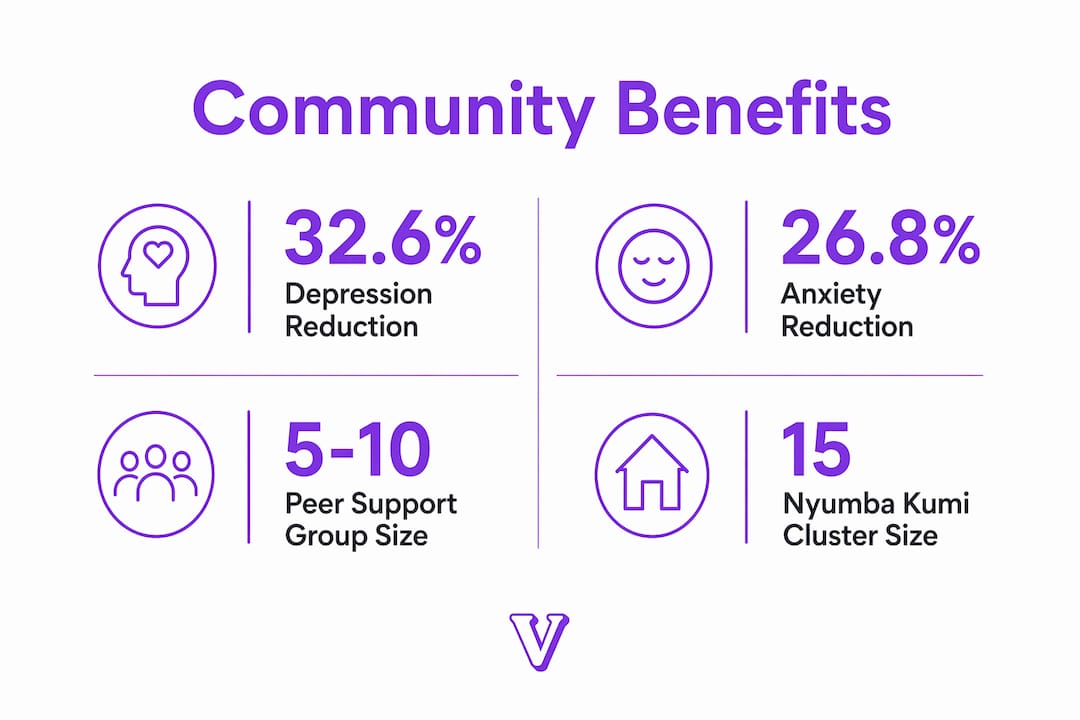
Social participation is one of the most consistent predictors of lower depression and anxiety across populations. A 26.8% reduction in stress and a 32.6% reduction in depression have been documented in rural communities through active social participation. That gap compared to urban settings, where stress reductions range from 8–16% and depression reductions from 14.9–23%, tells you something important: the quality and density of social bonds matter as much as their presence.

The mechanism behind this is collective efficacy, the shared belief within a group that it can solve problems together. When people feel part of a community that acts, they feel less helpless. Helplessness is one of the core drivers of depression. Community cohesion breaks that cycle by replacing isolation with shared agency.
Community cohesion also creates a sequential protective chain: stronger bonds lead to better social support, which builds resilience, which reduces depression risk over time. This is not a single intervention. It is a compounding effect that grows the longer someone stays embedded in a supportive community.
Pro Tip: Map your existing social network by listing the five people you talk to most. Then ask yourself which of those relationships feel genuinely supportive versus draining. Prioritizing depth over breadth in your social ties produces stronger mental health benefits.
| Type of social environment | Stress reduction | Depression reduction |
|---|---|---|
| Rural community participation | 26.8% | 32.6% |
| Urban community participation | 8–16% | 14.9–23% |
Who benefits most from community support?
Adolescents and marginalized groups gain some of the clearest mental health benefits from strong community ties. Among more than 2,000 urban adolescents of color in Northeastern New Jersey, higher social support correlated significantly with lower trauma, depression, anxiety, and alcohol use severity. That correlation held across validated instruments including the PHQ-9A, GAD-7, and Child Trauma Screen, which means the finding is not anecdotal.
A sense of community also reduces anxiety and supports emotional well-being in groups that face systemic barriers to care. When people feel they belong somewhere, they are more likely to seek help, share their struggles, and stay connected to support systems. That sense of belonging is not a luxury. For many adolescents navigating trauma, it is the difference between early intervention and crisis.
Culturally responsive frameworks amplify these effects. Community engagement works best when it reflects the values, language, and lived experience of the people it serves. Generic programs applied without cultural context produce weaker outcomes. Programs built from within communities, by people who share the experience, produce lasting change.
The specific benefits for adolescents and trauma survivors include:
- Lower rates of depression and anxiety when social support is consistently present
- Reduced trauma severity linked to a strong sense of belonging
- Decreased substance use, particularly alcohol, in socially connected youth
- Greater willingness to seek professional mental health support
- Improved emotional regulation through peer modeling and shared experience
- Stronger emotional resilience when community ties are stable and consistent
What are the most effective community mental health models?
The most effective community mental health models shift responsibility away from specialists and toward trusted people already embedded in communities. The Community Initiated Care model, known as CIC, trains teachers, elders, and community leaders to deliver frontline mental health support. This approach, used in the Tealeaf program, works because it removes the barrier of clinical distance. People are more likely to open up to someone they already trust.
Kenya's Nyumba Kumi model takes a different angle. It organizes communities into social clusters of 5–15 people, which mirrors the natural size of human social groups. Peer support within clusters of this size is sustainable because it does not overwhelm any single person and creates genuine mutual accountability. The insight here is biological as much as social: humans are wired to maintain meaningful relationships within groups of roughly this size.
Ambassador networks represent another layer of this infrastructure. Trained community ambassadors delivering Mental Health First Aid normalize conversations about mental health and connect people to evidence-based support before crises develop. Columbus Regional Health used this model to unify an entire county around mental well-being, demonstrating that ambassador networks scale effectively when paired with clear referral pathways.
Digital infrastructure strengthens all of these models. Combining digital platforms with physical networks reduces service backlogs and improves coordination between community workers and clinical providers. The digital layer does not replace human connection. It makes human connection more consistent and easier to access.
Pro Tip: If you want to start a peer support group in your area, aim for 5–10 people with a shared experience or goal. Keep meetings regular and low-pressure. The consistency of showing up matters more than the format of the meeting.
How can you build community connections for mental wellness?
Building meaningful community ties starts with identifying where you already have access to social infrastructure. Workplaces, faith communities, neighborhood associations, and online groups all count. The goal is not to join everything. The goal is to find one or two spaces where you feel genuinely seen and return to them consistently.
Support groups are particularly effective because they combine shared experience with structured interaction. People in support groups report feeling less alone, more understood, and more capable of managing their symptoms. The role of support groups in mental wellness is well-documented: they reduce isolation, provide practical coping strategies, and create accountability without judgment.
| Type of community engagement | Primary mental health benefit |
|---|---|
| Peer support groups | Reduced isolation, shared coping strategies |
| Volunteer work | Increased sense of purpose and belonging |
| Faith or cultural communities | Identity affirmation and emotional grounding |
| Online wellness communities | Accessible connection across geographic barriers |
| Neighborhood or civic groups | Collective efficacy and local problem-solving |
Daily practices also matter. Small, consistent actions build the social muscle that sustains mental wellness over time. These include:
- Reaching out to one person per day, even briefly, to maintain connection
- Attending recurring community events to build familiarity and trust over time
- Practicing active listening in conversations to deepen relational quality
- Using journaling for emotional well-being to process social experiences and clarify your needs
- Volunteering locally to create a sense of purpose alongside social contact
- Setting boundaries in draining relationships to protect your emotional capacity
Community-based mental health programs also show strong clinical results. Participants in the Problem Management Plus program delivered through a community-based mobile clinic showed a 25.4% reduction in mental health distress. That figure came from a controlled study conducted between january 2021 and december 2023, with confidence intervals of 13.1–37.9%. Structured community programs, not just informal connection, produce outcomes comparable to clinical interventions.
Key Takeaways
Community support is the single most accessible and evidence-backed tool for reducing depression, anxiety, and psychological distress across every age group and setting.
| Point | Details |
|---|---|
| Social ties reduce distress | Rural social participation cuts depression by 32.6%, far outpacing urban settings. |
| Collective efficacy matters | Shared belief in group problem-solving directly counters helplessness and depression. |
| Adolescents gain the most | Higher social support links to lower trauma, anxiety, and substance use in youth. |
| Trusted figures extend reach | Training teachers and community leaders delivers frontline mental health support effectively. |
| Small groups work best | Peer support clusters of 5–15 people match natural human social capacity and stay sustainable. |
What I've learned about community and mental health after years of watching the evidence
The research on community and mental health has become clearer every year, but one thing still gets underestimated: the difference between being around people and actually feeling connected to them. You can attend every group meeting, follow every community initiative, and still feel profoundly alone if the relationships lack depth or cultural resonance.
What the Nyumba Kumi model and the CIC approach both get right is that they start with trust, not structure. They do not build a program and then recruit people into it. They find the relationships that already exist and give them a framework. That sequence matters enormously. Programs that reverse it, building the structure first and hoping connection follows, consistently underperform.
The shift toward digital infrastructure is real and useful, but it works best as a coordination layer, not a replacement for physical presence. People need to be in the same room sometimes. They need to read body language, share silences, and feel the weight of someone else's attention. Digital tools that support those moments rather than substitute for them are the ones worth building.
The future of community mental health belongs to models that combine cultural grounding, trusted relationships, and smart coordination. The evidence already points there. The gap is in implementation, not knowledge.
— Voisley
Voisley and the science of connected well-being
Mental wellness does not happen in isolation. Voisley was built on that premise.

Voisley combines guided journaling, mood tracking, and AI-powered insights to give you a structured space for self-reflection that complements the community connections you build in daily life. Features like gratitude journals, shadow work prompts, and emotional trend visualizations help you process what happens in your relationships and understand your own patterns more clearly. When you know yourself better, you show up better for the people around you. Explore Voisley's mental wellness tools and see how private reflection and community support work together to strengthen emotional health.
FAQ
What is the role of community in mental health?
Community provides social support, belonging, and collective efficacy, all of which directly reduce depression, anxiety, and psychological distress. Strong community ties are one of the most consistent predictors of better mental health outcomes across age groups.
How does social isolation affect mental health?
Social isolation removes the protective effects of community, increasing vulnerability to depression, anxiety, and trauma. Loneliness amplifies nearly every existing mental health condition by eliminating the buffer that social connection provides.
Are support groups effective for mental wellness?
Support groups reduce isolation, provide shared coping strategies, and create accountability without clinical distance. Research on community-based programs shows measurable reductions in mental health distress when structured peer support is consistently available.
Why do rural communities show stronger mental health benefits from social participation?
Rural communities often have denser, more interdependent social networks than urban areas, which amplifies the protective effects of participation. Social participation produces a 26.8% stress reduction in rural settings compared to 8–16% in urban environments.
How can I start building stronger community connections for my mental health?
Start by identifying one recurring social space where you feel genuinely seen, whether a support group, faith community, or neighborhood group, and commit to showing up consistently. Depth and regularity of connection matter more than the number of groups you join.