
TL;DR:
- Community provides essential emotional validation, belonging, and practical support that buffer stress and improve mental health. Building intentional, consistent connections—whether online or offline—can effectively reduce loneliness and deepen resilience. Combining community support with professional care creates a comprehensive foundation for emotional well-being.
Most people assume emotional support comes from within. Work on yourself, build resilience, develop coping skills. And while those things matter, the research tells a different story. The role of community in emotional support is not just supplementary. It is foundational. 1 in 6 people worldwide experience loneliness, and that isolation carries health consequences comparable to smoking 15 cigarettes a day. If you've been doing the hard internal work but still feel emotionally depleted, the missing piece might not be inside you at all.
Table of Contents
- Key Takeaways
- The role of community in emotional support
- What the research says about community and mental health
- Myths and barriers that block community support
- How to actually build community connections that support you
- Integrating community with broader mental health care
- My honest take on community as emotional support
- Start building your emotional wellness foundation
- FAQ
Key Takeaways
| Point | Details |
|---|---|
| Community is more than geography | Emotional community includes online groups, peer networks, and shared-interest spaces, not just neighbors or family. |
| Loneliness has clinical consequences | Loneliness doubles the risk of depression and is now screened for by mental health providers as a modifiable risk factor. |
| Small actions build real bonds | Consistency in low-stakes interactions builds trust and belonging far more effectively than waiting for natural connection. |
| Peer support rivals clinical care | Community-administered interventions show clinically meaningful results in reducing anxiety and depression. |
| Technology can extend community | Digital platforms help people access social support networks when in-person options are limited, if used with intention. |
The role of community in emotional support
When most people hear "community," they picture a neighborhood block party or a church group. But community emotional support actually operates across a much wider range of relationships and settings. It includes the coworker who checks in after a rough week, the online forum where you process grief at 2 a.m., the peer who has been through what you're going through.
Community, in the emotional sense, is any consistent network of people who witness your experience, respond to it, and show up again. That definition matters because it expands who gets to have one.
Here's how communities actually function as emotional support systems:
- Validation — Other people confirm that your feelings make sense. This alone reduces the shame that often compounds emotional pain.
- Perspective — Shared experience offers context you can't generate alone. Someone who has survived what you're enduring can reframe your situation in ways a therapist or self-help book cannot.
- Practical aid — Emotional support is not always verbal. Bringing food, offering childcare, or simply sitting with someone are acts of community that directly reduce stress.
- Accountability — Community holds you to your growth. When people around you believe you can heal or change, that belief changes your behavior.
- Belonging — The deepest benefit. Knowing you are part of something reduces existential isolation, which is a distinct kind of suffering separate from circumstantial stress.
The contrast with isolation is stark. Social isolation does not just feel bad. Strong social ties correlate with longer, healthier lives, while chronic loneliness increases the risk of serious physical illness. The psychological mechanism is well established: without social feedback, our nervous systems stay in a low-grade threat response. Community signals safety.
What the research says about community and mental health
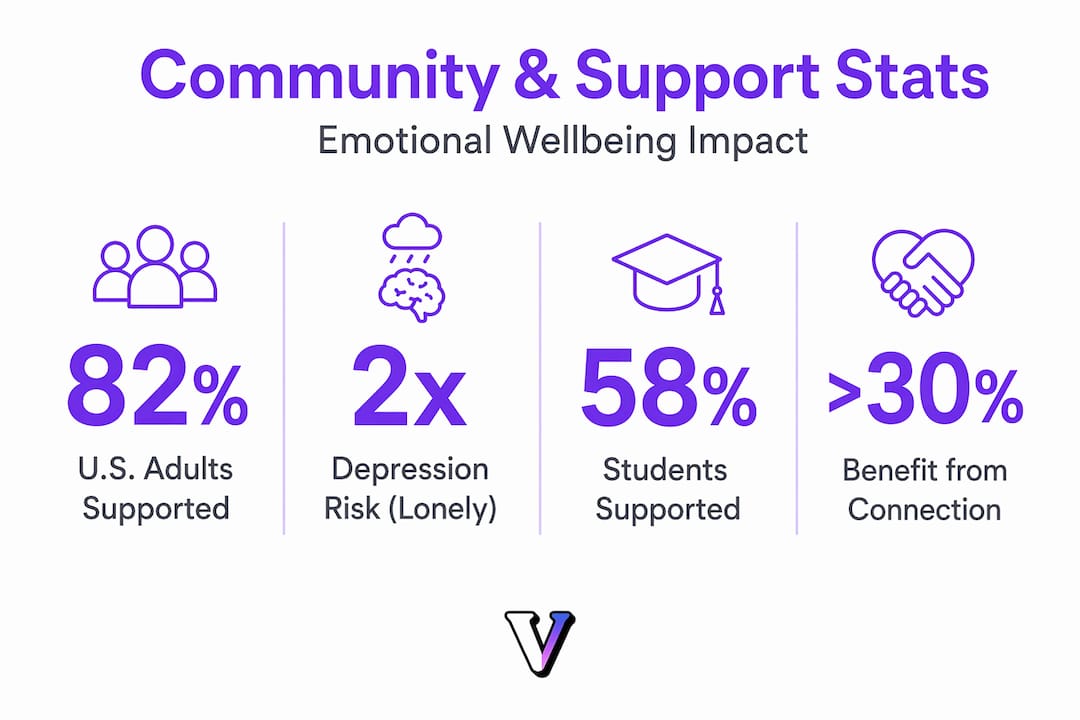
The data on community emotional support is more striking than most people realize. In 2021, 82% of U.S. adults reported receiving the social and emotional support they needed. But only 58% of U.S. high school students said the same during 2021 to 2023. That gap is not random. Young people are forming their social support networks during a period when digital connection has replaced many forms of in-person community, often without delivering the same emotional depth.
| Population | Reported social support received | Key risk |
|---|---|---|
| U.S. adults (2021) | 82% | Lower risk of depression |
| U.S. high school students (2021–2023) | 58% | Higher loneliness and anxiety rates |
| Older adults (general) | Variable | Loneliness linked to cognitive decline |
On the clinical side, the evidence is equally direct. Loneliness doubles depression risk and is now treated by many mental health providers as a screenable, modifiable risk factor. That shift in clinical thinking is significant. It means community connection is no longer just a "nice to have." It is a health intervention.
Interventions designed to improve community connection show real results. A meta-analysis of social support programs for older adults found a significant reduction in loneliness with short-term, multicomponent programs (SMD = -0.60). These were not intensive therapy programs. They were structured, community-based activities that helped people feel less alone.
One more finding worth sitting with: loneliness is not static. Higher momentary loneliness reduces social openness, which leads to fewer interactions, which deepens loneliness. It is a self-reinforcing cycle. That is why waiting to "feel ready" to connect often makes things worse. The pathway out requires action before the feeling changes.
Pro Tip: If you notice yourself withdrawing when you feel lowest, recognize that as the loneliness cycle at work. That is exactly the moment to reach out, even briefly, even imperfectly.
Myths and barriers that block community support
The biggest obstacle to building community emotional support is usually not logistics. It is a set of deeply held beliefs that most people have never examined.
Myth 1: Real community just forms naturally. This is the most damaging misconception. Intentional, repeated presence builds trust and belonging. Waiting for it to happen organically is a strategy that mostly works for extroverts in high-density social environments. For everyone else, community requires deliberate effort.
Myth 2: Community means large groups or perfect relationships. A single person who truly witnesses you can constitute meaningful community. Quality matters more than quantity. Strong relationship quality consistently outperforms a wide network of shallow connections when it comes to reducing loneliness.
Beyond myths, there are real psychological barriers:
- Stigma around vulnerability. Asking for help can feel like admitting failure, especially in cultures that celebrate self-sufficiency. This keeps people isolated even when support is available.
- The villager paradox. People want a village but resist doing the consistent, unglamorous work that builds one. They want support without sustained investment. The paradox is that showing up for others is precisely what creates the conditions for receiving support.
- Perfectionism in relationships. Waiting for the "right" people or the "right" group delays connection indefinitely. Imperfect, real relationships serve the emotional support function far better than an idealized connection that never materializes.
Pro Tip: Start by being the community you wish you had. Send the message. Make the call. Show up. The reciprocity usually follows.
How to actually build community connections that support you
Building social support networks is less about grand gestures and more about showing up repeatedly. Here is what that looks like in practice:
-
Start local and low-stakes. Your coworkers, neighbors, or fellow regulars at a gym or coffee shop are the easiest entry points. You don't need deep conversations immediately. Consistent small interactions build familiarity, and familiarity builds trust over time.
-
Join groups organized around activity, not emotion. Book clubs, hiking groups, volunteer teams, and creative classes bring people together through shared purpose. Emotional connection often develops as a byproduct without the pressure of being the explicit goal.
-
Use technology with intention. Online communities can provide real community emotional support, particularly for people dealing with specific challenges like chronic illness, grief, or niche experiences. The key is using these platforms as a genuine bridge to connection, not as a substitute for presence. AI mental wellness tools have also made it easier to support your mental health between social interactions.
-
Practice reciprocity. The importance of community support is a two-way reality. Show up for others without keeping score. Offer what you can, when you can. This builds the kind of trust that makes it safe to ask for support when you need it.
-
Prioritize consistency over intensity. Seeing the same people weekly for a month does more for belonging than a single intense bonding weekend. The brain builds social safety through repetition, not peaks. Small, repeated contact is the infrastructure of real community.
-
Name what you need. Most people are willing to help but unsure how. Saying "I just need someone to listen right now" or "Can we get coffee this week?" removes the guesswork and makes support more likely to materialize.
Integrating community with broader mental health care
Community emotional support does not replace professional mental health care. But for millions of people, it is the layer that makes clinical interventions stick, or that prevents the need for them in the first place.
Peer-administered psychotherapy interventions show clinically meaningful reductions in depression and anxiety, with effect sizes comparable to some formal treatments. This is a significant finding. It means that trained peers, not just licensed clinicians, can move the needle on mental health outcomes. Community is not just comfort. It is care.
The ways communities provide support are also expanding in clinical settings:
- Peer support specialists are now embedded in hospital discharge programs, addiction recovery centers, and community mental health clinics.
- Group-based interventions address both the psychological and social dimensions of mental health simultaneously, which individual therapy often cannot.
- Recovery-oriented models are shifting the focus from symptom management to social determinants of health, including housing, employment, and social inclusion.
This systems-level thinking matters because individual effort can only go so far. When someone lacks stable housing or social inclusion, building community ties is exponentially harder. Addressing these structural factors is part of how community and mental health intersect at scale. The impact of community on well-being is not just psychological. It is shaped by the conditions people live in.
My honest take on community as emotional support
I've seen a lot of people do everything right on paper. Journaling, therapy, meditation, gratitude practice. They are working hard on themselves. But they are still suffering. And when you look closely, the common thread is almost always isolation.
What I've learned is that emotional resilience is not something you build alone and then bring to your relationships. It is built in relationship. The nervous system regulation that makes you calmer, more grounded, and more capable of handling difficulty? It largely happens through co-regulation with other people. You need their presence to fully develop it.
My strongest opinion on this: our culture has overcorrected toward individualism in mental health. We celebrate the solo healing arc, the person who "figured it out" on their own. But that narrative is incomplete and, for many people, harmful. It implies that needing community is weakness. It isn't. It's biology.
What I'd encourage you to do is stop waiting to feel ready to connect and start treating community-building as a practice, not a personality trait. The people who have rich social support networks did not luck into them. They built them through boring, consistent, imperfect effort. That is available to you too.
— Voisley
Start building your emotional wellness foundation
Community connection and personal reflection are not competing strategies for emotional health. They are complementary ones. When you pair the support of others with a deeper understanding of your own emotional patterns, you build something more resilient than either approach alone.

Voisley is designed for exactly this kind of integrated approach. With guided journaling, mood tracking, and AI-powered emotional self-care tools, Voisley helps you process what you're going through privately and purposefully. The platform's community features and shared journaling also create space for the social support that research consistently shows matters for mental health. Whether you're processing a hard season or building long-term emotional habits, Voisley meets you where you are. Visit voisley.com to explore how it can support your well-being.
FAQ
What is the role of community in emotional support?
Community provides validation, belonging, perspective, and practical aid that buffer stress and protect mental health. Research shows strong social ties correlate with lower depression risk, greater resilience, and longer, healthier lives.
How does community help with loneliness?
Intentional community connection breaks the self-reinforcing cycle of loneliness by increasing social interaction and restoring a sense of safety. Short-term, structured social support programs have shown a significant reduction in loneliness among adults.
Can online communities provide real emotional support?
Yes, online communities can offer genuine community emotional support, especially for people facing specific challenges without access to local networks. The key is consistent, authentic engagement rather than passive scrolling.
How many people lack adequate social support?
While 82% of U.S. adults report receiving needed emotional support, only 58% of high school students say the same, signaling a significant gap particularly among younger populations.
How does community support complement professional mental health care?
Community support works alongside therapy and clinical care by addressing the social isolation that often underlies mental health struggles. Peer-administered interventions have shown effect sizes comparable to formal treatments in reducing depression and anxiety.