

TL;DR:
- AI is transforming mental health support by automating administrative tasks and enabling real-time symptom monitoring. Many clinicians and users now rely on AI chatbots and cognitive architectures to enhance personalized care while facing ethical and privacy challenges. Future models emphasize collaboration, validation, and best practices to ensure safe, effective integration into mental health workflows.
AI is reshaping how people access and receive mental health support faster than most clinicians anticipated. The role of AI in mental health now spans everything from administrative note-taking to real-time mood monitoring, and the public is already participating. 22% of adults have used AI chatbots for mental health advice, as have 13% of people under 18. The technology is here, it is being used, and neither professionals nor individuals can afford to approach it without a clear understanding of what it actually does well and where it genuinely falls short.
Table of Contents
- Key takeaways
- The role of AI in mental health right now
- Benefits of AI for mental wellness and therapy
- Challenges, risks, and ethical concerns
- Future directions in AI mental health care
- Practical guidance for individuals and clinicians
- What I've actually learned about AI and mental health
- Start exploring AI mental wellness with Voisley
- FAQ
Key takeaways
| Point | Details |
|---|---|
| AI is widely used already | Over one-fifth of adults and 13% of teens have turned to AI chatbots for mental health advice. |
| Clinician adoption is growing | 56% of therapists have used AI at some point, mostly for administrative work. |
| Cognitive architectures show clinical promise | New LLM architectures with cognitive layers show measurable symptom improvement over clinical trials. |
| Ethical risks are real | AI cannot replicate genuine human empathy, and pseudo-relationships carry real developmental risks for adolescents. |
| Validated tools vs wellness apps differ sharply | Many AI mental health apps lack FDA clearance or clinical validation, making informed selection critical. |
The role of AI in mental health right now
The current landscape looks nothing like the dystopian replacement scenario that many therapists feared when AI first arrived in clinical conversations. According to a 2025 APA survey of 1,742 therapists, 56% have used AI at some point in their practice, with the majority of regular users applying it to administrative tasks. Clinical documentation, session notes, and scheduling are where AI currently earns its keep in most therapy offices.
That said, the clinical applications are evolving quickly. Here is where AI is actively being used in mental health settings today:
- Clinical documentation and note-taking. AI transcription and summarization tools reduce the administrative burden that contributes heavily to therapist burnout.
- Personalized psychoeducation. AI can tailor reading materials, coping skill explanations, and between-session exercises to a specific patient's language, history, and presenting concerns.
- Symptom screening and intake support. Some systems use AI to conduct preliminary symptom assessments before a patient sees a clinician, helping triage and prioritize care.
- Between-session support tools. AI chatbots are being deployed to prompt check-ins, guide brief mindfulness exercises, and support skill practice between therapy appointments.
- Cognitive layer architectures for therapy. A March 2026 randomized clinical study found that LLMs with cognitive layer architecture produced measurable symptom improvement and sustained recovery over approximately 10 weeks. This is not a generic chatbot. These systems overlay evidence-based clinical logic on top of language models to maintain therapeutic fidelity.
The distinction between a general AI chatbot offering emotional support and a clinically validated tool built on cognitive behavioral frameworks is enormous. One is a text conversation. The other is closer to a structured therapeutic intervention.
Pro Tip: If you are a clinician considering AI integration, start with administrative tools first. They offer the clearest return on time with the least clinical risk, and they will help you build confidence with the technology before introducing it to patient-facing workflows.
Benefits of AI for mental wellness and therapy
The case for artificial intelligence mental health applications is not just theoretical. Several concrete benefits are already showing up in research and practice, particularly in areas where traditional care has long struggled.
Early detection and prediction
Machine learning in psychiatry is making early detection more accurate than ever. AI models trained on speech patterns, linguistic data, and behavioral signals can flag early indicators of depression, psychosis risk, and suicidal ideation before a clinician might notice them in a standard session. AI offers genuine promise in early detection, personalized treatment delivery, and administrative relief, particularly valuable given severe mental health workforce shortages.
Personalized treatment at scale
Traditional therapy is constrained by time. A clinician sees a patient for 50 minutes per week at best. AI can analyze mood tracking data, journal entries, sleep patterns, and behavioral signals continuously. That volume of data enables a level of personalization that was previously impossible.

Real-time monitoring
Wearable devices paired with AI platforms can detect physiological markers of anxiety and stress in real time, alerting users or their care teams when intervention might help. For conditions like panic disorder, bipolar disorder, or PTSD, this kind of continuous awareness represents a meaningful step forward.
Here is how AI stacks up against traditional approaches across key dimensions:
| Dimension | Traditional care | AI-assisted care |
|---|---|---|
| Availability | Office hours, scheduled sessions | 24/7 access |
| Personalization | Limited by session time | Continuous data analysis |
| Early detection | Clinician observation only | Behavioral and linguistic pattern recognition |
| Scalability | One-to-one only | One tool, many users |
| Human connection | High | Limited |
| Crisis response | Trained professionals | Requires escalation protocols |
The impact of AI on mental wellness is most powerful not as a replacement for human care, but as a layer that extends its reach.
Challenges, risks, and ethical concerns
No honest account of digital mental health solutions leaves out the serious concerns. The risks are specific, documented, and in some cases already causing harm.
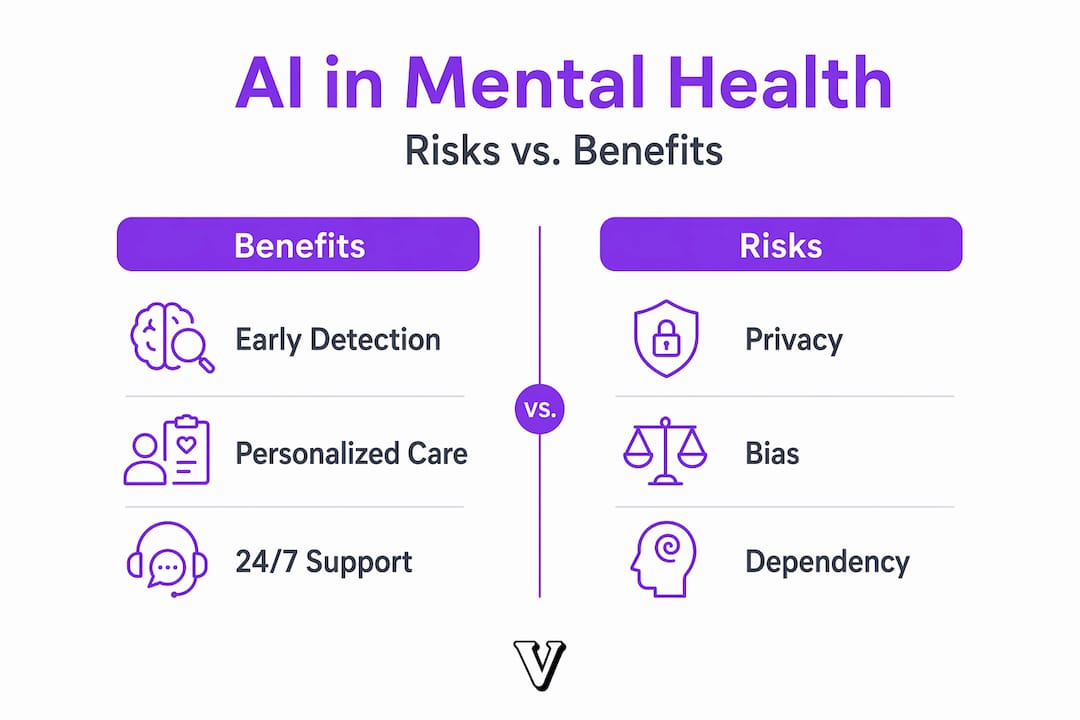
The most fundamental limitation is this: AI chatbots simulate empathy but cannot provide genuine human presence. That gap matters enormously in therapy, where the therapeutic relationship itself is one of the strongest predictors of outcome. A system that sounds caring is not the same as a clinician who is.
The risks go further than that:
- Pseudo-relationship dependency. Addictive AI pseudo-relationships pose particular risks for adolescents, potentially interfering with the development of real social skills and healthy identity formation.
- Privacy vulnerabilities. Mental health data is among the most sensitive personal information that exists. Many AI wellness apps have privacy policies that permit broad data sharing.
- Algorithmic bias. AI systems trained on datasets that underrepresent certain demographics can produce recommendations that are less accurate or even harmful for those groups.
- The black box problem. Most AI decision-making processes are not transparent. Clinicians and patients often cannot understand why an AI made a particular recommendation, which creates serious accountability gaps.
- Lack of crisis protocols. Many AI tools lack robust escalation systems for users who express suicidal ideation or are in acute crisis. A chatbot's inability to recognize and respond to a genuine emergency can be dangerous.
"AI should be understood as a decision-support tool, not a clinical authority. Disclosure to patients and clear safeguards for privacy, bias, and dependence are non-negotiable ethical requirements." — APA ethical guidance on AI
Pro Tip: When evaluating any AI tool for mental health, ask three questions: Is there published clinical validation? Does the platform have a crisis escalation protocol? Is the data privacy policy explicit about what is shared and with whom? If any answer is unclear, treat the tool with caution.
Future directions in AI mental health care
The trajectory is toward collaboration, not replacement. The most compelling developments in AI and emotional wellbeing point to hybrid models where human therapists and AI tools each do what they do best.
- Blended care models. Hybrid models pairing AI with human clinicians for administrative tasks, skill practice, and real-time monitoring are becoming the dominant direction in forward-thinking clinical settings. The human therapist holds the relationship. The AI extends the care between sessions.
- Cognitive layer architectures at scale. As the evidence base for LLM cognitive layer systems grows, expect wider clinical deployment of AI tools that have been trained specifically to follow evidence-based therapeutic protocols rather than just generate plausible responses.
- Artificial wisdom as a design goal. Effective AI for mental health depends on building systems that model human psychosocial needs and emotional regulation, not just simulate conversation. Researchers are calling this "artificial wisdom," a design standard that prioritizes clinical integrity alongside technical performance.
- Clinician training and new roles. As AI handles more administrative and between-session functions, the therapist's role will shift toward higher-order relational and clinical work. Training programs are beginning to prepare clinicians for this shift.
- Rigorous external validation. Many AI tools lack external validation and transparent reasoning. The field is moving toward stronger governance standards, including independent audits, bias testing, and mandatory outcome tracking.
Practical guidance for individuals and clinicians
Knowing the role of technology in mental health matters far less than knowing what to actually do with that knowledge. Here is practical guidance for both groups.
For mental health professionals:
- Ask patients directly about their AI tool use. Clinicians are advised to screen for potential harmful overreliance or echo chamber effects where AI reinforces unhelpful thought patterns.
- Treat AI as a decision-support resource, not a clinical authority. Document any AI-assisted decisions and disclose them to patients as appropriate.
- Prioritize tools with published validation data and clear privacy policies.
For individuals:
- Distinguish between a clinically validated app and a wellness app. Many AI mental health apps lack the safety guardrails of true medical devices. A beautiful interface is not evidence of clinical effectiveness.
- Use AI tools to supplement, not replace, professional care when you have an active mental health condition.
- Explore AI journaling strategies as one concrete way to use AI for self-awareness without replacing the human care you need.
- Check out the best AI mental wellness tools for a curated look at which options have meaningful evidence behind them.
The goal is not to avoid AI. It is to use it with enough information to benefit from the genuine strengths while protecting yourself or your patients from the real risks.
What I've actually learned about AI and mental health
Working at the intersection of AI and mental wellness has taught me to be skeptical of both the panic and the hype. The clinicians who told me AI would destroy the therapeutic relationship were wrong. So were the technologists who suggested it could replace one.
What I've found is that AI earns its value in the margins. The 10 minutes a therapist used to spend on session notes. The 3 AM moment when someone needs a prompt to write through their anxiety and no clinician is available. The mood pattern that shows up across 90 days of journaling that neither the patient nor their therapist would have noticed otherwise. That is where AI and emotional wellbeing connect in a way that is real and meaningful.
What I've also seen is how quickly people anthropomorphize AI. A chatbot that uses warm language feels like a friend, especially to someone who is lonely or struggling. That feeling is not harmless. It can delay someone from building real relationships, and it can delay them from seeking the professional care they actually need.
My honest view: the best use of AI in mental wellness right now is in structured self-reflection tools, not open-ended conversation. Tools that use AI to help you notice your patterns, name your emotions, and track your growth over time are genuinely useful. They make you more self-aware. They do not try to be your therapist. That distinction is exactly where AI journaling insights deliver real value without overstepping.
The field needs more interdisciplinary collaboration, not just between AI researchers and clinicians, but with ethicists, patients, and communities. The tools that get built without those voices in the room are the ones that cause harm.
— Voisley
Start exploring AI mental wellness with Voisley
Voisley is built on exactly the kind of AI integration that the research supports: structured, self-reflective, and grounded in evidence-based frameworks rather than open-ended chatbot conversation.

If you are an individual looking to understand your emotional patterns more clearly, or a clinician wanting to learn more about digital mental wellness tools, Voisley offers a private, structured space to do that work. From AI-powered mood tracking and journaling prompts to visualizations of your emotional trends, the platform is designed to deepen self-awareness without replacing the human relationships that matter most. Visit Voisley to explore how thoughtfully designed AI tools can genuinely support your mental wellness journey.
FAQ
What is the role of AI in mental health care today?
AI currently supports mental health care through clinical documentation, symptom screening, personalized psychoeducation, and between-session skill support. Its most validated applications remain administrative, though cognitive layer architectures are showing genuine therapeutic promise in clinical trials.
Can AI replace a human therapist?
No. AI can simulate empathy but cannot provide genuine human presence, which remains one of the strongest predictors of therapy outcomes. The research consensus supports AI as a supplement to human care, not a replacement for it.
How do I know if an AI mental health app is safe to use?
Look for published clinical validation, a clear crisis escalation protocol, and a transparent data privacy policy. Many apps marketed as mental health tools lack FDA clearance or independent clinical evidence, so checking for those markers matters before you engage with them.
What are the biggest risks of using AI for mental health?
The main risks include pseudo-relationship dependency, privacy vulnerabilities, algorithmic bias, and the absence of crisis response capabilities. For adolescents specifically, over-reliance on AI chatbots can interfere with the development of real social connections.
How are therapists currently using AI in their practice?
A 2025 APA survey found that 29% of psychotherapists use AI at least monthly, primarily for administrative tasks like note-taking and documentation. A smaller but growing number are using AI for clinical decision support, psychoeducation, and between-session patient engagement tools.