

TL;DR:
- Digital mental health tools vary from prescription therapeutics to wellness apps, with regulation and evidence guiding their credibility. They include internet-based CBT programs, self-management trackers, AI chatbots, and digital triage systems, each serving different roles in mental health care. Using tools aligned with your needs and checking their regulatory status ensures safe and effective support.
Digital mental health tools (DMHTs) are software products that provide assessments, therapy, or self-management strategies, and they range from FDA-regulated prescription therapeutics to general wellness apps you can download in under a minute. Understanding the types of digital mental health tools available is not just useful. It determines whether you pick a clinically validated intervention or a feel-good app with no evidence behind it. This guide categorizes each major type by function, evidence level, and best use case so you can make an informed choice.
1. What are the types of digital mental health tools?
The types of digital mental health tools fall into five core categories: prescription digital therapeutics, internet-based therapy programs, adjunct self-management tools, AI-powered chatbots and virtual therapy platforms, and digital triage and clinical decision support systems. Each category differs in regulatory status, evidence strength, and the role it plays in a person's care. Knowing which category a tool belongs to tells you more about its credibility than any app store rating ever will.
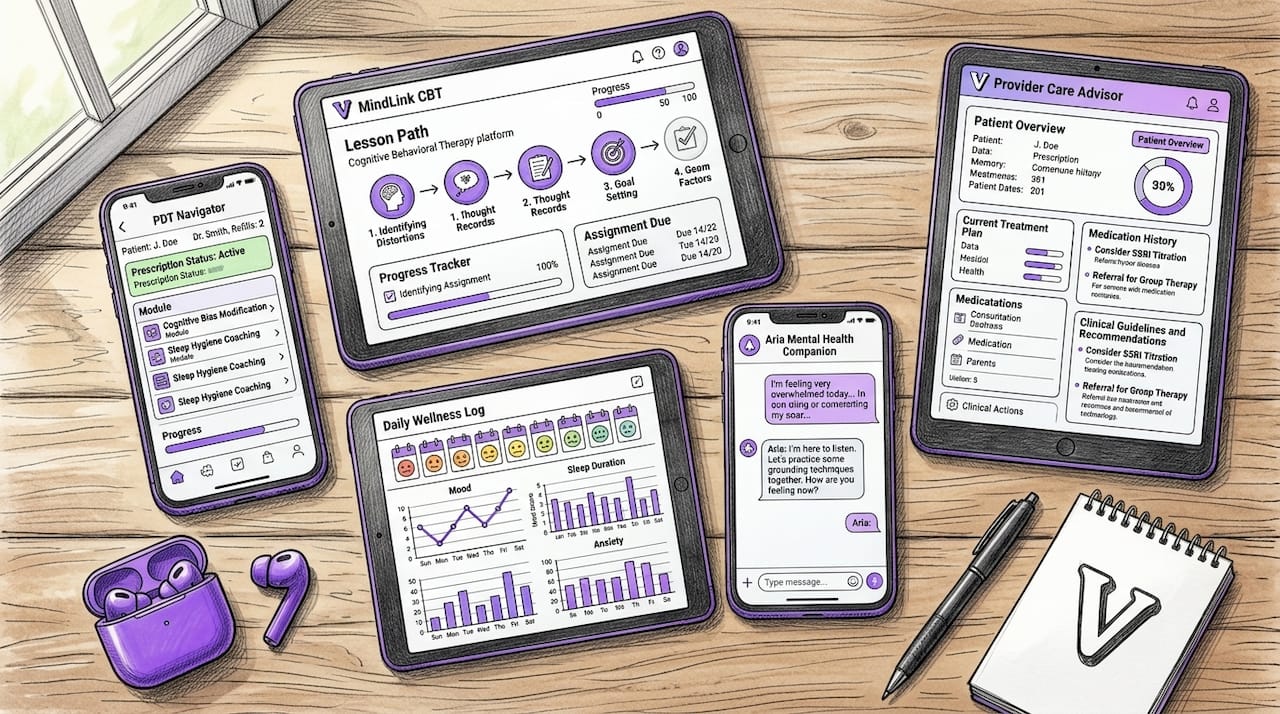
2. Prescription digital therapeutics (PDTs)
Prescription digital therapeutics are the most regulated category of digital wellness applications. Products like EndeavorRX (approved for pediatric ADHD) and DaylightRX (for generalized anxiety disorder) require a clinician's prescription and have passed randomized controlled trials before reaching patients. This places them in the same evidence tier as pharmaceutical treatments, which is a meaningful distinction when you are managing a diagnosed condition.
PDTs are classified as medical devices by regulatory bodies including the FDA and Australia's Therapeutic Goods Administration. The TGA classifies DMHTs as medical devices when they are intended for diagnosis, monitoring, or therapeutic intervention such as cognitive behavioral therapy (CBT). This means developers must meet clinical evidence standards before their product reaches you.
The practical implication is clear: if a digital therapy option carries a prescription requirement, it has been tested for both safety and efficacy. General wellness apps carry no such obligation.
Pro Tip: Before using any mental health app for a diagnosed condition, check whether it has been reviewed by the FDA, TGA, or an equivalent national regulator. A regulatory listing is the fastest signal of clinical credibility.
3. Internet-based CBT platforms
Internet-based CBT (iCBT) platforms are evidence-based digital mental health tools for depression and anxiety, delivered as either guided or self-guided programs. Guided iCBT involves a trained therapist or coach reviewing your progress and providing feedback at regular intervals. Self-guided programs run entirely on your own schedule without human input.
The difference in outcomes between these two formats is not trivial. Guided iCBT consistently shows stronger clinical results than self-guided versions, largely because human accountability increases completion rates and catches misapplication of techniques. Self-guided programs still outperform no treatment, making them a legitimate option when professional support is unavailable or cost-prohibitive.
Many iCBT platforms also incorporate third-wave CBT approaches such as Acceptance and Commitment Therapy (ACT) and Mindfulness-Based Cognitive Therapy (MBCT). A meta-analysis of 176 RCTs found that psychoeducation, relaxation, mindfulness, and self-monitoring are the most common active elements in mental health apps, while ACT and positive psychology appear less frequently but with measurable effect.
For anyone dealing with clinical depression or anxiety, iCBT platforms represent the most accessible form of structured digital therapy options short of a full prescription therapeutic.
4. Adjunct self-management and monitoring tools
Adjunct tools are the largest and most varied category of mental health support technology. They include mood trackers, digital journaling apps, symptom monitors, and screening questionnaires. These tools are not designed to replace therapy. They are designed to extend its reach into your daily life.
Research confirms that adjunct self-management tools like mood trackers and digital journals support ongoing self-reflection and complement therapeutic interventions. The key word is "complement." A mood tracker used alongside weekly therapy sessions gives your therapist richer data to work with. Used in isolation, it provides awareness without structured intervention.
The most common features across this category include:
- Mood logging: Daily check-ins that capture emotional state, energy level, and contributing factors
- Journaling prompts: Structured questions that guide reflection on thoughts, behaviors, and patterns
- Symptom monitoring: Tracking specific indicators like sleep quality, anxiety triggers, or depressive episodes
- Screening tools: Validated questionnaires such as the PHQ-9 or GAD-7 embedded in app format
Self-monitoring through these tools builds the kind of emotional self-awareness that makes therapy more productive and personal growth more measurable. Voisley, for example, combines mood tracking with AI-powered journaling prompts and emotional trend visualizations, giving users a structured space for self-reflection that goes well beyond a simple diary.
Pro Tip: Use adjunct tools to generate data, not just feelings. When you can show a therapist three weeks of mood logs with annotated triggers, you compress months of verbal recall into one actionable session.
5. AI-powered chatbots and virtual mental health resources
AI chatbots designed for mental health simulate therapeutic conversations using natural language processing. They fill a real gap: the hours between therapy sessions when distress spikes and no human support is available. These tools are particularly useful for low-level anxiety, stress processing, and practicing CBT techniques in real time.
The evidence for AI chatbots is promising but less robust than for iCBT platforms or PDTs. Most studies show reductions in self-reported anxiety and depression symptoms, but few have compared chatbot interventions directly against human therapy with rigorous methodology. This does not make them useless. It means you should treat them as supplementary support rather than primary treatment.
Virtual therapy platforms occupy a different position in this category. Services that connect users with licensed therapists via video, text, or audio are classified as teletherapy and carry the full clinical weight of in-person care. The modality changes; the professional standard does not. For busy professionals or people in underserved areas, teletherapy is often the most practical path to evidence-based care.
The key distinction to hold: an AI chatbot is a support tool, while a teletherapy platform is a delivery mechanism for real clinical care. Conflating the two leads to misplaced expectations.
6. Digital triage and clinical decision support tools
Digital triage tools are built for healthcare systems, not individual consumers. They use AI-driven risk prediction and structured intake workflows to standardize how patients are assessed before seeing a clinician. The goal is to reduce the inconsistency and bias that can enter human-only triage processes.
A hybrid, human-in-the-loop approach is the most effective model, balancing the consistency of algorithmic assessment with the contextual judgment that only a trained clinician can provide. Pure AI triage without human oversight risks missing nuance. Pure human triage without data standardization risks inconsistency. The combination addresses both failure modes.
Key applications of digital triage and decision support tools include:
- Automated intake screening: Patients complete validated questionnaires digitally before their first appointment, giving clinicians structured baseline data
- Risk stratification: AI models flag high-risk presentations for urgent review, reducing the chance that a serious case is triaged as routine
- Care pathway matching: Algorithms suggest appropriate levels of care based on symptom severity and history
- Bias mitigation: Standardized data collection reduces the influence of clinician fatigue, implicit bias, or inconsistent questioning
"A hybrid, human-in-the-loop approach is most effective to balance consistency and clinical discernment." — JMIR, 2026
For individuals, understanding this category matters because it shapes your first point of contact with mental health services. A well-designed triage system gets you to the right level of care faster.
7. Evidence and regulation: how they shape tool trustworthiness
Regulation depends more on therapeutic intent than on appearance or content type. An app that tracks your sleep for general wellness is unregulated. The same app, marketed to monitor insomnia as a medical condition, becomes a regulated medical device. This distinction, drawn by both the TGA and FDA, is the single most important framework for evaluating any digital therapy option.
For CBT-based tools in Australia, regulatory frameworks require that developers display visible, reviewable references to clinical guidelines inside the software. This conditional exclusion rule means users can verify the evidence base the tool is built on. If an app cannot show you its clinical guideline references, that absence is informative.
NICE in the UK has taken a conditional recommendation approach for some digital CBT technologies, requiring time-limited evidence collection before routine adoption decisions are made. This reflects a broader reality: many tools reach consumers before the evidence base is complete.
An analysis of NICE evaluations covering 30 DMHTs across 78 studies identified common evidence gaps including cost and resource usage, effectiveness compared to alternatives, and reporting of adverse events. These gaps do not mean the tools are harmful. They mean the full picture is not yet available.
| Evaluation criterion | What to look for |
|---|---|
| Regulatory status | FDA, TGA, or CE marking for therapeutic claims |
| Clinical guidelines | Visible references to CBT, ACT, or MBCT protocols |
| Evidence base | Published RCTs or peer-reviewed studies |
| Adverse event reporting | Transparency about known risks or side effects |
| Cost-effectiveness data | Comparison to standard care options |
Pro Tip: Search the name of any mental health app alongside "RCT" or "clinical trial" in Google Scholar. If no peer-reviewed studies appear, treat the tool as a wellness product, not a clinical intervention.
Key takeaways
Effective use of digital mental health tools requires matching the tool's evidence level and regulatory status to your actual need, not just your preference.
| Point | Details |
|---|---|
| Regulation signals clinical intent | Tools classified as medical devices by the FDA or TGA have met evidence standards that general wellness apps have not. |
| Guided outperforms self-guided | Guided iCBT produces stronger outcomes than self-guided programs due to human accountability and error correction. |
| Adjunct tools extend, not replace, therapy | Mood trackers and digital journals are most effective when combined with professional care or structured therapeutic programs. |
| AI chatbots fill gaps, not roles | Chatbots provide between-session support but do not substitute for licensed therapist care. |
| Evidence gaps are common | An analysis of 78 studies found that cost, comparative effectiveness, and adverse event data are frequently missing from DMHT evaluations. |
What we've learned building Voisley about digital mental wellness
The most common mistake people make with digital mental health tools is treating the category as uniform. They download a mood tracker expecting therapy-level outcomes, or they dismiss a journaling app because it is not a prescription product. Both errors come from the same place: not understanding what a tool is actually designed to do.
At Voisley, we sit firmly in the adjunct self-management category, and we think that category is undervalued. The research on self-monitoring and structured reflection consistently shows that people who track their emotional patterns over time develop better self-awareness, communicate more clearly with their therapists, and catch early warning signs before they escalate. That is not a small contribution to mental health care. It is the connective tissue between formal treatment episodes.
What we have found is that the tools people use most consistently are the ones that meet them where they are, not where they should be. A person who journals for ten minutes three times a week using Voisley's guided prompts will generate more usable self-knowledge than someone who downloads a PDT, uses it twice, and abandons it. Consistency beats sophistication in self-management tools.
The trend toward hybrid AI-human approaches in both triage and therapy is the right direction. AI can surface patterns in your emotional data that you would never notice manually. A human clinician can interpret those patterns in context. The tools that combine both, whether through teletherapy platforms with integrated monitoring or AI journaling apps that flag concerning trends for professional review, represent the most promising direction in digital mental wellness.
My honest recommendation: start with one adjunct tool you will actually use, build the habit, and layer in more structured interventions as your needs become clearer. Informed exploration beats paralysis by analysis every time.
— Voisley
Start your digital mental wellness practice with Voisley

Voisley is a science-backed digital wellness platform built for people who want more than a generic mood log. The platform combines AI-powered journaling prompts, mood tracking, emotional trend visualizations, and multiple journal types including gratitude, shadow work, and future goals into one structured space for self-reflection. Whether you are supplementing therapy, building emotional awareness, or working through complex feelings on your own terms, Voisley gives you the tools to do it with intention. Visit voisley.com to explore how guided journaling and AI-driven insights can support your mental wellness practice starting today.
FAQ
What are the main types of digital mental health tools?
The five main types are prescription digital therapeutics, internet-based CBT platforms, adjunct self-management tools (mood trackers, journals), AI chatbots, and digital triage systems. Each differs in regulatory status, evidence strength, and intended use.
Are mental health apps the same as regulated digital therapeutics?
No. Regulated digital therapeutics like EndeavorRX require clinical trials and provider oversight, while most mental health apps are unregulated wellness products. The TGA and FDA classify tools as medical devices only when they have a therapeutic intent backed by evidence.
How do I know if a digital mental health tool is evidence-based?
Check whether the tool references specific clinical guidelines such as CBT or ACT protocols, and search for published randomized controlled trials. An analysis of DMHT evaluations found that many tools lack comparative effectiveness data, so absence of published research is a meaningful red flag.
Can AI chatbots replace therapy?
AI chatbots provide useful between-session support and can reduce self-reported anxiety symptoms, but they do not replace licensed therapist care. Teletherapy platforms that connect users with credentialed professionals are the digital equivalent of in-person therapy, not chatbot tools.
What is the best digital mental health tool for self-reflection?
Adjunct self-management tools such as guided journaling apps and mood trackers are best suited for self-reflection. These tools build emotional awareness and track patterns over time, and they are most effective when used consistently alongside professional care or structured therapeutic programs.