

TL;DR:
- Many mental health apps lack scientific evidence and can be misleading despite their popularity.
- Effective apps incorporate skills-based content rooted in CBT or mindfulness to produce real therapeutic outcomes.
Not every app with a calming color palette and a breathing exercise qualifies as a mental health tool worth your time. Defining mental health apps accurately matters because, out of the 10,000 to 20,000 apps currently listed on major app stores, only 2 to 15% have any published evidence behind them. That gap between perception and reality is where people make costly mistakes, downloading apps that feel therapeutic but deliver little more than distraction. This guide cuts through the noise so you can understand what these apps actually are, which features matter, and how to choose one that genuinely supports your emotional well-being.
Table of Contents
- Key takeaways
- Defining mental health apps by purpose and evidence
- App features tied to real therapeutic outcomes
- Challenges and pitfalls when choosing mental health apps
- How mental health apps support self-awareness and emotional well-being
- How to evaluate and choose the right mental health app
- My honest take on mental health apps
- Explore mental wellness with Voisley
- FAQ
Key takeaways
| Point | Details |
|---|---|
| Not all apps are equal | Only 2–15% of mental health apps have published evidence; popularity does not signal effectiveness. |
| Category determines regulation | Apps are classified by intended purpose, not technology, separating wellness tools from clinical digital therapeutics. |
| Features drive outcomes | Skills-based content tied to CBT and mindfulness outperforms mood tracking alone in improving mental health symptoms. |
| Privacy is non-negotiable | Always check data handling policies before downloading, since many apps collect sensitive personal information. |
| Apps complement, not replace, care | Mental health apps work best alongside professional support, not as a substitute for it. |
Defining mental health apps by purpose and evidence
The phrase "mental health app" covers a spectrum so wide it has become almost meaningless on its own. At one end, you have general wellness apps offering guided breathing, sleep sounds, and mood journals. At the other end, you have regulated clinical tools designed to diagnose, treat, or monitor specific mental health conditions. Understanding digital mental wellness tools and where they fall on this spectrum is the foundation of any smart evaluation.
Regulatory bodies like Australia's Therapeutic Goods Administration (TGA) draw the line based on one thing: intended purpose. If an app claims to diagnose anxiety or treat depression, it enters the territory of a Digital Mental Health Tool (DMHT) or Digital Therapeutic (DTx) and faces stricter scrutiny. Regulation hinges on claims, not on the technology itself. A journaling app that helps you reflect on your day sits in a completely different regulatory category than software prescribed by a clinician to treat post-traumatic stress disorder.
This matters to you as a consumer because most mental health apps are not regulated by bodies like Health Canada or the FDA unless they meet strict medical device criteria. Developers can make bold claims about reducing stress or improving mood without proving those claims work. The branding may sound clinical, but the evidence behind it may not exist.
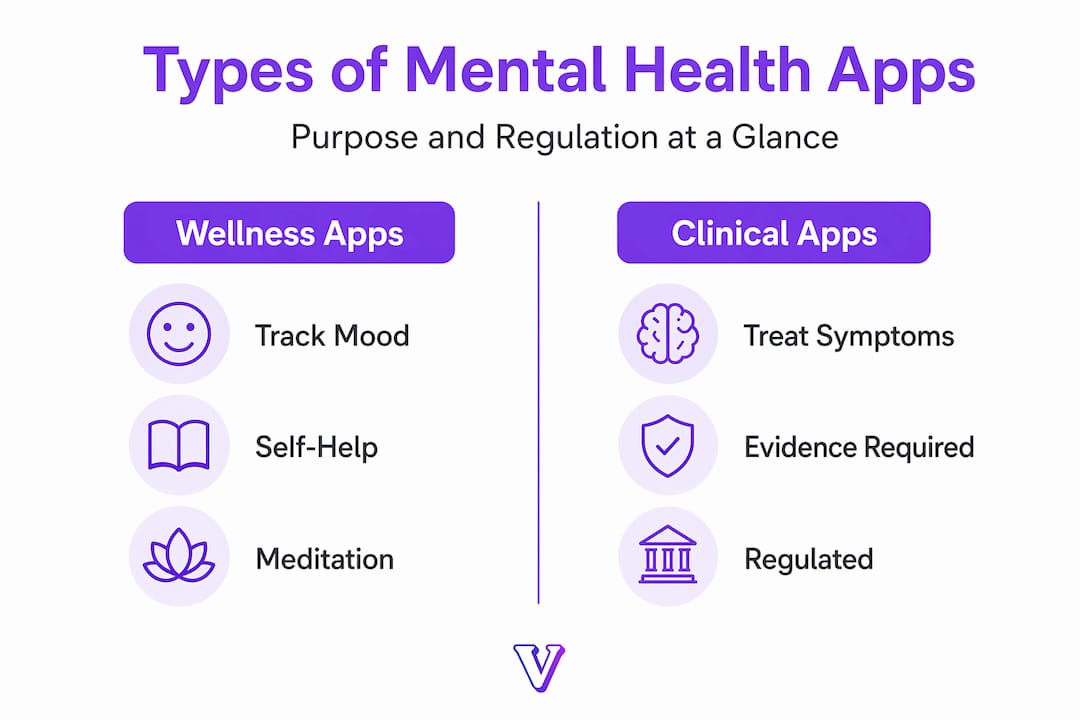
Here is a quick breakdown of the two primary categories:
| App type | Intended purpose | Regulatory status | Example features |
|---|---|---|---|
| Wellness and self-help apps | General well-being, self-reflection, habit building | Mostly unregulated | Mood tracking, journaling, breathing exercises |
| Clinical digital therapeutics (DTx) | Treat, diagnose, or monitor a clinical condition | Regulated as medical devices | CBT programs, clinician dashboards, prescription required |
Pro Tip: When you look at an app's description, ask yourself: is it making a treatment claim or a wellness claim? That single question tells you which category it belongs to and how much scrutiny to apply.
App features tied to real therapeutic outcomes
Once you understand the category, the next question is which features actually move the needle on mental health. Not all features are created equal, and the research tells a clear story.
A 2026 meta-analysis of 169 trials identified which active app elements were most strongly tied to symptom improvement. The results point to specific, named therapeutic mechanisms rather than general wellness activities. Here is what the evidence supports:
- Exposure and desensitization techniques for anxiety, where users gradually confront feared thoughts or situations in a structured way
- Stimulus control strategies for depression and insomnia, which involve changing environmental cues that trigger negative patterns
- Activity scheduling, a core CBT technique that helps people with depression re-engage with rewarding behaviors
- Mindfulness-based practices that train present-moment awareness and reduce rumination
- Skills-building content grounded in Cognitive Behavioral Therapy (CBT), including thought records and cognitive restructuring exercises
The critical insight here is that mood tracking alone is not enough. An app that lets you log "I feel anxious today" without providing any structured response to that feeling delivers minimal therapeutic value. The tracking is only useful when it connects to a skill, a prompt, or a reflection framework that helps you do something with that information.
Human support also matters more than most app marketing suggests. Engagement improves significantly when apps include coaching elements, clinician dashboards, or community features, because accountability and connection sustain the behavior change that purely solo experiences often cannot.
Pro Tip: Before downloading, look for apps that explicitly describe their evidence base. Phrases like "based on CBT" or "developed with clinical psychologists" are a starting point, but also check whether any published trials back those claims.
Challenges and pitfalls when choosing mental health apps
Here is the uncomfortable reality: the mental health app market is largely unregulated, and popularity does not equal safety or effectiveness. Many apps show only average quality and limited behavior change techniques, with few having been evaluated through randomized controlled trials.
Consider what that means in practice. You might download an app with 500,000 five-star reviews and a premium subscription costing $80 per year, only to find it relies entirely on daily affirmations and ambient music. That is not a mental health intervention. That is a mood board.
The four biggest pitfalls to watch for are:
- Unproven clinical claims. Apps that promise to "cure anxiety" or "treat depression" without regulatory backing are making claims they cannot substantiate. Words like "treat" and "diagnose" should trigger immediate scrutiny.
- Weak data privacy practices. Mental health data is among the most sensitive personal information you can share. Many apps collect, store, and potentially share mood logs, journal entries, and usage patterns. Always read the privacy policy before entering personal data.
- Subscription traps. A significant number of apps lock core features behind subscriptions after a free trial. Check what the free version actually offers before committing, and verify that the paid features are backed by evidence.
- Safety resource gaps. If you are dealing with serious mental health concerns, an app without clear crisis resources or referrals to professional help is inadequate. Look for apps that acknowledge their limits and direct you to appropriate support when needed.
The practical guidance from user evaluation research is direct: check the developer's credentials, look for transparent privacy policies, and search for any peer-reviewed studies connected to the app before downloading.
How mental health apps support self-awareness and emotional well-being
When chosen thoughtfully, mental health apps can meaningfully support your emotional life. The key word is support. Apps work best as complements to professional mental health care, not as replacements for therapy or medication when those are needed.
That said, the real-world use cases for well-designed apps are genuinely valuable:
- Closing care gaps. Many people face waitlists for therapy, financial barriers to sessions, or geographic limitations. A good app can provide structured coping tools and psychoeducation during those gaps.
- Building emotional self-awareness. Features like mood tracking for growth and reflective journaling help you notice patterns in your emotional state over time, which is foundational to self-regulation.
- Reducing stigma. The private nature of apps allows people to explore mental health concepts without the perceived vulnerability of seeking formal help, lowering the barrier to engagement.
- Supporting sleep and stress management. Features like grounding exercises, body scan meditations, and sleep hygiene content address common co-occurring concerns that compound anxiety and depression.
- Personalizing mental health support. Unlike a one-size-fits-all approach, the best apps adapt to your goals, whether that is managing work stress, processing grief, or building resilience through daily practice.
The apps that deliver on these benefits share a common thread. They combine reflection tools with skills-based content, they acknowledge their limitations, and they encourage you to seek professional support when your needs exceed what an app can address.
How to evaluate and choose the right mental health app
A structured approach to app evaluation saves you money, protects your privacy, and increases the chances that the tool you choose actually helps. Work through this sequence before committing to any app:
- Clarify your goal. Are you looking for general wellness support, help managing a specific symptom like sleep disruption, or a structured program for anxiety? Your goal determines which category of app you need.
- Check the evidence. Search the app's name alongside "clinical trial" or "peer-reviewed." Look for published studies, not just expert endorsements on the app's own website.
- Read the privacy policy. Confirm what data is collected, how it is stored, whether it is shared with third parties, and what happens to your data if you delete the account.
- Assess usability in the first session. If the onboarding is confusing or the interface creates friction, you will not use the app consistently. Usability matters because the best app is the one you actually open.
- Understand the cost structure. Identify what is free versus paid before you invest time in setup. Check whether the evidence-backed features are accessible without a premium subscription.
- Use it for at least two weeks. A single session tells you almost nothing. Two weeks of consistent use gives you enough data to know whether the app is actually serving your goals.
- Discuss your choice with a care provider. If you are working with a therapist or doctor, ask whether they have recommendations or concerns about specific apps. Some providers actively incorporate apps into treatment plans.
Pro Tip: Organizations like the American Psychiatric Association offer app evaluation frameworks and reviewed directories. These are far more reliable starting points than app store rankings.
Treat AI-powered features with measured expectations. Tools that generate personalized insights from your journal entries or mood data can add genuine value, but mental wellness AI strategies are still evolving. Verify that any AI feature has human oversight and does not replace clinical judgment.
My honest take on mental health apps
I have spent a lot of time with mental health app research, user behavior, and the gap between what these tools promise and what they deliver. Here is what I have actually learned.
The biggest mistake I see is people treating an app's popularity as a proxy for its effectiveness. A high download count tells you about marketing, not medicine. An app that went viral because of a celebrity endorsement is not more effective than one developed quietly by a team of clinical researchers. The correlation between app store success and evidence quality is weak at best.
What I have also found is that the most meaningful gains come from apps used with intention. People who approach a journaling or CBT-based app the way they would approach a therapy session, consistently, honestly, and with a specific outcome in mind, see real shifts in self-awareness and emotional regulation. People who open it passively when they feel bad and close it when they feel slightly better rarely get traction.
The future of mental health apps, as I see it, will be defined by accountability. More apps will need to publish their evidence, protect user privacy in verifiable ways, and integrate with care systems rather than operate in isolation. That is the direction the field is heading, and it is the right one. Until then, your job is to evaluate with the same rigor you would apply to any health decision.
— Voisley
Explore mental wellness with Voisley

If this article has clarified what to look for in a mental health app, Voisley is built around exactly those principles. It is a mental wellness platform grounded in evidence-based frameworks, combining guided journaling, AI-powered mood insights, and structured self-reflection tools designed to build genuine self-awareness over time. The platform offers multiple journal types, including gratitude, shadow work, and future-goal formats, alongside mood visualizations that reveal your emotional patterns. Privacy is central to how Voisley operates. Explore the tools and resources at voisley.com to find an approach to digital mental wellness that is purposeful, personal, and backed by real methodology.
FAQ
What are mental health apps, exactly?
Mental health apps are software tools designed to support emotional well-being, ranging from general wellness apps with journaling and breathing exercises to regulated clinical digital therapeutics that treat specific conditions. Their purpose and evidence quality vary widely across the category.
How do I know if a mental health app is evidence-based?
Search the app's name alongside "clinical trial" or "peer-reviewed study," and check whether the developer links to published research. Be cautious of apps that cite general CBT principles without any specific trial validation.
Are mental health apps safe to use?
Most wellness-category apps are safe for general use, but safety concerns arise around data privacy and unproven clinical claims. Always review the privacy policy and avoid apps that make treatment claims without regulatory backing.
Can a mental health app replace therapy?
No. Apps work best as a supplement to professional care, not a replacement. They can support coping skills and self-awareness between sessions, but they are not equipped to address serious mental health conditions on their own.
What features should I prioritize in a mental health app?
Prioritize apps with skills-based content tied to CBT or mindfulness, clear privacy policies, and transparent evidence. Features like activity scheduling and exposure techniques have stronger research support than mood tracking alone.